
How to Build an Employee Training Programme for UK SMEs
Table of Contents
Most small and medium-sized businesses in Northern Ireland and across the UK acknowledge that employee training matters. Far fewer have a programme that actually delivers consistent results. The gap between wanting to train staff and building something that works is usually a practical one: no clear process, no digital infrastructure, and no way to measure whether the investment is paying off.
This guide walks through eight steps to build an employee training programme that is structured, measurable, and set up for modern delivery. That means using digital tools where they save time, understanding your legal obligations as a UK employer, and building in evaluation from day one rather than as an afterthought.
Whether you are starting from scratch or overhauling a patchwork of onboarding documents and ad hoc sessions, the framework below applies to businesses of all sizes.
Why Employee Training Directly Affects Business Performance
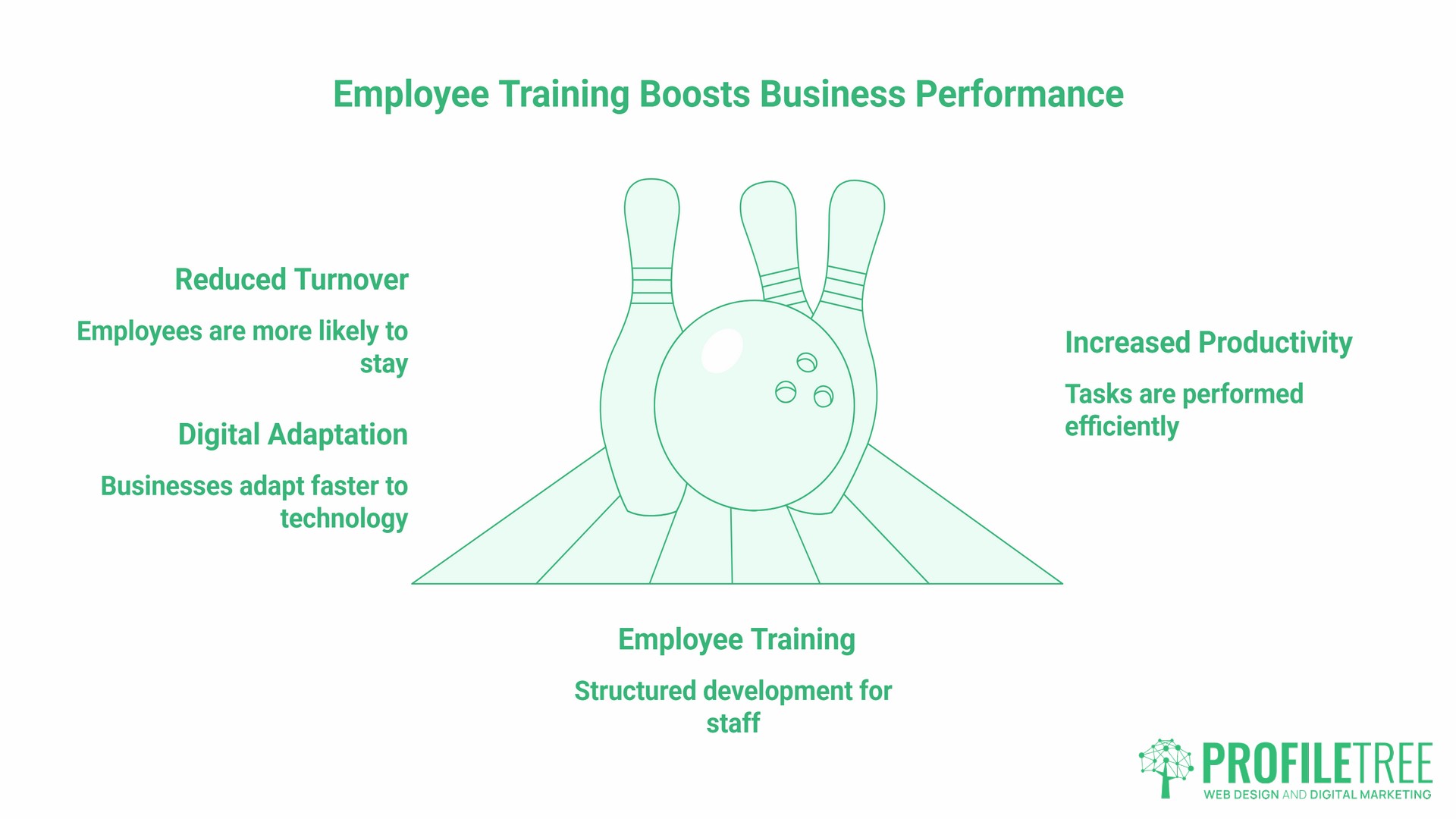
Employee training is not simply an HR function. For an SME, it is one of the most direct levers available to improve output, reduce staff turnover, and stay competitive as technology shifts.
The business case is straightforward. Employees who receive structured development are more likely to stay, perform to a consistent standard, and adapt when the business changes direction. According to CircleHR, the average cost of replacing a staff member earning £25k or more was £30,614 in 2024. PayFit’s 2025 report puts the average replacement cost at £25,000, rising to £40,000–£100,000 for specialist or senior roles. A well-run employee training programme does not eliminate turnover, but it reduces the avoidable kind.
There is also a productivity argument. Well-trained employees perform tasks more efficiently and make fewer errors. This matters most in roles with technical complexity, where a lack of structured training imposes a direct cost on the business and its customers.
For SMEs specifically, the case for digital-first employee training has strengthened considerably. Remote and hybrid working patterns mean classroom delivery is often impractical. Online learning platforms allow employees to complete modules at their own pace, managers to track progress without having to chase individuals, and businesses to update content without reprinting manuals or rebooking venues.
“Ciaran Connolly, founder of ProfileTree, puts it plainly: the businesses we work with that treat training as an ongoing digital process rather than an annual event tend to adapt faster, particularly when it comes to adopting new technology.”
A 7-Step Framework for Building a Modern Employee Training Programme
The structure below preserves the core programme-building sequence while integrating the digital delivery and measurement approaches that make employee training genuinely manageable for a small or mid-sized business.
Step 1: Identify Skills Gaps Through a Structured Audit
The starting point is understanding what your workforce currently knows and where the gaps are. This sounds obvious, but many businesses build training around what managers assume staff need rather than what any structured assessment shows.
A skills audit does not need to be complex. Start with job descriptions and compare them against performance review data or direct observation. Ask employees what they find most difficult in their roles. Use a simple self-assessment survey if you want a faster read across a larger team.
The output should be a ranked list of gaps, connected to specific roles or teams. This prevents the common mistake of building a single generic training programme that serves nobody particularly well.
Aligning this audit with your business goals is important. If your business is investing in AI tools, for example, a skills gap analysis should surface whether your team has the digital literacy to use them. If customer retention is a priority, service quality training rises to the top of the list.
Step 2: Set Measurable Learning Objectives
A training objective that reads “improve communication skills” is not useful. It gives no benchmark, no timeframe, and no way to know whether the training worked.
SMART objectives (specific, measurable, achievable, relevant, and time-bound) compel the programme designer to focus on outcomes rather than inputs. The question to ask is not “what will we teach?” but “what will employees be able to do differently after this programme, and by when?”
An example reframe: rather than “train the team on GDPR,” a SMART objective would be “all customer-facing staff pass the GDPR awareness assessment with a score of 80% or above by the end of the quarter.” The second version creates accountability and gives you a clear pass/fail signal.
Connect each objective to a business outcome where possible. Employee training works best when staff can see why a module matters to their day-to-day role, not just that someone in management decided it was necessary.
Step 3: Choose Your Technology Stack
This is the step most guides skip or treat superficially. For a UK SME, choosing the right delivery infrastructure is as important as designing the content itself.
The core technology decision is whether to use a dedicated Learning Management System (LMS) or build something lighter with tools you already have.
- Dedicated LMS platforms such as TalentLMS, LearnDash (for WordPress-based businesses), and 360Learning provide a structured environment with progress tracking, assessments, and reporting. TalentLMS offers a free tier for basic use, with paid plans starting at around $59 per month for up to 40 users. LearnDash, which runs as a WordPress plugin, starts at $199 per year for a single site with unlimited users. These are well-suited to businesses with five or more employees who need consistent training delivered repeatedly over time.
- Lighter-weight approaches using Google Workspace, Notion, or an internal wiki can work for very small teams or for businesses just starting to build their employee training infrastructure. The trade-off is less automation and weaker reporting.
- AI-assisted tools are increasingly relevant at this stage. Platforms such as Synthesia allow businesses to produce video-based training modules using AI avatars without a film crew. Tools like Descript make editing recorded walkthroughs fast and accessible to non-specialists.
The right choice depends on your budget, your team’s technical confidence, and how frequently your training content will change. ProfileTree’s digital skills training services include guidance on platform selection for SMEs that are not sure where to start.
A comparison of the main delivery approaches:
| Method | Setup Time | Cost Per Head | Scalability | Best For |
|---|---|---|---|---|
| Instructor-led (classroom) | Low | High | Low | Complex or sensitive topics |
| E-learning (LMS) | Medium | Low | High | Repeatable, compliance-heavy content |
| AI-generated video modules | Medium | Low | High | Product demos, process walkthroughs |
| Blended (LMS + live sessions) | High | Medium | Medium | Most SME programmes |
Step 4: Design Training Content with AI Assistance
Content creation is where many employee training programmes stall. Building a library of training materials from scratch takes time, and for a business without a dedicated L&D team, it often never gets finished.
AI tools have changed this significantly. Large language models can draft module scripts, generate quiz questions, and produce structured lesson outlines quickly. Synthesia can turn a script into a narrated video module without requiring a presenter to be recorded. These tools do not replace expert input, but they eliminate the blank-page problem and considerably reduce production time.
Content design should account for how different employees learn. Some staff absorb written material well; others benefit from video walkthroughs, worked examples, or live practice. A module structure that combines a short explainer video, a reading resource, and a practical activity will serve a wider range of learners than any single format alone.
Where your business has complex or technical training needs, working with AI implementation specialists to design content workflows can reduce the ongoing cost of keeping materials up to date.
Industry-specific content matters too. A hospitality business will need food safety and allergen awareness built into its programme. A professional services firm will have different compliance requirements. Generic content can cover foundational skills, but role-specific modules are where employee training actually changes behaviour.
Step 5: Build a Phased Delivery Schedule
Even well-designed training fails when it is loaded onto employees all at once. A phased schedule builds knowledge progressively, reduces overwhelm, and creates natural checkpoints for managers to assess whether learning is sticking.
A practical structure for most SMEs:
- Month 1: Onboarding and foundational knowledge (company processes, role-specific basics, compliance essentials)
- Months 2 to 3: Skills development (role-specific technical skills, tool adoption, customer-facing capabilities)
- Ongoing: Refresher modules, new product or process updates, professional development electives
Flexibility matters, particularly for businesses with shift workers or remote employees. An LMS that supports self-paced completion allows staff to work through modules without requiring everyone to be available simultaneously.
Regular check-ins within the schedule, either as automated progress reports from the LMS or as brief one-to-one conversations, give managers visibility without turning employee training into a supervision exercise.
Step 6: Engage Employees Throughout the Programme
The most common failure point in employee training is not poor content. It is low completion rates. Employees are busy, and training that competes with day-to-day demands tends to lose.
- Keep modules short. LinkedIn Learning’s platform data show that courses under 5 minutes have a 74% completion rate, while those over 15 minutes have a 36% completion rate. For self-paced digital employee training, shorter and more frequent modules consistently outperform longer, less frequent ones.
- Use varied formats to break monotony. Make the connection between the training and the employee’s actual job explicit from the first screen of any module.
- Gamification, in which learning progress is tied to points, badges, or visible milestones, can increase completion rates, particularly among younger workforces. Most LMS platforms include basic gamification features that require no custom development.
Recognition also matters. Acknowledging employees who complete training, particularly when it leads to a certificate or a new responsibility, reinforces that the time they invest has value.
Step 7: Measure Effectiveness Through Performance Metrics
Employee training that is never evaluated is an expense with no measurable return. Measurement does not need to be complicated, but it does need to be built in from the start rather than bolted on afterwards.
The most useful metrics depend on what the training was designed to achieve:
- Knowledge retention: Post-module assessment scores, compared against a baseline where possible
- Behavioural change: Manager observation or process audit data (error rates, call quality scores)
- Business outcomes: Customer satisfaction changes, productivity data, time-to-competence for new starters
- Completion rates: Tracked automatically by an LMS; a significant drop in completion is a design or scheduling problem, not just a motivation one
Collecting employee feedback after each module gives qualitative insight that metrics alone miss. A short, anonymous survey asking what was useful, what was unclear, and what topics were missing takes five minutes to complete and often surfaces problems that would otherwise stay hidden.
Long-term monitoring means returning to training cohorts at three and six months to check whether new skills are being applied. This is the difference between a training programme and a genuine learning culture.
ProfileTree’s AI training resources for teams include guidance on building measurement frameworks that connect learning activity to business outcomes.
Step 8: Build Towards a Culture of Continuous Learning
A single training programme, however well designed, is a one-time intervention. The businesses that see the clearest returns from employee training are those that treat learning as a regular operational activity rather than a remedial response to a skills gap.
Practically, this means:
- Allocating a defined amount of time per employee per month for development activity
- Making learning resources accessible rather than locked behind an infrequent formal programme
- Having leaders visibly participate in training signals that it is genuinely valued
Internet training options for teams have expanded considerably, and many professional bodies in the UK offer free CPD content that can be incorporated into a broader programme without adding budget pressure.
The goal is not to build a training programme and leave it running unchanged. It is to build the habit of learning into how the business operates, so that when new tools, regulations, or market conditions arrive, the team has the capacity to adapt.
UK Statutory Training Requirements
This is the area most generic guides skip entirely, and it matters significantly for employers in the UK and Ireland.
- Health and Safety at Work Act 1974 and Management of Health and Safety at Work Regulations 1999: UK employers have a legal duty to provide adequate health and safety training for all employees. The HSE confirms this must be given when employees first start work, when they are exposed to new or increased risks, and through regular refresher courses. Online delivery is accepted for knowledge-based training, such as hazard awareness, but practical skills, such as first aid and manual handling, require in-person, hands-on elements. Training must be provided during working hours and at no cost to the employee.
- UK GDPR: Since the UK retained its own data protection framework after 2020, all staff who handle personal data are required to complete training. The ICO provides guidance on what constitutes adequate GDPR training. This is particularly relevant for customer-facing roles, finance, and HR functions.
- Equality Act 2010: While the Act does not mandate specific training by name, equality and diversity training substantially reduces the risk of discrimination claims and is widely recommended by employment law practitioners as part of a documented employer’s defence.
- Fire Safety (Regulatory Reform (Fire Safety) Order 2005): Employers must make certain all staff are trained in fire evacuation procedures, with training repeated at regular intervals appropriate to the level of risk.
- Sector-specific requirements: Food businesses (Food Hygiene Regulations 2006), care providers (CQC requirements in England, RQIA in Northern Ireland), and construction businesses (CSCS, PASMA, IPAF) all carry statutory training requirements beyond the general baseline.
For most knowledge-based compliance categories, online delivery with documented completion records is legally accepted. An LMS with certificate generation and audit trail reporting makes compliance documentation straightforward.
Budgeting for Employee Training
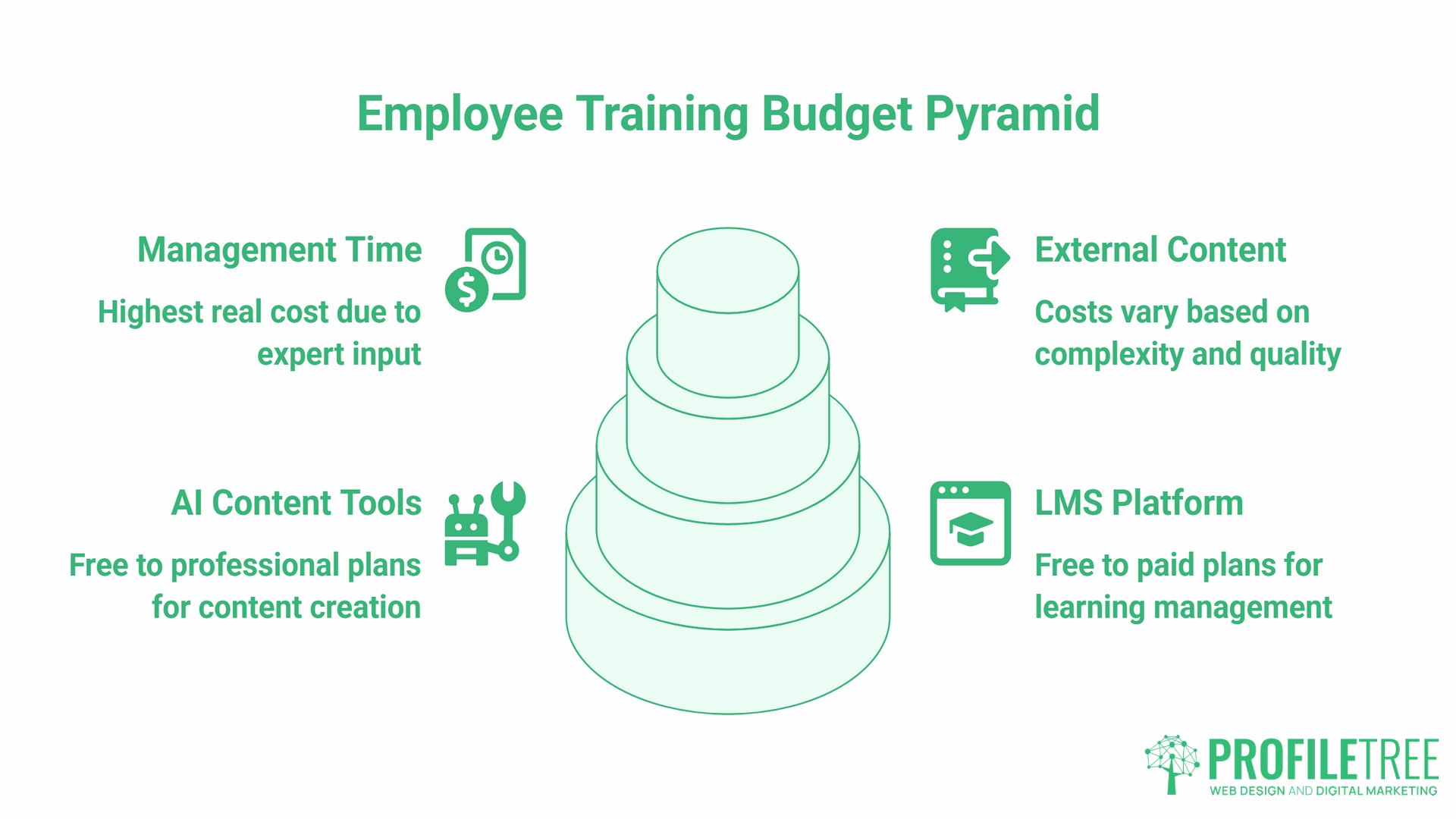
Cost is a practical constraint for most SMEs, and the range is wide. A useful starting point for a small business with 10 to 50 employees:
- LMS platform: Free tiers are available on platforms such as TalentLMS for basic use; paid plans for SMEs typically range from $59 to $200 per month, depending on user count and features. LearnDash for WordPress starts at $199 per year with unlimited users.
- AI-assisted content creation tools: Free tiers available on many platforms; professional plans for video and authoring tools typically range from £50 to £150 per month.
- External specialist content: Costs vary significantly depending on complexity, regulatory requirements, and production quality. Commission specialist content only where generic modules cannot meet the standard.
- Management time: Often the highest real cost for an SME. Building a new module from scratch typically requires meaningful input from a subject matter expert, a content reviewer, and someone to manage the LMS setup.
The cost per head for digital employee training is a fraction of the equivalent classroom-based delivery once fixed production costs are spread across a team, and content can be reused across multiple cohorts.
Common Pitfalls to Avoid
Over-automation is a real risk. An employee training programme that is entirely self-service, with no human touchpoints, tends to lead to low engagement and shallow learning. Digital tools work best as a delivery infrastructure, not as a replacement for human expertise and conversation.
Compliance training that is technically completed but not retained is another common problem. Clicking through slides to reach the certificate does not constitute genuine learning. Assessment questions that require actual understanding, not just pattern-matching, are a baseline requirement.
Building content that never gets updated is arguably the most widespread failure. Regulations change, processes evolve, and software is updated. A training programme that reflects how the business worked two years ago is actively misleading. Build a content review cycle into your calendar from the start.
Frequently Asked Questions
What should an employee training plan include?
At minimum: identified skills gaps, measurable learning objectives, a list of modules or topics to be covered, the delivery format for each, a completion timeline, and a measurement approach. For regulated sectors, documented evidence of completion is also required.
What are the four main types of employee training?
Onboarding training (introducing new starters to the business and their role), compliance training (legal and regulatory requirements), skills training (role-specific technical or procedural knowledge), and soft skills training (communication, management, customer service). Most employee training programmes combine all four in proportions that vary by business.
How can AI be used in employee training?
AI tools can speed up content creation through script drafting and automated video production, personalise learning paths based on assessment data, generate quiz questions and scenarios, and provide instant feedback to learners. For SMEs without a dedicated L&D resource, AI assistance makes it feasible to build a quality training library without outsourcing everything.
Is digital training legally valid for UK health and safety requirements?
Online delivery is accepted by the HSE for knowledge-based health and safety training, such as hazard awareness and RIDDOR reporting procedures. It cannot replace hands-on delivery for practical skills such as first aid, manual handling, or equipment operation, where physical competency must be demonstrated. Always check the specific requirements for your sector and activity.
What are the five stages of a training programme?
The ADDIE model is the standard framework: Analyse (identify needs), Design (set objectives and structure), Develop (create content), Implement (deliver training), Evaluate (measure outcomes). Most of the steps in this guide map directly onto the ADDIE model.
How do you structure a training session for employees?
A well-structured session works in three parts: an opening that explains why the session matters and what employees will be able to do afterwards; a core section covering the key content with at least one practical activity or worked example; and a close covering key points, next steps, and how to get further support. The proportion of time spent on each part depends on the topic’s complexity and whether the session is self-paced or instructor-led.
How long does it take to build an employee training programme?
For a basic onboarding and compliance programme using an LMS, allow four to six weeks from audit to first delivery. A full multi-module skills programme will typically take three to six months to develop properly, particularly if content requires expert review or regulatory sign-off.