
E-commerce Email Marketing Strategy for UK and Irish Brands
Table of Contents
Building effective email marketing campaigns for e-commerce is one of the few growth levers that gets more valuable every year, even as social platforms grow noisier and more expensive. For UK and Irish retailers, email offers something paid advertising cannot: a direct, owned channel built on first-party data that survives algorithm changes and cookie deprecation.
Most stores still leave revenue on the table by treating email as an afterthought rather than a structured programme with clear goals at every stage of the customer journey. This guide sets out how to plan effective email marketing campaigns for e-commerce, covering foundational list-building, UK compliance, automated flows, segmentation and the metrics that actually indicate profit.
Each section follows the order a UK or Irish store would tackle it in practice, starting with the foundations and ending with the numbers that tell you whether the programme is actually working.
Why Effective E-commerce Email Marketing Campaigns Deliver Strong ROI
Before the mechanics, it helps to understand why email still outperforms most other channels for online retail. The fundamentals haven’t changed, but the context around them has shifted considerably, and that shift makes an e-commerce email marketing strategy more valuable than it was five years ago.
First-Party Data as a Strategic Asset
The retirement of third-party cookies and the tightening of mobile tracking, including Apple’s App Tracking Transparency framework, have made first-party data the most valuable resource an e-commerce brand can own. Read more about the wider legal context in our guide to navigating data privacy laws in e-commerce, which sets out the obligations that sit alongside email compliance.
An email subscriber has actively chosen to share their address and, in compliant list-building, confirmed consent to hear from you. That relationship doesn’t depend on any platform. A social account can lose reach overnight after an algorithm change; an email list belongs to the business. For UK and Irish retailers building long-term resilience, this distinction matters more than ever.
Automation and Predictable Revenue
Automated flows, built once and triggered by subscriber behaviour, typically generate a disproportionate share of email revenue relative to the effort required to build them. Abandoned cart sequences, welcome series and post-purchase follow-ups all run while the team focuses on other work.
For a store serving the UK and Irish markets, local shopping seasons (Boxing Day, the January sales, Mother’s Day in March) combine with automated scheduling so revenue can be planned rather than chased. ProfileTree works with SMEs across Northern Ireland, Ireland and the UK on a digital marketing strategy that treats email as a core revenue driver rather than an afterthought, and this is usually where an e-commerce email marketing strategy starts to pay for itself.
Building Your Foundation: List Growth, Compliance and Platform Choice
Effective email marketing campaigns for e-commerce need the right infrastructure before the first send goes out. Cutting corners on list quality or compliance creates problems that get harder and more expensive to fix later.
Choosing the Right Email Service Provider
The email service provider shapes what is possible with segmentation, automation and reporting. For e-commerce specifically, platforms with native integrations to Shopify, WooCommerce or Wix are worth prioritising, and picking the right one is one of the more overlooked e-commerce email marketing best practices.
One of the simplest e-commerce email marketing best practices is to test before committing: run the automation builder, the segmentation depth and the quality of reporting through their paces before signing a contract. A platform that is awkward to use results in flows that never get built. Stores already running on Wix should look at automated emails on Wix before adding a third-party tool, since migrating an established list between platforms carries its own deliverability risk.
Whichever platform gets chosen, the migration and integration work matters as much as the feature list. A poorly configured integration between the store and the ESP causes far more damage to an e-commerce email marketing strategy than a slightly less polished interface, because broken data feeds show up as wrong prices, missing products and dead personalisation tags in live emails.
List Building That Attracts Genuine Buyers
A list of genuinely interested subscribers outperforms a larger list of unengaged contacts every time. The quality of the sign-up incentive and where the opt-in form sits both shape who ends up on the list.
Discount-led sign-up offers attract price-sensitive shoppers who may buy once and disengage. Content-led incentives, such as a buying guide or early access to new stock, tend to attract subscribers with genuinely higher purchase intent. Place opt-in forms at points of real engagement: exit-intent overlays, post-purchase confirmation pages and within product content, rather than pop-ups that interrupt the very first page view.
UK GDPR and PECR Compliance for E-commerce Email
This is where UK and Irish retailers face a more complex regulatory picture than their US counterparts, and where generic email guides fall short. Under UK GDPR, which mirrors the EU regulation post-Brexit, a lawful basis is required to process personal data. For existing customers, legitimate interests is the most commonly used basis; for prospects who haven’t purchased, explicit consent is required.
The Privacy and Electronic Communications Regulations add a further layer: direct marketing by email requires prior consent, with one important exception. The soft opt-in exemption, as set out by the Information Commissioner’s Office, lets UK businesses email customers who have bought similar products or services, provided those customers had a clear chance to opt out at the time of purchase and in every message since. A customer who bought running shoes can be emailed about new running gear without fresh explicit consent, as long as the opt-out was clear at checkout. This single distinction is one of the most useful e-commerce email marketing best practices for any UK retailer trying to grow a list without overstepping the law.
Irish retailers operating under EU GDPR, administered by the Data Protection Commission, face similar rules with some procedural differences around consent records. Retailers selling into both markets should satisfy the stricter requirement wherever the two diverge, and it’s worth putting the decision in writing rather than relying on memory once a list grows past a few thousand contacts.
None of this needs to slow a store down once the rule is understood. Most e-commerce platforms record the purchase date and product category automatically, which is exactly what is needed to apply the soft opt-in correctly. The practical step is making sure the checkout flow captures a clear, visible opt-out at the point of sale, not just a line buried in the terms and conditions.
“Most of the compliance questions we get from e-commerce clients aren’t really about GDPR in the abstract. They’re about one specific email: can we message this customer or not? Getting that one decision right, consistently, matters more than any policy document,” says Ciaran Connolly, founder of ProfileTree.
The Five Automated Flows Every E-Commerce Store Needs
Automated flows are the revenue engine behind most effective email marketing campaigns for e-commerce. Unlike one-off campaigns, they run continuously in the background, triggered by what a subscriber does or doesn’t do. Getting these flows right should come before any other email activity.
Welcome Series
Welcome series are consistently among the best-performing e-commerce email campaigns a store can run. A strong one spans three to five emails over seven to ten days. Open rates for welcome emails typically run three to four times higher than standard campaigns, simply because the subscriber has just signed up and the brand is front of mind.
The first email should deliver whatever was promised at sign-up, whether that’s a discount code, a guide or early access, and introduce the brand briefly. Later emails should build familiarity: social proof, a look at bestsellers, the story behind the business, and a gentle push toward a first purchase if one hasn’t happened yet.
Abandoned Cart and Browse Abandonment
Cart abandonment rates sit at roughly 70% globally, according to the Baymard Institute, meaning most shoppers who add a product leave without completing the transaction. A well-structured recovery sequence recaptures a meaningful share of that lost revenue, and it’s one of the highest-ROI pieces of any set of e-commerce email campaigns.
A three-email sequence works well for these e-commerce email campaigns: the first an hour after abandonment (a straightforward reminder), the second after 24 hours (addressing objections such as sizing, returns or delivery), and the third after 48 to 72 hours (optionally with a time-limited incentive). Browse abandonment sequences, triggered when someone views a product without adding it to a basket, use softer messaging since the intent signal is weaker. Both benefit from genuine personalisation: showing the specific product browsed, with accurate pricing, keeps the connection between the email and the original shopping intent.
Post-Purchase and Advocacy Flows
Post-purchase flows are one of the more neglected e-commerce email campaigns, even though the post-purchase period is the most underused phase of the email lifecycle. A customer who has just bought is at peak brand affinity: the transaction is done, anticipation is high, and they are receptive in a way they won’t be once the excitement fades.
Use post-purchase emails to confirm the order, provide delivery updates, and then, a few days after delivery, check satisfaction and request a review. Reviews requested at the right moment, with a frictionless link, generate noticeably higher response rates than generic requests sent weeks later. A second phase of the flow can introduce complementary products or invite the customer to a loyalty scheme, laying the groundwork for a second purchase. Building this out properly is part of what separates a genuine e-commerce email marketing strategy from a handful of disconnected campaigns.
Segmentation and Personalisation in a Post-Cookie World
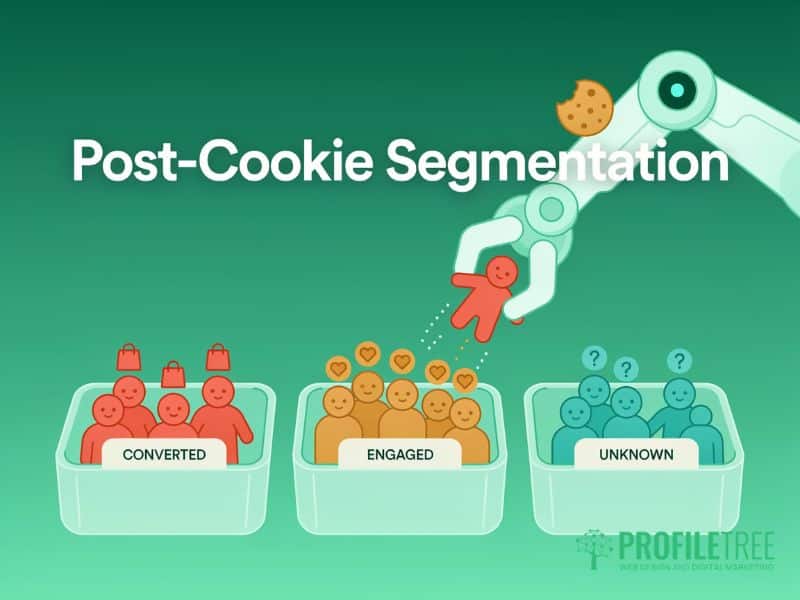
Segmentation is what separates a relevant email from an intrusive one. It’s no longer a nice-to-have for competitive ecommerce brands running effective email marketing campaigns for ecommerce; it’s close to table stakes.
Moving Beyond Demographics: RFM Analysis
Demographic segmentation (age, gender, location) is a starting point, but behavioural segmentation is far more useful. Purchase history, browsing behaviour, product category affinity and engagement recency all paint a clearer picture of what a subscriber actually wants.
RFM analysis, which scores customers on Recency, Frequency and Monetary value, is one of the most practical frameworks for e-commerce customer segmentation. Scoring every customer across these three dimensions makes it possible to quickly identify the best customers, those at risk of lapsing, and those who bought once but never came back. Each segment deserves a different approach; treating them identically wastes the data.
Zero-Party Data and Preference Centres
Zero-party data is information a customer voluntarily shares, typically through a quiz, a preference centre, or a sign-up form that asks specific questions. Unlike inferred behavioural data, it carries no ambiguity: the subscriber has told the brand what they want.
A product recommendation quiz at sign-up captures genuine preferences, such as style, budget and intended use, that improve the relevance of every email that follows. A preference centre lets existing subscribers say how often they want to hear from a brand and which topics interest them. Brands offering this level of control typically see lower unsubscribe rates and stronger engagement from the subscribers who remain. Tools built around AI-powered marketing tools are making this kind of personalisation at scale realistic for stores that don’t have a data science team on staff.
Predictive Segmentation Using Existing Data
Modern email platforms increasingly offer predictive features that use purchase history and engagement data to forecast future behaviour. Predicted next purchase date, predicted churn probability and predicted lifetime value are all signals that can inform automated flow triggers and campaign targeting, without any manual analysis on the store’s part.
For stores generating a reasonable volume of monthly orders, these features can meaningfully improve targeting once the underlying data is clean. Incomplete purchase records, duplicate customer profiles and inconsistent product categorisation all undermine predictive accuracy, so it’s worth auditing the data before switching predictive segments on. A well-run e-commerce email marketing strategy treats this kind of data hygiene as ongoing maintenance, not a one-off task.
Measuring What Matters: KPIs and Benchmarks
Open and click-through rates are useful directional signals, but they don’t say whether effective email marketing campaigns for e-commerce are actually generating profit. The metrics that matter most connect directly to revenue and to the health of the list itself.
Revenue Per Email and Revenue Per Subscriber
Revenue per email measures the average revenue generated by each email sent, calculated by dividing total attributed revenue by the number of emails delivered. It allows a like-for-like comparison of campaign types, subject lines and send times.
Revenue per subscriber, tracked monthly or quarterly, measures the productivity of the list as a whole. A growing list with falling revenue per subscriber usually means list quality is slipping, often because acquisition has prioritised volume over relevance. Reviewing these figures against wider industry benchmarks for email statistics gives useful context for a store’s own numbers.
Deliverability, List Health and A/B Testing
Deliverability is the proportion of emails that reach the inbox rather than the spam folder. It is affected by sender reputation, list quality and content. Bounce rate, spam complaint rate and unsubscribe rate all deserve regular monitoring; a spam complaint rate above 0.1% needs immediate attention.
Suppressing unengaged subscribers, typically those who have not opened or clicked in 90 to 180 days, is one of the simpler e-commerce email marketing best practices and isn’t just tidy housekeeping. It actively improves deliverability for everyone else on the list. A smaller, healthier list consistently outperforms a larger, unmanaged one, which is one of the less intuitive e-commerce email marketing best practices for brands focused on growth at any cost.
A/B testing rounds out the picture. Isolating one variable at a time (subject line, send time, offer structure) and measuring its effect on a defined outcome is the only way learning accumulates, rather than resetting with every campaign. Subject line testing alone, applied consistently, can lift open rates by 10 to 20% over several months without any other change to the programme. Stores wanting a wider view of how email fits alongside other channels can start with a digital marketing services audit, and it’s worth benchmarking the result against broader digital marketing ROI statistics rather than judging email in isolation.
Conclusion
Effective email marketing campaigns for e-commerce reward consistency and structure more than any other channel. The stores generating the strongest returns aren’t the ones with the largest lists; they are the ones treating email as a long-term asset built on clean data, genuine segmentation and automated flows that keep working in the background. A programme built mostly of promotional broadcasts still has the biggest opportunity ahead of it: turning that list into a properly structured e-commerce email marketing strategy, one flow at a time.
ProfileTree works with ecommerce businesses across Northern Ireland, Ireland and the UK to build email marketing programmes that drive measurable revenue growth.
FAQs About E-commerce Email Marketing
How often should an E-commerce store email its list?
It depends on the product category and purchase cycle. Fast-moving consumer goods brands can usually sustain two to three emails a week to engaged segments without a spike in unsubscribes. For higher-ticket items like furniture or electronics, one to two emails a week is usually enough, and segmenting by engagement recency lets a store send more often to its most active subscribers without irritating the rest of the list.
Do I need explicit consent to email past customers in the UK?
Not necessarily. Under PECR’s soft opt-in provision, a business can email existing customers about similar products or services without fresh explicit consent, provided they had a clear chance to opt out when they first purchased and in every message since. This applies specifically to existing customers; prospects who haven’t bought anything still need explicit consent before they are added to a marketing list.
What are the main types of e-commerce emails?
The core types are welcome emails, abandoned cart emails, post-purchase emails, win-back emails, promotional emails, transactional emails and newsletter or editorial emails. Together, these e-commerce email campaigns cover most of what a subscriber will ever receive from a brand. A mature programme usually runs several of these as automated flows rather than one-off sends.
Which email platform is best for E-commerce?
Klaviyo suits stores that need deep integration with Shopify or WooCommerce, advanced segmentation and predictive analytics. Omnisend suits brands that want to combine email and SMS in a single platform, and Mailchimp remains viable for simpler catalogues, though its ecommerce-specific features lag behind those of the two dedicated platforms.
How do I reduce my unsubscribe rate?
Better segmentation, a preference centre and regular list hygiene are the most effective interventions. If unsubscribes peak in the first two weeks, the sign-up expectation and the content delivered probably don’t match, which usually means the welcome series needs a rethink before anything else changes.