
Ecommerce Web Design Packages: How to Choose the Right Build for Your Business
Table of Contents
Most businesses searching for ecommerce web design packages already know they need a professional online store. What they’re less sure of is what they’re actually paying for, whether a package fits their real needs, and how to avoid buying the wrong thing.
This guide breaks down how ecommerce packages are structured, what separates a template build from a custom development, and what UK and Irish SMEs should ask before signing anything.
What Ecommerce Web Design Packages Actually Include
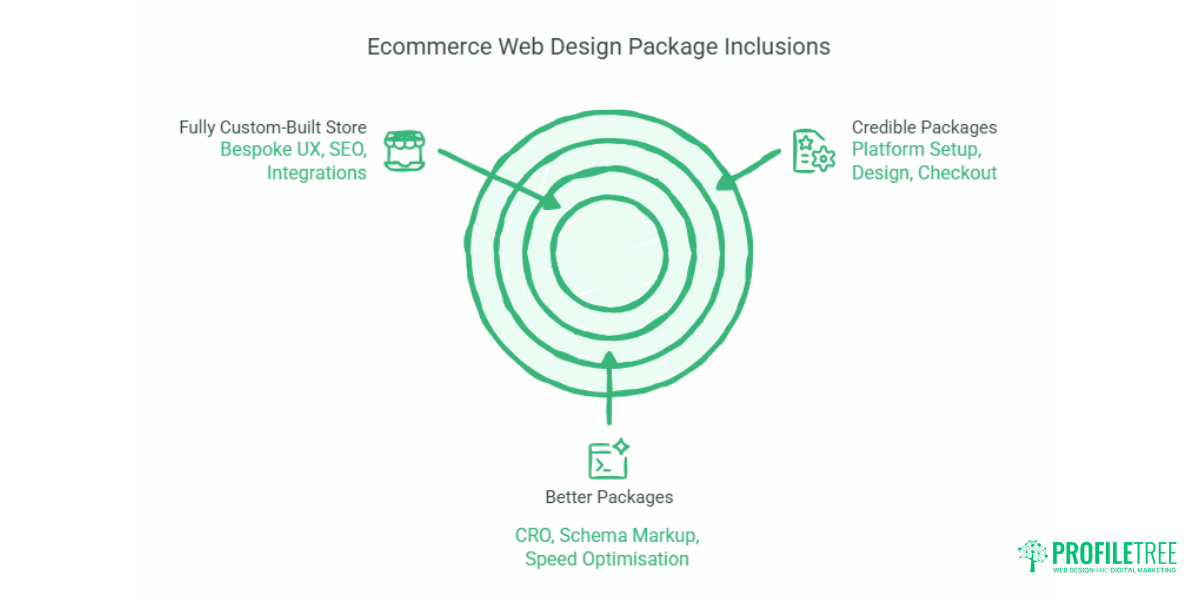
The word “package” covers a wide range of things depending on who’s selling it. At the basic end, a package might mean a preconfigured Shopify or WooCommerce template with a logo upload and a handful of product pages set up. At the other end, it means a fully custom-built store with bespoke UX design, integrated SEO, payment systems configured to your business model, and ongoing technical support.
The gap between those two things is significant, and the price difference reflects it. A starter template built by a freelancer might run to £800–£1,500. A professionally designed, custom WooCommerce or Shopify build from a specialist agency typically sits between £5,000 and £20,000+, depending on complexity, product catalogue size, and integrations required.
What most credible ecommerce web design packages have in common:
- Platform selection and setup (WooCommerce, Shopify, BigCommerce or custom)
- Custom or semi-custom visual design aligned to your brand
- Product catalogue structure and page templates
- Checkout and payment gateway integration
- Mobile-responsive build
- Basic technical SEO configuration
- A content management system you can update yourself
What better packages also include:
- Conversion rate optimisation is built into the page layouts
- Structured data and schema markup for product pages
- Site speed optimisation from the build stage
- Video integration on product pages
- Ongoing SEO and content strategy
Choosing Between DIY Platforms, Freelancers and Agencies
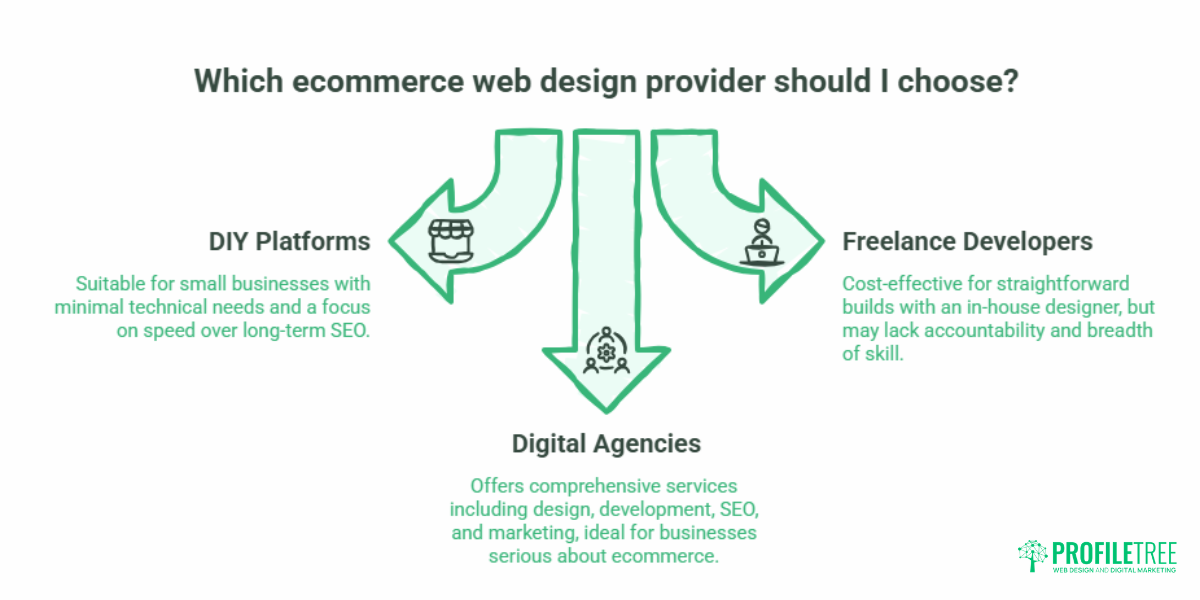
Before comparing specific e-commerce web design packages, it’s worth understanding the three types of providers and what each is suited to.
DIY Platform Builders
Shopify, Squarespace and Wix all offer ecommerce-capable website builders with monthly subscription plans. For businesses with small catalogues and minimal technical requirements, these can work well as a starting point.
The limitations become apparent as businesses grow. URL structures are often poor for SEO. Customisation beyond the template boundaries requires developer knowledge. Complex delivery rules, product variants and B2B pricing are difficult or impossible to implement without custom development. You’re also paying monthly fees indefinitely rather than owning the asset outright.
DIY platforms are appropriate for: sole traders testing an idea, businesses with under 20 SKUs, and side projects where speed matters more than long-term SEO.
Freelance Developers
A freelancer can build a functional WooCommerce or Shopify store at a lower daily rate than an agency. The trade-off is availability, accountability, and breadth of skill. A developer who is strong on the technical build may have limited UX or SEO knowledge. If they’re unavailable when something breaks, the impact on your business can be significant.
Freelancers are appropriate for: straightforward builds with a small scope, businesses with an in-house designer who can hand over assets, and projects where budget is the primary constraint.
Digital Agencies
An agency like ProfileTree, a Belfast-based web design and digital marketing agency, brings together the design, development, SEO and content capabilities under one structure. The advantage isn’t just convenience; it’s that ecommerce sites are designed with SEO and conversion strategy built in from the start, consistently outperforming stores where those elements are added as afterthoughts.
“The businesses that struggle with ecommerce aren’t usually struggling because their platform is wrong,” says Ciaran Connolly, founder of ProfileTree. “They’re struggling because the store was built without a customer journey in mind. Design, development and marketing have to be thought through together from day one.”
Agencies are appropriate for: businesses serious about e-commerce as a revenue channel, stores with complex product catalogues or custom functionality requirements, businesses that want SEO and digital marketing integrated from the build.
Platform Selection: What Works for Most UK and Irish SMEs
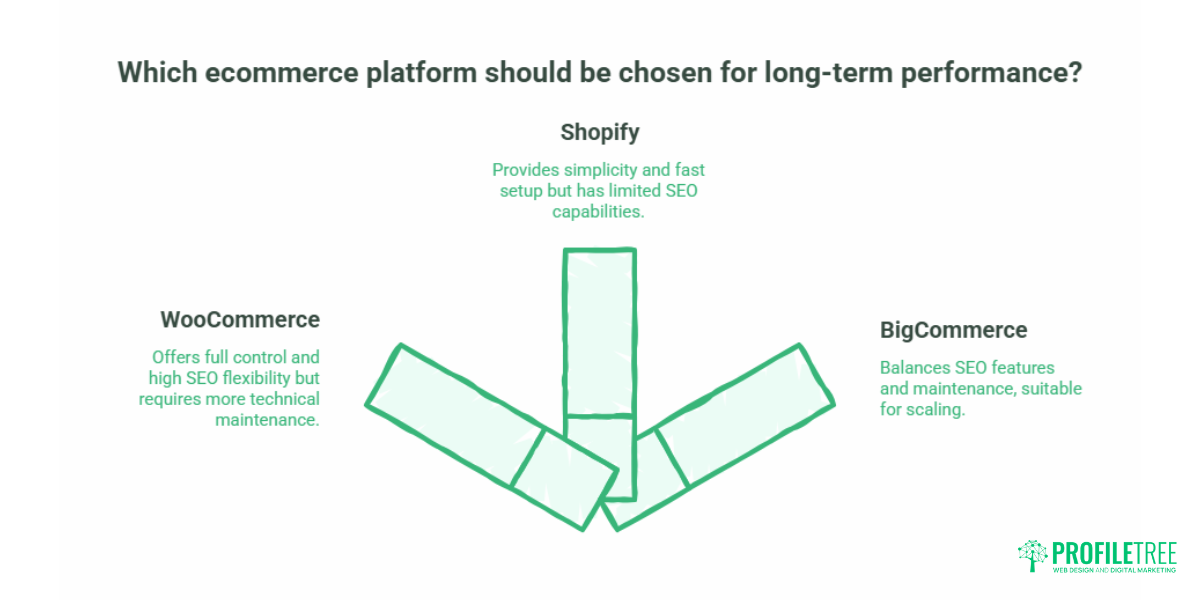
The platform choice matters because it affects every aspect of long-term performance: site speed, SEO flexibility, content management, and the cost of future changes.
WooCommerce
WooCommerce is a plugin for WordPress and remains the most widely used ecommerce platform globally. For SMEs in the UK and Ireland who already use WordPress or want maximum control over their site, it’s usually the most practical choice. It has no transaction fees, and the flexibility to customise URLs, page templates, and checkout flows means it can be configured properly for SEO from the outset.
The trade-off is that WooCommerce requires more technical maintenance than Shopify. Hosting, security and plugin updates need active management. With a capable agency handling the build and ongoing hosting, this is a manageable consideration.
Shopify
Shopify is the simpler option for businesses that want to focus on selling rather than website management. The hosted platform handles security, updates and uptime automatically. Its SEO capabilities are more limited than WooCommerce (canonical tag control, URL structure and schema markup all have constraints), but for many SMEs the trade-off is acceptable.
Shopify is particularly suited to businesses with straightforward catalogues, high transaction volumes, or teams without technical resources for ongoing WordPress management.
BigCommerce
BigCommerce sits between Shopify and WooCommerce in the market. It has stronger native SEO features than Shopify (no transaction fees, better URL control, built-in structured data) and a slightly lower technical maintenance burden than WooCommerce. It’s worth considering for larger catalogues or businesses planning to scale across multiple markets.
| Platform | Best For | SEO Flexibility | Monthly Cost | Transaction Fees |
|---|---|---|---|---|
| WooCommerce | Full control, complex builds | High | Hosting cost only | None |
| Shopify | Simplicity, fast setup | Medium | £25–£259/month | 0.5–2% (on lower plans) |
| BigCommerce | Scale, multi-region | High | £29–£299/month | None |
Design and User Experience: What Separates a Converting Store from One That Doesn’t
Platform choice is a technical decision. Design is a commercial one.
The layout, navigation and product page structure of an ecommerce store directly affect whether visitors buy. This isn’t an aesthetic preference; it’s measurable. Cluttered navigation increases exit rates. Product pages without sufficient detail (images, description, reviews, size or spec guidance) increase both bounce rates and post-purchase returns.
Navigation and Layout
Effective ecommerce navigation makes the path from landing to checkout as short as possible. Category structures need to reflect how customers actually think about products, not how the business organises its stock. Mega menus, filters, and breadcrumb trails all contribute to findability on larger catalogues.
A mobile-first approach is no longer optional. UK ecommerce traffic has been majority-mobile for several years. A layout that works on desktop but requires horizontal scrolling or has call-to-action buttons that are too small to tap on a phone loses sales at every stage of the funnel.
Product Pages
Product pages are where the buying decision is made. Each page needs high-quality images showing the product from multiple angles, a description that answers the specific questions a buyer has before purchasing, clear pricing, delivery information, and social proof.
Product video is increasingly significant on this type of page. A short video showing a product in use addresses the “touch and feel” gap that is the single biggest barrier to online purchase confidence. ProfileTree’s video production services cover this type of commercial content, and the investment typically covers itself in reduced return rates as much as in increased conversion. The rise of short-form video has made this easier to execute: a 20–30 second clip showing the product in context, shot vertically for mobile, can be produced without a large crew.
Checkout and Payment Integration
Cart abandonment is the ecommerce equivalent of a customer walking to the till and then changing their mind. The checkout experience is directly responsible for a significant proportion of this.
The fundamentals are widely understood but inconsistently implemented. Guest checkout reduces friction for first-time buyers. Autofill compatibility speeds up form completion. A visible progress indicator reassures the customer mid-checkout. Transparent delivery cost display at the earliest possible stage reduces the “surprise” that causes most late-stage abandonment.
Payment gateway integration should cover the methods your customers actually use. PayPal and Stripe cover most UK consumer purchases. For B2B ecommerce, invoice or purchase order options are often essential. Apple Pay and Google Pay are now standard expectations on mobile.
SSL certificates are the baseline for trust; any ecommerce site operating without HTTPS is losing sales to the security warning that browsers display.
Ecommerce SEO: What Should Be Built In From the Start
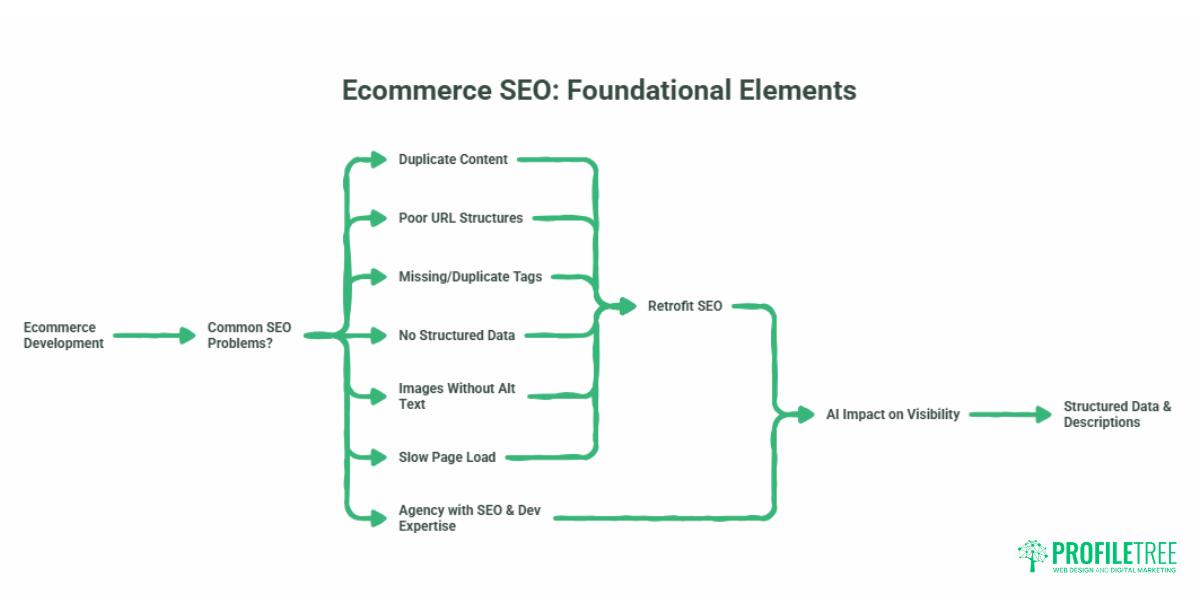
SEO for ecommerce isn’t a separate activity that happens after the store is built. The decisions made during development directly affect how well the store can rank.
The most common ecommerce SEO problems are created at the build stage:
- Duplicate content generated by filtering and sorting parameters
- Poor URL structures (platform-generated strings like
/product?id=4732rather than/mens-waterproof-jacket-medium/) - Missing or duplicate title tags and meta descriptions on product pages
- No structured data markup for products, reviews or prices
- Images without alt text
- Slow page load caused by unoptimised images or bloated theme code
An agency that understands both web development and SEO avoids these during the build. Retrofitting them to a live store is time-consuming and expensive. ProfileTree’s SEO strategies for multi-regional ecommerce sites cover the ongoing side of this, but the technical foundation has to be correct first.
The impact of AI on ecommerce conversion rates is also reshaping how product pages are found. AI search overviews increasingly surface product information directly, which means structured data and well-written product descriptions are more valuable than ever for visibility.
Digital Marketing: What Happens After the Store Goes Live
A well-built ecommerce site with good SEO will attract organic traffic, but most businesses need more than that, particularly in the first year. A digital marketing strategy layered onto a technically sound build creates the traffic and customer acquisition that turns the investment into a return.
The components that matter most for ecommerce:
Content marketing creates the informational content that captures buyers earlier in their research. A food producer selling direct-to-consumer in Northern Ireland, for example, benefits from recipe content, sourcing guides, and behind-the-scenes material that drives organic traffic from audiences who are not yet searching for the specific products. This approach (building an audience through genuinely useful content) is described in more detail in ProfileTree’s guide to digital marketing in Northern Ireland.
Email marketing remains one of the highest-ROI channels for ecommerce because it targets people who have already shown interest. A post-purchase sequence, an abandoned cart flow, and a regular newsletter to subscribers are the three automations that deliver the most return for the least ongoing effort.
Social media and video support discovery. Short-form video on platforms like TikTok and Instagram Reels drives traffic to product pages from audiences who would not otherwise find the store through search. ProfileTree’s video marketing service handles this type of content for ecommerce clients, from product demonstration videos through to brand storytelling content.
Digital marketing training is worth considering for owner-managed businesses that want to handle day-to-day marketing in-house after launch. ProfileTree runs training for SMEs across Northern Ireland and Ireland, covering SEO, social media, analytics and content management: practical skills that reduce ongoing agency dependency.
Understanding Ecommerce Package Pricing
Pricing for ecommerce web design packages varies considerably, and the range reflects genuine differences in what is included rather than simply profit margin.
A useful framework for UK and Irish SMEs:
| Tier | Typical Range | What It Covers |
|---|---|---|
| DIY/Starter | £0–£1,500 | Template-based, limited customisation, basic payment integration |
| Freelance Build | £1,500–£5,000 | Custom design, platform setup, basic SEO |
| Agency Standard | £5,000–£12,000 | Full custom build, UX design, SEO-ready, project management |
| Agency Custom | £12,000–£25,000+ | Complex catalogue, custom integrations, multi-region, performance-optimised |
The question is not which tier is cheapest; it’s which produces a positive return on investment within a realistic timeframe. A £1,200 template build that ranks poorly, converts at 0.5% and requires constant developer intervention to maintain often costs more over two years than a £7,000 agency build that ranks, converts at 2.5%, and runs reliably.
When evaluating any package, ask:
- Is SEO configuration included, or treated as an add-on?
- Who handles hosting and security ongoing?
- What happens if something breaks after handover?
- Are the design assets and code owned outright by the business?
- Does the package include training on the CMS?
Analytics and Measuring Ecommerce Performance
A live store needs measurement from day one. Google Analytics 4 with ecommerce tracking enabled gives visibility of which products are viewed, which pages cause exit before checkout, and which marketing channels drive actual purchases rather than just traffic.
The metrics worth monitoring for any ecommerce store:
- Conversion rate (industry average for UK ecommerce is roughly 1–3%; if you’re below 1%, something structural is wrong)
- Average order value (affects how much you can afford to spend on customer acquisition)
- Cart abandonment rate (industry average is around 70%; if yours is significantly higher, the checkout process needs attention)
- Organic search traffic (and which queries are driving it, useful for identifying content and product page gaps)
- Return rate (a high return rate often signals a product page problem, not a product problem)
Setting up these measurements correctly at launch, rather than retrospectively, is part of what distinguishes a professional build from a basic template setup.
Conclusion
Choosing ecommerce web design packages is ultimately a question of what you’re building toward. A template starter is a sensible test for a low-risk product idea. A professionally designed, SEO-configured, agency-built store is the right choice for a business treating ecommerce as a serious revenue channel. The gap between the two is not just price; it’s long-term performance. ProfileTree works with SMEs across Northern Ireland, Ireland and the UK to build stores that rank, convert and grow. Get in touch to discuss what the right build looks like for your business.
FAQs
What should an ecommerce web design package include for a small business?
At minimum: a mobile-responsive custom or semi-custom design, a reliable ecommerce platform (WooCommerce or Shopify are the most practical choices for most SMEs), payment gateway integration, basic on-page SEO configuration, and a CMS you can manage without developer help. Better packages also include structured data markup, site speed optimisation and post-launch support.
How much does ecommerce web design cost in the UK?
Costs range from under £1,500 for a basic template build through to £25,000+ for a fully custom agency build with complex integrations. Most SMEs commissioning a professionally designed WooCommerce or Shopify store from a specialist agency should budget between £5,000 and £12,000 for a standard build. The right question isn’t what’s cheapest; it’s what produces a positive return within a realistic timeframe.
What is the difference between web design packages and web development packages?
Web design packages focus on the visual and UX layer: how the store looks, how users navigate it, and how product pages are laid out. Web development packages cover the technical construction: database structure, platform integration, custom functionality, and back-end systems. Most professional ecommerce builds require both, which is why agency packages usually include both disciplines rather than separating them.
Is WooCommerce or Shopify better for SEO?
WooCommerce on a well-configured WordPress install gives more SEO flexibility, including full control over URL structure, canonical tags, schema markup, and page templates. Shopify has improved its SEO capabilities significantly, but still has constraints in areas like URL structure and duplicate content handling. For businesses where long-term organic search performance is a priority, WooCommerce is usually the stronger foundation.
Do I need an agency, or can I build an ecommerce site myself?
It depends on the complexity and commercial importance of the store. DIY builders like Shopify or Wix are practical for businesses with small catalogues, testing an idea. For a business treating ecommerce as a primary or significant revenue channel, the SEO, UX, and conversion rate benefits of a professionally built site typically justify the agency investment within 12–18 months.
How long does it take to build an ecommerce website?
A straightforward agency build typically takes 6–10 weeks from brief to launch. Complex builds with custom integrations, large catalogues or multi-region functionality can take 12–20 weeks. Timeline is usually driven by how quickly the client can supply product data, copy and imagery, rather than by development speed alone.
What ecommerce platforms do UK agencies typically work with?
WooCommerce and Shopify account for the majority of UK SME ecommerce builds. BigCommerce is used for larger or more complex stores. Magento (now Adobe Commerce) is used for enterprise-level builds. Most specialist agencies will have a preferred platform based on their development expertise, so it’s worth asking which platforms they have the most active projects on.