
ConvertKit for Maximising ROI: The SME Strategy Guide
Table of Contents
Most small businesses that sign up for an email marketing platform get the tool right and the strategy wrong. They import a list, send a few broadcasts, and then wonder why the numbers never move. ConvertKit (now officially rebranded as Kit) is one of the more capable platforms available to SMEs, but capability alone does not produce a return. What produces a return is connecting the tool to a coherent digital strategy: one that pulls in organic search traffic, converts visitors into subscribers, and then uses automation to build commercial relationships at scale.
This guide covers ConvertKit for maximising ROI from a strategic standpoint. It is aimed at business owners and marketing managers in Northern Ireland, Ireland, and the UK who either already use the platform or are evaluating it against alternatives. The focus throughout is on outcomes, not features.
Beyond the Inbox: Email as a Digital Growth Engine
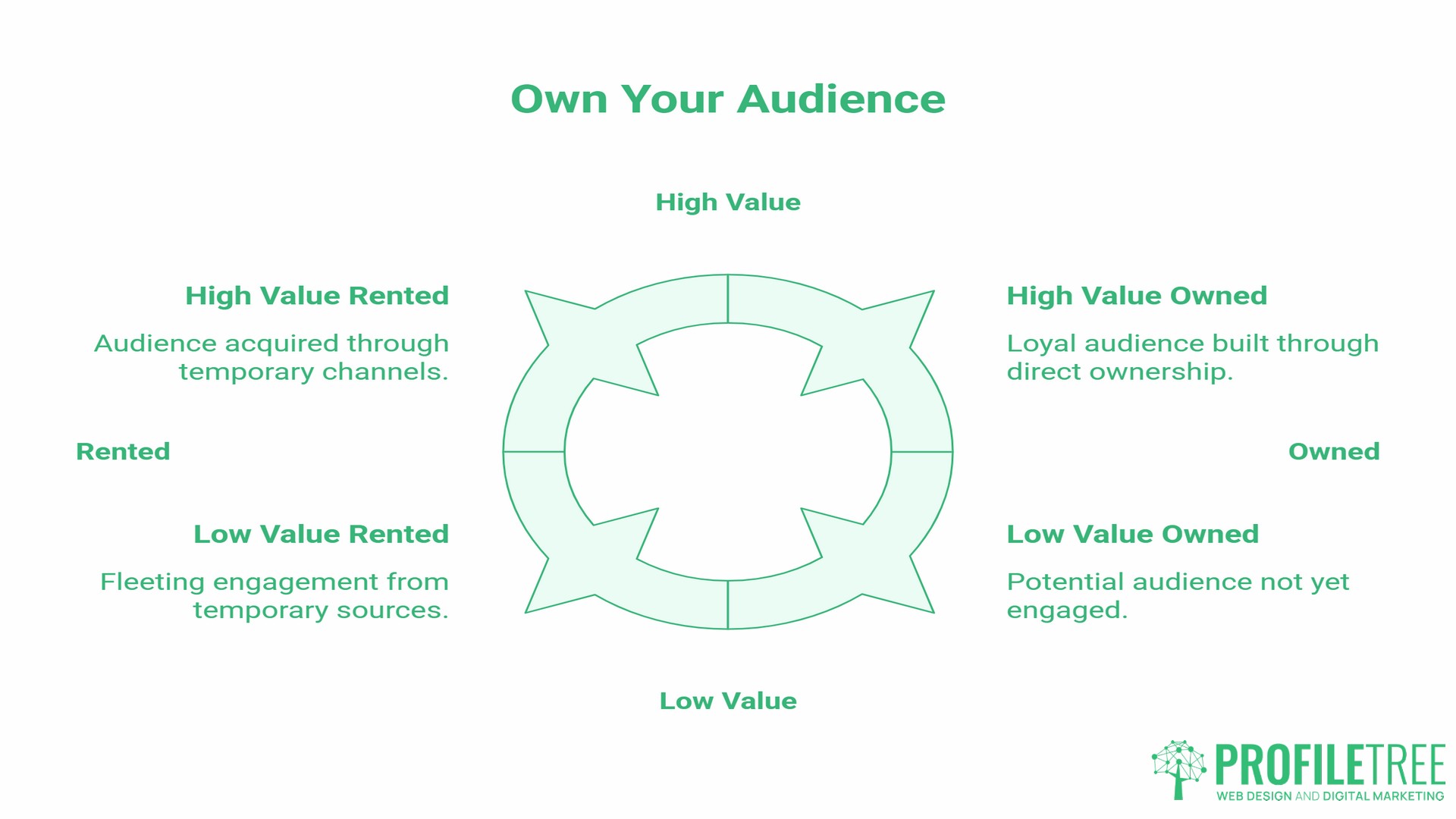
Email has a structural advantage over every other digital marketing channel: you own the list. Social media followers, search rankings, and paid ad placements can all disappear overnight when algorithms change or budgets run out. A well-managed email list does not. That is why ProfileTree, the Belfast-based digital marketing agency, consistently frames email not as a standalone tactic but as the retention layer within a wider digital marketing strategy.
“The email list is the only insurance policy an SME has against the volatility of social media algorithms and paid advertising costs,” says Ciaran Connolly, ProfileTree Founder. “Every other channel rents your audience. Email owns it.”
ConvertKit for maximising ROI only makes sense when the platform sits inside a system. That system starts with search: content that ranks brings in visitors who have already demonstrated intent. Those visitors convert to subscribers through well-designed forms and lead magnets. Automation sequences then move subscribers from initial interest to a purchase decision. At every stage, data flows back to inform what content gets created next. This is the digital marketing flywheel, and ConvertKit is the engine that powers the retention stage.
For UK and Irish SMEs, this matters more than most marketing conversations suggest. Customer acquisition costs via paid channels have risen significantly in recent years. Businesses that have invested in building an owned audience through email are far better positioned to weather that cost increase than those who rely entirely on Meta or Google Ads.
The Kit Rebrand: What It Means for Your Search Strategy
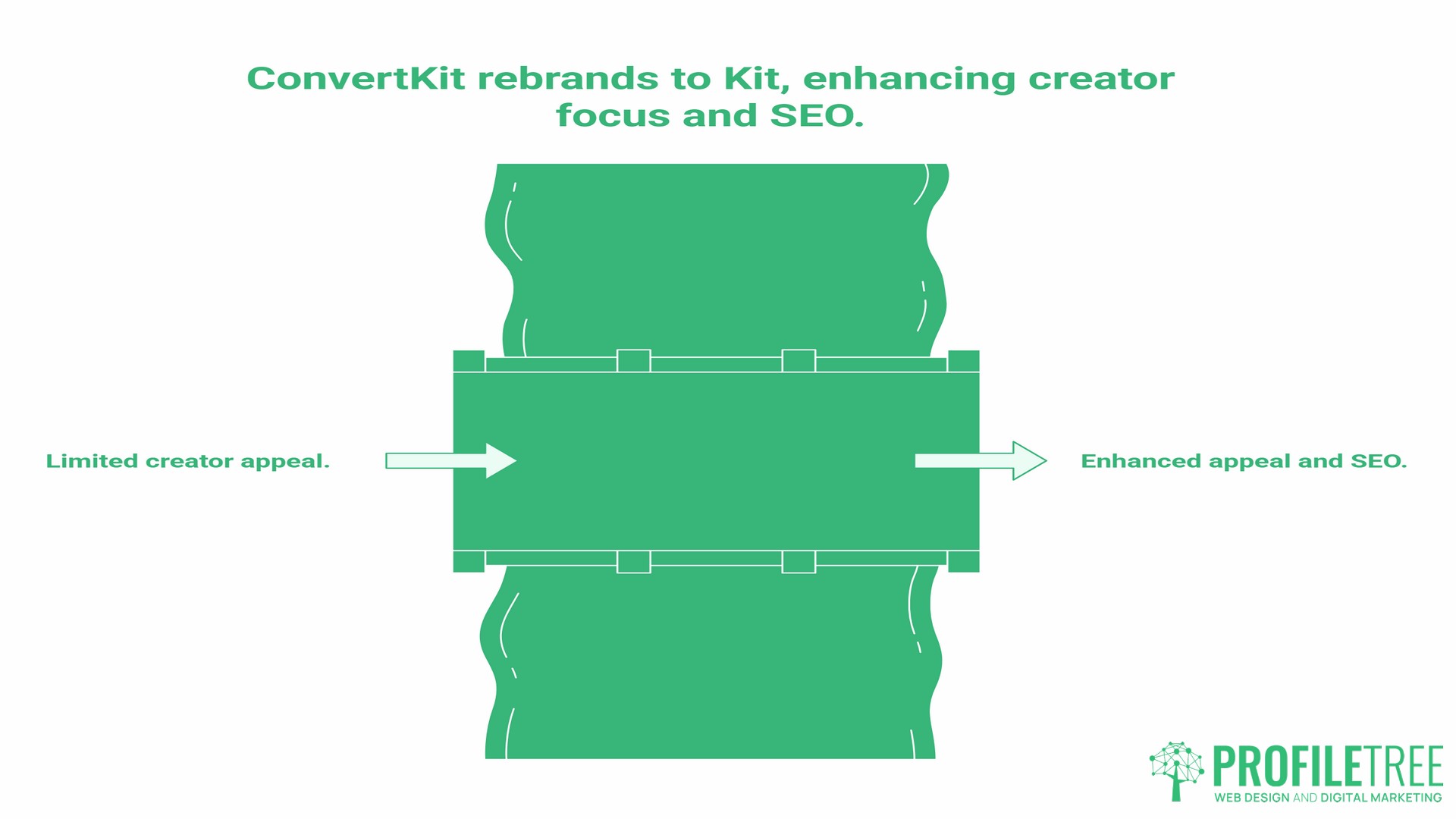
In 2024, ConvertKit officially rebranded as Kit. The platform itself did not change fundamentally. The rebrand was primarily about positioning the company as the go-to tool for creators and independent business owners rather than a generic email service provider. For users already on the platform, the transition is seamless in practice.
From an SEO standpoint, the rebrand creates a short-term opportunity. Many existing articles and guides still use the old name exclusively. A piece that covers “Kit (formerly ConvertKit)” captures both the legacy search traffic for the old brand name and the growing volume of searches under the new one. This guide uses both terms where relevant for exactly that reason.
The platform’s core value proposition has not changed: visual automations, subscriber tagging, behaviour-based segmentation, and a commerce layer that lets creators sell digital products directly from their list. What has changed is that Kit is now more explicitly positioned against newsletter-first platforms like Beehiiv, which means SMEs comparing tools should pay attention to which use case each platform is built for.
The SME Profit Model: How ConvertKit Drives Measurable ROI
ConvertKit for maximising ROI is not an abstract exercise. There are specific platform features that, when used correctly, deliver measurable revenue lift. Three of them matter more than the rest for SMEs.
Visual Automations and Lead Nurturing
Kit’s visual automation builder is the platform’s most commercially significant feature for small businesses. Rather than sending the same broadcast email to everyone on a list, automations let you build sequences that respond to subscriber behaviour. Someone who clicks a link about web design services gets a different follow-up than someone who clicks a link about social media.
This matters for ROI because relevance drives conversion. A subscriber who receives content aligned with their demonstrated interest is more likely to take the next commercial step than one who receives generic content. For a Belfast-based accountancy firm, this might mean sending a sequence about self-assessment deadlines to subscribers who downloaded a tax guide, while sending a different sequence about payroll to those who attended a webinar on staff costs.
Precision Segmentation
The platform’s tagging system lets you segment subscribers based on what they do, not just what they said when they signed up. A subscriber tagged as having visited your pricing page three times is showing a different intent than one who opened a welcome email once and then went quiet. Treating those two people identically is the most common source of poor email ROI.
Segmentation also reduces unsubscribe rates. Subscribers who receive emails genuinely relevant to their situation stay on lists longer, which compounds the value of every acquisition effort made to build that list in the first place. This connects directly to the email statistics across industries that consistently show relevance as the primary driver of open and click rates.
The Commerce Feature
Kit’s built-in commerce layer lets businesses sell digital products, paid newsletters, and courses directly on the platform without a separate e-commerce integration. For SMEs that produce educational content: training materials, guides, templates, or workshop recordings. This removes a significant barrier to monetisation. The transaction occurs within the email ecosystem, so the conversion data stays in one place and feeds back into segmentation.
Integrating Kit into Your Wider Digital Ecosystem
The businesses that see the strongest return from ConvertKit for maximising ROI are those that treat email as one part of a connected system, not a channel operating in isolation. Three integrations matter most for UK and Irish SMEs.
The SEO-to-Email Pipeline
Organic search is the most cost-efficient source of high-intent visitors for most SMEs. A well-ranked blog post or guide attracts readers who are actively seeking the kind of information or service you provide. The problem is that most of those visitors leave without converting to anything. A ConvertKit opt-in form, placed within or at the end of relevant content, turns a percentage of those one-time visitors into subscribers you can continue to communicate with.
The content that performs best for email acquisition is specific and useful: a checklist, a short guide, a tool comparison, or a template relevant to the article topic. Someone reading an article about how to use email marketing is already interested in the subject. Offering them a relevant resource in exchange for their address converts that interest into a commercial relationship.
This is where SEO strategy and email strategy need to be planned together rather than separately. ProfileTree’s SEO services approach this as an integrated question: which content will rank, and which of those ranking pages are suited to an email capture offer?
Using Email Data to Improve Content Strategy
One of the underused returns from email marketing is the data it generates about what your audience actually cares about. Subject line open rates tell you which topics generate interest. Click rates on individual links tell you which angles are driving action. Unsubscribe spikes tell you when content has missed the mark.
That data feeds directly back into the content marketing strategy. If a sequence about automation tools gets four times the clicks of a sequence about brand design, that signals where future content investment should go. Email becomes a research tool as much as a communication one.
Automation as a Staff Multiplier
For small teams, the practical ROI of automation is time. A well-built welcome sequence, a post-enquiry nurture flow, and a re-engagement campaign for cold subscribers are all things that, once built, run without manual effort. A sole trader or a two-person marketing team can deliver a consistent, personalised communication experience to hundreds of subscribers simultaneously.
This is particularly relevant for SMEs across Northern Ireland and Ireland, where marketing teams are often lean. Business automation is not an enterprise-only conversation. Kit’s automation builder is accessible enough for a non-technical user to set up with a half-day of focused work.
Navigating the UK and Irish Landscape: GDPR and Real Costs
Any honest conversation about ConvertKit for maximising ROI in the UK and Ireland has to address GDPR. The regulation is not primarily a compliance burden. It is a list quality filter. Businesses that build their email lists through double opt-in, clear consent language, and specific permission scopes end up with smaller, higher-intent subscriber lists. That, in practice, means higher open rates, higher click rates, and higher conversion rates.
Kit supports double opt-in natively. Enabling it on every form is the right default for UK and EU-based businesses, not just for legal reasons but for commercial ones. A list of 500 people who explicitly asked to hear from you outperforms a list of 2,000 people whose consent was implied or marginal.
On pricing: Kit’s plans are structured around subscriber count. The free Newsletter plan supports up to 10,000 subscribers with unlimited email sends, landing pages, and forms, though automation is limited to a single workflow. The Creator plan, which unlocks the full visual automation builder and third-party integrations, is priced in USD at $39 per month for up to 1,000 subscribers, following a price increase in September 2025. Billed in GBP at prevailing exchange rates, that works out at approximately £30 to £32 per month. The Creator Pro tier, which adds advanced reporting, subscriber scoring, and A/B testing, is priced at $79 per month for the same subscriber count.
For SMEs evaluating whether the investment is justified, the calculation is straightforward: if one sale per month is directly attributable to email, does it cover the platform cost? For most businesses selling anything above a low-margin product, the answer is yes, within two to three months of running a properly built automation sequence.
Performance Benchmarks: What Does Good ROI Look Like?
Benchmarks are useful only when read in context, and email open rate data has become harder to interpret since Apple’s Mail Privacy Protection began auto-loading email content in 2021. That change inflated reported open rates across the industry. Stripping out that noise, opted-in SME lists in the UK typically see open rates in the 25% to 40% range for well-targeted campaigns, according to data compiled by email marketing specialists covering UK B2B senders. Click-through rates on opted-in lists generally range from 2% to 4%, with top-performing segmented campaigns reaching higher. These are reference points, not targets; performance varies significantly by sector, send frequency, and list age.
The metrics that matter most for ConvertKit for maximising ROI are not open rates and click rates in isolation. They are:
- Revenue per subscriber. Divide total email-attributed revenue by total subscriber count. This shows the commercial value of each person on your list and provides a basis for deciding how much to spend on list growth.
- Sequence completion rate. What percentage of subscribers complete a full automation sequence? A low completion rate (under 40%) signals either sequence length issues or a mismatch between what subscribers expected and what they received.
- Conversion rate per sequence. Of the subscribers who complete a nurture sequence, what percentage take the commercial action at the end: a purchase, an enquiry, or a booking? This is the ultimate measure of whether the content inside the sequence is doing its job.
Tracking these figures in Kit’s reporting dashboard and reviewing them monthly rather than quarterly is what separates businesses that get consistent returns from those who report that email marketing “doesn’t work.”
Implementation Roadmap: From Setup to Scalability
Getting ConvertKit for maximising ROI requires a structured approach rather than a trial-and-error one. The following sequence is what a practical implementation looks like for an SME starting from zero.
- Weeks 1 to 2: Account and list setup. Create the account, verify the sending domain, and configure double opt-in. Import any existing contacts who provided explicit consent. Do not import contacts who have not specifically agreed to receive marketing emails. Importing non-consenting contacts damages deliverability and breaches GDPR.
- Weeks 3 to 4: Build the welcome sequence. A five-email welcome sequence, sent over 10 to 14 days, is the foundation of every effective email marketing programme. Its purpose is to set expectations, deliver immediate value, and establish the tone of what subscribers will receive going forward. The first email goes out immediately on sign-up. The second delivers the promised resource at the opt-in. Emails three to five introduce the business, address common questions, and move toward a soft commercial invitation.
- Month 2: Build the first conversion sequence. Once the welcome sequence is in place, build one dedicated sequence aimed at a specific commercial outcome: a product purchase, a service enquiry, or a consultation booking. Keep it to four to six emails. Use behaviour-based triggers to send it only to subscribers who have shown relevant intent.
- Month 3 and beyond: Optimise and expand. Review completion rates, click data, and conversion figures. Build a re-engagement sequence for subscribers who have not opened an email in 90 days. Add tagging to segment new subscribers by the content that brought them to the list. Begin testing subject lines systematically.
This is the point at which many SMEs find they need external input. ProfileTree’s digital training programmes cover email strategy as part of broader digital marketing capability-building, which is often more useful than platform-specific tutorials for teams that need to understand the strategy behind the tactics.
Kit vs. Mailchimp for SME ROI: A Practical Comparison
The comparison most UK SMEs consider is ConvertKit (Kit) against Mailchimp. Both are credible platforms; the right choice depends on what the business is trying to do.
| Feature | Kit | Mailchimp |
|---|---|---|
| Visual automation builder | Yes, included from Creator plan | Yes, but limited on lower plans |
| Free tier subscriber limit | 10,000 | 500 |
| GDPR double opt-in | Native | Native |
| Built-in commerce | Yes | No |
| Tagging and segmentation | Strong | Moderate |
| Best suited to | Creators, educators, service businesses | E-commerce, retail, high-volume senders |
For SMEs in the UK and Ireland that produce content, run courses, or sell professional services, Kit’s tagging and automation depth generally serve the use case better. For businesses with a large product catalogue and complex transactional email needs, Mailchimp’s e-commerce integrations are stronger. Neither platform delivers ROI on its own. The platform is the instrument; the strategy is the music.
ConvertKit for maximising ROI is a question of strategy before it is a question of software. The platform gives SMEs the tools to build a list, segment it, automate communication, and track what is working. What it cannot do is substitute for a content strategy that brings in the right people, a value proposition that converts them into subscribers, or a commercial offer that gives those subscribers a reason to buy.
For businesses that want to build that integrated system, ProfileTree works with SMEs across Northern Ireland, Ireland, and the UK on a digital marketing strategy that connects SEO, content, and email into a single, measurable growth framework. Get in touch to discuss what that looks like for your business.
FAQs
Is Kit (formerly ConvertKit) worth the cost for a very small business?
For businesses with fewer than 1,000 subscribers, the free tier covers the essential use cases: broadcasts, basic forms, and a landing page builder. The Creator plan becomes worth the investment once you need automations, which is typically when a business has a defined nurture process and at least one digital product or service offer. If one email-attributed sale per month covers the subscription cost, the platform is paying for itself.
How long does it take to see ROI from Kit automations?
Most businesses see meaningful data within two to three months of launching a properly built sequence. The first month is typically spent gathering open and click data. The second month is when patterns become clear enough to make adjustments. Conversion from a nurture sequence usually increases significantly between months two and four as the sequence is refined based on real subscriber behaviour.
Does Kit handle GDPR compliance for UK businesses?
Kit supports the technical requirements of GDPR, including double opt-in, data processing agreements, and subscriber data export and deletion. However, compliance is the business’s responsibility, not the platform’s. Double opt-in should be enabled by default on all forms. Consent language on forms should be specific and unambiguous. UK businesses should confirm that a data processing agreement is in place with Kit as a processor.
Can I sell products directly through Kit without a separate website?
Yes. Kit Commerce lets you sell digital products, paid newsletters, and subscriptions directly on the platform. Payments are processed through Stripe. For businesses selling digital goods at a relatively simple level, this removes the need for a separate e-commerce integration. For businesses with a broader product range or more complex fulfilment needs, a dedicated website remains the better foundation.
How does Kit compare to Mailchimp for ROI in the UK market?
Kit generally suits content-led businesses, professional services, and creators better than Mailchimp does, primarily because of its superior tagging and automation capabilities. Mailchimp remains stronger for businesses with high-volume transactional email needs or complex product catalogues. For most SMEs in the UK and Ireland running a content and email strategy alongside their main service offering, Kit’s model fits the use case more directly.
What is the best way to grow a Kit list using SEO?
The most effective method is to create content that ranks for specific search queries, then place a highly relevant opt-in offer within or at the end of that content. The offer should be directly related to what the reader came for: a checklist, a guide, a template, or a short course on the same topic. Generic newsletter sign-up prompts convert poorly. Specific, relevant lead magnets convert well.