
Commercial Video Trends Irish Brands Should Plan For Now
Table of Contents
Commercial video in Ireland is shaped by four forces: short vertical formats, AI-assisted production, authentic creator and employee content, and shoppable video. Irish digital adspend reached £1.146 billion equivalent in 2025, with video up 14% year on year, so brands that plan format, platform and measurement before filming see the strongest commercial returns.
Irish brands are spending more on video every year, yet most still treat it as a one-off production rather than a planned commercial channel. That gap is where budgets get wasted. As Ciaran Connolly, founder of ProfileTree, puts it: “The businesses that get the most from video are not the ones with the biggest budgets. They’re the ones who decided, before pressing record, exactly what they wanted the viewer to do next.”
This guide covers the commercial video trends that matter for Irish businesses, what each one means for the way you plan and produce content, and how to turn rising viewer attention into measurable results. For the financial side of that question, the companion guides on video ROI and measuring video campaigns go deeper on attribution and return.
The Numbers Behind Irish Video Spend

Video is the fastest-growing format in Irish digital advertising, and the spending data backs that up. Total digital adspend in Ireland reached €1.146 billion in 2025, an 8% rise on the year before, with video growing 14% over the same period (IAB Ireland / IRM Online Adspend report, May 2026). Publisher and broadcaster video grew faster still at 22%, and connected TV now accounts for 58% of that segment as viewers move from linear television to streaming.
The same study forecasts 7% market growth for 2026, with video, digital audio and creator marketing named as the leading drivers. For Irish SMEs, the practical takeaway is simple: the audience and the advertising money are both moving toward video, so the question is how to produce it well rather than whether to bother.
| Metric (Ireland, 2025) | Figure | Source |
|---|---|---|
| Total digital adspend | €1.146 billion (+8%) | IAB Ireland / IRM |
| Total video growth | +14% year on year | IAB Ireland / IRM |
| Publisher / broadcaster video | +22% to €45m | IAB Ireland / IRM |
| CTV share of publisher video | 58% | IAB Ireland / IRM |
| 2026 market growth forecast | +7% | IAB Ireland / IRM |
Four Commercial Video Trends Shaping the Market
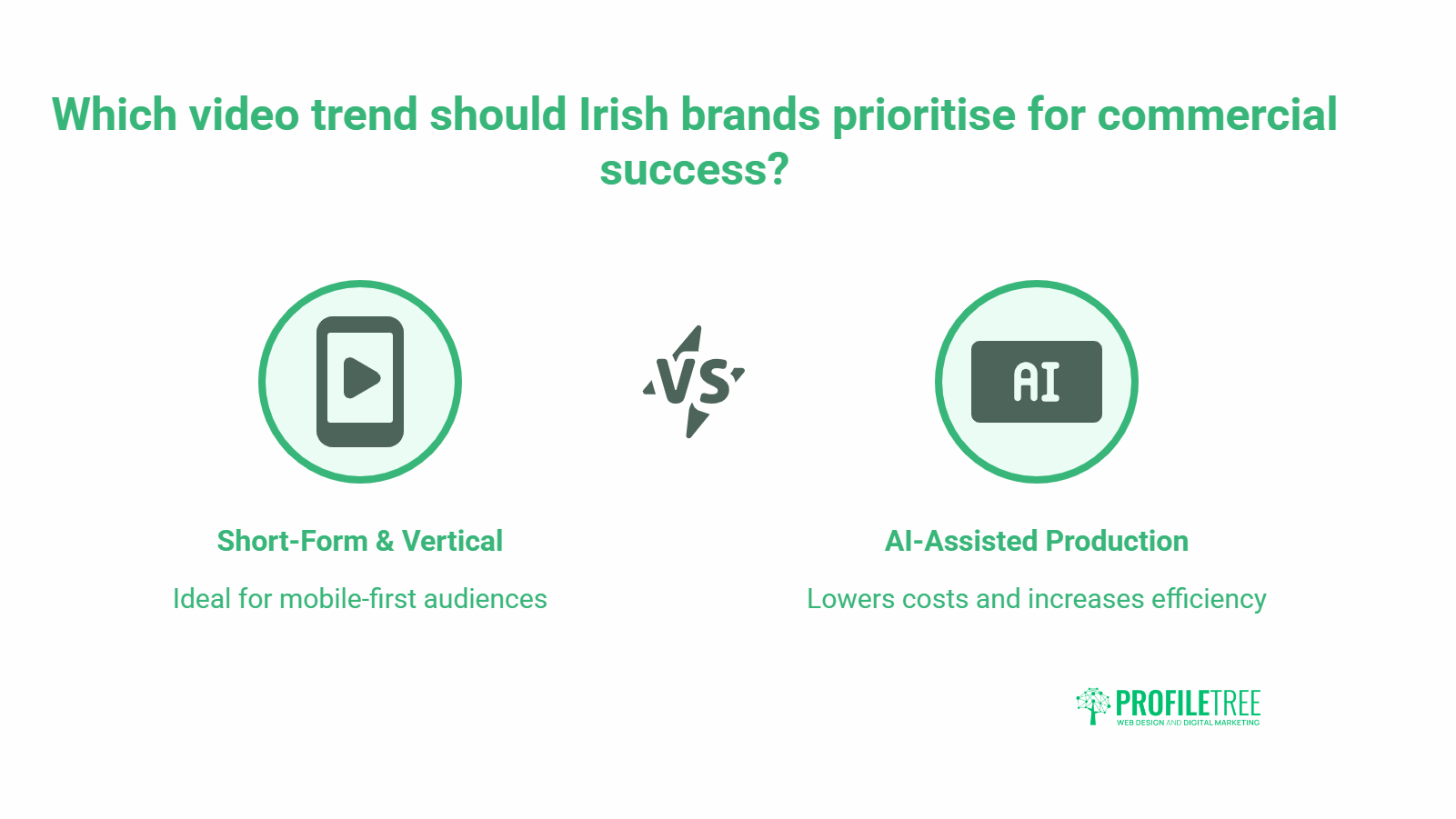
The trends below are the ones with direct commercial consequences for Irish brands. Each changes how you plan, what you produce, and where you place it.
Short-Form and Vertical Video
Short vertical video is now the default for mobile-first audiences. TikTok, Instagram Reels and YouTube Shorts have trained viewers to expect content shot for a phone screen, with the message landing in the first few seconds. Each platform rewards a slightly different approach: TikTok favours authentic, trend-aware content, Reels reward a strong visual identity, and Shorts benefit from clear, searchable topics.
For most Irish SMEs, the move to vertical is the single biggest production change. Filming “vertical-first” rather than cropping a landscape edit afterwards keeps the framing tight and the captions readable, which matters when a large share of viewers watch with the sound off. ProfileTree’s social media marketing services help brands match each platform’s format to a clear commercial goal.
AI-Assisted Video Production
AI tools are lowering the cost of professional-looking video, which helps smaller Irish businesses produce more without a broadcast budget. Useful applications include rough-cut editing from raw footage, automatic captioning, reformatting one shoot into multiple platform versions, and producing localised variants for different regional audiences.
The caution is that AI handles the mechanical work well, but not the judgment. It will not decide what the viewer should do next or whether a story is worth telling. ProfileTree covers how to apply these tools sensibly through its AI transformation and digital training programmes.
Creator, Customer and Employee Content
Authentic, non-studio content has earned a permanent place in commercial video. Customer testimonials, behind-the-scenes clips and staff explaining their work build trust in a way that polished adverts often cannot. The strongest approach for most brands is hybrid: a professional framework with genuine customer or employee content inside it, so the result is credible without being rough.
This works because viewers increasingly check whether a brand looks real before they buy. A digital strategy that plans where this content fits across the buying journey gets far more value from it than ad-hoc posting.
Shoppable and Social Commerce Video
Commerce is moving directly into video. Instagram and TikTok Shop, YouTube’s in-video shopping and shoppable pins all let viewers move from watching to buying without leaving the app. For Irish retailers, the value is in shortening the path between interest and purchase, with product tags, one-tap checkout and retargeting based on what someone watched.
Getting this right depends as much on the underlying platform as the video itself. ProfileTree’s website development team builds e-commerce sites that handle video playback and checkout cleanly, so the commerce features actually convert.
Putting the Trends to Work
Trends only matter once they change what you do. For Irish brands, the practical sequence is strategy, then production, then distribution, in that order.
Start With Strategy, Not a Camera
Decide what you want the viewer to do next before you plan any filming. That single decision drives format, length, platform, and call to action. Map content to stages of the buying journey: awareness content can live on social, while detailed explainers and case studies often work better embedded on your own site, where you control the experience and capture leads. ProfileTree’s content marketing services help plan that mix around real business goals.
Match Production to Commercial Value
Spend in proportion to what the video is worth, not to a vague sense that better quality means more budget. A single on-site case study film can serve awareness, lead generation and sales support at once, which justifies professional production. A series of short FAQ videos filmed on a phone can answer common customer questions at near-zero cost. Both are valid; the skill is matching the investment to the goal. ProfileTree’s video marketing services scale to suit different budgets across Northern Ireland, Ireland and the UK.
Distribute Where Your Audience Already Is
A strong video on the wrong platform wastes its potential. Choose channels based on where your customers actually spend time, not where it feels modern to post. Reformat one shoot for each platform rather than producing separately, and embedding key videos on relevant pages of your own site supports search engine optimisation and keeps visitors engaged for longer.
ProfileTree’s video production showreel, showing the range of commercial formats covered above.
Measuring What Video Returns
Video is a commercial channel, so it should be measured like one. Track the full path from view to enquiry, not just view counts, and review performance monthly so you can move budget toward what works. The metrics that matter most are watch time and retention (content quality), click-through to your site (commercial intent), and conversion or enquiry rate (business impact).
Brand awareness and trust build over time and resist neat attribution, so combine direct-response metrics with longer-term measures rather than judging every video on immediate sales. For a full framework, ProfileTree’s guides on maximising video ROI and analysing video campaign returns set out the attribution models and tools in detail.
Two external references worth bookmarking for measurement: YouTube Analytics documentation for platform-level data, and the IAB Ireland adspend reports for market benchmarks.
Video as a Planned Commercial Channel
For Irish brands, commercial video has moved from an optional extra to a planned part of how you reach and convert customers. The businesses seeing consistent returns are not waiting for the perfect setup; they start with a clear goal, the right format for the platform, and a way to measure what happens next. If you want help planning, producing or measuring video that supports real business outcomes, talk to ProfileTree’s video team.
Frequently Asked Questions
What video formats do Irish brands request most often?
Short vertical clips for social, customer testimonial videos, and on-site explainer or case study films are the most common requests. Quick-turnaround social formats are rising fastest as brands react to trends and platform changes.
How much does commercial video production cost in Ireland?
It varies widely with scope. A phone-filmed FAQ series can cost very little, while a professional brand film with a shoot day, editing and review rounds is a larger investment. Match the spend to the commercial value of the goal.
Is AI good enough to produce a commercial video on its own?
AI handles editing, captioning and reformatting well, but not the strategic judgement of what to film or what the viewer should do next. Treat it as a production aid, not a replacement for planning.
Which platform should Irish businesses prioritise for video?
The one your customers already use. B2B audiences tend toward LinkedIn and YouTube; consumer brands often see better results on Instagram and TikTok. Choose by audience behaviour, not platform novelty.
How do you measure return on video marketing?
Track the full path from view to enquiry: watch time, click-through to your site, and conversion rate. Combine these direct measures with longer-term brand metrics and review monthly.