
Clubhouse social media app: what it is and how it works now
Table of Contents
The Clubhouse social media app is a voice platform where people talk in live audio rooms or leave each other recorded voice messages called Chats. It launched in 2020, peaked in early 2021, and remains available on iPhone and Android phones. ProfileTree, a Belfast social media agency, treats it as a niche channel for a narrow professional audience.
That makes Clubhouse a question of fit for most business owners. If you are weighing it against the platforms your market uses now, our social media marketing Belfast team starts from the audience and works back to the channel, and the same approach runs through this guide.
What the Clubhouse app is and where it came from
Clubhouse is a social audio app, meaning the conversation happens by voice with no text posts, photos, or video at its centre. Paul Davison and Rohan Seth launched it in spring 2020 as an invitation-only app for iPhone, and the scarcity of invites became part of its appeal during the first pandemic lockdowns.
The app grew quickly through the winter of 2020 and into 2021. Live rooms hosted by well-known founders and investors drew large audiences; Elon Musk appeared in a room in February 2021, and a funding round that spring was widely reported to value the company at around $4 billion. For a few months, business owners in Belfast and Dublin hosted rooms next to Silicon Valley executives.
The growth did not hold. Clubhouse released its Android app in May 2021 and dropped the invitation requirement in July 2021, but by then larger platforms had copied the format. Twitter launched Spaces, Spotify launched its own live audio app and closed it again in 2023, and people returning to offices had less time for hour-long conversations. Clubhouse cut staff in June 2022 and then let go of more than half its employees in April 2023.
How Clubhouse changed when it launched Chats
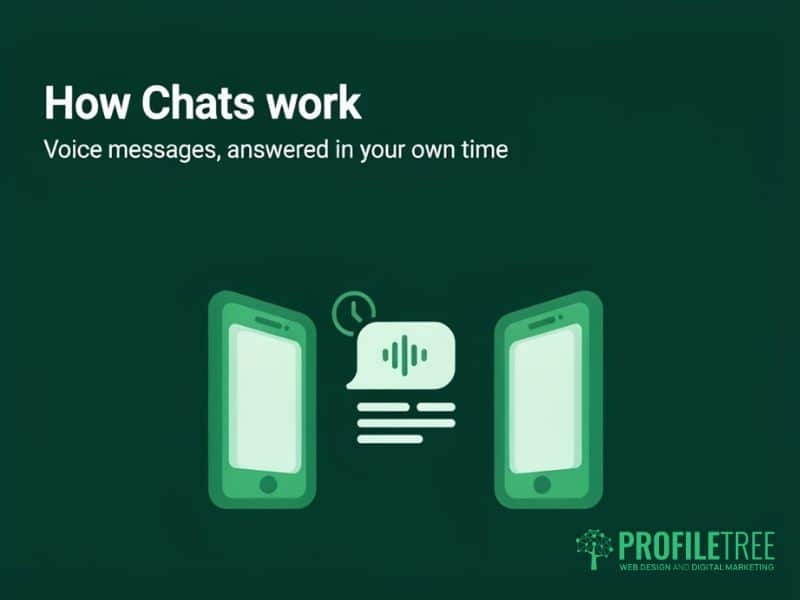
In September 2023, Clubhouse relaunched around a feature called Chats, and this is the version a new user meets today. Chats are asynchronous, which means nobody has to be online at the same moment: you record a voice message, send it to a group, and others reply when they are free.
The app transcribes each message (turns the speech into written text), so people can read a message when listening is not practical. You can keep a Chat to friends or open it to friends of friends, and the messages stay in the thread for anyone who joins later. Rooms did not disappear, but they now sit alongside Chats as a second way to take part.
The reasoning behind the change was practical. Rooms needed people to turn up at a set time and stay for the length of the conversation, and most users would not do that every week. Recorded messages remove the scheduling problem, which matters for any business that wants a running conversation with clients or peers.
Chats compared with live rooms
A live room works like a panel event. A host, called the moderator, controls who speaks, listeners raise a hand to ask a question, and the conversation ends when the room closes. That suits a planned discussion with a guest, a launch, or a question-and-answer session, as long as you can bring an audience at that hour.
A Chat works more like a voice-based group message. It suits small, ongoing conversations between people with an existing connection, such as a group of clients, a peer network or a project team. Discovery is weak, because Chats travel through your existing connections, so they are far better for keeping in touch than for meeting new contacts.
Houses and how communities form
Houses are the community areas within Clubhouse, and they replaced the earlier Clubs. A House is a group built around a shared interest, profession, or place, with a membership and rooms of its own. Joining one or two relevant Houses is the quickest way to find conversations worth hearing, and running your own House gives a business a private space for a client community.
Is Clubhouse still active?
Clubhouse is still running, with listings on the App Store and on Google Play, but it serves a much smaller audience than it did in 2021. The company does not publish regular active user figures, and the estimates repeated across the web come from third parties whose methods are not public, so this guide does not quote them.
What can be checked is the direction of travel. The 2023 relaunch, reported at the time by TechCrunch, was the company’s attempt to win back users after two rounds of cuts. The live audio features of the larger platforms have since become the default for big public conversations, and Clubhouse now functions as a quieter space for those who prefer speaking to typing.
For a UK business, the practical test is whether your contacts and prospects are there. An evening spent searching for Houses in your industry, and noting how many members are active, will usually answer it.
How to set up Clubhouse for a business profile
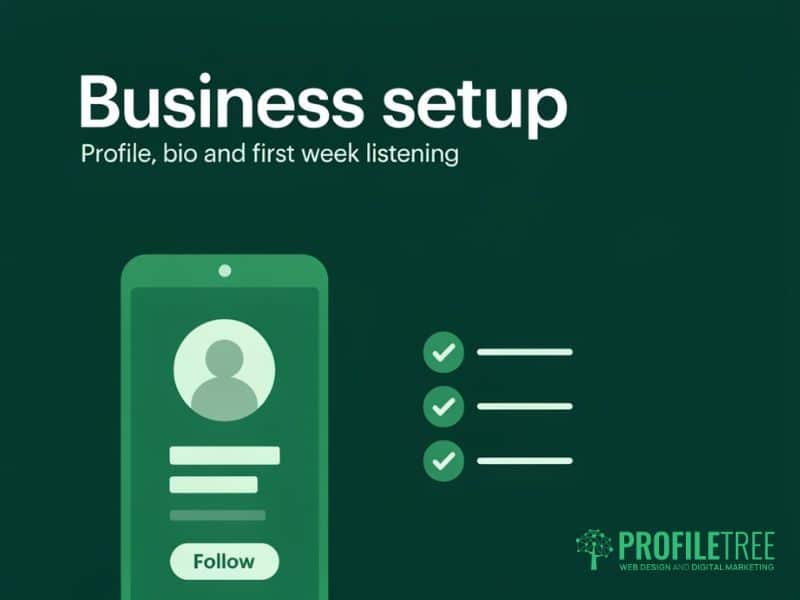
Setting up takes a few minutes and costs nothing. Download it, register with a mobile number, and pick some interests so Clubhouse can suggest accounts to follow. No invitation is needed.
Clubhouse profiles belong to individuals, which shapes how a firm should appear. Set up a profile for whoever will represent the firm, usually the owner or a senior member of the team, and write a short bio that says what they do, who they help, and where the business is based. Use a clear headshot, because each speaker appears as a small photo and name.
Spend the first week as a listener. Join the Houses closest to your trade, sit in on rooms run by people your clients follow, and note what gets asked more than once. Those recurring queries are useful well beyond Clubhouse, because they show you the language buyers use, which can feed your website copy and your posts on other channels.
Once you have a feel for the tone, start small. Reply in a Chat you have been added to, put your hand up in a room, or co-host with someone who has a following. Opening a room before anyone knows you usually means talking to an empty stage.
Clubhouse compared with X Spaces and Discord
The main difference between the audio options is where the listeners are. X Spaces runs inside X, Discord runs voice channels inside communities built for chat, and Clubhouse is a separate app built around voice alone.
| Question | Clubhouse | X Spaces | Discord |
|---|---|---|---|
| Separate app needed | Yes | No, it runs inside X | Yes |
| Asynchronous voice | Yes, through Chats | No, live only | Voice channels are live |
| How new people find you | Houses and existing connections | Followers and the X feed | Server invitations and links |
| Best fit for a firm | Small professional groups who prefer voice | Reaching an existing X audience live | Running a community that also uses text |
For most UK SMEs, X Spaces is the easier route to a large live crowd, because the listeners are on that platform anyway. Discord suits an organisation that wants a members’ area with text, files and voice in one place. Clubhouse makes sense when you want a tight, engaged group and the asynchronous chat format suits how they work. Our guide to using Clubhouse for networking covers the follow-up side in more detail.
When Clubhouse is worth a business’s time
Clubhouse is worth testing when your buyers are professionals who like voice and someone in your business is comfortable speaking unscripted. It suits consumer brands badly, because their buyers spend their time on visual platforms such as Instagram and TikTok.
As Ciaran Connolly, founder of ProfileTree, puts it: “Most Northern Ireland businesses that ask ProfileTree about a new social platform are really asking where their customers spend their attention. Deciding which customer you are addressing is half the job, and it is the first question we ask about any social media marketing plan in Belfast, whichever app it ends up on.”
In practice, we suggest a two-week listening test before committing any time to Clubhouse, and these are the questions it should answer.
- Search Clubhouse for your industry and your region, and count the Houses where people you would sell to are taking part.
- Listen to at least four conversations, and write down what prospects ask, word for word.
- Check whether the people in those rooms also follow you on LinkedIn or another channel, because that tells you whether Clubhouse reaches anyone new.
- Agree who would represent the business and how often, since a room or Chat that goes quiet for a month does more harm than good.
If the count is low and the discussions are off topic, close the app and put the time into channels where your audience is active. If you find a small but active group, a monthly room or a regular Chat for clients can work as one part of a wider audio marketing approach that also includes podcasts and video.
Business uses that tend to work
The uses that suit Clubhouse are those where engagement from a few people matters more than reach. A professional services firm could host a regular room on a specialist subject, such as tax changes for small companies, and attract exactly the people who need that expertise. A training provider or membership body could run a House as a space for past clients to keep talking after a course.
Listening is the use that is easiest to underrate. Sitting in on rooms run by your clients shows you how they describe their problems, which is hard to get from analytics. Those phrases often make better headings and FAQ questions than anything drafted in an office.
Privacy and data on Clubhouse
Treat everything said on Clubhouse as a public record. Chats are stored and transcribed, rooms can be recorded for replay by the host, and listeners can always take their own notes, so client names, figures, and anything commercially sensitive should stay out of both.
Clubhouse also faced questions in April 2021, when profile data from a large number of accounts was scraped (collected automatically by software) and posted online. The company said the information was public profile data and that its systems had not been breached, but the episode is a reminder that a profile, a bio and a list of connections can be gathered and reused by others.
If staff speak on behalf of your business, agree in writing what they can and cannot share, and check the app’s privacy settings for who can find them and who can message them. Businesses that handle personal data under UK GDPR should apply the same rules to voice as they do to email and social posts.
Building an organic social media plan around your audience
The next step is to decide which channels your customers prefer and build a plan around those, with Clubhouse included only if the listening test finds an active audience. That means choosing a small number of platforms, agreeing what you post and who posts it, and measuring whether the effort turns into enquiries.
ProfileTree is a Belfast web design and digital marketing agency, founded in 2011 and based at the McSweeney Centre. Our team builds organic social strategies and manages channels for businesses across the UK and Ireland, and we do not sell paid advertising. If you want a plan that starts from your customers, see how our social media marketing service works, or read our guide on building a social media community to start on your own.
FAQs
1. Is the Clubhouse app still active?
Yes, Clubhouse is still running and can be downloaded on both major phone platforms. Its audience is much smaller than at its peak, and since the 2023 relaunch, it has centred on voice Chats alongside rooms.
2. Do you need an invite to join Clubhouse?
No, anyone can join Clubhouse with a mobile number. The invitation-only system ended in July 2021, a couple of months after the Android app was released.
3. Is Clubhouse free to use?
Yes, Clubhouse is free to download and use for both rooms and Chats. There is no subscription needed to listen, speak, host a room, or join a House.
4. What is the difference between Clubhouse Chats and live rooms?
Chats are recorded messages that people send and answer whenever it suits them, while live rooms need everyone listening at once. Chats suit small groups who know one another, and rooms suit planned discussions led by a host.
5. Can a business use Clubhouse for marketing?
Yes, but it works for a narrow set of businesses. Clubhouse suits professional services and specialist firms whose buyers enjoy talking things through, and it rarely pays off for consumer brands.