
Big Data in Marketing: A Practical Guide for UK and Irish SMEs
Table of Contents
Most UK and Irish SMEs already collect more marketing data than they use. Website visits, email opens, search queries, and social mentions pile up in half a dozen disconnected tools, and the gap isn’t a lack of data. It’s a lack of a plan for turning that data into decisions. Big data marketing addresses that gap: it’s the practice of pulling signals from across your channels into one picture of customer behaviour, then acting on it, rather than reviewing a single dashboard once a quarter.
This guide covers what big data marketing actually means, how UK-GDPR and the ICO shape what you can collect, and where a big data marketing strategy pays off for a mid-sized business without a data science team. If you’re weighing up whether to build this in-house or bring in a big data marketing agency, the sections below will help you make that call with a clearer head.
What Is Big Data in Marketing?
Big data in marketing refers to the collection, analysis, and application of large, varied datasets to inform marketing decisions. Unlike a standard CRM record, which primarily captures what a customer has already done, big data for marketing incorporates signals from social behaviour, website interactions, search trends, and real-time events to build a fuller picture of intent.
Five characteristics define it. Volume is the sheer scale generated by every digital interaction, a page visit, a product view, an email open; the real challenge isn’t storage but relevance, working out which of those data points actually inform a better decision. Velocity is the speed at which data needs to be processed; real-time analytics let a campaign manager adjust spend or targeting mid-flight rather than after the fact. Variety covers the mix of structured data (purchase records, form submissions) and unstructured data (social comments, video engagement) that together produce a more accurate read on intent. Veracity is about accuracy: duplicate records and bot traffic can corrupt a campaign from the inside, so data governance is as much a marketing responsibility as an IT one. Value is what matters most in practice. Data only earns its cost when it drives something measurable: a higher conversion rate, a lower cost per acquisition, a customer kept rather than lost.
Big Data Marketing vs Traditional Marketing Analytics
The two overlap, but they’re not the same thing, and confusing them leads businesses to either overspend on tools they don’t need or underinvest in the ones they do.
| Traditional Marketing Analytics | Big Data Marketing | |
|---|---|---|
| Data sources | Single platform (e.g. GA4 or a CRM) | Multiple platforms combined: web, social, CRM, email, search |
| Processing speed | Periodic (weekly or monthly reports) | Often near real-time |
| Scope | Describes what happened | Combines what happened with prediction of what’s likely next |
| Typical use | Campaign reporting | Personalisation, churn prediction, segmentation, automation |
A small business tracking GA4 sessions and email open rates is doing traditional analytics, and that’s often enough at an early stage. Big data marketing becomes worthwhile when you’re trying to consolidate separate reports into a single view of a customer’s journey.
Why This Matters for UK and Irish SMEs, Not Just Enterprises
The traditional marketing funnel assumed a straight line from awareness to purchase. In practice, customers move across channels, pause, come back, and respond to context in ways a single report rarely captures.
Segmentation is the starting point most teams already understand: grouping customers by age, location, or purchase category and sending broadly relevant messages. Big data marketing analytics adds precision on top of that. Rather than emailing everyone in a “25 to 34” bracket the same offer, a business can identify which specific customers browsed a product page and didn’t buy, then follow up at the time they’re statistically most likely to open an email. ProfileTree’s digital marketing strategy services help UK and Irish businesses build this kind of framework, starting with a data audit and building toward full campaign personalisation.
Predictive analytics extends the same idea forward. Churn models flag customers at risk of leaving before they cancel. Propensity scoring helps a small sales team prioritise which leads to chase first. None of this needs a data science department; it needs clean data and a clear question, which is often the harder part for a growing business managing a digital marketing budget that has to stretch across several channels.
The UK and Ireland Regulatory Context: GDPR, the ICO, and Life After Third-Party Cookies
For UK and Irish businesses, big data marketing can’t be separated from data protection law. The ICO has published specific guidance on AI and big data marketing analytics, and its position is clear: lawful basis, transparency, and data minimisation aren’t optional extras; they’re requirements. You can read the ICO’s own guidance on AI and data protection for the latest details on this.
The phasing out of third-party cookies has changed how digital marketers collect and use this data. Cross-site behavioural tracking, the backbone of programmatic advertising for two decades, is being dismantled. What replaces it is zero-party data (information customers actively hand over, such as a preference centre selection) and first-party data (gathered directly through your own site, app, or email list).
First-party data tends to be more accurate and more legally defensible than the third-party data it replaces. Building a first-party data strategy needs a good reason for a customer to share information willingly: a loyalty scheme, a genuinely useful tool, or content worth giving an email address for. Well-known UK examples of loyalty-driven first-party data collection, Tesco’s Clubcard being the most recognisable, show the model at scale, though most SMEs will be working with far smaller, simpler versions of the same idea.
Under the UK GDPR, the lawful basis for marketing data processing is usually either consent or legitimate interest. Consent has to be freely given, specific, informed, and unambiguous; a pre-ticked box doesn’t count. Legitimate interest needs a documented balancing test showing the activity serves an interest a reasonable customer would expect and wouldn’t object to. Treating this as a compliance box to tick misses the commercial point: customers share more, and more willingly, with businesses they trust, and that trust gets built through plain-written privacy notices and honest preference centres, not small print.
Generative AI as the New Engine for Big Data Marketing
The tools processing this data have changed faster than the underlying principles have. A large share of marketing data has always been unstructured: emails, support tickets, social comments, review text, none of it fitting neatly into a spreadsheet column. Older analytics tools mostly ignored it. Generative AI and large language models now make that unstructured layer usable, turning a folder of customer support transcripts or a stream of social mentions into themes, sentiment trends, and even draft customer personas.
For an SME, the practical shift is that you no longer need a dedicated data science hire to get value from this. A well-set-up AI implementation and transformation project can connect existing tools (a CRM, a helpdesk, a social listening tool) to an AI layer that summarises and flags patterns a human would otherwise miss, buried in hundreds of individual messages. The output still needs a person to sanity-check it and decide what to act on; AI narrows down where to look, but it doesn’t replace the judgement call.
Five Practical Applications of Big Data Marketing for UK SMEs
These applications are within reach for most mid-market businesses using widely available, often free or low-cost tools.
Sentiment analysis for brand health. Data drawn from social platforms, review sites, and forums gives a real-time read on how a brand is perceived. Sentiment tools classify mentions as positive, negative, or neutral, flagging shifts before they escalate into broader problems. ProfileTree’s content marketing services build this kind of monitoring into an ongoing content and reputation strategy, alongside the social media metrics that show whether the response is landing.
Customer segmentation using first-party data. Recency, frequency, and monetary (RFM) modelling uses purchase data to identify your highest-value customers and the ones starting to drift. Behavioural segmentation, based on how people actually use your site rather than their age bracket, tends to outperform demographic grouping. GA4 and most modern CRM platforms support this without specialist engineering.
Content and search optimisation. Search performance data is one of the most directly actionable forms of big data marketing available to an SME. A page with high impressions and a low click-through rate is being found but not chosen, which usually points to a weak title tag, meta description, or content structure rather than a ranking problem. This is the kind of pattern ProfileTree’s SEO services work through page by page to lift organic performance across the UK and Ireland.
Video and YouTube performance data. Watch time, drop-off points, and click-through rates on end screens are big data in a format many SMEs overlook. A video that loses most viewers in the first fifteen seconds is telling you something specific about the opening, not the topic. ProfileTree’s video production and animation teams use this kind of engagement data to shape what gets made next, and a YouTube marketing strategy built around it tends to outperform one built on guesswork about what an audience wants.
Churn prediction and retention. For subscription businesses and service firms, keeping an existing customer is cheaper than winning a new one. Models built on login frequency, support ticket volume, and email engagement can flag an at-risk account before it lapses, giving a retention offer or check-in message somewhere to land before the customer has already decided to leave.
Overcoming the Data Silo Problem
One of the most persistent barriers to any of this working is the data silo: customer information sitting in disconnected systems that don’t talk to each other. A CRM that isn’t linked to the email platform. An ecommerce database that’s never been reconciled with support records. A web analytics setup that has nothing to do with offline sales.
The consequences are predictable. Customers get emailed about products they’ve already bought, sales teams chase leads that disqualified themselves weeks ago, and any analysis built on top is incomplete because the conversion data lives somewhere the impression data can’t reach. A Customer Data Platform centralises information from multiple sources into one profile any team can access, and tools like Segment or HubSpot’s integration features offer this at mid-market pricing. Often the harder fix is organisational rather than technical: silos reflect departmental boundaries, and closing them usually needs a proper look at how your website and its underlying systems actually connect, not just a new software licence. This is also where the underlying platform matters: a site built on WordPress web design with a clean data layer makes that connective work considerably easier than retrofitting tracking onto an ageing template.
Measuring Return on Big Data Marketing
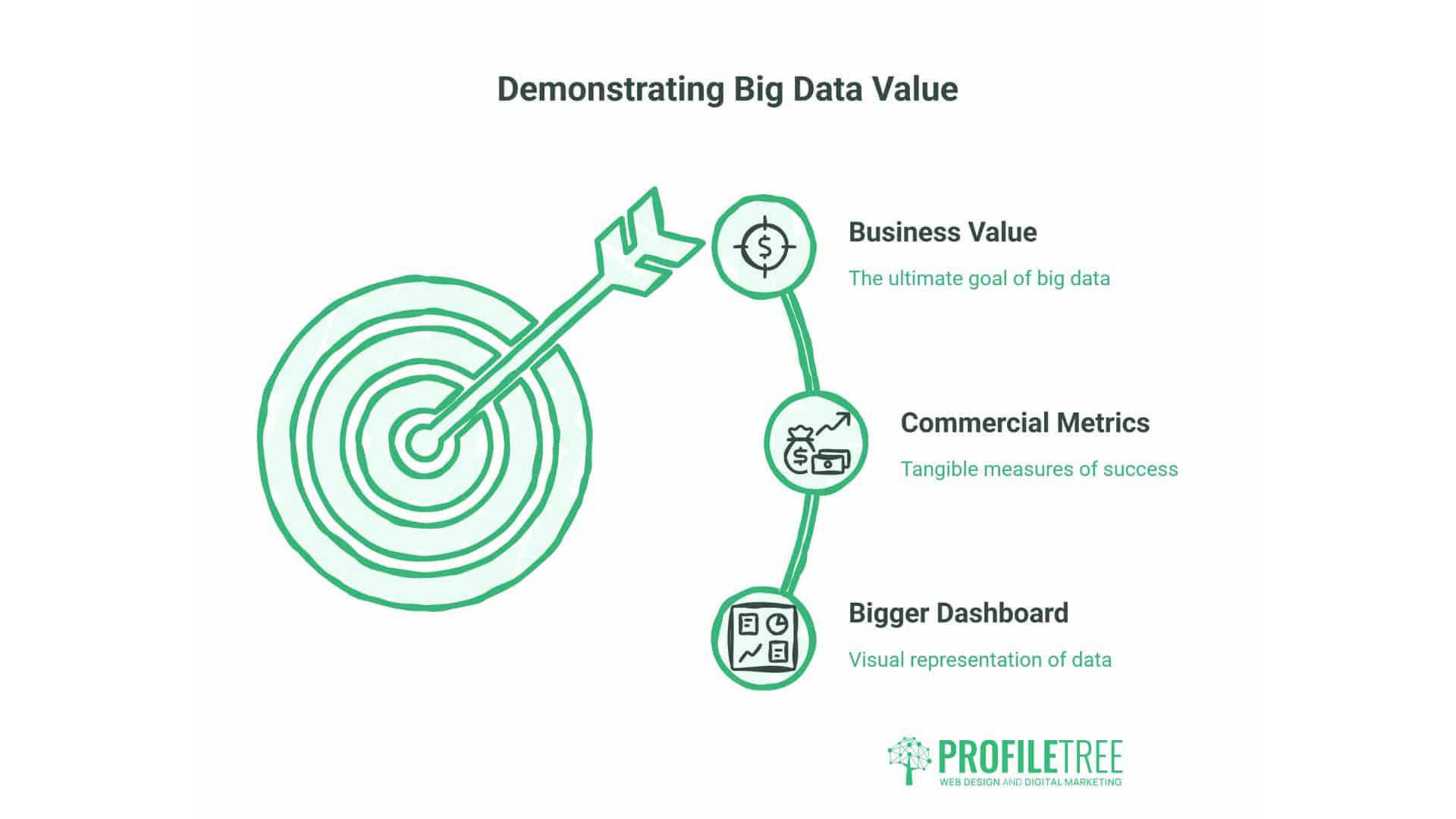
Demonstrating the value of this work to a board or a business owner needs commercially grounded metrics, not just a bigger dashboard.
Customer Acquisition Cost measures the spend per new customer won; a well-implemented approach reduces this over time by improving targeting and cutting wasted spend. Customer Lifetime Value estimates total revenue over a customer relationship, and modelling this as a predicted future value helps determine how much to allocate to acquisition versus retention for a given segment. Conversion rate by segment shows whether personalisation is actually producing outcomes; flat rates despite investment usually point to poor data quality or misaligned targeting. Marketing attribution becomes considerably more accurate once channels are viewed together rather than on a last-click basis, showing which touchpoints genuinely influence a sale rather than simply being present at the end of one. Data quality score, the percentage of records that are complete, accurate, and current, is worth a quarterly audit on its own; poor data undermines every other metric on this list.
“Data is not just a tool; it is the backbone of our growth strategies,” says Ciaran Connolly, ProfileTree Founder. Businesses that consistently track these KPIs tend to make faster, more accurate decisions than those that rely on periodic reviews and gut feel.
The Big Data Marketing Tool Stack for UK SMEs
| Category | Tool | Key Benefit | UK Compliance Note |
|---|---|---|---|
| Web Analytics | GA4 | Behavioural data at SME scale | Requires a cookie consent banner |
| Search Performance | Google Search Console | Query-level data, free | No personal data collected |
| CRM & Segmentation | HubSpot (free tier) | Contact-level tracking | GDPR-ready with consent logging |
| Social Listening | Mention or Brand24 | Real-time sentiment tracking | EU/UK server options available |
| Marketing Automation | Mailchimp or ActiveCampaign | Automated, data-triggered sends | ICO-registered providers |
| Data Visualisation | Looker Studio | Connects GA4, GSC, and CRM in one view | Free; needs a Google account |
A Data Maturity Scale for UK and Irish Businesses
Businesses that get the most from this work tend to have the clearest sense of what they’re trying to find out. Use this scale to honestly assess your own business.
Level 1, Data-Aware: analytics tools are installed but rarely reviewed. Most UK SMEs start here. Level 2, Data-Active: key metrics inform campaign decisions, and basic segmentation is in place. Level 3, Data-Driven: decisions across marketing and sales are consistently data-led, and attribution modelling is in use. Level 4, Data-Optimised: real-time data feeds directly into campaign management, and the first-party data strategy is fully operational. Level 5, Data-Innovative: machine learning drives personalisation at scale, and data informs product and pricing decisions too.
ProfileTree’s digital marketing training programmes, alongside AI training delivered through sister brand Future Business Academy, are built around moving a marketing team up this scale in stages, so the capability stays in-house rather than sitting entirely with an external agency.
Common Pitfalls and a Simple Data Health Check
A few mistakes recur, and most are fixable without new software.
Tracking gaps are the most common: a conversion event that stopped firing after a site update or WordPress development change, or a form that was never connected to the CRM in the first place. Duplicate contact records inflate list size and skew every open and click metric calculated against it. Vanity metrics, impressions and follower counts with no link to revenue get reported because they’re easy to pull, not because they’re useful. And attribution left on last-click by default hands all the credit to the final touchpoint, which usually flatters paid search or email at the expense of the content and awareness work that did the earlier heavy lifting.
A short health check worth running quarterly:
- Do your GA4 conversion events still fire correctly after your last site update?
- Are your CRM and email platform reading from the same contact list, or two separate ones?
- Can you point to one recent decision where your data actually changed?
- Does anyone check for duplicate or outdated contact records, and how often?
- Is your attribution model still set to last-click by default?
If you’re not confident answering all five, that’s a reasonable starting point for a conversation rather than a sign that anything has gone badly wrong.
How to Choose a Big Data Marketing Agency
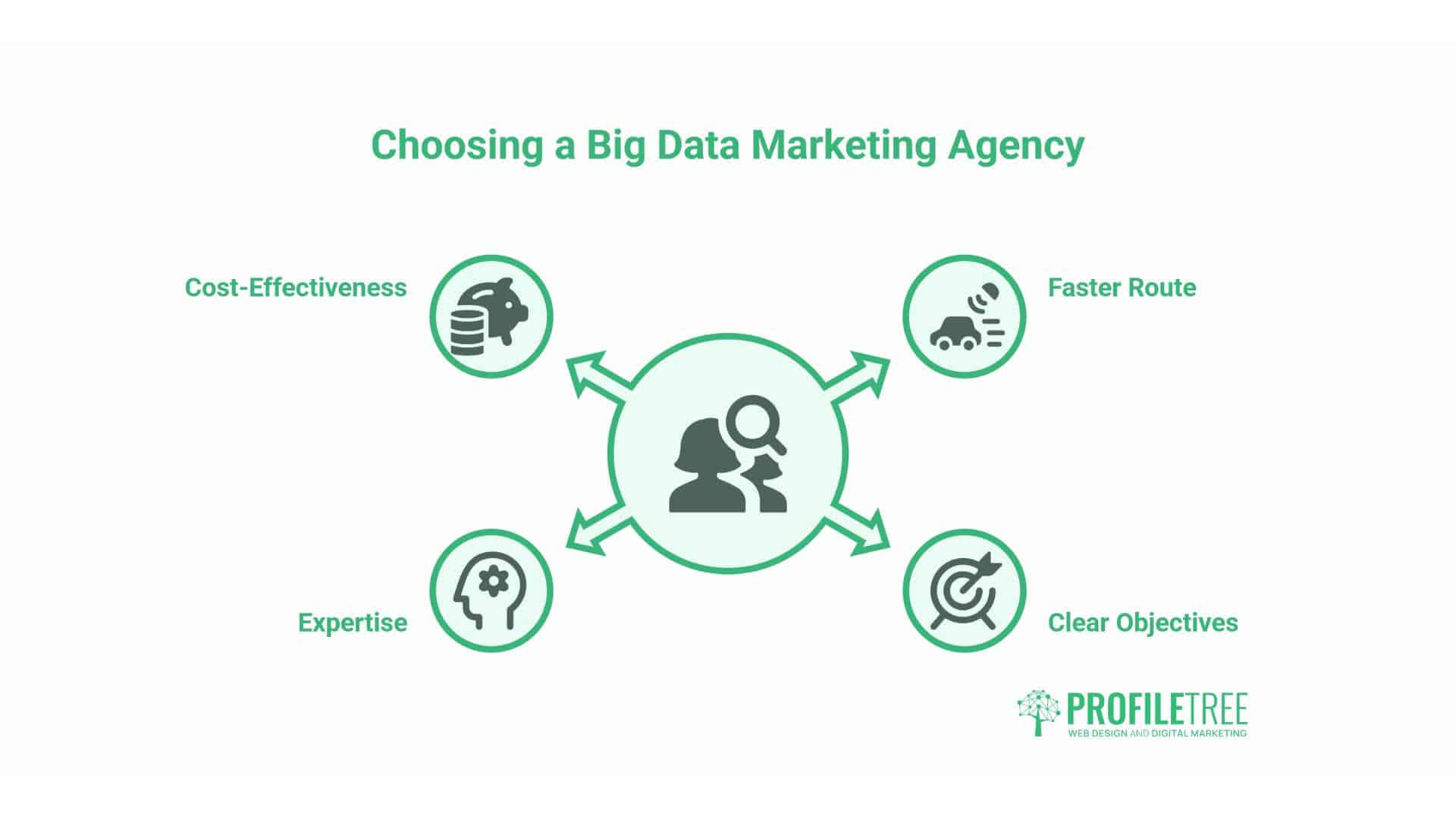
Not every SME needs to build this in-house, and bringing in a big data marketing agency is often the faster route, provided you’re clear on what to look for.
Ask what they’d actually connect first. A credible agency starts with an audit of your existing tools, GA4, your CRM, your search console data, before recommending anything new; if the first conversation jumps straight to a new platform, that’s worth questioning. Ask how they handle UK-GDPR specifically, not data protection in general; consent management and lawful basis documentation should come up unprompted. Ask for a plain description of how they’ll report value back to you, in terms you’d recognise (cost per acquisition, retention rate) rather than only platform-specific metrics. And ask whether the work builds capability inside your team over time, or creates a dependency where nothing moves without them.
ProfileTree’s digital marketing strategy work follows a four-stage process: audit, plan, deliver, then monitor and refine, built specifically for this kind of engagement with UK and Irish SMEs. You can see examples of that approach applied across different sectors in our project portfolio.
Turning Big Data Into a Daily Marketing Habit
Big data marketing doesn’t require a team of data scientists or an enterprise budget. It needs clarity about what you actually want to know, discipline about the data you collect, and a habit of acting on what it tells you rather than filing it away in a monthly report nobody reopens.
Start small: pick the one question that would change a decision you’re making this quarter, find the data that answers it, and build the habit from there. If you’d rather have that audit done for you, get in touch with ProfileTree, and we’ll talk through where your business currently sits on the maturity scale above.
FAQs
What is the role of big data in marketing?
Big data lets marketers move from broad, demographic-based decisions to ones grounded in actual customer behaviour: what people browse, buy, abandon, and respond to. Its main role is closing the gap between a campaign going out and knowing, with evidence, whether it worked.
What are the 5 Vs of big data in marketing?
Volume (the scale of data generated), Velocity (the speed it needs processing at), Variety (the mix of structured and unstructured data types), Veracity (its accuracy and reliability), and Value (whether it actually drives a measurable outcome). Some sources cite only the first three or four; the fifth, Value, is the one that determines whether the other four were worth the effort.
Is big data marketing only useful for large corporations?
No. Cloud tools and SaaS platforms have made this accessible at the SME scale. GA4, Google Search Console, and most modern CRM platforms are free or low-cost and provide big-data marketing analytics capabilities that once required a dedicated data science team. The limiting factor is usually clarity about the right questions, not the size of the dataset.
What is the difference between big data and web analytics?
Web analytics is a subset of big data marketing, limited to what happens on your own website or app. Big data marketing analytics draws on that plus CRM records, social behaviour, search trends, and other real-time signals from outside your own platforms, combining them into a broader, more predictive view of the customer.