
AI Websites and the Website Building Process: A UK SME Guide
Table of Contents
AI websites have made it faster than ever to publish a business site. The design is generated in minutes, the copy is drafted automatically, and the whole thing is live before lunch. For many SME owners in Northern Ireland, Ireland, and the UK, that speed is genuinely useful. But speed and strategy are different things, and confusing the two is where most AI-built websites start to stall.
This guide walks through how the website building process has changed with AI, what the main tools do well, where they create problems that surface months later, and how to make better decisions about when to use them and when to bring in professional support.
How AI Websites Actually Work
The phrase “AI websites” covers a range of things. At one end, you have AI website builders that generate a full site layout from a short questionnaire or text prompt. At the other end, you have AI tools that sit inside professional workflows, helping developers and designers work faster without removing them from the process.
Most of the consumer-facing AI websites and builders follow a similar model. The user answers questions about their business type, preferred style, and basic content needs. The platform generates a template, populates it with placeholder or AI-generated text, and presents a drag-and-drop editor for adjustments. Wix ADI works this way. So does 10Web for WordPress users.
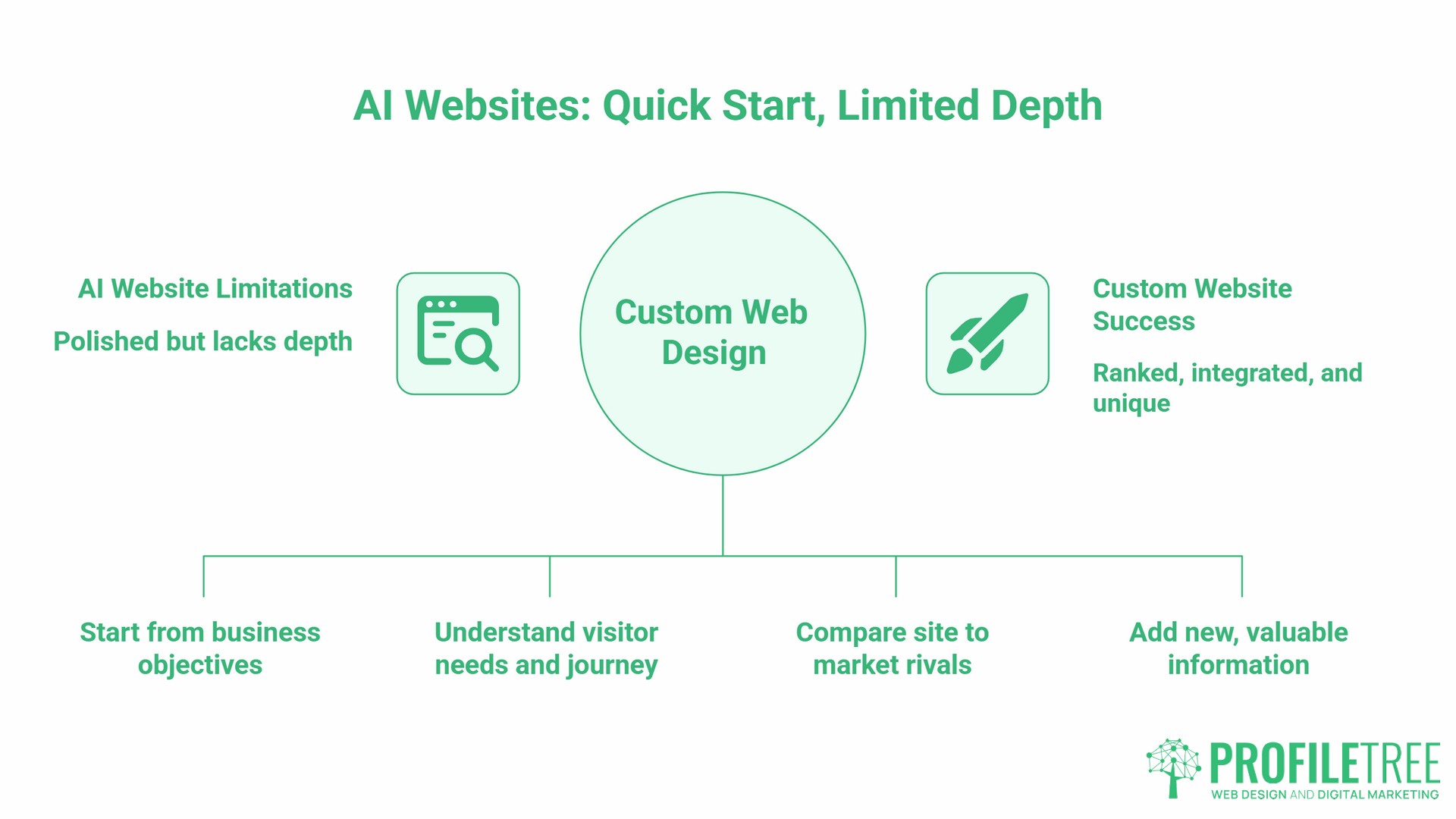
The output from these AI websites looks polished at first glance. The problems tend to appear later, once the business owner tries to rank the site, integrate custom functionality, or move to a different platform.
Automated Layouts Versus Custom Design
An AI-generated layout draws from a library of existing templates and recombines elements based on your inputs. That is genuinely useful for quickly getting a visual starting point. What it does not do is consider your specific audience, your conversion journey, or how your site compares to competitors in your market.
A custom web design brief starts from the business goal and works backwards. It considers what action the visitor should take, what objections they might have, and how the visual hierarchy should guide them. AI can produce a reasonable approximation of good design. It cannot replicate the thinking behind it.
AI-Generated Copy and the Information Gain Problem
Several AI websites and website builders include content generation as part of the website building process. The tool writes introductory paragraphs, service descriptions, and sometimes entire page sections based on your business category.
The output is usually grammatically correct and reads reasonably well. The issue is that Google’s ranking systems specifically reward content that adds something new. Research by Ahrefs and SurferSEO found that pages ranking across multiple related sub-queries are 161% more likely to appear in AI Overviews than pages ranking only for the primary search term. Content that repeats the same points in different words does not qualify. AI-generated copy that draws from generic training data tends to look very similar to every other piece of AI-generated copy in the same category. That is the opposite of what earns visibility.
Evaluating the Main AI Website Platforms
The AI websites and platforms below are the ones most commonly considered by SME owners during the website building process. Each has specific strengths and specific limitations worth understanding before committing.
Wix ADI: Best for Getting Started Quickly
Wix ADI generates a complete site from a short setup questionnaire. The drag-and-drop editor is genuinely accessible, and the mobile-responsive templates are well-built. For a business that needs a basic online presence without custom functionality, it does the job.
The limitations become relevant when the business grows. Wix sites cannot be exported. If you decide to move to WordPress or a custom-built platform later, you will rebuild from scratch. SEO control is moderate: you can edit titles and meta descriptions, but schema markup, Core Web Vitals optimisation, and custom code integrations require workarounds or paid apps.
UK pricing starts at £9 per month for a basic plan, with the Core plan at £16 per month, unlocking e-commerce and full marketing tools. Advanced tiers start at £25.
10Web: Best for WordPress Users Who Want AI Speed
10Web sits inside the WordPress environment, which immediately gives it an advantage for SEO and portability. It uses AI to rebuild or generate WordPress sites from a prompt or from an existing URL. Because the output is a standard WordPress installation, you are not locked into a proprietary platform.
The trade-off is that “AI-generated WordPress site” still means inheriting the page-structure 10Web creates, which may not be what a professional developer would choose. Performance depends heavily on how the generated theme and plugins are configured.
For businesses already on WordPress or seeking the platform’s flexibility without building from scratch, 10Web is a reasonable starting point, provided the site is reviewed by an SEO specialist before launch.
Framer AI: Best for Design-Focused Teams
Framer’s AI tools are aimed at designers and development teams rather than first-time builders. The platform generates high-fidelity layouts from text prompts and allows significant code-level customisation. It is less relevant for most SMEs, but worth knowing if you are working with a design team that wants to speed up prototyping.
AI Content Tools: ChatGPT, Jasper, and the Strategy Gap
Tools like ChatGPT and Jasper are frequently recommended as part of the AI website building workflow for content generation. They can produce first drafts of service descriptions, blog posts, and landing page copy at speed.
The gap they cannot fill is content strategy. Knowing which pages to create, which keywords to target, how to structure content for both readers and search engines, and how to build topical authority over time. These require a content marketing strategy that sits above the individual piece. AI tools can execute within a strategy. They cannot replace one.
Ciaran Connolly, founder of ProfileTree, puts it this way: “AI content tools are very good at producing volume. The businesses that see results are the ones that give those tools a clear brief and then edit the output against a proper SEO structure. Without that layer, you end up with a lot of words and no rankings.”
The Hidden Risks of AI-Generated Websites
The appeal of AI websites is clear. The risks are less often discussed, which is why so many businesses discover them after the fact.
Technical SEO Debt
AI website builders prioritise visual output. The underlying code quality varies significantly between platforms, and most SME owners have no way to assess it at the point of purchase.
Common technical issues in AI-generated sites include bloated CSS and JavaScript that slow page load times, missing or incorrect structured data markup, images that are not compressed or served in modern formats, and heading hierarchies that do not reflect the content structure search engines expect.
These issues do not prevent the site from going live. They do limit how well it ranks. Core Web Vitals scores directly affect Google rankings, and a site generated by an AI builder without post-build optimisation will often underperform a well-built custom site, even if the content is comparable.
A technical SEO audit before or shortly after launch is not optional: it is the step that separates an AI website that performs from one that just exists.
The Portability Problem
This is the risk most AI website builder reviews do not mention. Several main platforms, including Wix and Squarespace, do not allow you to export your site’s code. If you outgrow the platform, change your business model, or need custom functionality that the builder cannot support, you start over.
For a business investing in content, SEO, and brand development, that is a significant problem. The domain authority and inbound links you have built do not transfer to a new site structure without careful redirect management. The content has to be migrated. The design has to be rebuilt.
WordPress-based solutions, including 10Web and self-hosted builds, avoid this problem. The site is portable because it runs on an open-source platform.
Brand Dilution and the Template Look
AI website builders generate designs from template libraries. The visual elements (layouts, spacing, typography combinations) are drawn from a finite set of options. Two businesses in different industries in different cities can end up with sites that look functionally identical because they used the same builder and answered similar setup questions.
Brand distinctiveness matters for conversion and for trust. Visitors who encounter a site that looks like a dozen others they have seen form a quick, often subconscious, judgement about the business behind it.
GDPR and Data Handling
This is particularly relevant for UK and Irish businesses. Many AI website builders are US-headquartered platforms that process and store data on servers outside the UK and EU. Under UK GDPR and the Data Protection Act 2018, businesses are responsible for ensuring that any data collected through their website, including contact form submissions and analytics data, is handled in compliance with the law.
Before committing to any AI website platform, check where data is stored, what the platform’s data processing agreement covers, and whether the default cookie consent tools meet UK ICO requirements.
The Hybrid Approach: Where AI Helps and Where It Stops
The most effective approach for SMEs is not to choose between AI tools and professional web design. The question is: where does each add the most value?
Where AI Adds Genuine Value in the Website Building Process
AI tools are genuinely useful for several stages of the website building process. Generating layout options and visual direction quickly, producing first-draft copy for internal review, creating image variations for A/B testing, and automating repetitive formatting tasks are all legitimate use cases.
For internal-use pages, microsites, or rapid prototyping before a full build, AI website builders can save significant time and cost. An AI-generated site can serve as a functional brief, showing stakeholders what the structure and content feel like before professional development begins.
When Professional Web Design and Development Are Necessary
The website building process for a business that needs to compete on search, convert visitors at a reasonable rate, and represent a brand distinctively requires more than a template builder can provide.
Specifically: e-commerce sites with complex product catalogues and payment integrations; sites requiring custom functionality such as booking systems, quote calculators, or CRM integrations; any site where local SEO is central to the marketing strategy; and sites in competitive industries where ranking positions directly affect revenue. These are situations where the limitations of AI website platforms create real business risk.
ProfileTree’s web design and development team works primarily on WordPress, which keeps client sites portable and gives full technical control. You can find out more about our web development services.
Improving an Existing AI-Built Site
If you already have a site built on an AI platform, the priority is not necessarily to rebuild from scratch. A structured SEO audit and content review can identify the specific gaps (technical issues, thin pages, missing structured data) and address them without disrupting what is already working.
Our guide on using AI tools to support Google Business Profile optimisation covers practical ways to extend AI-assisted improvements beyond the initial build.
AI Websites and SEO: What the Evidence Shows
The question of whether AI-built websites rank on Google is often framed wrongly. Google does not penalise sites for being built with AI. It penalises low-quality content, poor technical performance, and thin pages, all of which are common outputs of rushed AI website builds.
The ranking factors that matter are the same regardless of how the site was built. Page experience signals (Core Web Vitals), content depth and originality, structured internal linking, and E-E-A-T signals (experience, expertise, authority, and trust) all apply equally to AI-generated and professionally built sites.
Where AI websites typically underperform is in originality of content and technical quality. Both are addressable, but they require deliberate work after the initial build, which most AI website builder marketing does not emphasise.
Our SEO guide covering Google’s YMYL update covers the content quality signals that affect rankings in more detail. If you are working with AI-generated content and want to understand how search engines assess its quality, our guide to AI content detection explains what signals matter.
AI Website Builder Comparison
| Platform | Best For | Portability | SEO Control | UK/GDPR Consideration |
|---|---|---|---|---|
| Wix ADI | Quick launch, simple sites | None (no export) | Moderate | US-based servers; review DPA |
| Squarespace | Portfolios, creatives | Very limited | Moderate | US-based; GDPR tools available |
| 10Web | WordPress users | Full (open-source) | High | Depends on hosting choice |
| Framer AI | Design teams, high-fidelity | Moderate | High | EU hosting available |
The 5-Point Vetting Checklist Before Committing to an AI Platform
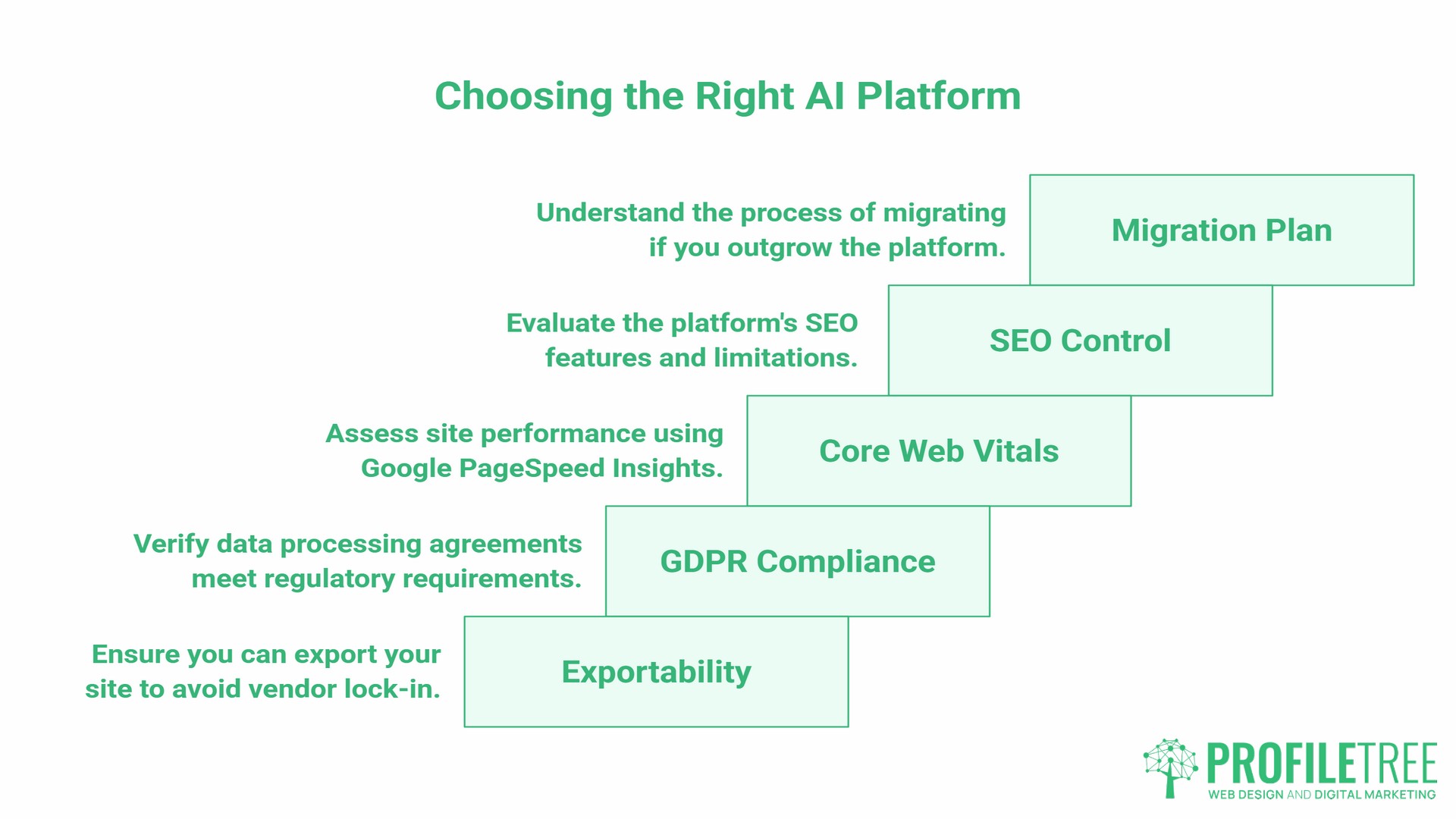
Before selecting any AI website platform as part of your website building process, work through these questions:
- Can you export the site? If the answer is no, you are renting your web presence. Factor the long-term cost of that decision into your evaluation.
- What does the platform’s GDPR data processing agreement cover? Check where contact form data and analytics are stored and whether the default consent tools meet UK ICO requirements.
- What is the Core Web Vitals score for a typical site on this platform? Most builders publish demo sites. Run them through Google PageSpeed Insights before signing up.
- How much SEO control does the platform give you? Can you edit schema markup, create custom redirects, and access site logs? If not, understand what those limits are.
- What does migration look like if you outgrow the platform? Get a clear answer before you start building.
The website building process has changed significantly with AI. The businesses that get the most from that change are the ones that use AI tools where they genuinely help, and bring in professional expertise where the stakes are higher.
If you would like to talk through your website options, get in touch with the ProfileTree team.
Frequently Asked Questions
Can AI build a fully functional professional website?
AI website builders can quickly produce a functional, presentable site. Whether that constitutes a professional website depends on what you need it to do. For a business competing on search rankings, requiring custom integrations, or investing in brand distinctiveness, the output of an AI builder is usually a starting point rather than a finished product. The website building process for a serious business asset requires human judgment at the strategy, SEO, and development stages.
Does Google penalise AI-built websites?
No. Google’s systems assess content quality, technical performance, and relevance, not the tools used to create the content. An AI-built site with original, well-structured content and clean technical implementation can rank well. The problem is that most AI-generated sites, as built out of the box, do not meet those standards without further work.
Is AI-generated website code SEO-friendly?
It varies significantly by platform. WordPress-based AI builders like 10Web produce code that can be optimised to a professional standard. Proprietary builders like Wix and Squarespace give less access to the underlying code, which limits what you can do with structured data, custom redirects, and performance optimisation.
Are AI website builders GDPR compliant for UK businesses?
Not automatically. Compliance depends on how the platform handles data, where it is stored, and how the site’s consent management is configured. UK businesses need to explicitly check these points rather than rely on the platform’s default settings.
How do I improve the SEO of an existing AI-built website?
Start with a technical audit to identify Core Web Vitals issues, missing structured data, and crawl errors. Then review content for originality and depth.
What is the best AI website builder for a UK e-commerce business?
For e-commerce with UK payment gateways and GDPR compliance, platforms built on open-source foundations with professional hosting give the most control. AI builders that lock you into proprietary platforms create complications at scale. A conversation with a web development team before you build is worth the time.