
AI Training for Business: How SMEs Can Successfully Adopt Artificial Intelligence
Table of Contents
Most business owners know AI matters, but fewer understand how to actually implement it without wasting money on tools nobody uses. AI training gives your team the practical skills to use artificial intelligence for real business outcomes – automating repetitive tasks, improving customer service, generating better content, and making faster decisions based on actual data rather than gut feeling.
ProfileTree is a Belfast-based digital agency that has delivered AI training to over 1,000 businesses across Northern Ireland, Ireland and the UK since 2023. This guide covers what AI training actually involves, how to choose the right programme for your organisation, and the specific skills your team needs to get measurable returns from artificial intelligence.
What AI Training for Business Actually Covers
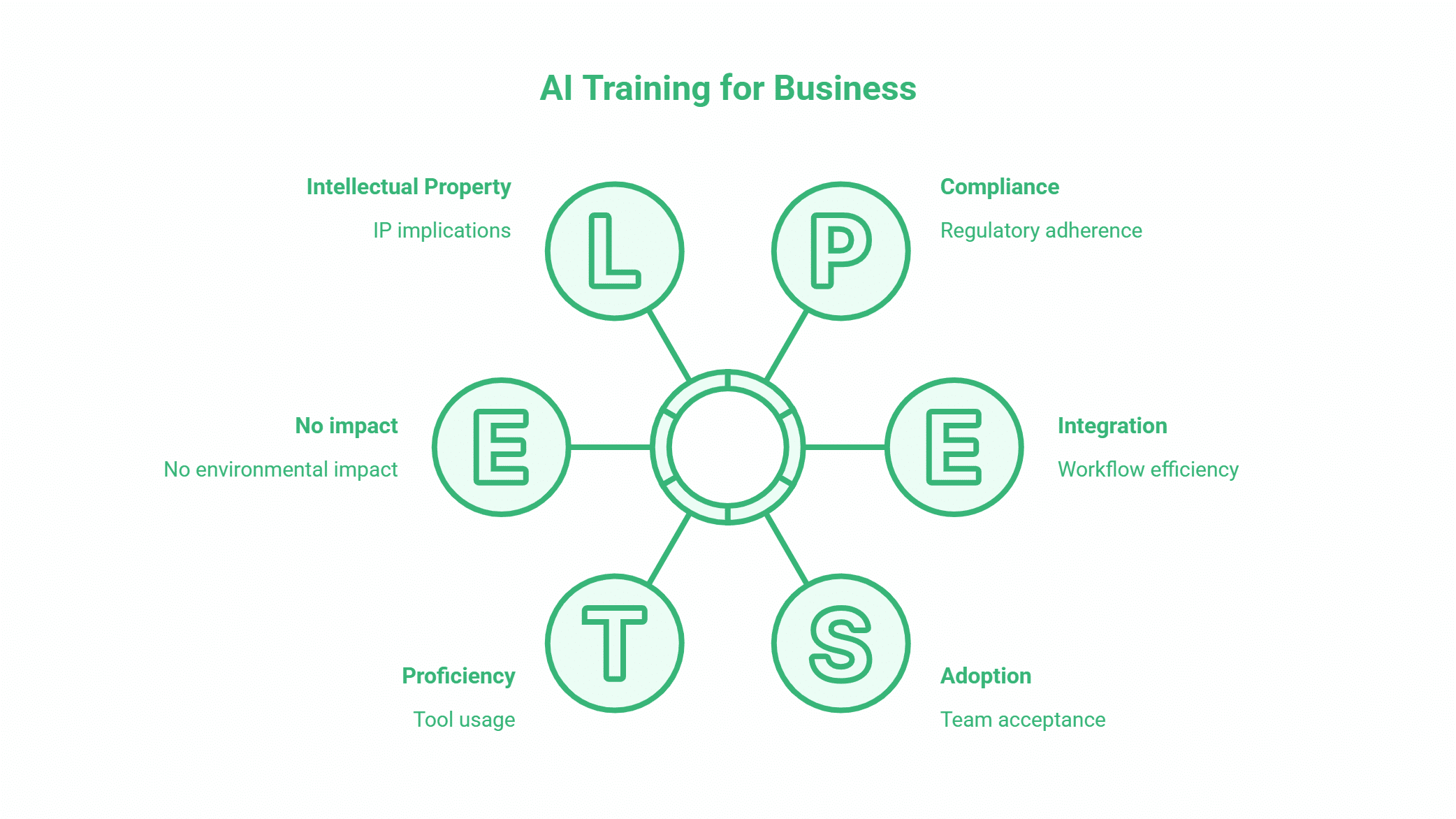
AI training programmes teach employees how to use artificial intelligence tools effectively within their specific job roles. This goes beyond watching YouTube tutorials – proper business AI training connects AI capabilities directly to your operational needs, compliance requirements, and industry context.
Core Components of Business AI Training
- Practical tool proficiency forms the foundation. Your team learns how to use AI writing assistants like ChatGPT and Claude, image generators, data analysis tools, and automation platforms. The focus stays on tools relevant to your business – a manufacturing company needs different AI skills than a professional services firm.
- Prompt engineering teaches staff how to communicate with AI systems to get useful outputs. Poor prompts produce poor results, and most people dramatically underestimate how much skill goes into writing effective instructions for AI tools. A well-trained employee can accomplish in five minutes what an untrained colleague takes an hour to produce badly.
- Critical evaluation covers how to verify AI outputs, spot errors and hallucinations, and understand where AI adds value versus where human judgment remains essential. AI makes confident-sounding mistakes regularly, and your team needs to catch them before they reach customers or affect business decisions.
- Workflow integration addresses how AI fits into existing processes. Standalone AI experiments rarely stick – lasting adoption requires connecting AI capabilities to the systems and habits your team already uses. This might mean integrating AI into your content marketing strategy or using it to support your SEO efforts.
- Governance and compliance ensure your organisation uses AI responsibly. This includes data protection considerations under GDPR, intellectual property implications, and industry-specific regulations that affect how you can deploy AI in client-facing contexts.
Why SMEs Need Formal AI Training
Sending your team a ChatGPT login and hoping they figure it out rarely works. Research from Microsoft found that 75% of knowledge workers already use AI at work, but most do so without guidance, leading to inconsistent quality, security risks, and missed opportunities.
The Hidden Cost of Self-Taught AI Use
When employees teach themselves AI tools, several problems emerge. Different team members develop conflicting approaches, making collaboration difficult. Sensitive company or client information ends up in AI systems without proper consideration of data handling implications. Time gets wasted on AI tasks that would be faster done manually, while genuine efficiency opportunities get overlooked.
Formal training creates a baseline of capability across your organisation. Everyone understands what AI can and cannot do, when to use it, and how to evaluate whether it’s actually helping.
Business Outcomes from Structured AI Training
The businesses seeing the best results from AI share a common pattern – they invested in training before scaling adoption. A digital strategy that incorporates AI training typically delivers faster ROI than one that treats AI as a tool people will naturally figure out.
Specific outcomes ProfileTree clients have reported include reducing content production time by 40-60% whilst maintaining quality standards, automating customer service responses for routine queries while freeing staff for complex issues, improving data analysis speed for monthly reporting from days to hours, and generating more creative options for marketing campaigns through AI-assisted ideation.
Types of AI Training Programmes Available
AI training ranges from two-hour introductions to multi-week programmes covering advanced implementation. The right choice depends on your current capabilities, budget, and how deeply AI needs to integrate into your operations.
Awareness-Level Training
- Duration: 2-4 hours
- Best for: Leadership teams, boards, and staff who need to understand AI without using it daily
Awareness training covers what AI can do, where it’s heading, and how it affects your industry. Participants leave understanding AI terminology, major tools, and strategic implications without necessarily becoming hands-on users themselves.
This level works well for senior managers who need to make informed decisions about AI investment, even if they won’t personally use the tools daily. It also helps non-technical staff understand why colleagues are changing their workflows.
Practical Skills Training
- Duration: 1-2 days
- Best for: Individual contributors who will use AI in their daily work
Skills training focuses on tool proficiency across writing, analysis, and automation tasks. Participants complete hands-on exercises using actual AI platforms, learning prompt engineering, output evaluation, and integration with common business software.
Most SME employees benefit from this level. The content adapts to job functions – marketing teams learn AI content creation, finance staff focus on data analysis, and customer service teams practise AI-assisted communication.
Advanced Implementation Training
- Duration: Multiple sessions over 4-8 weeks.
- Best for: Teams leading AI transformation or building custom AI solutions
Advanced training covers building AI workflows, connecting AI to business systems, managing AI projects, and developing organisation-specific AI policies. This level suits businesses making AI central to their competitive strategy rather than using it for incremental improvements.
Implementation training often includes ongoing support as teams apply learning to real projects. ProfileTree delivers this through our digital training services, combining classroom learning with practical project support.
How to Choose an AI Training Provider
The AI training market has exploded with options ranging from excellent to actively misleading. Several factors distinguish programmes worth your investment.
Credentials That Actually Matter
- Recent practical experience matters more than academic AI qualifications. AI tools change monthly – trainers need current hands-on experience with the platforms your team will actually use, not theoretical knowledge from research papers.
- Business context understanding separates useful training from generic tutorials. Trainers should understand your industry’s workflows, compliance requirements, and practical constraints. An AI programme designed for enterprise tech companies won’t help a Northern Ireland accountancy practice.
- A verifiable track record provides evidence beyond marketing claims. Ask for case studies, client references, and specifics about outcomes delivered for businesses similar to yours.
Red Flags in AI Training Providers
- Hype-heavy language about AI “transforming everything” without specifics suggests a shallow understanding. Quality trainers acknowledge AI’s limitations alongside its capabilities.
- No hands-on component means participants leave without practical skills. Reading about AI isn’t the same as using it under expert guidance.
- Outdated content becomes obvious when trainers reference tools or capabilities that have changed significantly. Ask when materials were last updated and how frequently the curriculum evolves.
- One-size-fits-all programmes rarely deliver. Effective AI training adapts to your industry, team skill levels, and specific business objectives.
What Your Team Needs to Learn About AI
Different job functions require different AI competencies. Rather than putting everyone through identical training, consider what skills matter most for each role.
Essential Skills for All Staff
- Basic prompt writing applies across every AI interaction. Every employee using AI needs to understand how to structure requests, provide context, and iterate when initial outputs miss the mark.
- Output verification prevents AI mistakes from causing business problems. Staff need practical techniques for checking AI-generated content, calculations, and recommendations before acting on them.
- Security awareness ensures employees don’t compromise company or client data through careless AI use. This includes understanding what information shouldn’t enter AI systems and how to configure privacy settings appropriately.
Role-Specific AI Competencies
- Marketing and content teams need advanced prompt engineering for writing, image generation, and campaign ideation. They should understand how to maintain brand voice through AI assistance and know when AI content needs human enhancement.
- Sales and customer service benefit from AI communication assistance, conversation summarisation, and response drafting skills. They need to balance AI efficiency with an authentic human connection.
- Finance and operations focus on data analysis, reporting automation, and process optimisation through AI. Skills here often involve connecting AI capabilities with spreadsheets, databases, and business intelligence tools.
- Leadership and management require enough AI understanding to make informed investment decisions, set realistic expectations, and recognise both opportunities and risks in AI adoption.
Implementing AI Training Successfully
Training alone doesn’t create lasting change. The organisations getting real value from an AI training approach treat it as a change management exercise, not just a skills development event.
Before Training Starts
- Audit current AI use to understand where you’re starting from. Many organisations discover staff already using AI informally – training can standardise and improve these existing practices.
- Identify specific use cases rather than training on AI generally. “We want to reduce proposal writing time” gives trainers something concrete to address, unlike “we want to use more AI.”
- Secure leadership commitment because AI adoption requires process changes that middle managers can’t authorise alone. When leadership visibly supports AI training, staff take it more seriously.
During Training Delivery
- Use real examples from your actual business operations. Training exercises built around genuine company challenges produce more transferable learning than generic scenarios.
- Allow practice time rather than packing agendas with demonstration after demonstration. Participants need to make mistakes and ask questions while expert support is available.
- Address concerns honestly because AI anxiety is real and reasonable. Good trainers create space for discussions about job impact, quality concerns, and practical limitations.
After Training Concludes
- Provide follow-up support for the weeks when participants apply learning independently. Access to trainers for questions as challenges arise prevents people from abandoning new skills when they hit obstacles.
- Measure outcomes against the specific use cases identified before training. Track time savings, output quality, and adoption rates to understand actual return on investment.
- Iterate and expand based on what works. Initial training often reveals additional opportunities or areas needing deeper development.
AI Training Costs and ROI
AI training investment ranges from a few hundred pounds for online courses to several thousand for comprehensive programmes with ongoing support. The right investment level depends on how central AI is to your business strategy.
Typical Cost Structures
- Per-person pricing works well for organisations training small teams or individual high-value employees. Expect £150-500 per person per day for quality in-person training.
- Organisation-wide programmes suit businesses training multiple teams simultaneously. These often work on fixed-price arrangements covering needs assessment, delivery, and follow-up support.
- Subscription models provide ongoing access to updated training materials and support. This suits organisations where AI tools and best practices evolve faster than annual training cycles can address.
Calculating Return on Investment
Measuring AI training ROI requires baseline metrics before training starts. Common measurements include:
- Time savings on specific tasks that AI can accelerate. If proposal writing currently takes 8 hours and AI-assisted processes reduce this to 3 hours, you can calculate savings across proposal volume.
- Quality improvements in outputs that previously required multiple revision rounds. Fewer iterations mean faster delivery and lower labour costs per deliverable.
- Capacity gains allow existing staff to handle the increased workload. This matters most for growing businesses facing hiring costs for additional headcount.
Typical payback periods range from 2 to 6 months for practical skills training when organisations implement learned techniques consistently. Businesses that train without applying learning see no return at all.
AI Training for Specific Industries
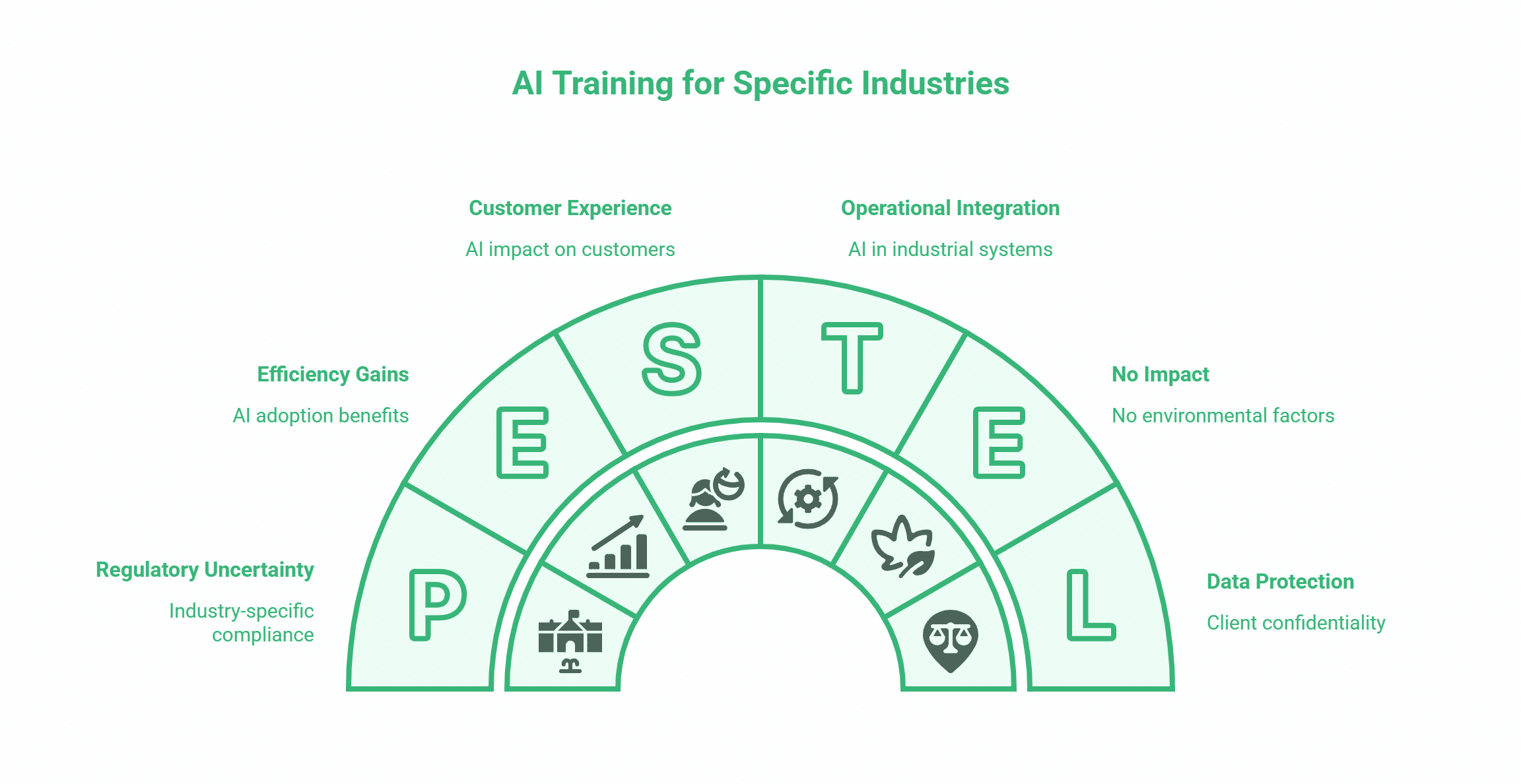
While core AI skills transfer across sectors, industry context shapes how AI training should be delivered and what compliance considerations apply.
Professional Services
Accountants, solicitors, and consultants face specific considerations around client confidentiality and professional liability. AI training for these sectors emphasises data handling, output verification standards, and scenarios where AI assistance is inappropriate, regardless of efficiency gains.
The professional services sector has been slower to adopt AI, partly due to regulatory uncertainty. Quality training addresses these concerns directly rather than pretending they don’t exist.
Healthcare and Social Care
Healthcare AI training must address patient data protection, clinical decision support regulations, and the ethical implications of AI in care settings. Northern Ireland health and social care organisations face specific governance requirements that generic AI training ignores.
Manufacturing and Engineering
Manufacturing AI applications often focus on predictive maintenance, quality control, and supply chain optimisation. Training for these sectors requires understanding operational technology environments and integration with existing industrial systems.
Retail and Hospitality
Customer-facing industries benefit most from AI applications in personalisation, inventory management, and staff scheduling. Training emphasises customer experience implications and integration with point-of-sale and booking systems.
Getting Started with AI Training
Taking the first step toward AI training doesn’t require committing to a comprehensive programme immediately. A sensible approach builds understanding before making major investment decisions.
Assessment and Planning
Start by understanding where your organisation stands with AI currently. What tools do staff already use? What frustrations exist that AI might address? What concerns do people have about AI affecting their work?
ProfileTree offers an initial consultation to help businesses understand their AI readiness and identify the highest-value training investments for their specific situation.
Pilot Programmes
Before training entire organisations, pilot programmes with smaller groups test whether planned approaches work for your culture and workflows. Lessons from pilots improve full-scale implementation and build internal champions who can support colleagues after training.
Scaling What Works
Once you’ve validated AI training value with initial groups, expand systematically. Capture what worked and what didn’t from early cohorts, refine materials and approaches, and create internal resources that support ongoing learning beyond formal training events.
Frequently Asked Questions
How long does AI training take to show results?
Teams typically start applying AI skills within the first week after training. Measurable productivity improvements usually appear within 4-8 weeks as new habits are established. Full organisational impact takes 3-6 months as AI-enhanced processes become standard practice.
Can employees learn AI through free online resources instead?
Free resources cover basics effectively, but business-specific application requires structured training. The gap isn’t tool knowledge – it’s connecting AI capabilities to your specific workflows, compliance requirements, and quality standards. Self-taught AI users often develop inconsistent practices that create problems at scale.
What if staff are worried AI will replace their jobs?
Address this concern directly because ignoring it doesn’t make it disappear. Current AI augments human capabilities rather than replacing entire roles for most jobs. Training should explain what AI does well (repetitive, structured tasks) versus what humans still do better (judgment, creativity, relationship building). Organisations that upskill staff rather than replacing them typically see better outcomes than those attempting wholesale automation.
Is AI training relevant for small businesses?
Small businesses often benefit most from AI training because efficiency gains have a proportionally larger impact. A three-person company that saves 10 hours weekly through AI represents a more significant capacity gain than the same saving in a 300-person organisation. The key is right-sizing training to small business budgets and focusing on immediately applicable skills.
How often does AI training need refreshing?
AI tools evolve rapidly – expect significant capability changes every 6-12 months. Annual refresher training keeps skills current, with shorter updates when major new tools or features launch. Organisations building AI deeply into operations often maintain ongoing training relationships rather than one-off events.
What’s the difference between AI training and digital transformation?
AI training builds specific skills in using artificial intelligence tools. Digital transformation is a broader strategic shift in how technology supports business operations. AI training often forms one component of larger digital transformation programmes, alongside web development, SEO strategy, and process redesign.
Why ProfileTree for AI Training
ProfileTree delivers AI training that connects artificial intelligence capabilities to real business outcomes for SMEs across Northern Ireland, Ireland, and the UK. Our approach differs from generic AI courses in several specific ways.
Belfast-Based, Business-Focused
As a digital agency headquartered in Belfast since 2011, we understand the practical constraints and opportunities facing businesses in our region. Training content reflects UK and Irish business contexts, regulations, and market conditions rather than one-size-fits-all approaches developed for different markets.
Integrated Digital Expertise
AI training works better when connected to broader digital capability. ProfileTree’s background in WordPress web development, SEO, video production, and digital strategy means we can show how AI enhances these capabilities rather than teaching AI in isolation.
Practical, Outcome-Oriented
Every training programme is tied to specific business outcomes. We work with clients to identify measurable goals before training starts and track progress afterwards. This accountability ensures training delivers actual value rather than theoretical knowledge.
Ongoing Support Included
Learning doesn’t stop when training sessions end. ProfileTree clients receive follow-up support as they apply new skills, with access to trainers for questions that arise during real implementation.
Ready to explore how AI training could benefit your organisation? Contact ProfileTree to discuss your specific situation and discover the right training approach for your team.