
How to run a successful social media audit in 6 steps
Table of Contents
A successful social media audit reviews every account your business holds, measures what each one produces, checks the audience against your customers and ends with a 90-day plan. ProfileTree runs audits in six steps, from access and compliance to content data and benchmarking, so the findings turn into decisions the team can act on.
This guide is for business owners and marketing managers in Northern Ireland, Ireland and the rest of the UK who manage their own channels or are preparing to brief a social media marketing Belfast team. It includes a template you can copy and a comparison of free and paid audit tools.
What a social media audit is and when to run one
A social media audit is a structured review of every social channel a business uses. It checks whether each profile is complete, secure and on-brand, whether the content is producing measurable results, and whether the activity supports the goals of the business.
For many SMEs, the audit confirms a familiar pattern: regular posting, slowly rising follower numbers, and very few website visits or enquiries from those channels. The audit shows where that gap comes from, whether it is the wrong platform, the wrong content or the wrong audience.
Plan a complete audit annually, and before any significant change such as a new brand identity, a new service, a new market or a decision to bring in outside help. Starting from a measured baseline means you can tell later whether the changes worked.
Six steps to a successful social media audit
The six steps run in order, because each one depends on the one before. You cannot judge content properly until you know which accounts you control, and you cannot plan until you know which content and audiences are worth the effort.
Step 1: list every account and lock down access
Start with a list of every social account the business has ever created, including inactive ones, platforms you no longer use and profiles set up by former staff or a previous agency. Abandoned profiles still carry your name, and they often show old phone numbers, old addresses or links to a previous website.
For each account, record who holds admin access and whether two-factor authentication (a second login check, usually a code sent to a phone) is switched on. Many audits find that a former employee or agency still has admin rights, so remove anyone who no longer works with the business and make sure at least two current staff hold access.
Then decide which platforms deserve your time. For most SMEs, doing three platforms well brings more than spreading effort across six, so mark each account as keep, close or merge.
Step 2: check profiles for consistency and UK rules
Open the profiles side by side and compare the profile picture, cover image, bio, website link and contact details. A customer who sees your Instagram and then checks LinkedIn should recognise the same business, with the same phone number and a link to the right page of your current site.
UK advertising rules belong in this step, and many audit guides leave them out. The ASA’s guidance on recognising ads says paid or incentivised posts must be labelled clearly, with a prominent “ad” at the start. The CMA’s guidance for brands adds that gifted products count as well, and that brands can be held responsible for creators’ posts made on their behalf.
The stakes have risen. Since April 2025, the CMA has been able to fine businesses directly for breaking consumer protection law, up to 10% of global turnover, according to its announcement of the new regime. Look back through past posts involving influencers, gifted products or partnerships, and correct any that were not labelled.
Check data handling too. If you run competitions or collect contact details through social media, your privacy notice needs to cover that data under UK GDPR.
Step 3: measure what your content actually does
Pull the last three to six months of data from each platform’s own analytics and record the figures that show commercial value. The table sets out what to collect and why.
| Measure | What it tells you |
|---|---|
| Reach | How many separate accounts saw your posts |
| Engagement rate | Interactions divided by reach, a fairer measure than total likes |
| Link clicks | How many people left the platform to visit your website |
| Saves and shares | Which posts people found useful enough to keep or pass on |
| Follower growth | Net new followers over the period, not the running total |
Large follower numbers and likes look good but say little about business value. A LinkedIn post with 400 impressions and 12 link clicks has done more for the business than one with 2,000 impressions and four likes, so give most weight to actions that leave the platform, such as website visits and messages. Check your website analytics as well for visits and enquiries that arrived from social media, since that shows the commercial result directly.
Then sort your posts by engagement rate and study the top fifth. Look at the format (video, carousel or single image), the topic, the time of posting and the style of the caption. Most businesses find two or three types of post that consistently do better than the rest, and those become the core of the plan in Step 6. The guide to social media analytics for SMEs explains each platform’s reports in more detail.
Step 4: check your audience matches your customers
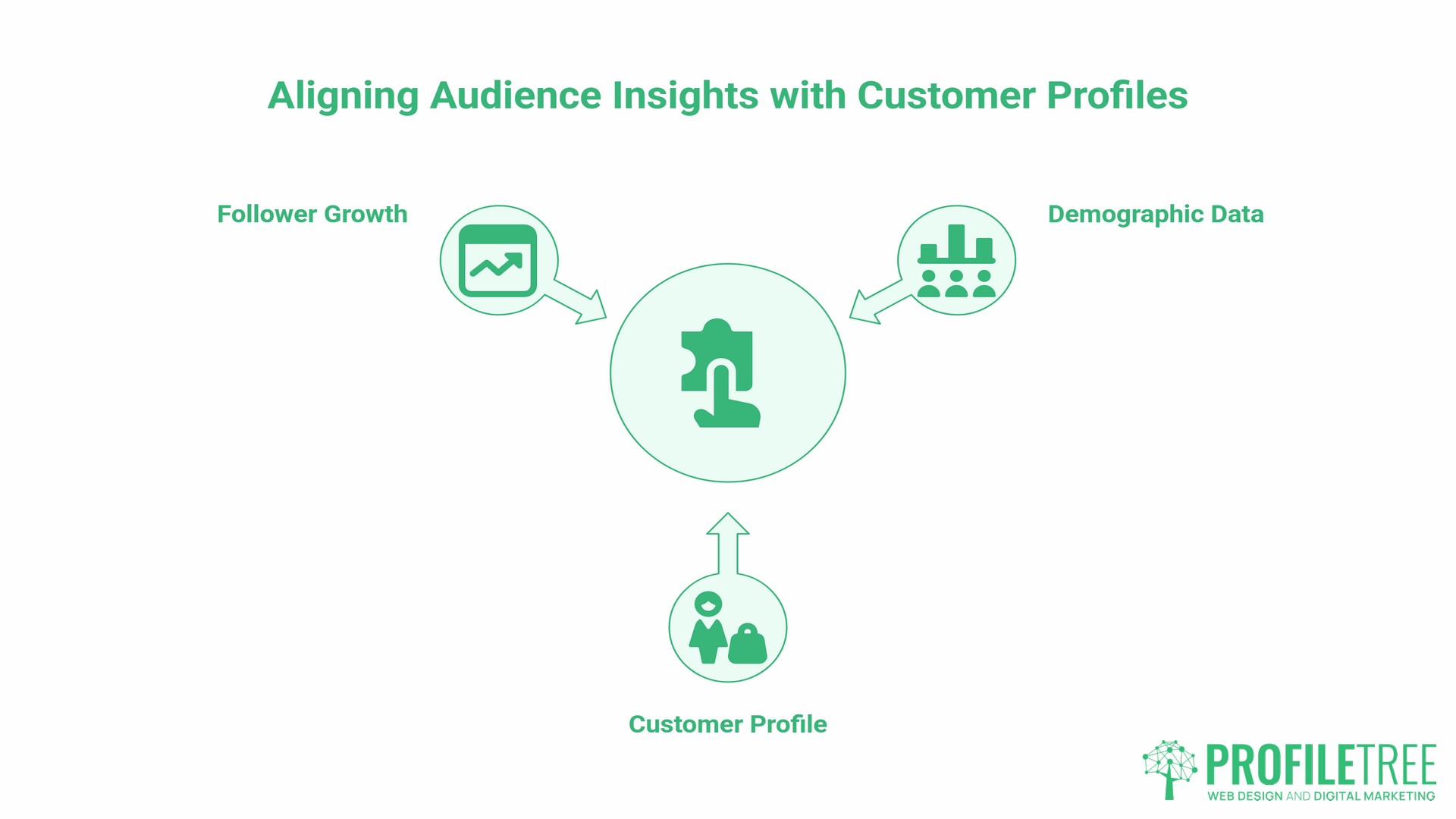
Every major platform shows the age, location and, on LinkedIn, the industry and job level of your followers. Compare that data with the customers who actually buy from you.
A Belfast business-to-business firm whose LinkedIn followers are mostly decision-makers in Northern Ireland and Ireland is in a healthy position. An Instagram audience made up largely of young followers overseas is a poor fit for the same firm, and the problem usually lies in the choice of platform more than in the quality of the posts.
Look at how followers arrived as well. Steady growth over months is a good sign, while a sudden spike followed by a flat line often points to a giveaway that attracted people with no interest in buying.
Step 5: benchmark against similar businesses
Benchmarking gives your figures context, because an engagement rate that is strong in one sector can be weak in another. Choose three to five businesses at the level you are aiming for, either local competitors or similar firms in other UK and Irish cities.
For each one, record how often they post, which formats they use, which platforms they favour and which posts draw the most response. For a rough engagement figure, divide the visible interactions on recent posts by their follower count, and use the same method for every business so the comparison is fair.
The point is not to copy anyone. Look for gaps: questions your customers ask that nobody answers well, formats your sector ignores and platforms where competitors are absent. Those gaps are where a smaller business can stand out.
Step 6: turn the findings into a 90-day plan
An audit only earns its time when the findings become decisions, so sort everything you found into three groups.
- Fix this week: profile gaps, admin access, unlabelled posts and broken links.
- Change over the next 30 days: the mix of content, how often you post and which platforms get priority.
- Plan for days 30 to 90: new formats such as video, a new platform, or a series that needs time to produce.
Your best-performing post types from Step 3 become your core formats, the audience findings from Step 4 shape topics and tone, and the gaps from Step 5 show where to build authority. Give each change a measurable target, such as raising video from a fifth of posts to half over 90 days while tracking engagement each month, and keep to three priority goals per platform. A social media calendar turns those goals into a weekly schedule.
“An audit only works if someone does the thing afterwards,” says Ciaran Connolly, founder of ProfileTree. “That is why ProfileTree builds its social media training in Belfast around the business’s own accounts, and people leave the McSweeney Centre with the first fixes already made on their own profiles.”
A social media audit template you can copy
A simple spreadsheet is enough for most SME audits. Give each platform its own row, use these columns, and repeat the audit with the same layout each year so the results can be compared.
| Column | What to enter |
|---|---|
| Platform and handle | The platform name and the exact account name |
| Status and decision | Active, inactive or abandoned, and keep, close or merge |
| Admin access | Who holds access, and whether two-factor authentication is on |
| Profile check | Whether the image, bio, link and contact details are correct |
| Labelling check | Whether past paid, gifted or partnership posts were labelled as ads |
| Posts per week | The average over the audit period |
| Reach and engagement rate | Totals and averages for the period |
| Link clicks and website visits | From the platform and from your website analytics |
| Best post types | The two or three formats or topics that performed best |
| Audience fit | How closely followers match your customers |
| Benchmark notes | What similar businesses do better or leave out |
| Actions | This week, within 30 days, or within 90 days |
Free and paid social media audit tools compared
Most SMEs can complete a thorough audit with free tools. Paid tools save time when you manage many accounts or want automated competitor reports, but they are not essential.
| Tool | What it does in an audit | Cost |
|---|---|---|
| Native analytics (Meta Business Suite, LinkedIn page analytics, TikTok and YouTube Studio) | Reach, engagement, follower demographics and post-level results | Free |
| Google Analytics 4 | Visits and enquiries that arrive from social media | Free |
| Meta Ad Library | Shows the ads other businesses are currently running on Facebook and Instagram | Free |
| A spreadsheet | Records and compares the findings across platforms | Free |
| Scheduling tools such as Buffer or Hootsuite | Reports across several accounts in one place | Paid, with free tiers |
| Sprout Social | Deeper benchmarking and reporting for larger teams | Paid |
AI assistants can speed up the analysis. Paste in post-level data and ask for patterns by format, topic or time of day, then check every conclusion against the figures before acting on it. The guide to free social media analytics tools compares the free options in more depth.
How often to audit and who should do it
Run a full six-step audit once a year and a lighter review each quarter, covering the Step 3 figures and any changes to platforms or audience. Businesses going through a rebrand, a launch or a move into a new market should audit before the change and again a few months after it.
Whoever runs the audit needs access to every account and the authority to act on the findings. If you plan to bring in outside help, the finished audit is the most useful brief you can hand over, because it shows the baseline, what works, who the audience is and what the business needs from social media.
ProfileTree is a Belfast web design and digital marketing agency, founded in 2011 and based at the McSweeney Centre, and organic social media strategy is one of its core services. Teams that want to run audits themselves can learn the process through ProfileTree’s digital training.
Frequently asked questions
What is the goal of a social media audit?
The goal of a social media audit is to set a clear baseline across your platforms and turn it into a plan. It shows what works, what does not and where your activity falls short of the business’s goals, so the next quarter’s work is deliberate and measurable.
What should a social media audit include?
A social media audit should include a list of every account with its access details, a check of profiles and ad labelling, content performance figures, an audience comparison, a benchmark against similar businesses and an action plan. The template above covers each of these in one spreadsheet.
Do I need a paid tool to audit social media?
No, the analytics built into each platform provide the core figures, and a spreadsheet is enough to record and compare them. Paid tools help when you manage many accounts or want automated competitor reports.
How often should an SME audit its social media?
An SME should run a full audit once a year, with a lighter quarterly review of the performance figures. Run an extra full audit before and after a rebrand, a launch or a change of target market.
How do I audit social media for UK advertising rules?
Review past posts that involved payment, gifted products or a partnership, and check each one was clearly labelled as an ad at the start. The ASA and the CMA both publish guidance for brands, and brands can answer for creators’ posts about them, so correct any unlabelled posts you find.
What does a professional social media audit include?
A professional audit usually covers all six steps in this guide, with a written report and a prioritised action plan, and often a workshop to agree the next 90 days. ProfileTree prices audits on request, depending on the number of platforms and the depth of benchmarking.
Get help acting on your audit
The audit shows what to fix and what to do more of, and the next step is putting those changes into practice. ProfileTree’s social media marketing service helps businesses across the UK and Ireland with organic social media strategy and content, with pricing quoted on request.