
SERP Features for Small Businesses: A Practical UK & Ireland Guide
Table of Contents
Most small business owners think of SEO as a competition to reach position one on Google. That framing misses what is actually happening on the results page. For many searches today, position one is buried below ads, a local map pack, review stars, a featured snippet, and a People Also Ask section. Understanding SERP features and knowing which ones your business can actually win is more useful than chasing a ranking number.
This guide explains what SERPs are, how the main SERP features work, and what businesses in Belfast, Dublin, and across the UK and Ireland can do to take up more space on the results page without increasing their advertising spend.
What Are SERPs? A Plain-English Definition
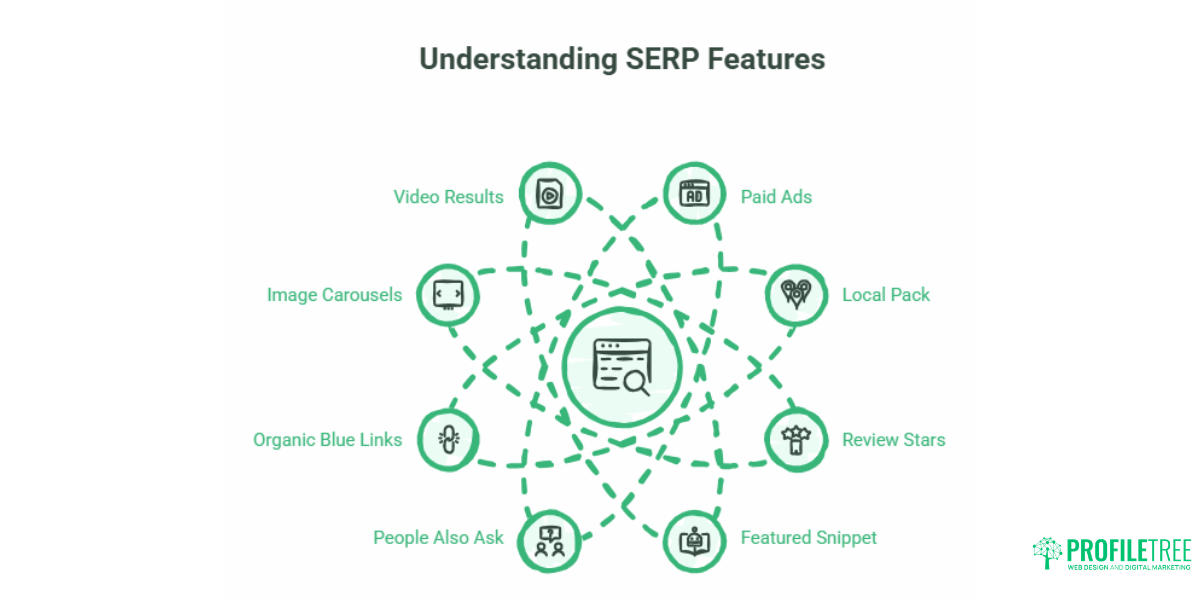
A search engine results page (SERP) is the page Google or Bing displays after someone types a query. The term covers everything visible: paid ads, organic blue links, map results, image carousels, video results, featured answer boxes, review stars, and the AI-generated summaries that now appear at the top of many searches.
SERPs in SEO refer to the relationship between your website’s optimisation and where and how it appears within those results. You are not just optimising for a single organic listing. You are optimising for the full range of places your business could appear on the page.
Understanding this distinction is the starting point for any realistic SEO strategy. A local plumber in Belfast who appears in the Local Pack with five-star reviews and a phone number will receive more calls than a competitor sitting at organic position two with a plain blue link.
Why SERP Features Matter More Than Position Numbers
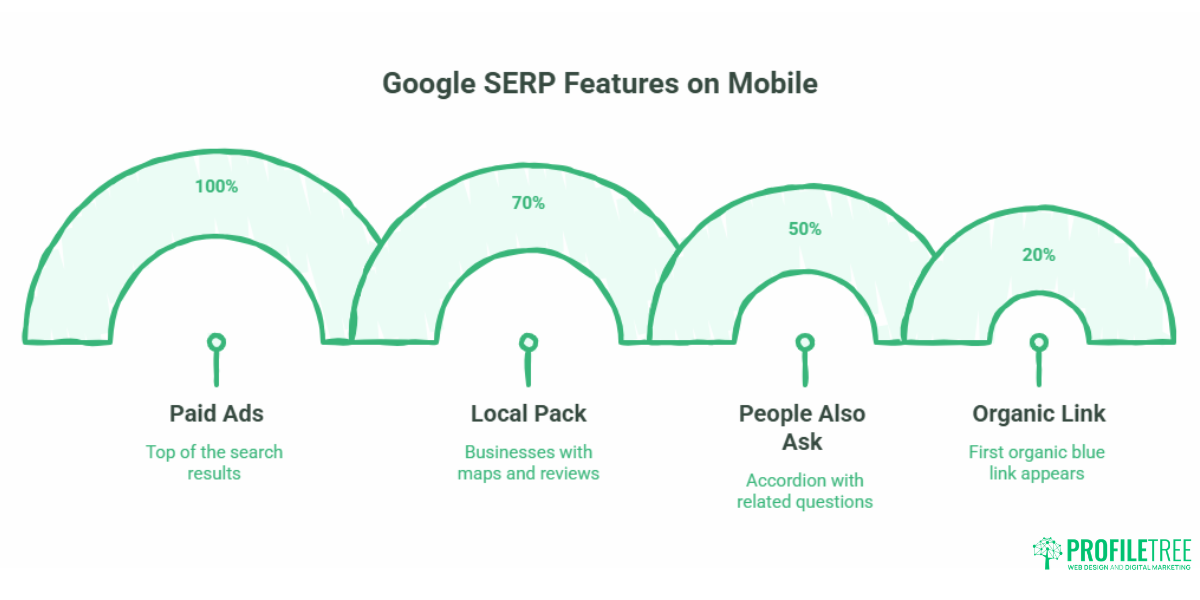
Google’s results page has changed substantially over the past five years. On a mobile phone, a typical search for a local service will show paid ads, then a Local Pack of three businesses with maps and reviews, then a People Also Ask accordion, before the first organic blue link appears. That organic link can sit between 70 and 80 per cent of the way down the screen.
This is what is sometimes called the zero-click problem. A user gets what they need directly from the SERP without visiting any website. For small businesses, this creates both a risk and an opportunity.
The risk: if your competitors own the Local Pack, the featured snippet, and the review stars, your organic ranking barely gets seen.
The opportunity: SERP features are disproportionately accessible to small businesses. Google does not award the Local Pack to the biggest company. It awards it to the most relevant, best-reviewed, and best-optimised local listing. A sole trader with a fully completed Google Business Profile and 40 genuine reviews can outrank a national brand in the Local Pack for searches in their town.
The Main SERP Features and How to Win Each One
The results page contains several distinct feature types. Each has its own optimisation logic.
The Google Local Pack
The Local Pack is the three-business map result that appears for location-based searches. It is the single most valuable SERP feature for service businesses, retailers, and hospitality across Northern Ireland, Ireland, and the UK.
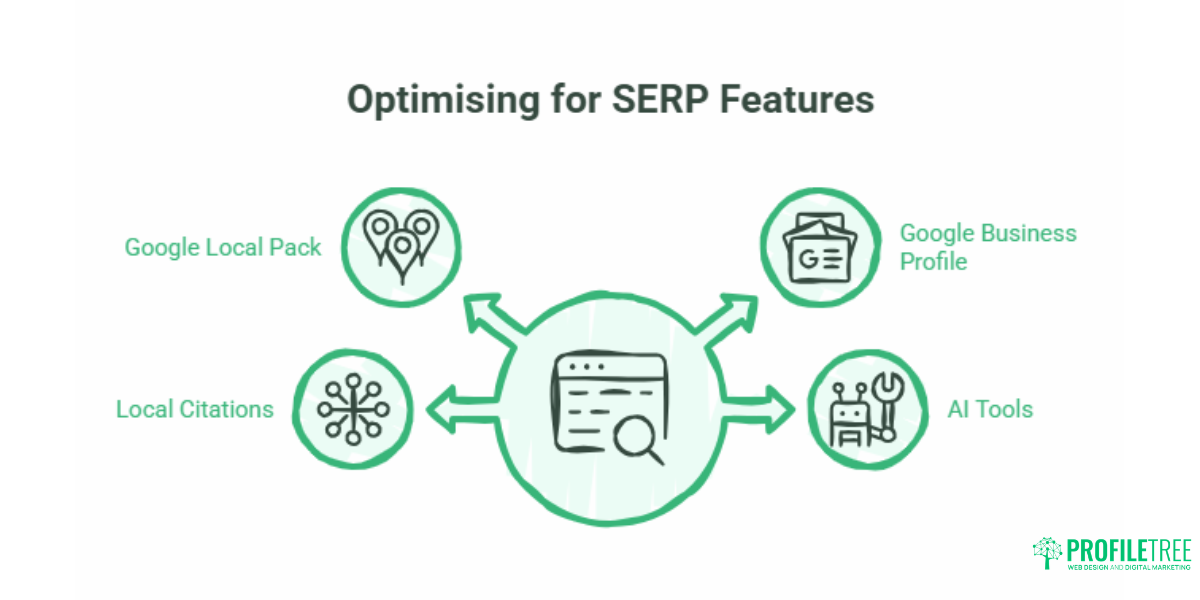
To appear in the Local Pack, your Google Business Profile must be complete and accurate: consistent name, address, and phone number; correct business categories; photos; regular posts; and a steady stream of genuine customer reviews. Local citation consistency matters too. Listings on Yell, Bing Places, Apple Maps, and the Irish Golden Pages all help confirm your NAP (name, address, phone) data to Google’s local algorithm.
Optimising your Google Business Profile with AI tools can help you identify gaps in your profile before competitors do. For a broader view of how local signals feed into your overall search presence, ProfileTree’s local SEO work for SMEs covers how to build that authority in practical terms.
Featured Snippets
A featured snippet is the highlighted answer box that appears at position zero, above all organic results. Google pulls a short extract from a page that directly answers a specific query, then displays it as a standalone answer.
To win featured snippets, structure your content around direct questions and answer them in 40 to 60 words immediately below the question heading. List-type snippets require clean bullet or numbered lists under a clear H2 or H3. Definition-type snippets need a one or two-sentence answer in plain language at the top of the relevant section.
Small businesses can compete for snippets in their specialist area because Google rewards specificity. A Belfast accountant who writes a clear, direct answer to “what expenses can a sole trader claim in Northern Ireland” is more likely to win that snippet than a generic national finance blog covering the same topic loosely.
People Also Ask
The People Also Ask (PAA) boxes appear mid-page and contain related questions that expand into short answers when clicked. Each expanded answer often triggers new PAA questions below it, creating a chain that keeps users on the SERP.
PAA boxes are increasingly significant for content strategy because they show exactly what related questions your potential customers are asking. Writing FAQ content that matches PAA phrasing helps Google pull your answers into these boxes and builds topical authority across related queries.
Review Stars and Aggregate Ratings
Star ratings appear in search results when a page has valid Schema markup for ratings, or when Google pulls review data from your Google Business Profile. For service businesses and e-commerce, review stars increase click-through rates meaningfully because they convey trust before the user visits the site.
Aggregate Rating Schema should be implemented on service pages and product pages. Ensuring your web developer has this in place is a basic technical requirement for appearing with stars in the results. If you are unsure whether your site has it, ProfileTree’s SEO services include a technical audit that checks Schema implementation alongside other on-page signals.
Video Results
YouTube videos appear directly in Google SERPs for how-to queries, review queries, and tutorials. A plumber who publishes a YouTube video titled “How to fix a dripping tap in 5 minutes” can appear as a video result in the SERP for that query, sitting alongside and sometimes above organic text results.
For SMEs, this is an underused opportunity. Most local and niche competitors do not have video content. A short, well-titled video on a topic your customers actually search for can secure a SERP feature that your text-only competitors cannot access.
AI Overviews
Google’s AI Overviews appear at the top of the SERP for many informational queries, pulling from multiple sources to generate a summary answer. Pages cited in AI Overviews tend to have clear, self-contained sections with direct answers, structured headings, and factual content with verifiable sources.
For small businesses, the primary path to AI Overview citation is the same as for featured snippets: write specific, direct answers to real questions your customers ask. The AI system rewards clarity and specificity, not brand authority.
SERP Features on Mobile: Why the Screen Size Changes Everything
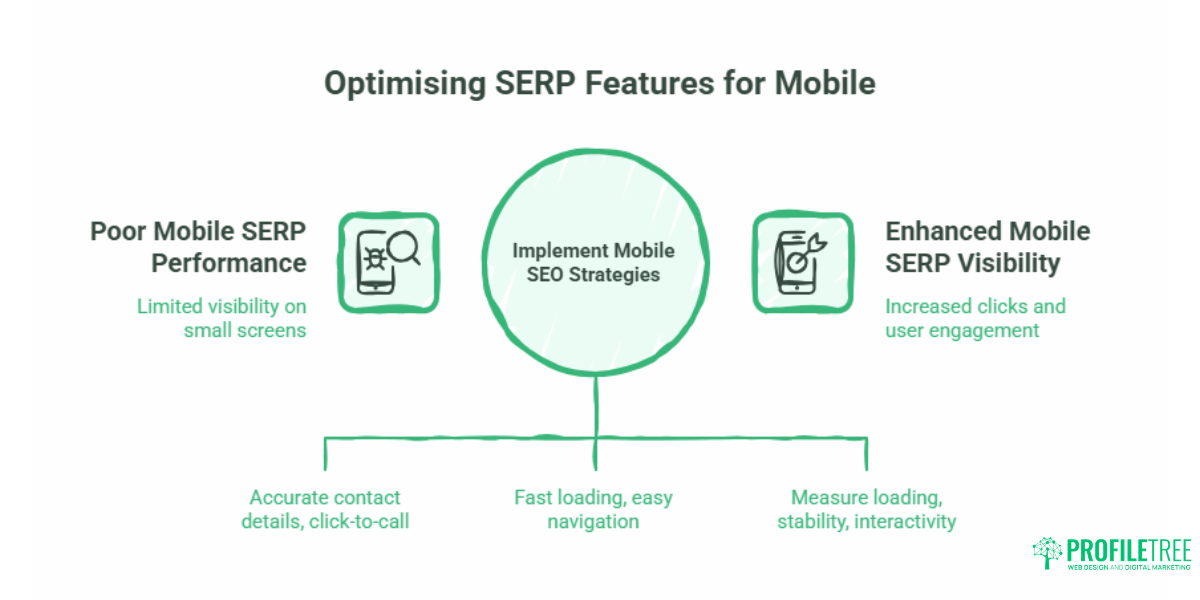
On a desktop, a user can see several results at once. On a mobile phone, a single SERP feature can occupy the entire screen. The Local Pack on mobile shows a map and three businesses with phone buttons and star ratings. On a small screen, a user may tap the phone button without ever visiting a website.
This matters for mobile SEO in two ways. First, your Google Business Profile must have accurate contact details, opening hours, and a click-to-call phone number. Second, your website must load quickly and be navigable on a small screen, because any user who does click through will leave immediately if the site is slow or difficult to use.
Google’s ranking signals now include Core Web Vitals, which measure loading speed, visual stability, and interactivity. Sites that fail these thresholds are less likely to appear in the Local Pack and less likely to maintain any SERP feature. This is where web design and web development connect directly to SEO performance. A well-built site is not just a matter of user experience; it is a ranking factor.
ProfileTree’s web design work in Belfast is built around these technical foundations, because a site that cannot pass Core Web Vitals assessments will underperform in the results regardless of how strong the content is.
Voice Search and Conversational SERPs
Voice searches typically take the form of natural questions: “Where is the nearest electrician in Derry?” or “What time does the pharmacy in Lisburn open?” Google answers these queries by reading out the featured snippet or Local Pack result.
Voice search SEO requires the same structural principles as featured snippet optimisation: direct answers, question-based headings, and Schema markup. The practical difference is that voice results almost always draw from a single source, making snippet ownership more valuable.
For local businesses, the highest-impact voice search action is keeping Google Business Profile data accurate. Voice assistants pull opening hours, phone numbers, and addresses from GBP first. An outdated listing will produce wrong answers and lose customers before they visit.
The UK and Ireland Context: What Competitors Miss
Most SERP feature guides are written for the US market. There are meaningful differences for UK and Irish businesses worth knowing.
UK local directories, including Yell, Scoot, Thomson Local, and 192.com, carry citation weight in Google’s local algorithm. For Irish businesses, Golden Pages and Boards, i.e., listings, contribute to local entity verification. Ensuring your NAP data is consistent across these platforms confirms your business entity to Google and supports Local Pack eligibility.
Trading Standards regulations in Northern Ireland and consumer protection legislation in the Republic of Ireland mean that any claims appearing in SERP features, including review stars, must be genuine and compliant. Incentivised reviews that violate these standards can result in GBP suspension and loss of all local SERP features.
For businesses across both jurisdictions, the proximity factor in local search is particularly relevant. Google’s Local Pack algorithm weights geographic proximity heavily for “near me” searches. This means a smaller business with a well-optimised GBP and strong local citations can regularly outperform larger competitors in Local Pack results for searches within their service area.
How to Measure SERP Feature Performance
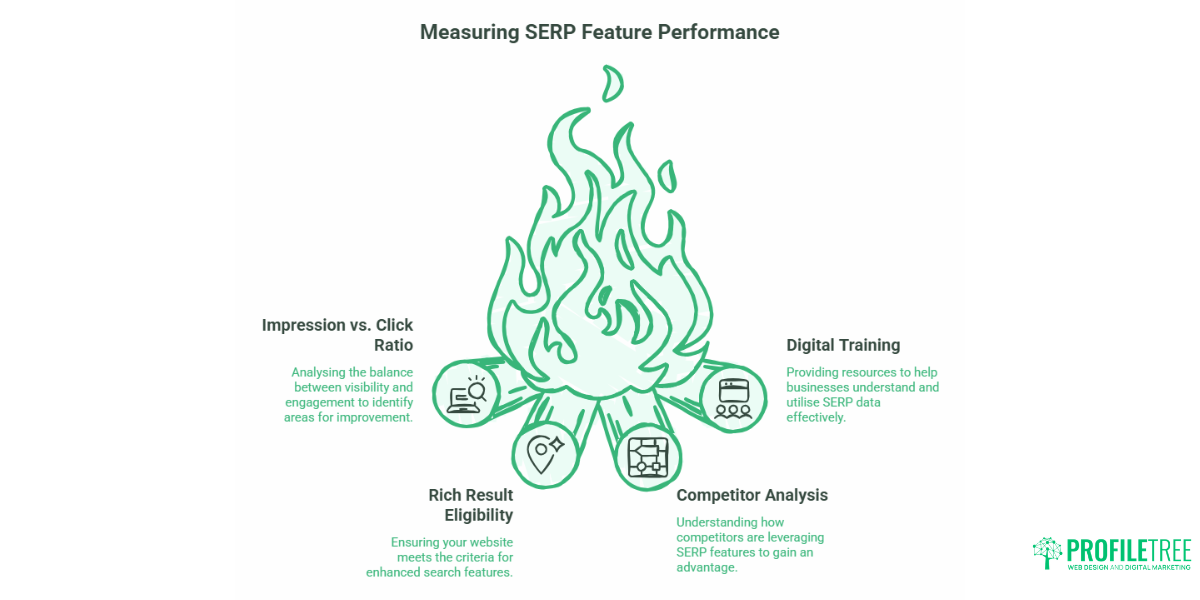
Standard Google Search Console reports do not always show SERP feature appearances clearly, but there are ways to track progress.
In Search Console, filter by query and check Impressions against Clicks. A deep impression count with low clicks often indicates your result is appearing but not attracting clicks, which can mean a competitor’s featured snippet or Local Pack listing is drawing attention first. Improving your structured data or GBP optimisation can shift that ratio.
Google Search Console also flags rich result eligibility. The Enhancements section shows whether your Schema markup is valid and whether your pages qualify for review stars, FAQ results, or other rich features.
Ciaran Connolly, founder of ProfileTree, notes: “A lot of SME owners we work with are focused entirely on their organic ranking position, but when we pull up the actual SERP, they can see straight away that their competitors are owning the page with star ratings and a map listing. Fixing that is often faster than building organic links and has a more immediate impact on enquiries.”
If tracking SERP features and interpreting Search Console data feels unfamiliar, ProfileTree’s digital training for businesses covers exactly this. Understanding your own data is the foundation for making the right decisions about where to focus.
A Practical SERP Feature Audit for SMEs
Before spending time on optimisation, it is worth knowing which SERP features are currently appearing for your most important search terms, and which you already appear in.
Search for your primary service and location combination. Note: Are there ads above the organic results? Is there a Local Pack? Is there a featured snippet? Are there video results? Are there People Also Ask boxes?
Then search specifically for your business name. Check whether your Knowledge Panel is appearing. Verify that your Google Business Profile shows the correct details.
Finally, run your homepage and key service pages through Google’s Rich Results Test (available free at search.google.com/test/rich-results). This confirms whether your Schema markup is valid and what rich features your pages currently qualify for.
| SERP Feature | What You Need | Time to Implement |
|---|---|---|
| Local Pack | Complete GBP, consistent citations, reviews | 2 to 4 weeks |
| Featured Snippet | Direct Q&A content structure | 48 hours to index |
| Review Stars | Valid Aggregate Rating Schema | 1 to 2 days (dev task) |
| People Also Ask | FAQ content matching PAA phrasing | 1 to 2 weeks |
| Video Results | YouTube video with optimised title/description | 1 week |
| AI Overview | Clear, factual, structured content | Ongoing |
Conclusion
SERP features are not an advanced SEO topic reserved for large businesses with specialist teams. They are the most practical way for SMEs in Northern Ireland, Ireland, and the UK to take up more space on the results page without paying for advertising. The Local Pack, featured snippets, and review stars are within reach for most small businesses that are willing to complete the groundwork: accurate business profile data, structured content, and technically sound websites.
If you are unsure where your business currently stands on the results page or which features represent the biggest opportunity for your sector, ProfileTree’s SEO services include a full SERP audit as part of the initial strategy review.
Frequently Asked Questions
What are SERPs in SEO?
SERPs stands for search engine results pages. In SEO, the term refers to the full page Google or Bing displays in response to a search query. This includes not just the standard list of organic links but all the additional features that appear on the page, including ads, local map results, featured snippets, video results, review stars, and AI-generated summaries. SEO aims to improve your visibility across all of these, not just your organic link position.
What is the most valuable SERP feature for a local business?
For most local service businesses, the Google Local Pack is the highest-impact SERP feature. It appears before organic results on mobile, includes a phone button, shows star ratings, and displays your address and opening hours. Users can contact a business directly from the Local Pack without visiting the website. Winning and maintaining a Local Pack position requires a well-optimised Google Business Profile, consistent local citations, and genuine customer reviews.
Do I have to pay to appear in SERP features?
No. The Local Pack, featured snippets, People Also Ask, review stars, and video results are all organic features. You do not pay Google to appear in them. They are earned through relevance, accuracy, technical setup, and content structure. Only the ads that appear at the top and bottom of the results page are paid placements.
Can a small business beat a large brand for a featured snippet?
Yes. Google selects featured snippets based on content specificity and directness, not brand authority. A small business that writes a clear, well-structured answer to a specific question within its specialism can outperform large competitors who cover the same topic more broadly. The key is to answer the question directly and concisely in a standalone section, using the question as the heading.
How long does it take to appear in the Local Pack?
It depends on how competitive the local search results are for your sector and location. With a fully completed and verified Google Business Profile, consistent citation data, and a reasonable number of reviews, most local businesses begin appearing in the Local Pack within two to six weeks. More competitive markets may take longer and require ongoing review, acquisition, and citation building.
Does my website speed affect SERP features?
Yes. Core Web Vitals, which measure loading speed, visual stability, and responsiveness, are used by Google as a baseline signal for page quality. Pages that fail Core Web Vitals thresholds are less likely to rank in the Local Pack and less likely to retain featured snippet positions. A slow or technically poorly built website can undermine SERP feature performance regardless of how well the content and profile are optimised.
What is a zero-click search?
A zero-click search occurs when a user’s query is answered directly on the results page, meaning they do not click through to any website. This happens when the featured snippet, Local Pack information, or AI Overview fully satisfies what they were looking for. For businesses, zero-click searches highlight the importance of owning the SERP features themselves: if a user sees your business name, phone number, and star rating in the Local Pack, they may call you directly without your website being involved at all. ifts anticipated in the SERPs and SEO, paving the way for businesses to stay ahead in the digital arena.