
Market Research for Small Businesses: A Practical Guide
Table of Contents
Most small businesses skip market research because they assume it costs a fortune or takes weeks. It doesn’t. With the right tools and a clear process, you can gather genuinely useful data in an afternoon and use it to make better decisions about your website, your content, and your digital marketing.
This guide walks you through how to conduct market research as a small business owner, with a focus on practical methods, free and low-cost tools (including SurveyMonkey), and how to turn your findings into action.
Why Market Research Matters for Small Businesses
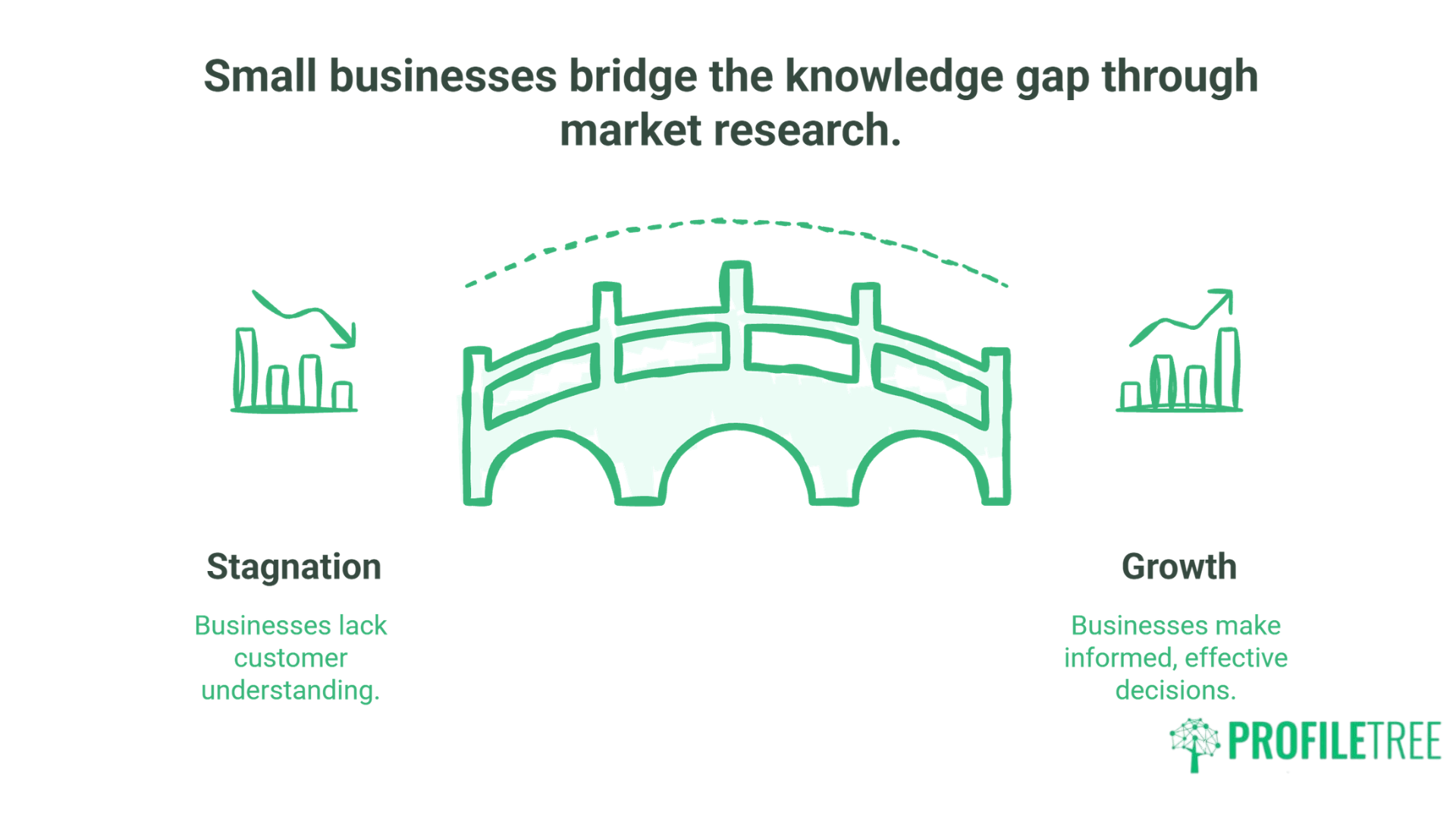
The gap between businesses that grow steadily and those that stagnate is rarely about budget. It’s usually about understanding. Businesses that know what their customers actually want — not what they assume they want — make better decisions about every part of their digital presence, from how their website is structured to what they write about.
Market research for small businesses doesn’t need to mean commissioning a professional study. It means gathering enough real-world data to reduce the guesswork in your decisions. A local tradesperson asking five regular customers why they chose them over a competitor has just done market research. A café owner posting a quick poll to their social media followers about opening hours has just done market research. The tools and scale differ from what a large corporation might use, but the principle is identical.
Where small businesses in Northern Ireland, Ireland, and the UK increasingly benefit from structured research is in their digital strategy. Understanding what your audience searches for, what language they use, and what problems they need solved feeds directly into SEO, content marketing, and web design decisions that actually work.
Primary vs. Secondary Research: What’s the Difference?
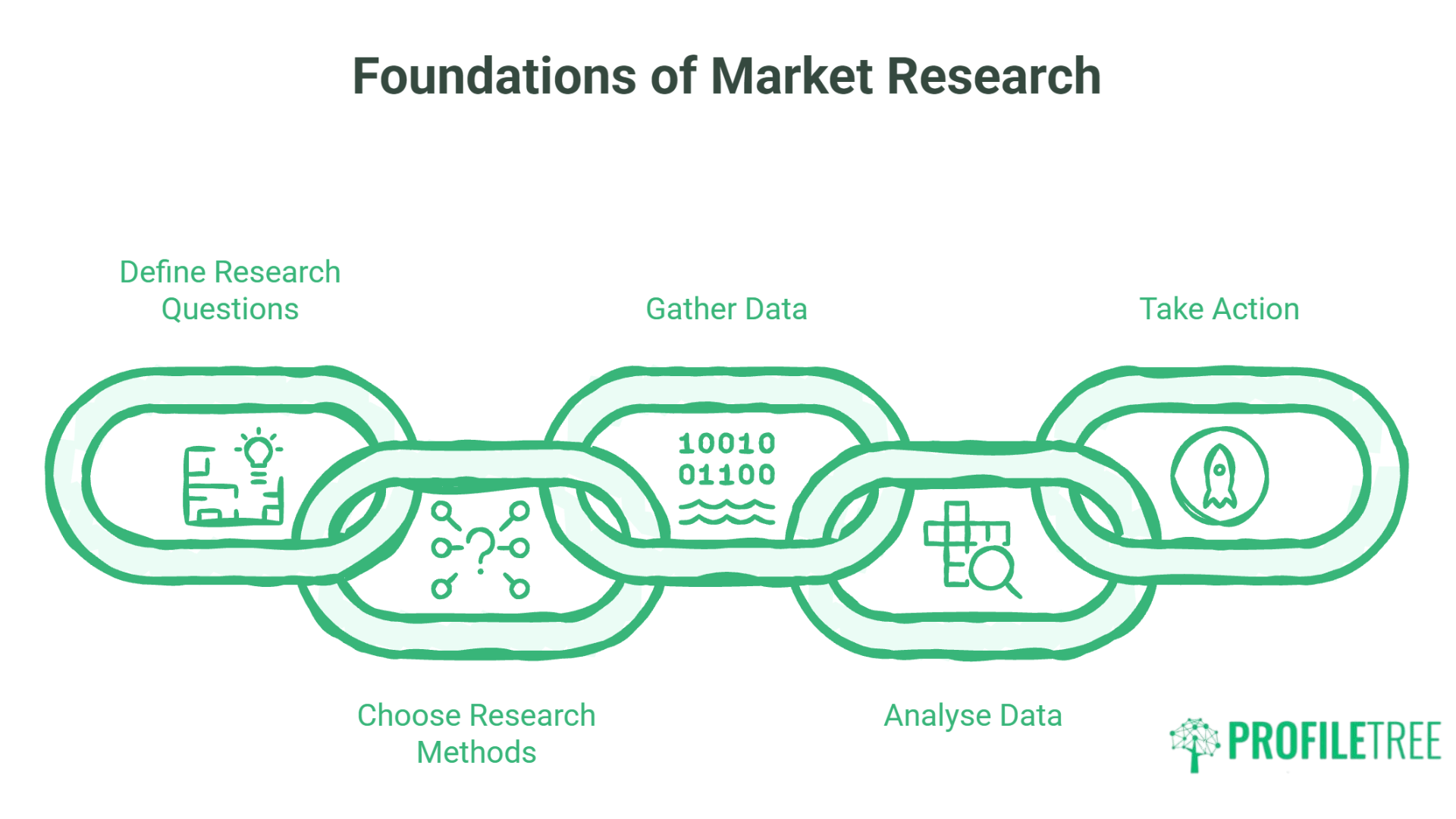
Before choosing a method, it helps to understand the two categories of market research.
Primary research is data you collect yourself, directly from real people. Surveys, interviews, focus groups, and on-site polls all fall into this category. It’s specific to your business and your audience, which makes it the most valuable type — but it takes time to gather.
Secondary research is data that already exists. Government statistics, industry reports, competitor websites, Google Trends data, and ONS (Office for National Statistics) datasets are all secondary sources. It’s faster to access and often free, but it may not reflect your specific audience or location.
For most small businesses, the most effective approach combines both: use secondary research to understand the broader market, then use primary research (a short survey, a few customer conversations) to validate what you find against your own audience.
| Method | Type | Cost | Time | Best For |
|---|---|---|---|---|
| Online survey (SurveyMonkey free tier) | Primary | Free | 1–3 hours | Customer preferences, feedback |
| Customer interviews | Primary | Free | Half a day | Deep insights, new product ideas |
| Google Trends | Secondary | Free | 30 minutes | Search demand, seasonal patterns |
| ONS / Companies House data | Secondary | Free | 1–2 hours | Market size, industry benchmarks |
| Social media analytics | Secondary | Free | 1 hour | Audience demographics, engagement |
| Enterprise Ireland / Invest NI reports | Secondary | Free | 1–2 hours | Regional market conditions |
How to Conduct Market Research in Five Steps
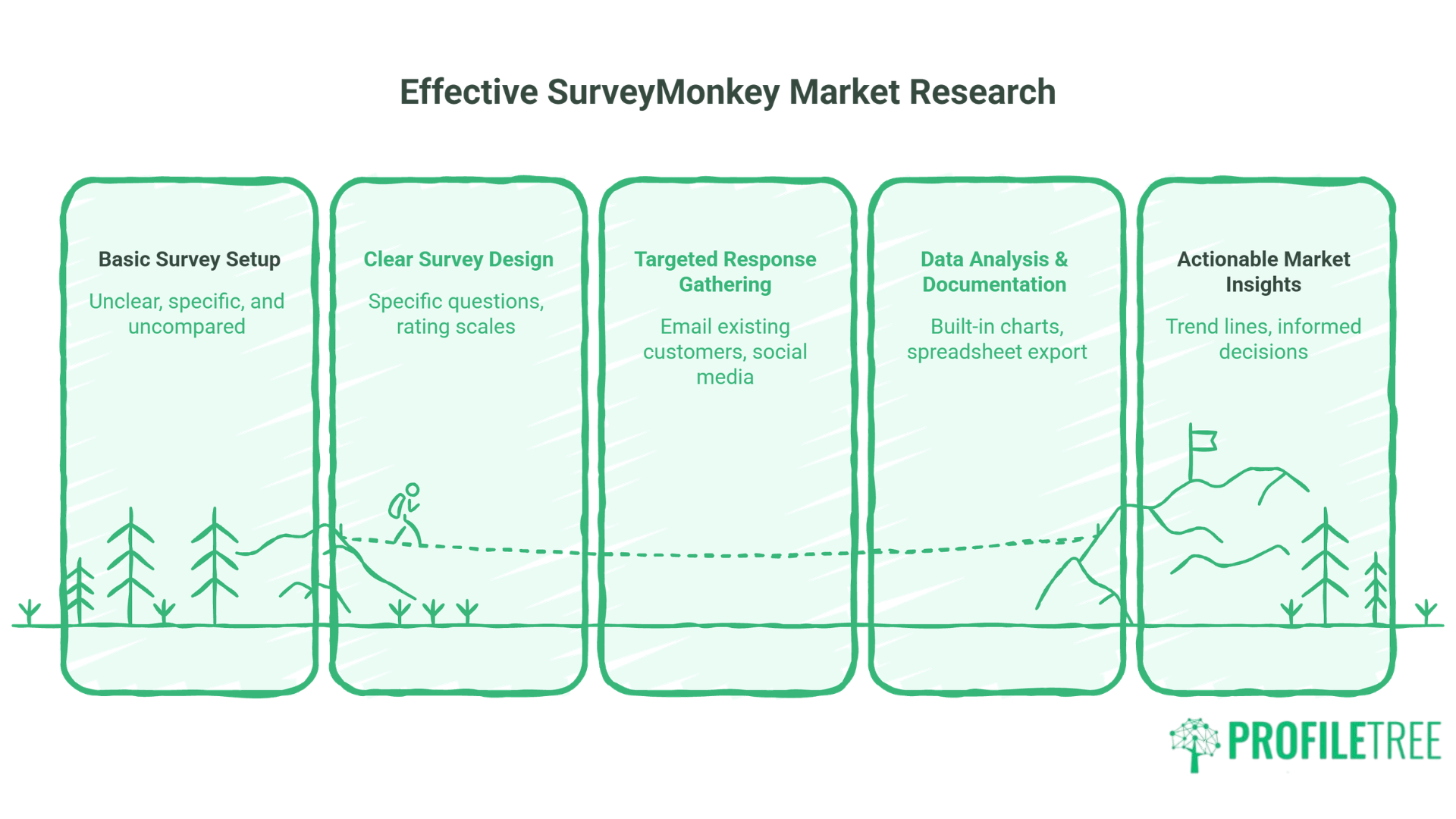
Step 1: Define What You Actually Need to Know
The most common mistake in market research is starting with tools rather than questions. Before you open SurveyMonkey or Google Trends, write down the specific decision you’re trying to make.
Good research questions sound like: “Do my customers prefer to book online or by phone?” or “Which service do new customers value most in their first three months?” Vague questions like “what do customers think of us?” produce vague answers that don’t help anyone.
Write two or three clear questions before you start. Everything else follows from those.
Step 2: Choose Your Method
For primary research on a tight budget, online surveys are the most accessible starting point. SurveyMonkey’s free tier allows you to create surveys of up to ten questions and collect up to 40 responses per survey — enough for a small business to gather directional insight.
Keep surveys short. Five to eight questions take most respondents under three minutes. Response rates drop sharply beyond ten questions. Use a mix of multiple-choice questions (easy to analyse) and one or two open-text questions (which surface insights you wouldn’t have thought to ask about).
For secondary research, start with free UK and Irish resources:
- The Office for National Statistics (ons.gov.uk) publishes business, economic, and demographic data broken down by region, including Northern Ireland.
- Enterprise Ireland and Invest NI both publish sector reports and market intelligence relevant to businesses on the island of Ireland.
- Companies House data gives you a picture of your competitive landscape — how many businesses operate in your category, their size, and their location.
- Google Trends (trends.google.com) shows you how search interest in a topic changes over time and varies by region, which is directly useful for SEO and content decisions.
Step 3: Gather Your Data
When running a survey, distribute it through channels where your actual customers are. Emailing your existing customer list consistently produces better response quality than posting to social media, because your email subscribers have already chosen to hear from you. If you have a mailing list of 200 people and achieve a 20% response rate, 40 completed responses is a meaningful sample for a local small business.
For secondary research, give yourself a time limit. It’s easy to spend an entire day reading reports without producing anything actionable. Set a two-hour cap, note the three to five most relevant data points, and move on.
Step 4: Analyse What You’ve Found
SurveyMonkey’s free analytics features show response breakdowns for each question, which is sufficient for most small business needs. Look for patterns, not individual responses. If 70% of respondents say they found you through a Google search, that tells you your SEO matters. If 60% say they’d like to book appointments online but you don’t currently offer that, you’ve just identified a gap.
Cross-reference your primary and secondary findings. If your customer survey shows strong interest in a particular service, check Google Trends to see whether broader search demand supports that. If it does, you have a solid basis for a content or SEO investment.
“Effectively segmenting your data allows for a tailored approach that speaks directly to each customer’s needs,” notes Ciaran Connolly, founder of ProfileTree. “That level of detail is what turns general data into decisions you can actually act on.”
Step 5: Turn Research Into Action
Data without action is just an interesting document. The value of market research comes from what changes as a result.
For a small business, the most common actions that follow good research are:
- Updating your website to reflect what customers actually say about why they choose you (not what you assume they value).
- Adjust your content strategy to focus on the topics and questions your audience is genuinely searching for.
- Identifying gaps in your service offering that competitors aren’t filling.
- Prioritising the digital channels where your audience actually spends time.
Each of these connects directly to how your business performs online. A website that reflects your customers’ language ranks better in search and converts more visitors. Content built around real customer questions earns more organic traffic than content built around assumptions.
Using SurveyMonkey for Small Business Market Research
SurveyMonkey is one of the most accessible survey tools for small businesses. Its free tier is functional enough for most basic research needs, and the platform’s template library covers the most common research scenarios — customer satisfaction, product feedback, competitor awareness, and brand perception.
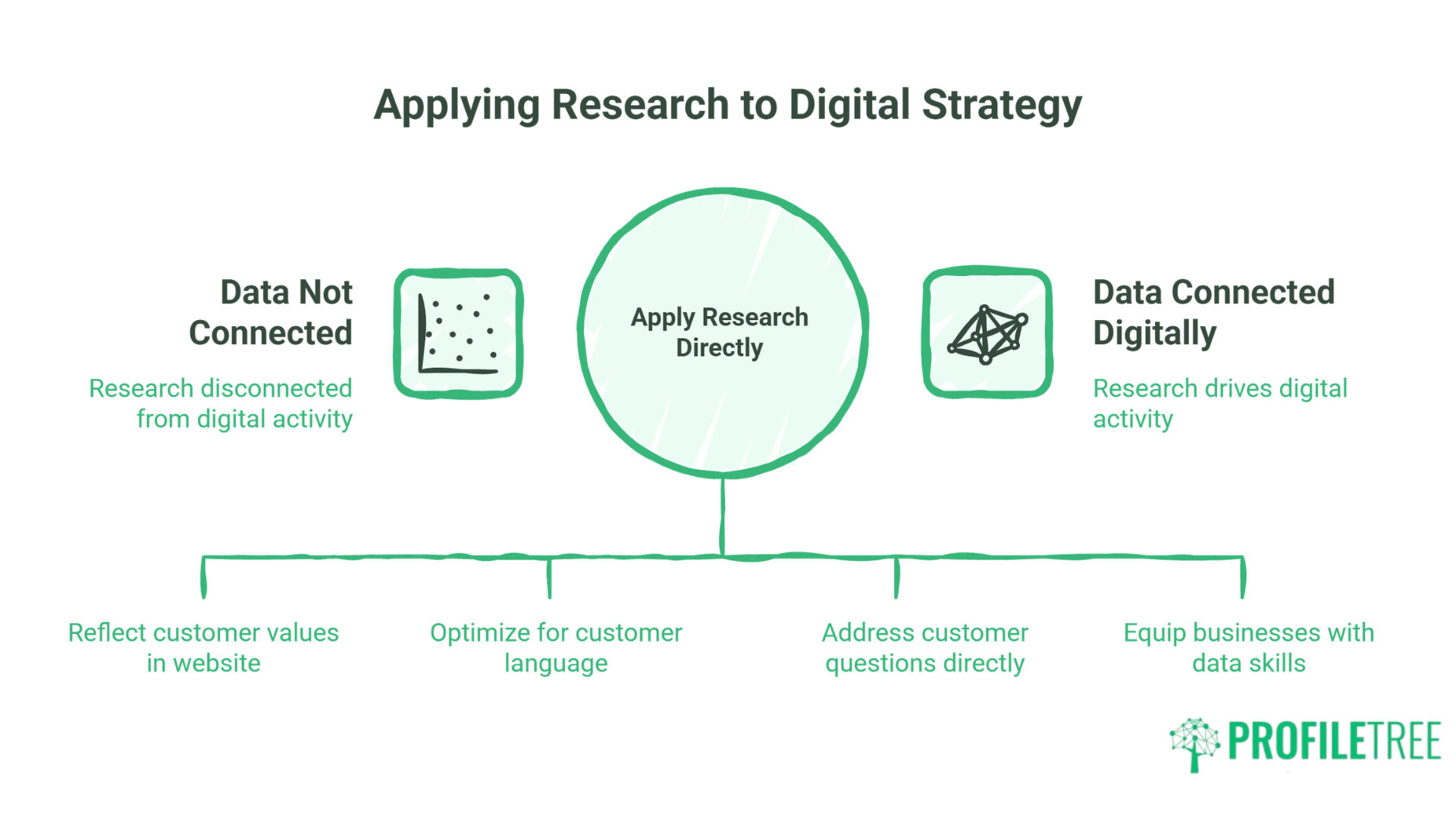
Setting up an effective survey: Start with a clear title that tells respondents what the survey is about and how long it takes. Keep questions specific. “How did you first hear about us?” is better than “Tell us about your customer journey.” Use rating scales (1–5 or 1–10) for questions where you want to track change over time, because they’re easy to compare across survey rounds.
Getting responses: Your existing customer base is your most valuable source. Send surveys by email with a brief, honest explanation of why you’re asking. Avoid offering large incentives, which can skew responses. For B2C businesses, social media works reasonably well for short polls, though the audience may skew toward followers rather than customers.
Using results: SurveyMonkey’s built-in charts make it straightforward to see response distributions. Export your data to a spreadsheet if you want to cross-reference responses or share findings with your team. The key is to document what you found and link it explicitly to the decisions you’re about to make.
For businesses that want to track brand health over time — monitoring whether awareness, satisfaction, or preference is improving — running the same short survey every quarter gives you a trend line that’s more useful than a single snapshot.
Free UK and Irish Resources for Secondary Research
One area where most market research guides fall short is localisation. The majority are written for US audiences and point to resources that aren’t directly useful to businesses in Northern Ireland, Ireland, or the wider UK. These are the sources that actually matter for this region.
Office for National Statistics (ons.gov.uk): Population data, business counts, earnings data, and economic output broken down by region. Useful for understanding market size and demographic trends in your area.
Enterprise Ireland (enterprise-ireland.com): Sector reports, market intelligence, and trade data covering the Republic of Ireland. Particularly useful for businesses selling into or from the Irish market.
Invest Northern Ireland (investni.com): Market research support, sector intelligence, and export market data for businesses based in Northern Ireland. Invest NI also funds market research projects for qualifying businesses.
Companies House (find-and-update.company-information.service.gov.uk): Free access to registered company information across Great Britain. Useful for scoping the competitive landscape — how many businesses operate in your category, where they’re based, and their filing history.
Local libraries: Most public libraries in Northern Ireland and the Republic of Ireland provide free access to business databases and market research reports that would otherwise cost hundreds of pounds. Worth checking before paying for a commercial report.
Applying Research to Your Digital Strategy
Gathering data is only useful if it connects to your digital activity. These are the most direct applications for small businesses.
Website and web design: Research findings about what customers value most should be reflected in how your website is structured. If research shows that customers prioritise response time, that should be in your homepage headline — not buried on a contact page. ProfileTree’s web design services are built around understanding what your audience needs before a single page is designed.
SEO and content: The language your customers use in surveys and interviews is the language they type into Google. If five customers describe your service as “affordable accountant Belfast” and your website says “cost-effective financial services,” you’re optimising for your vocabulary, not theirs. Running customer language through a keyword research process — part of any solid SEO strategy — is one of the most direct ways research improves rankings.
Content marketing: Research that identifies the questions customers ask before buying is a direct content brief. If your survey shows that customers routinely ask “how long does it take?” or “what’s included in the price?”, those are the articles and FAQs your website needs. ProfileTree’s content marketing work starts from exactly this kind of audience insight.
Digital training: Many small businesses in Northern Ireland and Ireland have the data but not the skills to act on it. Understanding how to read Google Analytics, interpret survey results, or use Google Trends is something that can be learned relatively quickly with structured digital training. The return on a day’s training often exceeds the return on a month of unguided experimentation.
Common Market Research Mistakes to Avoid
Asking leading questions. “How much did you enjoy our service?” assumes the customer enjoyed it. “How would you describe your experience with our service?” doesn’t. Leading questions produce flattering data that doesn’t help you improve.
Surveying too small a group. Ten responses might confirm your existing assumptions but rarely reveals anything new. Aim for at least 30 responses before drawing conclusions from primary research.
Ignoring what you already have. Google Analytics, your email open rates, your social media insights, and your website contact form enquiries are all forms of market data. Most businesses have more research material than they realise — they just haven’t treated it that way.
Doing research once. Markets change. Customer preferences shift. Research from two years ago may no longer reflect your current audience. Building a habit of regular, lightweight research (a short quarterly survey, a monthly check of Google Trends data) is more valuable than a single thorough study conducted once.
Gathering data without acting on it. The point of research is to make better decisions. If your survey reveals that customers struggle to find your contact information, fix the website. If Google Trends shows that interest in your service spikes in September, plan your content calendar around that. Data that sits in a spreadsheet is wasted effort.
Conclusion
Market research doesn’t need to be expensive or complicated. A clear question, a short survey to your existing customers, thirty minutes with Google Trends, and a look at ONS regional data can give a small business owner in Belfast, Dublin, or anywhere across the UK more clarity than many businesses ever achieve. The tools exist. The data is largely free. The gap for most businesses is knowing where to start and what to do with what they find.
If you’re ready to turn research into a digital strategy that produces results, ProfileTree works with SMEs across Northern Ireland, Ireland, and the UK on exactly this kind of work.
FAQs
Is market research expensive for small businesses?
Not necessarily. The most useful research methods for small businesses are customer surveys, Google Trends analysis, and public data from the ONS or Enterprise Ireland, which cost nothing but time. Paid tools become relevant when you need larger sample sizes or more sophisticated analysis, but most small businesses can answer their core research questions without spending anything.
How many people do I need to survey to get useful data?
For a small local business, 30 to 50 responses are enough to identify clear patterns in customer behaviour and preferences. You’re not trying to produce statistically significant data for a published study you’re looking for directional insight to inform decisions. Quality of respondents matters more than quantity: 30 responses from genuine customers are more useful than 300 from people who don’t know your business.
What is the difference between primary and secondary research?
Primary research is data you collect yourself, directly from people through surveys, interviews, and polls. Secondary research is data that already exists, such as government statistics, industry reports, and competitor analysis. Primary research is more specific to your business; secondary research is faster to access and provides a broader market context.
How often should small businesses conduct market research?
Treat it as an ongoing activity rather than a one-off project. A short customer survey once or twice a year, combined with regular checks of Google Trends and your own website analytics, gives you a much more useful picture than a single comprehensive study conducted every few years.
Can AI tools help with market research?
Yes, within limits. AI tools can help summarise large volumes of qualitative data (such as open-text survey responses), identify patterns across data sets, and speed up secondary research. What they can’t do is replace the direct insight that comes from talking to your actual customers. AI works best as a synthesis and analysis layer on top of primary research you’ve already gathered.