
Building Brand Presence: A Practical Guide for UK Businesses
Table of Contents
Brand presence is not a single campaign or a social media following. It is the accumulated weight of every interaction a potential customer has with your business across every channel where they might encounter your search results, social feeds, video platforms, review sites, and now AI-generated answers.
For SMEs across Northern Ireland, Ireland, and the UK, building that presence has become both more accessible and more complex at the same time. The tools are cheaper than ever. The competition for attention is fiercer. And the rules of how people discover brands are shifting again, this time driven by AI systems that decide which businesses to mention and which to ignore.
This guide explains what brand presence actually means in practice, why the virtual and digital dimensions matter more than ever, and how smaller businesses can build something durable without an enterprise-level budget.
What is Brand Presence?
Brand presence is the degree to which your business exists and is recognised in the spaces where your customers spend time. That includes Google search results, social media platforms, video channels, online reviews, industry directories, and increasingly the outputs of AI tools like ChatGPT, Perplexity, and Google’s AI Overviews.
It is worth separating brand presence from brand awareness. Awareness is passive: a person has heard of you. Presence is active: your business appears, is recognised, and carries credibility when someone is making a decision. A business can have awareness without presence; people know the name, but cannot find a reason to choose it. Presence without awareness is rarer but equally possible: a business that ranks well, earns good reviews, and appears in AI answers even though few people seek it out by name.
The goal for most SMEs is both: becoming known and being findable, credible, and consistent wherever that search happens.
Brand Presence vs Brand Awareness vs Brand Authority
These three terms are often used interchangeably, but they describe meaningfully different stages.
| Concept | What It Measures | Primary Metric | Role in AI Discovery |
|---|---|---|---|
| Brand Awareness | Whether people have heard of you | Branded search volume, recall surveys | Low — AI systems cite sources, not fame |
| Brand Presence | Whether people can find and trust you across channels | Impressions, share of voice, review volume | Medium — consistent presence signals credibility |
| Brand Authority | Whether people (and algorithms) treat you as a reliable source | Backlinks, citations, AI mentions | Backlinks, citations, and AI mentions |
For a Belfast trades business or a County Down retailer, awareness might come from word of mouth. But presence — appearing in Google Maps, holding strong Trustpilot reviews, publishing useful content — is what converts that awareness into enquiries. Authority is what makes Google and AI tools recommend you without being asked.
Why Virtual and Digital Brand Presence Matters for SMEs
The word “virtual” no longer refers only to VR headsets and gaming platforms. For practical purposes, your virtual brand presence is your entire digital footprint: how your business appears across every screen-based environment a customer might use to research, compare, or contact you.
This matters for three reasons.
First, search behaviour has changed. A growing share of discovery happens through zero-click results, AI Overviews, and AI chatbots rather than traditional link clicks. If your business is not mentioned in those outputs either because you lack sufficient online presence or because your content is not structured in a way AI systems can extract, you miss a customer who never reaches your website at all.
Second, trust signals have moved online. UK consumers rely heavily on Google Reviews, Trustpilot, and social proof before making purchasing decisions, particularly for service businesses. A business with a thin or inconsistent digital presence loses credibility even if its work is excellent.
Third, immersive digital formats, such as video, interactive content, and experience-led marketing, now sit within reach of businesses that previously could not afford them. Video production costs have fallen. Platforms that host and distribute video are free. The brands that invest in these formats build presence faster than those still relying on static content alone.
The Five Pillars of a Modern Brand Presence Strategy
For most SMEs, the strongest brand presence comes from consistency across a focused set of channels rather than sporadic activity across many channels. These five pillars cover the areas where effort compounds each reinforces the others, and a gap in any one of them gives competitors room to move.
1. Digital Consistency Across Channels
Consistency is the foundation. Your business name, contact details, visual identity, and messaging need to match across your website, Google Business Profile, social media accounts, and any directories or listing sites where you appear. Inconsistencies, different phone numbers, mismatched trading names, and outdated addresses actively damage local SEO and erode the trust signals that search engines and AI systems use to validate a business as legitimate.
For most SMEs, this starts with the website. A well-designed, fast-loading site with clear service descriptions, genuine contact details, and structured data markup is the single most controllable brand presence asset a business owns. Everything else feeds from it. ProfileTree’s web design services are built around this principle: the site is the anchor, and every other channel should point back to it.
2. Content That Builds Authority
Publishing useful, honest content on topics your customers are actively searching for is the most sustainable way to build brand presence over time. This does not mean producing content for the sake of volume. It means identifying the questions your target customers ask about your services, your industry, and common problems they face and answering them clearly and specifically.
A Northern Ireland manufacturing firm that publishes a practical guide to supplier due diligence will attract procurement managers searching for exactly that. A Belfast accountancy practice that explains Making Tax Digital in plain English will appear when local business owners search for help. The content creates presence where it matters: at the moment of need.
Content marketing strategy works alongside SEO to ensure that content reaches the right audience through organic search, not just social sharing.
3. Video as a Brand Presence Accelerator
Video is the format that builds brand presence fastest across digital channels. It combines visual identity, voice, personality, and information into a single asset that can be distributed across YouTube, LinkedIn, Instagram, and embedded into web pages and blog posts.
For SMEs, the barrier to entry is lower than most assume. A well-lit interview with a founder explaining the business’s approach, a short walkthrough of a completed project, or an explainer on a commonly misunderstood aspect of your service, these create presence in ways that text alone cannot. They also improve time-on-page metrics, which are a positive signal to search algorithms.
ProfileTree’s video production and YouTube marketing services are designed specifically for businesses that want to use video strategically, not just post occasionally. The difference is a content plan with measurable objectives, not a camera pointed at a desk.
4. Trust Signals and the Review Layer
For UK and Irish consumers, reviews are a primary trust signal, often more influential than any marketing content a business produces itself. Google Reviews, Trustpilot, and industry-specific platforms (Checkatrade for tradespeople, Houzz for interior designers, for example) serve as publicly visible credibility layers.
Building this layer is not passive. It requires a consistent process for requesting reviews from satisfied customers, responding to all reviews (including negative ones) professionally, and monitoring mentions across platforms. A business with 12 reviews from three years ago carries less weight than one with 80 reviews from the past six months, even if the older business is objectively better.
This extends to AI systems. LLMs that generate recommendations for service businesses draw on the same data: review platforms, business directories, industry associations, and press coverage. A business that appears across multiple credible third-party sources is more likely to be cited than one that exists only on its own website.
5. Share of Voice in Your Market
Share of voice measures how visible your business is relative to competitors across all the channels where your category is discussed: search results, social media, industry publications, podcast mentions, and press coverage. You do not need to dominate every channel. You need sufficient presence in the channels your customers actually use.
For a Belfast-based digital agency, that might mean appearing in local business press, contributing to industry events, publishing on LinkedIn, and earning backlinks from reputable directories and trade publications. For a Galway hospitality business, it might mean a strong Google Maps presence, active Instagram engagement, and consistent coverage on Irish food and travel sites.
The point is intentionality. Spreading effort thinly across every platform produces a weak presence everywhere. Concentrating effort on two or three channels where your customers are active produces a meaningful presence that compounds over time.
Building Brand Presence in Digital and Virtual Spaces
Virtual brand experiences, the kind built on platforms like Roblox or powered by augmented reality, are still largely the territory of large consumer brands with dedicated innovation budgets. For most SMEs, the more immediately relevant virtual space is the one your customers already inhabit: search engines, social platforms, YouTube, and the AI tools they use to research purchases.
That said, immersive and interactive formats are becoming accessible. Animated brand content, interactive website elements, and virtual event formats (webinars, live Q&As, online workshops) are all forms of virtual brand experience that sit within reach of a small business. ProfileTree’s animation and video production services cover this territory for clients who want to move beyond static content without the cost of full VR production.
Brand communities in virtual spaces, such as LinkedIn groups, Discord servers, and WhatsApp communities, are also worth considering for businesses with a B2B audience or a loyal customer base. These spaces build presence through regular, low-effort engagement rather than campaign-driven activity.
Localising Brand Presence: Winning the UK and Ireland Markets
Global brand presence guides rarely account for the specific trust signals that matter most to UK and Irish consumers. A few that are worth noting.
Google Reviews carry significant weight in the UK. Trustpilot is widely used and often appears in Google search results for brand-name queries. UK B2B buyers respond to case studies with named clients (where permission is given), published process documentation, and professional association memberships. LinkedIn is the dominant professional network for reaching decision-makers across the UK and Ireland, particularly in professional services and technology.
For Northern Ireland specifically, local business press (Belfast Telegraph Business, Business First, Ulster Business) and connections with Invest NI, local councils, and enterprise programmes provide credibility signals that matter in the regional market. ProfileTree is based in Belfast and works with SMEs across Northern Ireland, Ireland, and the UK. The agency understands the specific dynamics of building presence in markets where personal reputation and local visibility carry as much weight as domain authority.
The AI dimension is also worth flagging. When someone in Dublin or Manchester asks an AI tool to recommend a digital marketing agency, the answer is shaped by which businesses appear consistently across authoritative sources: their own website, industry directories, press mentions, review platforms, and third-party content. ProfileTree’s AI training and implementation services include guidance for businesses on structuring their digital presence to be more visible in AI-generated responses, an area that will only grow in importance.
How to Measure Brand Presence
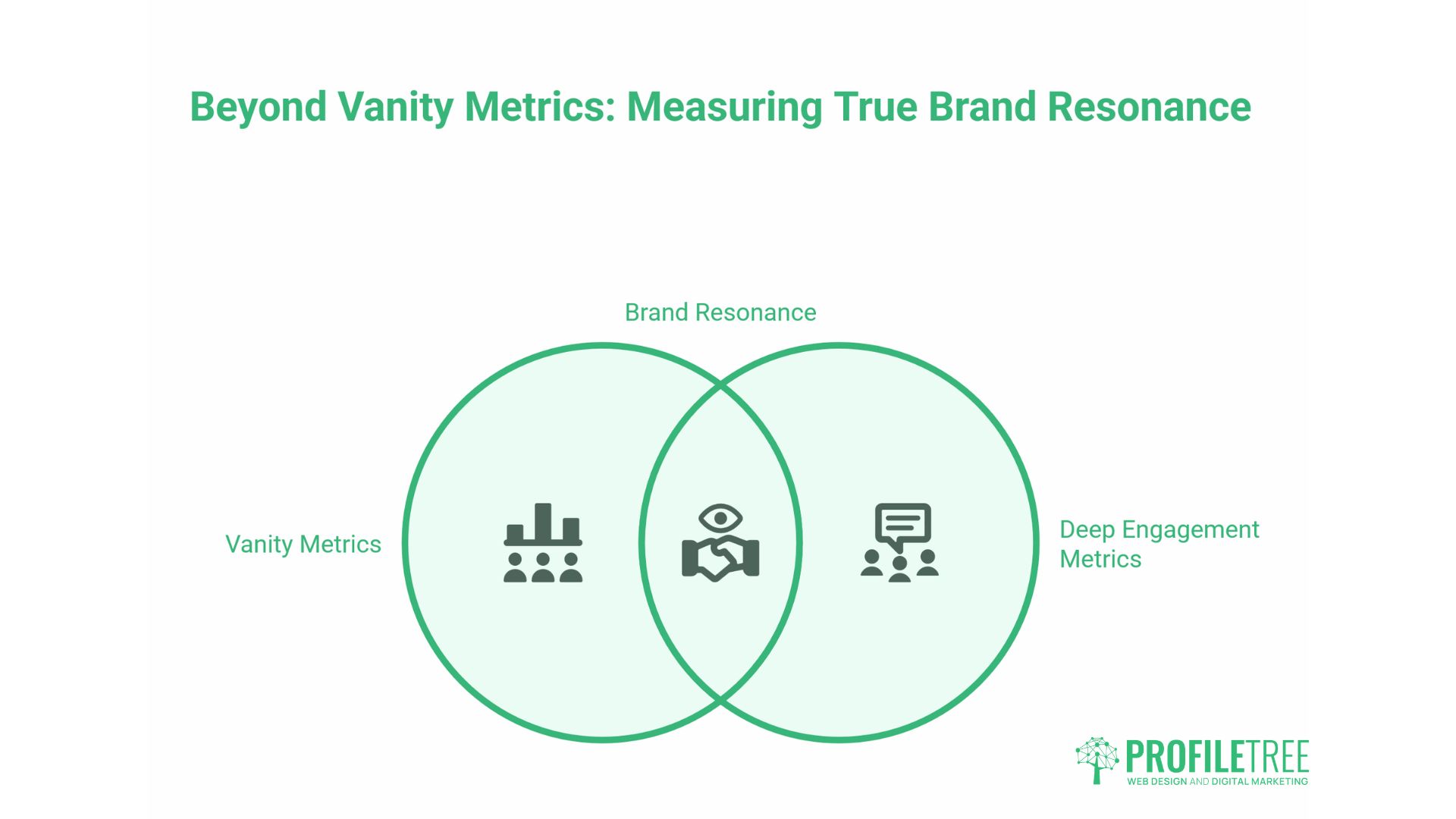
Most metrics commonly used for social media likes, followers, and reach are poor indicators of a brand’s actual presence. More meaningful measurements:
Branded search volume. How many people search for your business name directly? This is the clearest signal that awareness is converting to active interest. Track it in Google Search Console.
Share of voice in organic search. For your core keywords, how often does your business appear relative to competitors? Tools like Ahrefs or SEMrush provide this data. Google Search Console shows your impressions and average position for non-branded queries.
Review volume and recency. Not just your average rating, but the number of recent reviews. A consistent flow of new reviews signals an active, trusted business.
AI citations. An emerging metric: how often does your business appear in AI-generated answers for relevant queries? This can be tested manually by asking tools like ChatGPT, Perplexity, and Google’s AI Overviews about businesses in your category. ProfileTree’s digital training programme covers this in detail for business owners who want to understand how AI-driven discovery works.
Referring domains and press mentions. How many credible external sites link to or reference your business? This is the foundation of both search authority and AI visibility.
How ProfileTree Helps SMEs Build Brand Presence
Brand presence does not arrive fully formed. It is the result of deliberate decisions made across web design, content, video, SEO, and digital strategy, and for most SMEs, the challenge is knowing where to start and what to prioritise.
ProfileTree is a Belfast-based digital agency working with businesses across Northern Ireland, Ireland, and the UK. The team brings together web design and development, content marketing, SEO, video production, animation, and AI implementation under one roof, which matters when brand presence depends on all those channels working in the same direction rather than pulling in opposite directions.
As Ciaran Connolly, ProfileTree Founder, puts it: “Most SMEs we speak to have activity across several channels but no coherent presence. The website, the social media, and the Google listing tell slightly different stories. Getting those aligned is usually the single biggest quick win before anything else.”
Work typically starts with an audit of what exists: the website, the Google Business Profile, review volume, current search visibility, and content output. From there, the team identifies the gaps with the highest impact and builds a plan that reflects the business’s actual capacity, not an idealised content calendar that collapses after six weeks.
For businesses ready to invest in video, ProfileTree’s production team handles everything from scripting and filming to editing and YouTube distribution. For those starting with SEO and content, the agency produces research-led articles and service page copy that builds organic presence over time.
Conclusion
Brand presence is built from consistent, deliberate activity across the channels your customers use, not from a single campaign or a large ad spend. For SMEs in Northern Ireland, Ireland, and the UK, the foundations are the same whether the audience is local or national: a credible website, useful content, genuine reviews, strategic use of video, and a presence on the platforms where your customers make decisions.
If you want to understand where your current digital presence stands and what it would take to improve it, ProfileTree works with businesses across the UK and Ireland to do exactly that. Talk to the team about what a practical brand presence strategy looks like for your business.
FAQs
What is brand presence in simple terms?
Brand presence is how visible and credible your business is across the channels your customers use, such as search, social media, reviews, video, and AI tools. It goes beyond awareness: it means being findable and trustworthy when someone is making a decision.
How is brand presence different from brand awareness?
Awareness is whether someone has heard of you. Presence is whether they can find you, trust you, and choose you when it matters. A business can have high awareness and poor presence if it is hard to find online or has little credible content.
How long does it take to build a noticeable brand presence?
For organic search and content, expect results to compound over 6 to 12 months. Social and review presence can grow faster with a consistent process. There are no reliable shortcuts.
How do I build brand presence on a small budget?
Concentrate on one or two channels rather than spreading effort everywhere. For most UK SMEs, that means Google Business Profile, consistent content on LinkedIn or Instagram, and a steady process for gathering reviews, all for free.