
Web Design for International Audiences: Cultural Considerations That Affect UX and Conversions
Table of Contents
When a business in Belfast, Dublin or Manchester decides to reach customers in Germany, the UAE or Japan, the website they already have is rarely fit for purpose. The layout, colours, navigation and content were built for one cultural context. International audiences bring different expectations, reading behaviours and trust signals, and a site that ignores those differences tends to underperform regardless of how well it ranks.
This guide covers the cultural implications of key website characteristics that matter most when designing for global audiences: from colour psychology and typographic architecture to technical internationalisation, compliance requirements and multilingual SEO. Each section includes practical decisions that web designers and SME owners can act on.
The fundamentals apply whether a business is targeting one additional market or a dozen. Getting them right from the planning stage is considerably less expensive than retrofitting them after launch.
Why Cultural Considerations in Web Design Matter for Business Outcomes
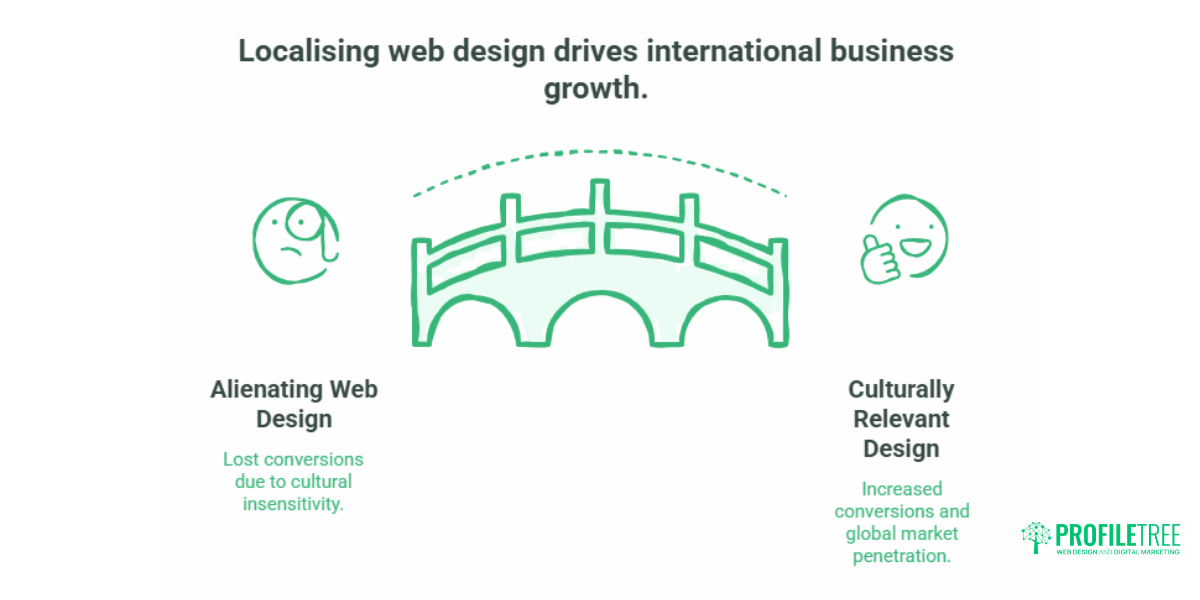
Cultural considerations in web design are not a secondary concern for larger organisations. For any SME that sells across borders, markets into a diaspora community, or competes for customers in more than one country, they are a conversion factor. A visitor who lands on a page that feels visually alien, uses idioms they do not recognise, or structures trust signals in a way that contradicts their expectations is unlikely to enquire or buy.
The distinction between translation and localisation sits at the centre of this. Translation converts words. Localisation adapts the full user experience: colour meaning, imagery, layout density, navigation depth, date and currency formats, accessibility requirements and the cultural framing of calls to action. A site can be accurately translated and still feel wrong to the audience it is targeting.
For businesses weighing the investment, the practical question is whether the cost of proper cultural adaptation exceeds the cost of losing visitors who could have converted. In most cases, when a business has genuine demand in a second market, it does not.
Cultural Implications of Key Website Characteristics: Colour, Imagery and Icons
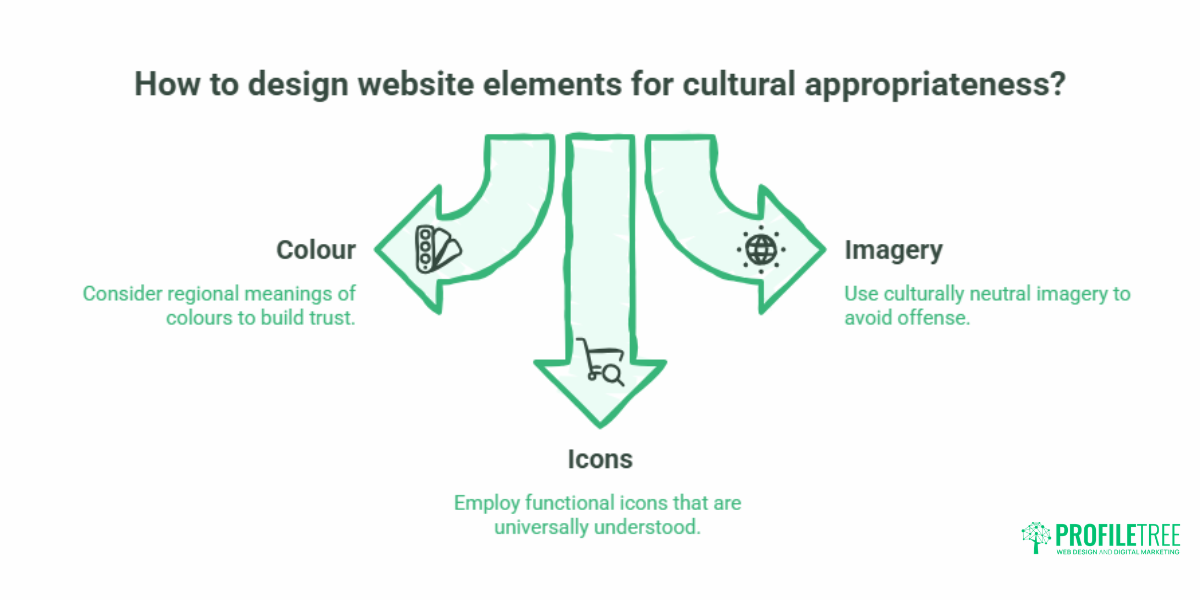
The cultural implications of key website characteristics begin with what visitors see first. Colour, imagery and iconography communicate meaning before a single word is read, and that meaning varies by region in ways that affect whether a site builds trust or undermines it.
Colour and Its Regional Meaning
White communicates purity and simplicity in most Western markets. In parts of East Asia, it is the colour of mourning. Red signals danger or urgency in the UK and Ireland; in China, it is associated with luck and celebration. Green carries environmental connotations in European markets and religious significance in several Middle Eastern contexts. These are not obscure edge cases. They are the default associations audiences bring to a page, and a colour palette built without accounting for the target market can undermine brand trust before the content has been read.
The practical implication for web design is that colour decisions made for a domestic audience need to be reviewed against each target market before internationalisation. A colour scheme that performs well in Northern Ireland is not automatically appropriate for a campaign targeting the Gulf states or Southeast Asia.
Imagery, Icons and Cultural Neutrality
Photography and iconography carry similar risks. An owl icon is associated with wisdom in Western cultures and misfortune in others. Imagery of people eating certain foods, wearing specific clothing or using particular gestures can read as respectful representation in one market and as culturally inappropriate in another. The safest approach for truly international sites is to use parameterised imagery: a modular design system where regional visual components can be swapped without rebuilding the base layout.
Icons that work across language barriers tend to be those grounded in function rather than cultural metaphor. A magnifying glass for search, a shopping trolley for a basket, a house icon for home: these travel well. Icons built around culturally specific metaphors do not.
Applying Hofstede’s Cultural Dimensions to Digital Interfaces
Hofstede’s cultural dimensions theory provides a useful framework for making design decisions with evidence behind them. The key dimensions with direct relevance to web design are Individualism vs Collectivism, Uncertainty Avoidance, Power Distance and Indulgence vs Restraint.
High-individualism cultures, common in the UK, Ireland, the US and Australia, respond to messaging that emphasises personal benefit, choice and individual control. High-collectivism cultures, common across much of Asia and Latin America, tend to engage more readily with messaging that emphasises community, consensus and shared outcomes. This affects everything from headline copy to the framing of testimonials.
High uncertainty-avoidance cultures, including many in continental Europe and Japan, need more explicit trust signals: detailed specifications, clear return policies, named contacts and comprehensive FAQs. Low uncertainty-avoidance cultures tolerate more ambiguity and are less deterred by concise, minimalist pages. Designing for one profile and deploying globally will leave one segment of the audience underserved.
“Every culture possesses a unique narrative that must be embraced in web design,” says Ciaran Connolly, founder of ProfileTree. “Ignoring this can result in a digital presence that feels alien rather than inclusive.”
Typography, Layout Direction and Script Compatibility
Typography is among the most technically demanding aspects of web design for international audiences. It is also one of the most commonly underestimated during the initial build phase.
Managing Text Expansion in Translation
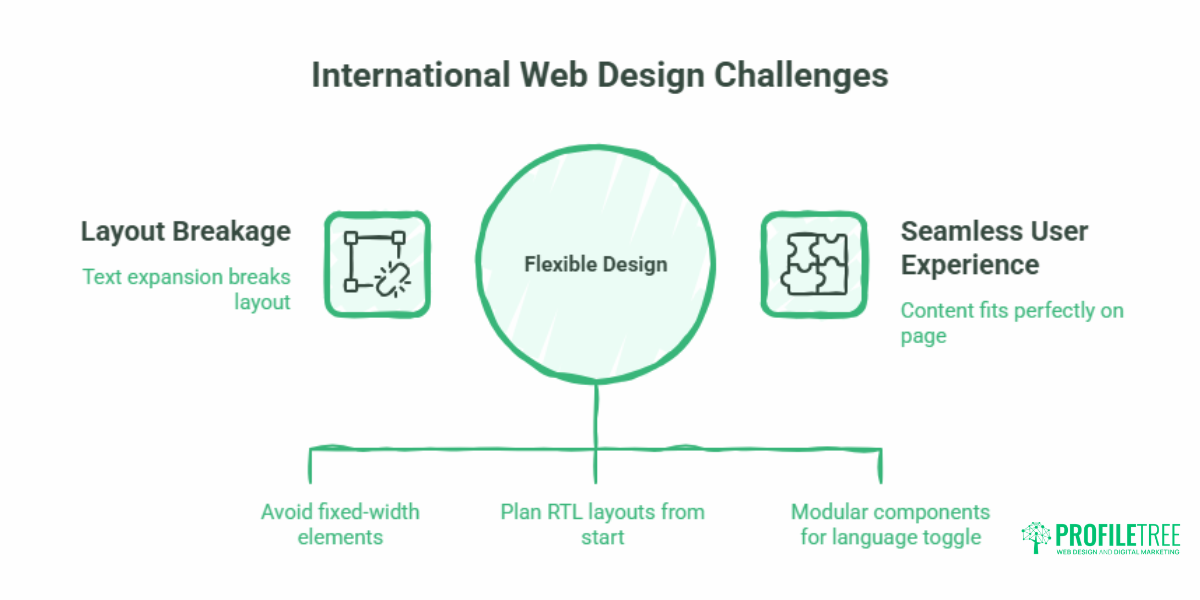
English is a relatively compact language. When a page is translated into German or French, the same content typically requires 30 to 40 per cent more space. In Finnish, it can be longer still. A navigation menu that sits neatly across one line in English can wrap or overflow after translation, breaking the layout and damaging readability. Buttons sized for English labels may truncate translated text. Call-to-action copy that fits a specific container width in one language may require two lines in another.
The practical solution is to build with text expansion in mind from the start: use flexible containers, avoid fixed-width elements that contain text, and test translated versions of all UI components before launch rather than after. Retrofitting flexibility into a fixed-width build is time-consuming and costly.
Bidirectional Layouts: Designing for LTR and RTL Scripts
Arabic, Hebrew, Persian and Urdu are read right to left. A website built for a left-to-right reading flow does not simply need its text reversed to serve these audiences. The full layout logic changes: navigation typically moves to the right, progress indicators move right to left, and directional icons such as arrows need mirroring. CSS logical properties and the HTML dir attribute provide the technical basis for bidirectional support, but they need to be planned into the build architecture from the outset. Adding RTL support as an afterthought often requires rebuilding core layout components.
Bilingual Layouts: Welsh, Irish Gaeilge and the UK and Ireland Context
SMEs operating in Wales and serving the public sector or regulated industries face a specific requirement that most international web design guides overlook entirely. Organisations subject to the Welsh Language Standards are legally required to provide equivalent Welsh and English digital experiences. This is not a design preference but a compliance requirement, and it creates specific layout challenges: Welsh words and phrases are frequently longer than their English equivalents, meaning the text-expansion problem affects even a domestic UK website if it serves a Welsh-language audience.
In Ireland and Northern Ireland, Irish language provision on public-interest and educational websites is an increasing expectation rather than an exception. Managing an English and Irish Gaeilge interface simultaneously requires the same modular component logic as a full internationalisation project: language toggle functionality that does not force a full page reload, conditional typography rules, and copy review by a native speaker rather than a machine translation engine.
For businesses working with ProfileTree on web design or localisation strategy, these regional requirements are addressed during the discovery and scoping phase rather than added as post-launch features.
The video below covers key principles of how a well-structured web design builds support for long-term performance across different markets and audiences.
Technical Infrastructure for International Web Design: Hreflang, CDNs and Compliance
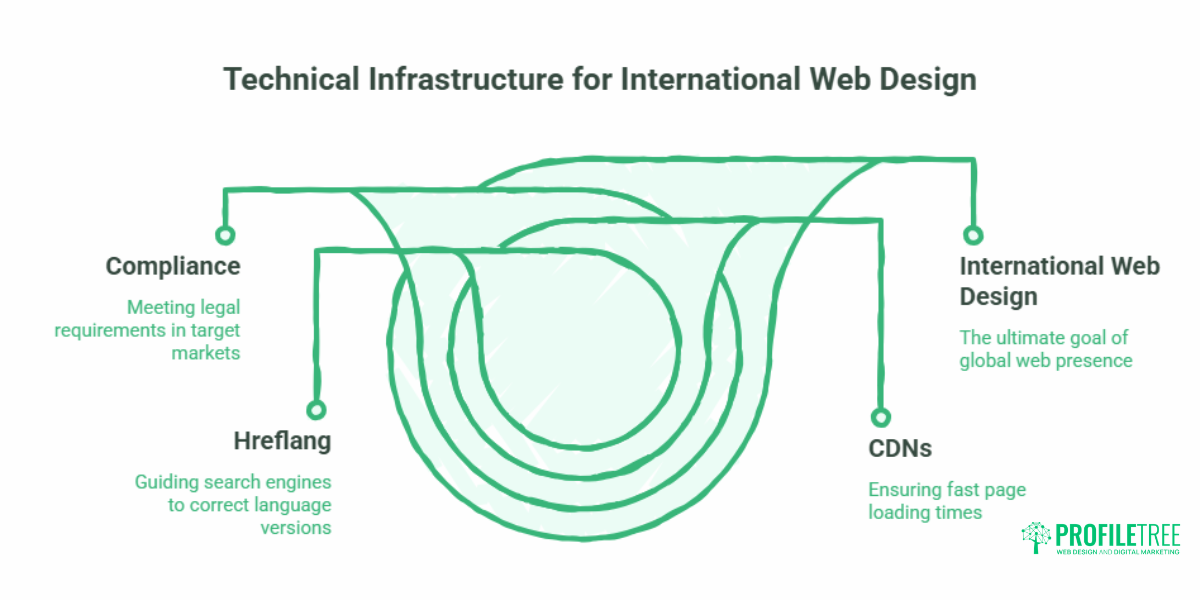
Cultural adaptation and visual localisation are necessary but not sufficient for a website that performs well across multiple regions. The technical architecture underneath the design determines whether search engines can index the correct language version for each audience, whether pages load fast enough to retain international visitors, and whether the site meets the legal requirements of the markets it is entering.
Hreflang Configuration and URL Structure
Hreflang is the HTML attribute that tells search engines which language and regional version of a page to show to which audience. Without correctly implemented hreflang, a site targeting English-speaking audiences in the UK, Ireland and Australia may serve the same URL to all three, missing the opportunity to show region-specific content to each market. More critically, a site with German and English versions that lacks hreflang will often have both versions competing against each other in search results rather than each ranking for its intended audience.
The three main URL architecture options for multilingual sites each carry different trade-offs:
| Structure | Example | SEO Authority | Setup Complexity | Best For |
|---|---|---|---|---|
| Country-code top-level domain (ccTLD) | example.de / example.fr | Strong local signals; authority split across domains | High | Large businesses with significant investment per market |
| Subdirectory | example.com/de/ / example.com/fr/ | Full domain authority shared; recommended for most SMEs | Medium | SMEs expanding into two to five markets |
| Subdomain | de.example.com / fr.example.com | Treated as separate sites by Google; weaker authority passing | Medium | Rarely the best choice for SMEs |
For most SMEs in Northern Ireland, Ireland and the UK expanding into European or global markets, the subdirectory approach offers the best balance of SEO authority preservation and management simplicity. ProfileTree’s SEO services include international architecture planning as part of broader technical SEO engagements.
Content Delivery Networks, Server Location and UK GDPR
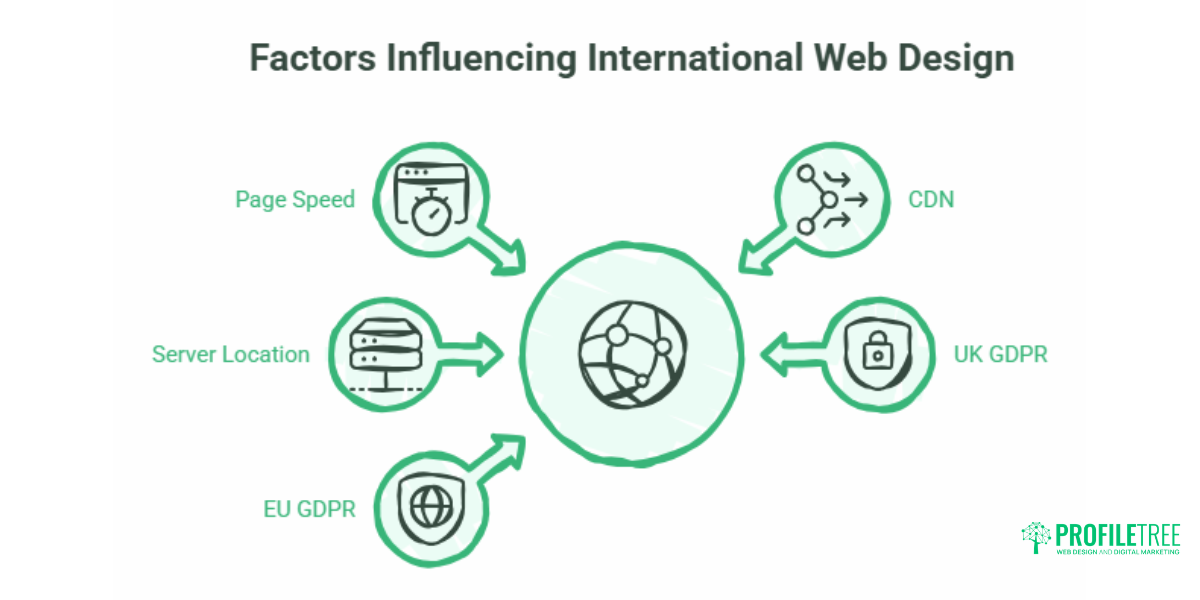
Page speed is a ranking factor and a retention factor. A visitor in Tokyo accessing a site hosted on a single UK server will experience meaningful latency compared to a visitor in Belfast. Content Delivery Networks (CDNs) resolve this by caching and serving static assets from edge nodes physically closer to the visitor’s location, reducing load times across geographies.
Post-Brexit, UK businesses managing international audiences face a specific compliance consideration. UK GDPR and EU GDPR have diverged since January 2021. A UK business serving EU customers must comply with EU GDPR for those users, which affects how personal data is transferred and where it is stored. CDN providers with edge nodes inside the EU can help maintain compliance for EU visitor data; those routing all data through UK-only infrastructure create a potential gap. This is not a theoretical risk for regulated industries: it is a procurement requirement that business customers in the EU will check.
The impact of Brexit on digital marketing and data is covered in more detail elsewhere on the site. For website builds with an international scope, these compliance questions need to be resolved before a hosting and CDN architecture is finalised.
The European Accessibility Act and UK Websites Serving EU Markets
The European Accessibility Act (EAA) came into force across EU member states in June 2025. It applies to businesses providing products and services within the EU market, including digital services. UK businesses selling into the EU are not automatically exempt because they are based outside the EU: if the product or service is accessible to EU consumers, the accessibility requirements apply.
In practical web design terms, EAA compliance overlaps significantly with WCAG 2.1 Level AA requirements: sufficient colour contrast, keyboard navigability, screen reader compatibility, accessible forms and resizable text. A site built to WCAG 2.1 AA for domestic audiences is largely positioned to meet EAA requirements. The gap areas tend to involve documentation, PDFs and video content, which need additional attention. The relevant guidance on using ARIA to improve accessibility covers the technical implementation side of this.
Content Strategy and Multilingual SEO for Global Audiences
A site with localised visual design and technically sound architecture still needs content that serves its audience. For international audiences, this means moving beyond translation into genuine content localisation, and applying SEO methodology separately to each target language and region.
Why Automated Translation Is Not Sufficient
Browser-based auto-translation tools and unedited machine translation outputs share several failure modes. They produce literal translations that do not account for idiomatic meaning. They frequently mishandle technical terms, product names and calls to action in ways that reduce clarity or introduce unintended meaning. They do not adapt the cultural framing of a message, only its surface language. And because machine-translated content tends to follow predictable syntactic patterns, it often reads as obviously non-native to the target audience.
The practical standard for any market that represents a meaningful commercial opportunity is human editorial review of machine translation output, not a choice between the two. The machine provides speed; the human editor provides accuracy, cultural appropriateness and readability.
Multilingual SEO: Keyword Research Across Languages
Keyword research does not translate. The way an English-speaking user in Belfast searches for a product or service is not the same as the way a German-speaking user in Hamburg searches for the equivalent. Direct keyword translation often produces phrases that are technically accurate but not how native speakers actually search. Multilingual SEO requires fresh keyword research in each target language, using tools that access regional search data, to identify the phrases real users in each market are typing.
Structured data also needs to be implemented per-language version, and XML sitemaps need to reflect all language variants with their hreflang attributes for proper search engine indexing. These are technical requirements that sit at the intersection of web development and SEO: getting them right from the start is considerably less disruptive than fixing them after a multilingual site has launched.
Culturally Adapted Content Marketing
Beyond search, content marketing for international audiences requires that the editorial voice, examples, references and calls to action are adapted for each market. A blog post written for a Northern Ireland SME audience, using local business references, UK regulatory context and culturally familiar idiom, will not resonate in the same way with an audience in Poland or Malaysia. The underlying information may be valid across markets; the framing and delivery need to be rebuilt for each.
ProfileTree’s content marketing services address this at the strategy level: defining which content assets can be localised, which need to be built fresh for each market, and how to maintain consistent brand messaging across culturally different editorial contexts.
Testing and Evaluating International Web Design Performance
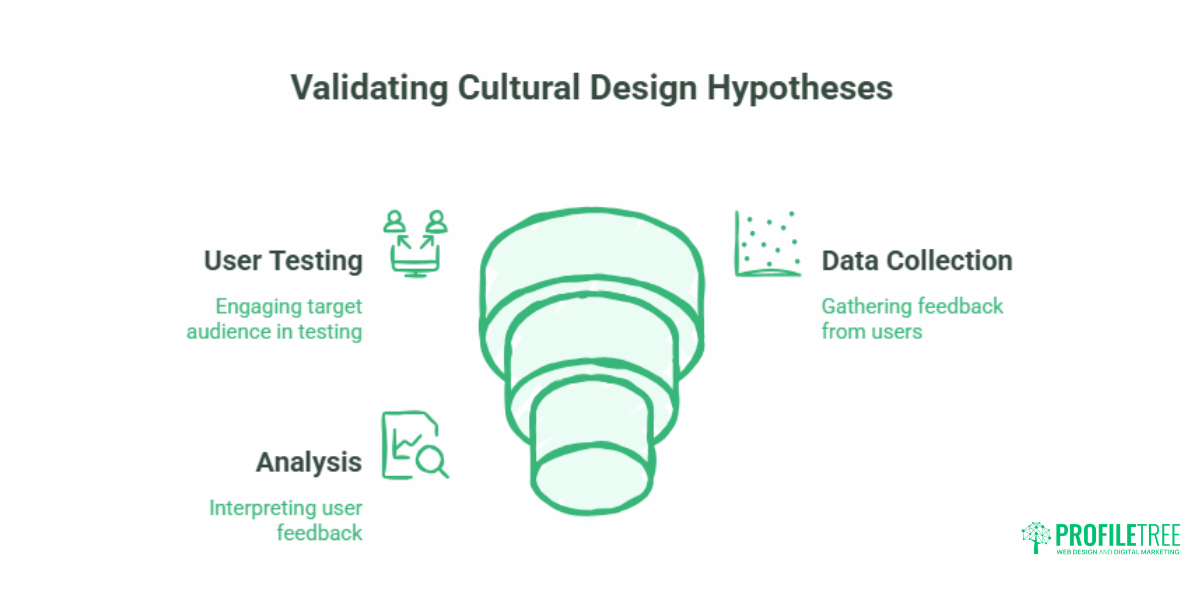
Cultural adaptation decisions made during a web design project are hypotheses until they are tested with real users from the target markets. User testing with participants from the intended audience is the only reliable way to identify gaps between what a design team intended and what the audience actually experiences.
What to Test Across International Audiences
The practical scope of international user testing should cover navigation comprehension (do users from this market understand the information architecture as intended?), icon recognition (do the icons used carry the assumed meaning?), trust signal effectiveness (do the proof points, testimonials and credentials read as credible to this audience?), and form usability (do field labels, error messages and validation patterns work in the local language and cultural context?).
Qualitative testing with five to eight users per market tends to surface the most significant usability issues. Quantitative analysis of conversion rates, bounce rates and time-on-page by country provides the performance layer, and tracking these metrics separately for each target region allows ongoing iteration based on real data rather than assumptions.
Analytics Tools and Regional Performance Tracking
Proper website performance analysis for an internationally targeted site requires segmenting analytics data by country and language from the outset. A site that appears to perform adequately in aggregate may be failing significantly in a specific target market, and that failure will not be visible unless the data is segmented. Setting up location-based segments in Google Analytics or an equivalent platform, alongside conversion tracking per language version, is a prerequisite for meaningful international performance management.
AI-Driven Personalisation in International Web Design
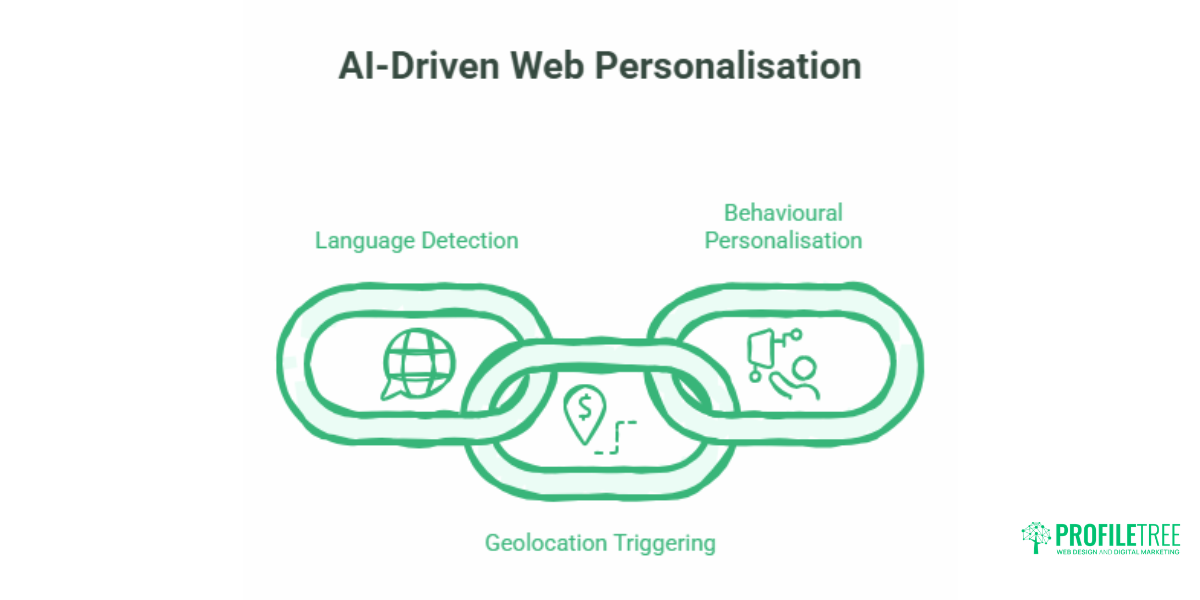
AI tools have moved from experimental to practical in web personalisation over the past two years. For internationally targeted sites, the most useful current applications are language detection and content surfacing (automatically presenting the correct language version based on browser settings and location), geolocation-triggered imagery and currency display, and behavioural personalisation that adapts content recommendations based on regional engagement patterns.
These tools do not replace the foundational work of cultural adaptation: a site that has not been properly localised will not be rescued by personalisation logic. But for a site that has done the foundational work, AI-driven personalisation can meaningfully improve conversion rates by reducing the friction between landing and finding relevant content. ProfileTree’s AI implementation services help SMEs identify which personalisation tools are appropriate for their traffic volumes and international ambitions, and how to integrate them into an existing WordPress build without introducing performance or compliance problems.
Planning International Web Design From the Start
The cultural implications of key website characteristics span every layer of a web project: visual design, typography, architecture, content, compliance and performance. The businesses that handle international audiences most effectively are those that plan for them at the scoping stage rather than adapting after launch. If your site needs to serve more than one market, the right time to address cultural considerations in web design is before the first wireframe is signed off.
Frequently Asked Questions
What is website localisation and how does it differ from translation?
Translation converts text from one language to another. Localisation adapts the complete user experience for a specific market: design, imagery, colour usage, cultural references, date and currency formats, compliance requirements, and the cultural framing of calls to action. A translated site can still feel foreign to the audience it is targeting if localisation has not been carried out.
Is automated translation sufficient for international web design?
For a market that represents a genuine commercial opportunity, automated translation alone is not sufficient. Machine translation produces literal output that does not account for idiomatic meaning, cultural context or the layout implications of text expansion. The practical standard is human editorial review of machine translation output, applied at a minimum to all pages that carry trust signals, calls to action, product descriptions and navigational elements. Pages where a mistranslation would create confusion or damage credibility need native-speaker review, not just a machine pass.
How do cultural differences in colour and imagery affect web design for global audiences?
Colour carries culturally specific associations that affect whether a site builds trust or undermines it before any content is read. Red, white, green and other common web colours carry different meanings across East Asian, Middle Eastern and Western markets. Imagery of people, food, gestures and settings is similarly culturally loaded. The practical implication is that a colour palette and imagery library built for a domestic audience needs to be reviewed against each target market before an international site is launched.
Why does website loading speed matter more for international audiences?
Visitors accessing a site from a country distant from the hosting server experience higher latency. In markets where mobile connectivity is the primary access method, this is amplified. A Content Delivery Network (CDN) addresses this by serving static assets from edge nodes physically closer to the visitor. For UK and Irish businesses with EU audiences, CDN selection also has a compliance dimension: post-Brexit, EU visitor data handling must comply with EU GDPR regardless of where the hosting business is based.
What is the European Accessibility Act, and does it apply to UK websites?
The European Accessibility Act (EAA) applies to businesses providing digital products and services within the EU market. UK businesses selling to EU consumers are not automatically exempt on the basis of being UK-based. If the service is accessible to EU users, the accessibility requirements apply. In practical terms, a site built to WCAG 2.1 Level AA covers the majority of EAA web requirements. The gaps are most commonly found in document accessibility (PDFs and downloadable files) and video content.
How do you design for Welsh or Irish bilingual layouts without doubling costs?
The most efficient approach uses modular component architecture and CSS logical properties, so language content can be swapped without rebuilding the layout. A parameterised translation system, where the design is built to accommodate the longer text strings common in Welsh and Irish Gaeilge, avoids the need to create separate design files per language. The key investment is in the initial build architecture and in human review of translated copy, not in producing duplicate designs. This approach works within WordPress using established multilingual plugins and does not require a separate codebase per language.
What are the prime considerations for culturally sensitive web design for global audiences?
The most important considerations are: colour and imagery choices reviewed against each target market; typography and layout built to handle text expansion and bidirectional scripts; technical architecture (hreflang, CDN, URL structure) planned before build rather than retrofitted; compliance requirements (WCAG, EAA, GDPR) scoped by market; multilingual SEO conducted with native-language keyword research; and user testing with real participants from each target audience before and after launch. The target market is critical to enhancing user experience and overcoming potential barriers.