
AI Implementation for SMEs: A Practical Cost and ROI Roadmap
Table of Contents
AI implementation in SMEs has moved past the “should we?” stage. Across Northern Ireland, Ireland and the UK, most business owners have already accepted that some form of AI adoption is coming. What holds them back is much more practical: nobody has given them a straight answer on what it actually costs, what it genuinely returns, or how UK and EU rules apply once a business starts using it. ProfileTree, a Belfast-based digital agency working with SMEs across these markets, put this guide together to answer those questions directly, without the vendor bias or inflated projections that dominate most AI implementation content.
The Real Cost of AI Implementation: Three Investment Tiers
Cost is the first question most SME owners ask, and it’s also where the most misleading information circulates. Published pricing for AI tools typically covers only the software licence. The true cost of an AI implementation roadmap for an SME is meaningfully higher once integration, data preparation, training, and ongoing governance are included.
Most SMEs fall into one of three broad investment bands, though the boundaries blur in practice.
The entry-level tier covers off-the-shelf tools: a customer service chatbot, an AI-assisted email platform, or a subscription add-on to an existing CRM. This typically costs £100-£500 per month in subscription fees, with modest setup time and minimal disruption to existing workflows. Widely available tools such as Microsoft Copilot or Google’s Gemini for Workspace often sit at this level, making them a sensible starting point for a business testing whether AI genuinely fits a specific process.
The mid-range tier involves customising an existing platform: connecting it to your CRM or accounting system via APIs, configuring workflows to match your specific processes, and training staff to use it effectively. Depending on the complexity of your current stack, integration work here can range from a few hours of configuration to a project running for several months. Annual contracts for enterprise-grade platforms at this level can run to £ 50,000 or more.
The top tier is bespoke development: a machine learning solution built around your own proprietary data. This can run to £20,000 to £100,000 or more in development costs, plus ongoing maintenance, and is only worth considering when your use case is genuinely distinctive and existing tools can’t address it.
| Tier | What it covers | Typical cost | Best suited to |
|---|---|---|---|
| Off-the-shelf | Subscription AI tools, minimal customisation | £100 to £500 per month | First AI project, testing a single use case |
| Customised platform | API integration with existing systems, configured workflows | Several thousand pounds to £50,000+ annually | A defined process with clear ROI potential |
| Bespoke build | Proprietary machine learning model | £20,000 to £100,000+ | Distinctive use cases existing tools can’t solve |
A realistic annual maintenance budget, regardless of tier, is around 15-20% of the initial implementation cost. Model retraining, staff upskilling, and governance monitoring all carry recurring costs that get consistently underestimated when a business builds its first-year ROI case. Building a conservative financial model isn’t pessimism. It’s the approach that produces better decisions and avoids a project being abandoned mid-way when early returns disappoint inflated expectations, a pattern business automation statistics consistently bear out.
Data preparation is the most frequently underestimated cost. AI systems trained on poor-quality data produce poor-quality outputs, and businesses with fragmented, inconsistent records will spend real time auditing and structuring data before they see returns. For businesses whose website, CRM or booking system isn’t set up to hold clean, structured data in the first place, web development work often needs to be done before any AI tool can connect to it properly. This is one of the most common reasons an AI project stalls before it starts.
Assessing Your AI Readiness Before You Spend
Before any procurement decision, assess your starting position honestly. A useful AI readiness audit covers four areas: data quality and availability, existing technology infrastructure, staff capability, and the documentation of your business processes.
The key question worth answering is: Is your customer data centralised and consistently formatted? Do your existing systems have APIs that allow integration? Does your team have any familiarity with data-driven tools? Are your core processes well enough documented to hand over to a third party?
An honest audit will tell you whether you’re three months from a first deployment or twelve months away with real groundwork required first. Neither answer is wrong. Both are useful, and both are far better to know upfront than to discover halfway through a rollout.
A Six-Step Implementation Framework for SMEs
The gap between AI ambition and AI outcomes almost always traces back to the approach to implementation. Businesses that succeed tend to follow a structured path. Those who struggle typically attempt too much at once, without adequate data preparation or governance in place. The following framework is built around constraints typical to SMEs: limited internal technical resources, tight budgets, and the need to keep the business running throughout.
Step 1: Identify high-value use cases. Not all AI applications deliver equal value. Prioritise processes where the volume of repetitive work is high, the required data already exists in reasonable quality, and the task is well-defined enough to automate without constant exception handling. Customer service automation, marketing personalisation and financial reporting are the three areas where SMEs most commonly see strong early returns. AI forecasting tools are a particularly underused application that often delivers faster payback than more complex deployments, and AI chatbot implementations are frequently the fastest route to a measurable result, given the volume of routine queries most businesses handle.
Step 2: Buy vs build vs customise. Most SMEs should start with commercial off-the-shelf solutions rather than custom development. Custom builds carry higher cost, longer timelines and greater technical risk, and are appropriate only where your use case genuinely can’t be met by existing tools. Customising an existing platform through APIs and configuration suits many SME scenarios, offering more flexibility than pure off-the-shelf without the full complexity of a bespoke build. When evaluating vendors, ask specifically about data ownership terms. Some AI platforms use customer data to train their own models, which creates both competitive and regulatory exposure.
Step 3: Run a contained pilot. Choose one process, set clear success metrics before you begin, and run the pilot for a defined period, typically eight to twelve weeks. This limits financial exposure, generates real performance data for your ROI model, and gives your team time to adapt before a full rollout. A pilot that underperforms against its targets isn’t a failure. The information: the reasons for underperformance (data quality issues, integration friction, user adoption barriers) are precisely what you need to understand before scaling.
Step 4: Upskill your team. AI doesn’t replace the need for human judgement; it changes what that judgement needs to focus on. Staff who previously spent time on data processing will need skills in interpreting AI outputs, managing exceptions and overseeing model performance. Understanding staff AI training needs before committing to a full implementation is a genuine strategic choice between building capability in-house and bringing it in through a delivery partner, and the right answer depends on the scale of your implementation. ProfileTree’s digital training programmes are built specifically for business teams navigating this transition, covering AI literacy, data management and practical application without assuming a technical background.
Step 5: Scale and govern. Once a pilot delivers its target returns, the case for scaling is evidenced rather than assumed. Extend the implementation using the operational model the pilot established, and introduce a governance framework as you go: who owns AI-related decisions, how model performance gets monitored, how errors are escalated, and how compliance obligations are met. Governance isn’t overhead. It’s the mechanism that keeps scaled AI from generating value while creating liability.
Step 6: Review and adapt. AI tools and the regulatory environment around them both move quickly. A framework that made sense at the pilot stage may need revisiting a year later as new tools reach the market or a scheme funding your rollout changes its criteria.
The Human Gap: Managing Change in a Small Team
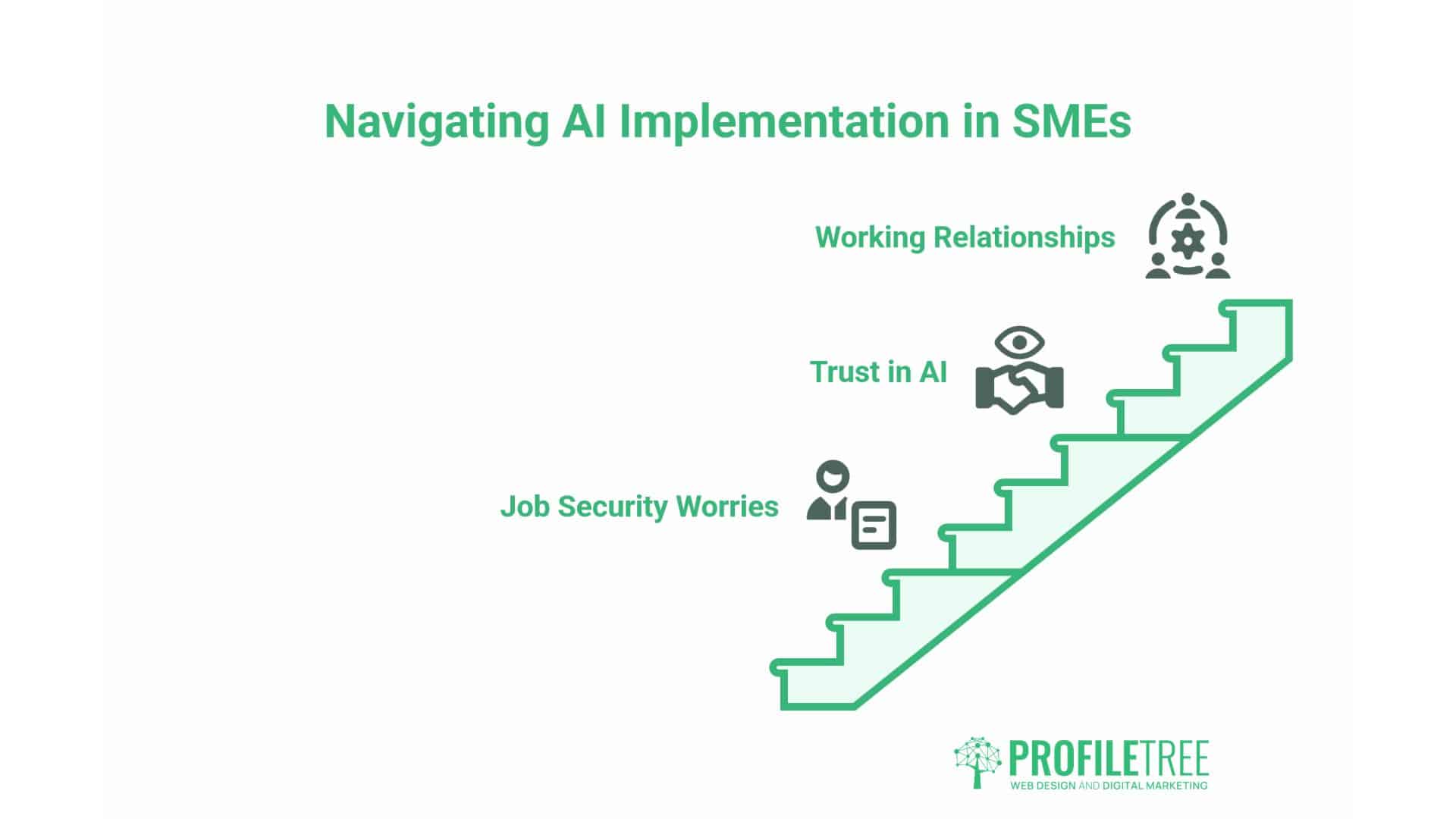
Most guidance on AI implementation focuses on the technology. For SMEs, the harder part is usually the people. In a small, tight-knit team, a new AI tool isn’t just a process change. It touches job security worries, trust in a system nobody fully understands, and the working relationships that make a small business function day to day.
Involving staff early, before a tool is chosen, tends to produce better outcomes than presenting AI as a decision that has already been made. People who understand why a specific process is being automated and what it frees them to do instead adopt new tools with far less friction than those who feel a system has been imposed on them.
As Ciaran Connolly, founder of ProfileTree, puts it: “The businesses that get AI adoption right treat it as a change management project with a technology component, not a technology project with a training afterthought.”
A written AI ethics or use policy, even a short one that covers which data can go into which tools and when a human needs to check an output before it reaches a customer, gives staff a clear reference point and reduces the anxiety that comes from ambiguity. This matters particularly for any AI tool that produces customer-facing text or recommendations, where an unchecked error (an AI “hallucination”) can reach a customer directly. Building a simple human-review step into any customer-facing AI process is one of the most practical safeguards an SME can put in place, and it costs nothing beyond a clear internal rule.
Sector Snapshots: Where SMEs Typically See Value First
The right starting use case varies by sector. A professional services firm handling a high volume of routine client enquiries might find the fastest return in triaging and drafting first-response emails, freeing fee-earning staff from repetitive administrative work. A manufacturing SME could see earlier value in predictive maintenance or demand forecasting, where consistent production data already exists and small improvements in accuracy compound over the course of a year. A retail or hospitality business often finds the clearest early win in personalising marketing content and offers based on purchase history, an area where maximising marketing ROI and AI-driven targeting genuinely overlap.
None of these is guaranteed. They’re illustrative starting points based on where the underlying data and process characteristics typically make automation easier, not a promise of a specific result for any individual business.
UK and EU AI Rules: What SMEs Need to Know
Legal risk is the most frequently cited concern among SME decision-makers who are otherwise willing to move forward with AI. The concern is legitimate. AI systems that process personal data carry real compliance obligations, and the picture has grown more complex with the EU AI Act sitting alongside existing GDPR requirements.
A compliance failure in an AI context carries the same GDPR penalties as any other data breach: up to 4% of global annual turnover or €20 million, whichever is higher. The reputational cost to an SME can be more damaging than the financial penalty.
GDPR and AI. Any AI system processing personal data must meet the same UK GDPR standards as any other data processing activity: a lawful basis for processing, records of processing activities, and appropriate technical and organisational measures to protect data. Team GDPR training is a useful precursor to any AI deployment that touches customer or employee records, and protecting user data properly is a foundational requirement before implementation begins, not an afterthought once a tool is live. Under Article 22 of the UK GDPR, individuals have the right not to be subject to solely automated decisions that produce significant effects, so any AI system that makes or materially influences decisions about customers, credit assessments, or pricing needs a clear route to human review built in. The ICO’s guidance on AI and data protection sets out how these principles apply in practice.
The EU AI Act. The EU AI Act introduces a risk-based framework for AI systems, with the most significant compliance requirements attached to high-risk applications such as employment decisions, credit assessment or biometric identification. Most AI tools used by SMEs for marketing, customer service and operations fall into lower-risk categories with more proportionate obligations. For businesses operating in Ireland or selling into the EU from Northern Ireland, the Act applies directly, which creates a genuinely dual regulatory position that purely GB-based businesses don’t face.
| Area | UK position | EU / Ireland position |
|---|---|---|
| Core framework | Principles-based, distributed across existing regulators (ICO, FCA and others) | Risk-based, structured under the EU AI Act with tiered obligations |
| Personal data | UK GDPR applies to any AI system processing personal data | EU GDPR applies where EU customers’ data is processed |
| High-risk applications | Handled sector by sector through existing regulators | Explicit high-risk category with documentation and oversight requirements |
| Who this affects most | UK-only SMEs | Ireland-based SMEs and NI businesses selling into the EU |
For most SMEs operating purely in the UK market, practical compliance requirements are primarily UK GDPR obligations. The key action is confirming that vendor agreements clearly set out data ownership, processing purposes, and the protections in place for any personal data your AI systems handle.
Funding Your AI Investment: UK and Irish Support Schemes
The cost picture for SME AI implementation is materially affected by available funding, which is more developed than most business owners realise. Innovate UK’s BridgeAI programme is the primary vehicle for AI adoption support in the UK, providing funded consultancy, access to AI expertise and, in some cases, direct grant support for pilot projects. Eligibility is broad, covering sectors from manufacturing and professional services to creative industries. Beyond BridgeAI, Innovate UK runs a regular cycle of Smart Grants and sector-specific challenges that include AI applications, and Northern Ireland businesses can also access Invest NI’s digital transformation programmes.
In Ireland, Enterprise Ireland’s Digital Transition Fund provides up to €25,000 in funding for qualifying SMEs undertaking significant digital transformation projects, including AI implementation. Local Enterprise Offices offer Trading Online Vouchers and Digital Consultancy Vouchers that can help cover the cost of AI tools, implementation support, and training.
The important practical detail across all these schemes is that applications must be submitted before spending begins, accompanied by clear project plans and measurable outcomes. A structured approach to investing in technology, one that maps grant eligibility against your implementation roadmap, meaningfully reduces the net cost of getting started, and working with an implementation partner experienced in these funding mechanisms tends to improve application success rates.
Calculating Return on Investment
ROI from AI typically arrives through four channels: direct cost reduction from fewer hours of manual labour; revenue growth from improved marketing performance and conversion rates; risk reduction from fewer errors and faster compliance; and strategic capability from faster decision-making or new service offerings.
The most reliable way to build an ROI model is to start with a single, specific process. Identify its current cost in hours, headcount and error rates. Model what AI intervention would reduce those costs to, calculate the implementation cost, and divide the net saving over three years by that investment. If the payback period is under 18 months, the case is strong. If it stretches beyond three years, it’s worth asking whether a different use case would deliver a faster return.
Whether this is your first AI project or part of a broader digital marketing strategy, the same discipline applies: measure the process before you automate it, so you have something real to compare the result against.
Overcoming the Barriers That Stall AI Projects
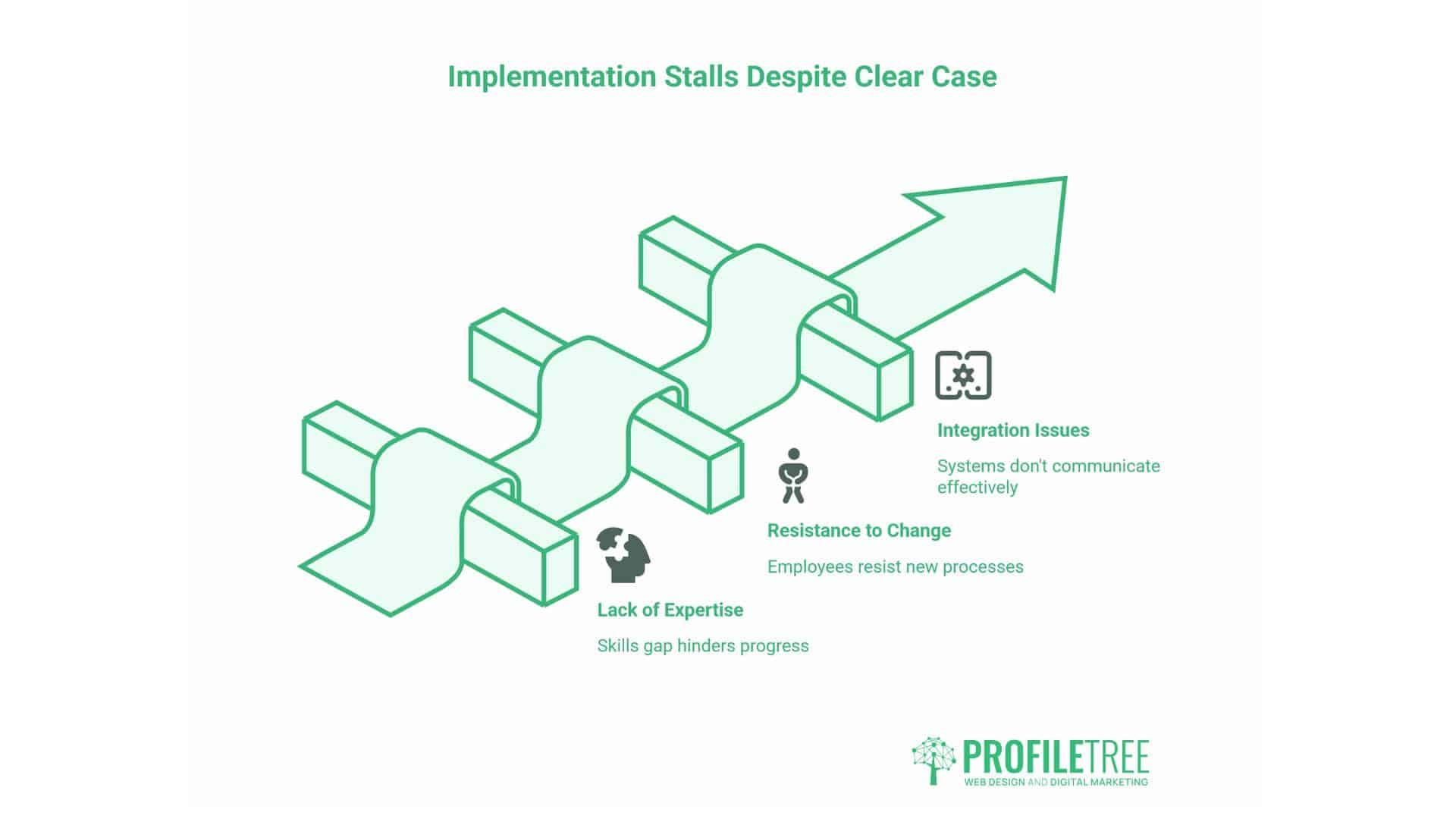
Even when the financial case is clear and funding is available, implementation stalls due to three recurring barriers.
The skills gap is the most consistently cited obstacle. Many SME teams have no experience with AI tools, data management or the analytical thinking needed to get value from AI outputs. The answer isn’t necessarily hiring. It’s training existing staff and, where specialist capability is genuinely needed, accessing it through a delivery partner rather than recruiting permanently for a capability the business will eventually build in-house. Machine learning techniques have historically required specialist expertise, but that’s changed substantially with managed platforms and user-friendly interfaces. Still, teams need a baseline of AI literacy to use these tools well and to question outputs rather than accept them automatically.
Cost uncertainty is the second barrier. Without a clear, bounded cost and a credible ROI timeline, investment approval is difficult in any organisation, and particularly so where capital decisions are closely scrutinised. The framework in this guide, starting with a readiness audit, running a contained pilot, and building your ROI model from real pilot data, is designed to replace that uncertainty with evidence rather than optimism.
Data privacy concerns are the third barrier. Many business owners worry that using AI means exposing customer data to third-party systems they can’t fully control. A solid grounding in business risk management helps frame these concerns proportionately: the answer isn’t to avoid AI, but to select tools appropriate to your data sensitivity, include data processing obligations explicitly in vendor contracts, and put in place the protections your GDPR obligations already require. For business leaders wanting a broader grounding before committing budget, AI entrepreneur books offer a useful, low-cost starting point, and further reading on AI in the workforce, AI for customer onboarding, and AI in customer support provides more in-depth coverage of specific applications.
Where to Start: AI Implementation in SMEs
AI implementation isn’t a single decision. It’s a sequence of structured choices about where to start, what to spend, and how to manage the change internally. SMEs that begin with an honest readiness assessment and a contained pilot consistently see better outcomes than those attempting a wholesale transformation in one move.
The commercial case is real, funding support exists in both the UK and Ireland, and the compliance obligations, while genuinely more complex for businesses straddling UK and EU rules, are manageable with the right groundwork. What’s needed now is a clear starting point: one process, measured honestly, before you commit to the next step.
All prices and figures in this guide are indicative UK and Ireland examples and correct at the time of writing. Use them as a benchmark rather than a fixed quotation.
FAQs
How much does AI implementation actually cost for a small business?
Costs vary significantly by scope and approach. Off-the-shelf tools typically cost £100 to £500 per month. Customised platform integrations can run from a few thousand pounds to £50,000-plus annually. Bespoke development runs from £20,000 to £100,000 or more.
Is there government funding for AI adoption in the UK or Ireland?
Yes. In the UK, Innovate UK’s BridgeAI programme offers funded consultancy and project support, with Invest NI supporting Northern Ireland businesses through digital transformation schemes. In Ireland, Enterprise Ireland’s Digital Transition Fund and Local Enterprise Office vouchers can contribute to the costs of AI tools, implementation, and training.
Do I need a data scientist to start using AI?
Not for most first implementations. Modern AI platforms and automation tools are designed for business users rather than technical specialists. You do need staff who can interpret outputs critically and manage exceptions, but that’s a training challenge rather than a recruitment one.
What’s the easiest AI tool for an SME to start with?
Widely available, subscription-based tools such as Microsoft Copilot or Gemini for Workspace tend to offer the fastest route to a first result, since they require minimal setup and integrate with tools many businesses already use.