
SEO Myths Debunked: The Agency Reality Check for UK SMEs
Table of Contents
Bad SEO advice is everywhere. Business owners across Northern Ireland, Ireland, and the UK are regularly told that rankings can be guaranteed, that AI content is penalised by Google, that more backlinks always win, or that local SEO is only for corner shops. These are SEO myths, and acting on them wastes money and stalls growth.
ProfileTree audits and rebuilds websites and SEO strategies for SMEs across Northern Ireland, Ireland, and the UK. The same misconceptions keep surfacing, often planted by agencies selling shortcuts or by clients who read something outdated in a trade newsletter two years ago. This guide directly addresses the most damaging SEO myths, explains why each belief took hold, and outlines what the reality looks like for a business trying to grow organically.
The Cost of Believing SEO Myths
SEO myths are not harmless misunderstandings. When a business owner believes that rankings can be bought cheaply, locked in permanently, or separated from the quality of their website, they make budget decisions based on that belief. They buy packages that do nothing, leave technical problems unfixed for years, or dismiss organic search entirely after one failed attempt.
The most dangerous SEO myths are the ones that contain a kernel of truth. Keyword density mattered enormously in 2008. Exact match domains did carry a ranking advantage until Google’s 2012 EMD update reduced that signal. Social signals were genuinely debated as a ranking factor for several years. These beliefs had a factual basis at some point, which is precisely why they are so difficult to dislodge.
What follows is a myth-by-myth breakdown drawn from patterns that recur in SME web design, SEO strategy, and digital marketing work across the UK and Ireland.
The Core SEO Myths Debunked
The following myths are ordered by how frequently they cause real commercial damage, not by how often they appear in blog posts.
Myth 1: SEO Delivers Fast Results
The Reality: Organic search takes months, not weeks. For a new page on a competitive topic, expect three to six months before meaningful traffic arrives, and longer in competitive sectors.
This myth persists because paid advertising works immediately. A Google Ads campaign starts showing clicks the same day it goes live. Business owners sometimes assume SEO should behave similarly, especially when they see their new page indexed within 48 hours.
Indexing is not ranking. Being in Google’s index means Googlebot found it. It says nothing about where the page appears for any given query, or whether it will ever appear on page one. Rankings build as the page earns authority, as internal links point to it, and as content depth demonstrates topical relevance over time.
For SMEs setting SEO budgets, this has a practical implication: the first three months of an SEO campaign should be measured by leading indicators (crawlability, indexed pages, improved technical scores, content published) rather than revenue. Expecting immediate ROI from organic search leads to campaigns being cancelled before they have had time to compound.
Myth 2: AI-Generated Content Is Penalised by Google
The Reality: Google does not penalise content for being produced with AI. It penalises content that is unhelpful, thin, or fails to demonstrate genuine expertise.
This is one of the most common SEO myths circulating, driven partly by misinformation and partly by Google’s own messaging, which has been imprecise. Google’s guidance on AI content has consistently stated that it rewards content that is “helpful, reliable and people-first,” regardless of how that content was created. What Google penalises is mass-produced, low-effort content that offers no real value to readers.
The risk for SMEs is publishing content that reads like a template, answers nothing specifically, and fails E-E-A-T (Experience, Expertise, Authoritativeness, Trustworthiness). AI-assisted content that is reviewed, edited, grounded in real experience, and written for a specific audience performs well. AI-generated filler that could apply to any business in any country does not.
ProfileTree’s AI implementation work with clients includes helping businesses understand where AI tools belong in a content workflow and where human expertise must lead. The distinction matters for SEO.
Myth 3: Keyword Stuffing and Exact Match Domains Still Work
The Reality: Keyword stuffing has been actively penalised since Google’s Panda update in 2011. Exact-match domains carry negligible ranking benefits today.
Why this myth lingers: both tactics produced results for a period, and some websites that benefited from them still rank, leading to the false impression that the tactic is still working. In most cases, those sites rank despite their keyword practices, not because of them.
Modern keyword strategy is about topical relevance and semantic coverage. A page about local SEO for Belfast businesses should use the phrase naturally, cover related subtopics (Google Business Profile, NAP consistency, local citation building), and address the questions real searchers ask. Stuffing “Belfast SEO” into a page 40 times signals nothing to Google and actively degrades the reading experience.
Exact-match domains (domains like belfast-seo-agency.co.uk designed solely around a keyword) were quietly devalued by Google in 2012. The domain name is a weak ranking signal. Brand authority, content quality, and backlink profile are the signals that matter.
Myth 4: More Backlinks Always Equal Higher Rankings
The Reality: Link quality outweighs link quantity by a meaningful margin. One backlink from a reputable UK industry publication can outperform 500 links from low-authority directories.
This myth has survived in part because backlinks are quantifiable. It is easy to sell “50 backlinks per month” as a service. It is harder to sell “we will pursue three high-quality editorial placements over the next quarter,” even though the latter produces better outcomes.
Google’s Penguin update (first rolled out in 2012, now integrated into the core algorithm) permanently changed this. Sites that built large volumes of low-quality links saw ranking drops. The update runs in real-time, meaning toxic links are discounted continuously rather than in periodic sweeps.
For a Belfast SME, a single link from a Northern Ireland business publication, a local chamber of commerce, or a relevant trade body carries a more authoritative signal than a bulk purchase of directory links. Link-building should be treated as a relationship and reputation exercise, not a volume game.
As Ciaran Connolly, founder of ProfileTree, puts it: “Link-building should mirror relationship-building. It is about creating genuine, authoritative connections that bring long-term value to your SEO strategy, not chasing numbers on a dashboard.”
Myth 5: Social Media Likes Are a Direct Ranking Factor
The Reality: Social signals (likes, shares, follower counts) are not a confirmed direct ranking factor in Google’s algorithm. Google has stated this on multiple occasions.
The confusion is understandable. Pages that perform well on social media often also rank well in search. But correlation is not causation. Content that earns shares tends to be well-researched, specific, and genuinely useful. Those same qualities lead to higher rankings. Both are outputs of the same thing: content worth reading.
There is an indirect benefit: high social visibility can drive referral traffic, increase branded search volume, and attract backlinks from people who discover content through social channels. All of these do influence SEO. But optimising for social engagement as a route to rankings is chasing a shadow of the actual mechanism.
For SMEs with limited marketing time, this matters for prioritisation. Producing one thoroughly researched, well-structured article that earns a backlink from an industry site will outperform a month of social posting for search rankings, even if the social activity drives short-term traffic.
Myth 6: Technical SEO Is Only for Large Websites
The Reality: Technical SEO is arguably more important for small business websites than for large ones. A single crawl error on a five-page brochure site can prevent the whole site from being indexed.
This is one of the SEO myths that does real, silent damage. Small business owners assume that technical SEO (site speed, crawlability, structured data, mobile responsiveness, Core Web Vitals) is something enterprise companies worry about. In practice, a slow, poorly structured small business website loses search visibility just as surely as a large one.
The web design decisions made when a site is built determine its technical SEO foundation. A site built on poorly written JavaScript that prevents Googlebot from reading service page content, or a WordPress theme that generates thousands of near-duplicate tag archive pages, or a site without a proper internal linking structure, will underperform regardless of the content published on it.
When ProfileTree audits websites for SMEs, technical problems are the most common finding. They are also the most fixable. A site audit followed by a structured web development sprint to resolve crawl issues, improve page speed, and implement schema markup regularly produces ranking improvements within weeks, because the content was always there, but Googlebot could not access or understand it properly.
If your web design and SEO strategy are handled by different people with no communication between them, you are probably paying for SEO that is fighting itself.
Myth 7: Meta Descriptions Are a Ranking Factor
The Reality: Meta descriptions do not directly influence where a page ranks. Google rewrites them frequently anyway, pulling content from the page that matches the specific query.
Meta descriptions matter for click-through rate. A well-written meta description that accurately reflects the page content and speaks directly to what the searcher wants will attract more clicks from search results. Higher click-through rates are a behavioural signal that may indirectly influence rankings over time, but the meta description itself is not a ranking input.
The practical implication: write meta descriptions for humans, not for search engines. They should be accurate, specific, and give a clear reason to click. They should not be stuffed with keywords in the hope that Google will reward them.
Myth 8: Local SEO Does Not Matter for National Brands
The Reality: Local search intent is growing across every sector, and national brands that ignore local SEO leave real traffic and revenue on the table.
Users searching for services with local intent (even when they do not type a city name) are served results based on their location. A national brand with no Google Business Profile, no location-specific content, and no local citation presence will lose those searches to local competitors every time.
For SMEs in Northern Ireland, this cuts both ways. A Belfast business can compete effectively in Belfast search results against much larger national competitors if its local SEO signals are stronger: consistent NAP (Name, Address, Phone number) across directories, a well-maintained Google Business Profile, location-specific service pages, and local backlinks from regional publications and directories.
The misconception that local SEO is only relevant for shops and restaurants has cost many professional services firms, consultancies, and B2B businesses in Ireland and the UK years of organic local visibility.
Myth 9: SEO Is a One-Time Project
The Reality: SEO is an ongoing activity. Rankings shift as competitors publish new content, as Google updates its algorithm, and as search behaviour evolves.
This is perhaps the most persistent of all SEO myths because it is what many business owners want to hear. A one-time project has a defined cost and a defined end. Ongoing SEO requires a budget line that continues month after month.
A useful comparison: maintaining fitness requires ongoing effort. Going to the gym for six months and then stopping will not preserve the results indefinitely. SEO works the same way. The rankings earned through a period of good work will erode if competitors continue publishing content, earning links, and improving their technical setup while your site sits still.
Practically, this means that SEO strategy should be built into recurring business planning, not treated as a periodic spend when traffic drops. The businesses that build consistent organic visibility over the years are the ones that treat SEO as a channel, not a project.
Myth 10: You Need Separate Websites for Different UK Regions
The Reality: You do not need separate domains for London, Manchester, and Belfast. A single well-structured website with properly differentiated location pages will outperform multiple thin regional sites.
This myth has spawned a cottage industry of unnecessary domain registrations and duplicated site builds. The search benefit of separate regional domains is negligible. What Google rewards is unique, substantive, location-specific content that genuinely serves searchers in that area.
A location page for Belfast web design should contain more than the city name swapped into a template. It should include information specific to that market: the nature of local demand, relevant local references, team members serving the area, and local proof points. When those pages have real depth, they rank. When they are thin templates with only the city name changed, they do not, regardless of whether they sit on a separate domain or within a larger site.
Myth 11: Hosting Location Has No Effect on UK or Irish Rankings
The Reality: Server location is a minor but real signal for local search relevance, particularly in markets like Ireland, where a .ie domain hosted on a server in Dublin sends a clearer geographic signal than a .com hosted in the US.
This does not mean that UK businesses must host in the UK, or that a US-hosted site cannot rank well in Irish search results. A properly configured CDN (Content Delivery Network) largely neutralises the speed disadvantage of hosting on distant servers. But for businesses specifically targeting Irish organic traffic, a .ie domain with Irish hosting is a modest supporting signal for local relevance.
The related myth about country-code top-level domains (.co.uk, .ie) is worth addressing: these domains carry a geographic relevance signal for searches in their respective markets. A .ie domain signals relevance to Irish search results. A .co.uk domain signals relevance to UK results. Neither is inherently stronger for global rankings, but for localised search intent, the ccTLD can provide a supporting signal.
Myth 12: Guaranteed Rankings Are a Real Service Offering
The Reality: No agency, tool, or individual can guarantee specific search rankings. Any SEO company making this promise is either misrepresenting what they sell or planning to use tactics that will damage your site in the long run.
Google’s algorithm considers hundreds of ranking signals, none of which any third party controls. Search results are also personalised based on user location, device, search history, and intent. “Position one” for your target keyword varies across users and contexts.
Agencies that guarantee rankings typically do one of two things: they target keywords with so little competition that the guarantee is meaningless (ranking first for a five-word phrase nobody searches), or they use manipulative link schemes that produce short-term ranking lifts before triggering penalties.
When evaluating SEO proposals, the absence of guaranteed rankings is a sign of an honest agency.
The AI and SGE Angle: New SEO Myths
The emergence of Google’s AI Overviews and AI-powered search features has generated a new wave of SEO myths, many of them circulating faster than the evidence to evaluate them.
The most common is that traditional SEO is dead because AI answers will replace organic results. This overstates what AI Overviews actually do. For many informational queries, an AI Overview appears above organic results. For commercial queries (where a user is looking to hire a service, buy a product, or get a quote), traditional organic results remain dominant. The buying journey still runs through search, and the businesses that rank for commercial terms still receive the traffic.
A second emerging myth is that optimising for AI Overviews requires a completely different strategy from traditional SEO. The evidence does not support this. Pages that are cited in AI Overviews tend to be those that rank well organically, answer specific questions clearly, use structured formatting, and carry genuine authority. These are the same characteristics that traditional SEO rewards.
The practical instruction for SMEs is the same as it has always been: produce specific, well-structured content that genuinely answers what your target audience is asking. That approach serves both traditional organic rankings and AI citation eligibility.
Regional Realities: SEO Myths in the UK and Ireland
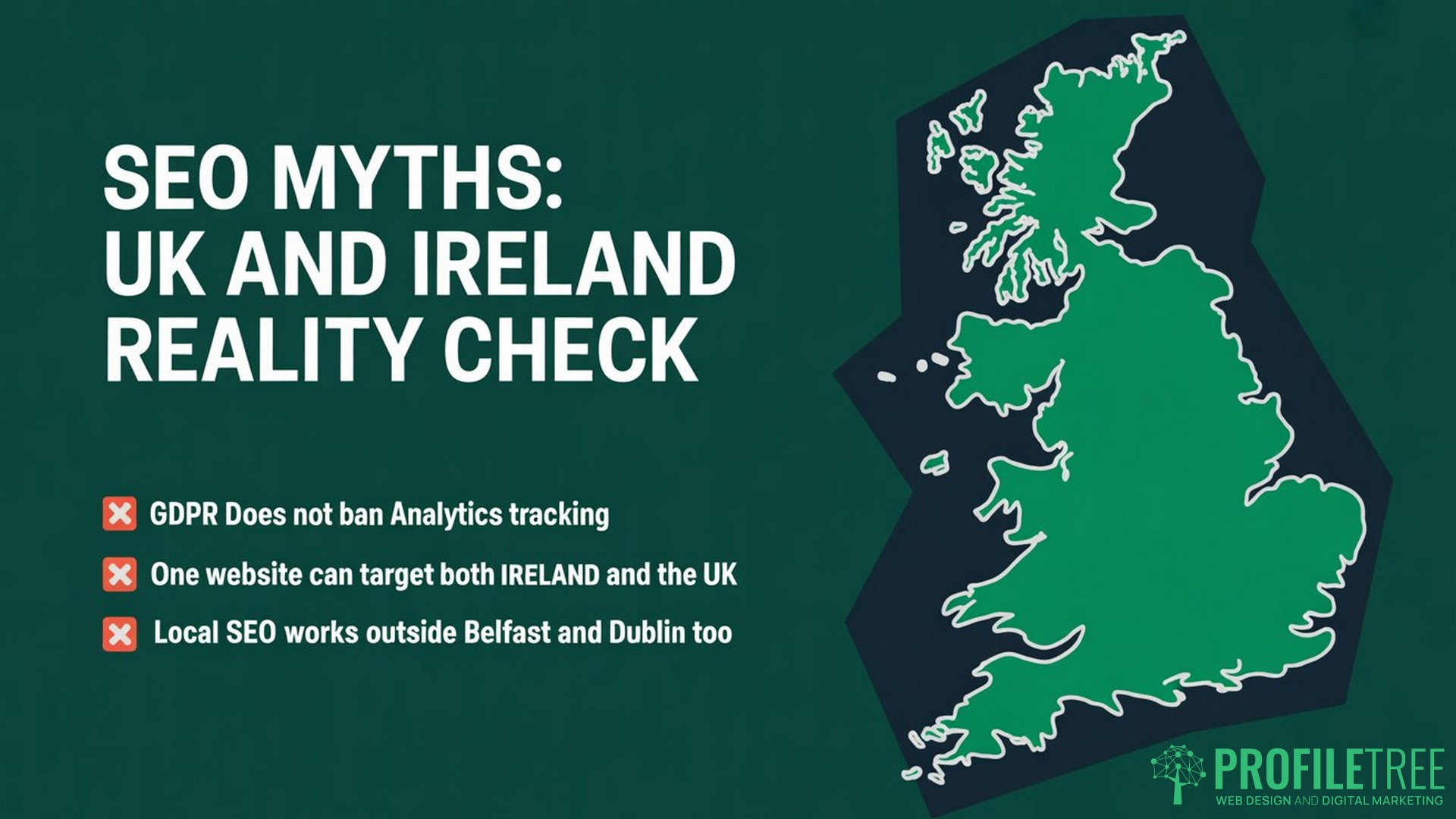
Most SEO myth content is US-centric. A few points are specific to businesses operating in the UK and Irish markets.
The GDPR and tracking myth: Some business owners believe that GDPR compliance requires removing analytics tracking entirely, which then leaves them unable to measure SEO performance. This is not accurate. First-party analytics with proper consent mechanisms are fully GDPR-compliant. Running SEO without performance data is a strategic disadvantage, not a legal requirement.
The separate-site myth for cross-border businesses: companies operating in both Northern Ireland and the Republic of Ireland sometimes believe they need one site for each jurisdiction. In most cases, a single well-structured site with clear geo-targeting signals, location pages, and a correctly configured Google Search Console property for each country is sufficient.
The “big city only” myth: businesses in Derry, Newry, Cork, or Galway sometimes assume that local SEO is only worth pursuing for competitors based in Belfast or Dublin. Localised search intent is real in every town and city. The competitive field is also smaller outside major cities, making it proportionally easier to rank for local service queries.
How to Spot a Myth-Based SEO Pitch
Business owners evaluating SEO proposals should treat the following as red flags.
Any promise of guaranteed first-page rankings should immediately raise questions. As explained above, no ethical agency makes this promise.
Monthly deliverables measured only in link quantity (50 backlinks per month) rather than link quality, placement, and relevance suggest a volume-based approach that does not reflect how Google actually works.
An SEO proposal that omits technical SEO, site structure, or web design compatibility treats search in isolation. Rankings are built on the foundation of a crawlable, well-structured website. Agencies that skip this entirely are selling content and links without addressing whether the site can actually benefit from them.
Reporting dashboards that show only keyword positions and hide traffic, leads, and conversion data make it easy to appear successful while delivering nothing of commercial value.
Pricing that falls well below market rate usually reflects a volume-based model that uses tactics that produce short-term results but long-term problems. Good SEO is a skilled, time-intensive service. It is priced accordingly.
Then vs Now: How SEO Has Changed
The table below summarises how several common tactics have shifted. Many SEO myths persist because business owners recall a time when the “then” column worked.
| Tactic | 2015 Approach | Current Reality |
|---|---|---|
| Keyword targeting | Exact keyword density targets | Semantic relevance across a topic; natural usage |
| Backlinks | Volume of links from any domain | Quality and relevance of linking domains |
| Content length | Longer always better | Appropriate depth for the query; no padding |
| Domain choice | Exact match domains for ranking lift | Brand domain; ccTLD for local signal |
| Meta descriptions | Stuffed with keywords | Written for click-through rate; Google rewrites many |
| Technical SEO | Optional for small sites | Foundation-level requirement for all sites |
| Local SEO | Only relevant for shops | Relevant for any service with a geographic audience |
| AI content | Not applicable | Quality-assessed, not tool-assessed |
ProfileTree’s content and SEO team covers the principles behind building organic visibility that lasts, without shortcuts and without the myths that waste business budgets.
Frequently Asked Questions
Is SEO dead because of AI?
No. SEO has changed considerably as AI-powered search features have expanded, but organic search remains a primary channel for commercial discovery. AI Overviews appear prominently for many informational queries, but businesses and services are still found, evaluated, and contacted through organic results. The content and authority signals that earn organic rankings are the same signals that earn AI Overview citations. A well-executed SEO strategy serves both simultaneously.
Can I do SEO myself, or do I need an agency?
Plenty of SME owners handle their own SEO successfully, particularly the parts that depend on knowing the business: writing service pages that answer real customer questions, keeping a Google Business Profile current, and building relationships that lead to local links. The parts that usually need outside help are technical diagnosis and anything requiring tools you would otherwise pay for individually. A reasonable middle path is to commission a technical audit and a content plan, then run the ongoing work in-house with periodic review. What rarely works is doing nothing for six months, then buying a cheap package to catch up.
Will redesigning my website damage my rankings?
It can, and it frequently does, but the cause is almost always the migration rather than the design. Rankings drop when URLs change without redirects, when page content is shortened during the rebuild, when heading structure is flattened for visual reasons, or when a staging site is launched with indexing still blocked. A redesign that keeps URLs stable, preserves content depth, and carries over internal links tends to hold rankings and often improves them through better page speed. Ask any designer you commission how they plan to handle redirects before work starts, not after launch.
Should I disavow toxic backlinks?
Usually not. Google discounts low-quality links automatically rather than passing a penalty for them, so for most SMEs the disavow file solves a problem that does not exist. The exception is a manual action in Search Console naming unnatural links, or a site with a documented history of paid link schemes it is trying to clean up. Disavowing links you merely dislike carries real downside, because removing a link you misjudged means losing whatever value it was passing. If you have no manual action and no history of buying links, spend the time on earning better ones instead.
How do I know if my website has a technical SEO problem?
Three checks will catch most of it. Search your domain in Google using the site: operator and compare the number of results against the number of pages you think you have; a large gap in either direction points to indexing or duplication problems. Open Google Search Console and read the Pages report, which lists what has been excluded and why. Then run your two or three most commercially important pages through PageSpeed Insights on mobile. If those three checks look reasonable, your foundations are probably sound enough to build on. If any of them throws up something you cannot explain, that is where the budget should go before content or links.
Does PPC advertising improve organic rankings?
No, not directly. Running Google Ads does not influence where your pages appear in organic search results. There is no direct communication between Google’s paid advertising and organic ranking systems. The indirect benefit is that PPC data can inform your SEO keyword targeting: high-converting paid keywords often make strong organic targets, and PPC can build brand familiarity that leads to higher click-through rates on organic results over time.
What is the most common SEO myth that costs businesses money?
From the client work ProfileTree carries out across Northern Ireland, Ireland, and the UK, the most commercially damaging myth is that SEO can be separated from web design and development. Business owners commission SEO services for a website that is technically broken: slow to load, poorly structured, inaccessible to Googlebot on key pages, or built on a framework that generates thousands of near-duplicate URLs. The SEO spend achieves nothing because the site cannot benefit from it. Fixing the technical foundation first, then building content and authority on top of it, is consistently more effective than the reverse.