
Market Share Statistics: Global Data & How UK Businesses Can Use It
Table of Contents
What Are Market Share Statistics?
Market share represents the percentage of total sales within a defined market captured by a single company. If a market generates £100 million in annual revenue and your business brings in £3 million of that, your market share is 3%.
The formula is straightforward:
Market Share (%) = (Your Sales ÷ Total Market Sales) × 100
What makes this figure strategically useful is context. A 3% share in the UK’s £100 billion grocery market represents enormous scale. A 3% share of a specialist manufacturing niche in Northern Ireland could mean you are already the second or third largest player in that space.
As Ciaran Connolly, founder of ProfileTree, puts it: “When we start working with a new client, one of the first questions we ask is not ‘how many visitors does your website get?’ but ‘how visible are you compared to your nearest three competitors?’ That visibility gap is your digital market share problem, and it has a practical solution.
| Concept | Definition | Why It Matters |
|---|---|---|
| Market share | Your revenue as % of total sector revenue | Shows competitive position |
| Relative market share | Your share vs your largest competitor | More actionable than absolute share |
| Digital market share | Your visibility in search, social, and AI results | Directly addressable through digital strategy |
| Share of voice | Your brand’s presence across all marketing channels | Indicates future market share direction |
How to Calculate Market Share: A UK Business Example
The standard calculation divides your company’s sales by total industry sales over a set period, then multiplies by 100. In practice, SMEs in the UK rarely have access to precise total industry figures, so most use proxy measures instead.
Finding Total Market Size Data for UK Industries
For UK-specific figures, the most reliable free sources are the Office for National Statistics (ONS), Companies House filings, and sector trade bodies. Euromonitor International and Statista offer paid datasets with regional breakdowns, while IBISWorld provides UK industry reports at the sector level. For Northern Ireland specifically, the Northern Ireland Statistics and Research Agency (NISRA) publishes detailed business and economic data.
Using Proxy Measures When Exact Data Is Unavailable
Most SMEs work with proxies rather than precise figures. Common approaches include using industry association membership data to estimate total sector revenue, combining Companies House financial filings for the top five to ten competitors in a defined geography, or using Google Trends data to estimate relative search demand compared to competitors.
Calculating Your Digital Market Share
Digital market share is simpler to measure and more immediately actionable. Your share of organic search impressions for a defined keyword set, compared to total impressions across all ranking sites, gives you a working figure. Tools such as Google Search Console, Semrush, and Ahrefs make this calculation straightforward. ProfileTree’s statistics in business decision-making guide covers this data interpretation process in more detail.
Global Market Share Statistics: Key Sectors
Understanding where the dominant players sit in global markets provides UK businesses with a useful reference point, particularly in industries where global platforms compete directly with local providers.
Search Engine Market Share
Google’s dominance in search is not uniform across all countries, but in the UK it is close to total. Google consistently holds above 90% of UK search volume, with Bing taking the majority of the remainder. This concentration matters enormously for UK businesses: the practical implication is that Google rankings are not one option among several — they are the primary channel for organic discovery.
Bing’s growing integration with Microsoft Copilot and AI-powered search features has made it more significant than its raw traffic share suggests, particularly for B2B audiences working in Windows-heavy corporate environments.
E-commerce and Retail Market Share
Amazon holds the largest single share of UK e-commerce, though precise figures shift quarterly. The UK’s overall e-commerce sector is one of the largest in Europe relative to population, with the Office for National Statistics consistently reporting that internet retail accounts for a significant proportion of total retail spending. Grocery has seen the most visible market-share shifts in recent years, with the Kantar grocery panel regularly reporting the continued growth of Aldi and Lidl at the expense of the traditional Big Four supermarkets.
Mobile Operating Systems
iOS and Android, between them, account for virtually all UK smartphone usage, with Android holding a larger share than in the US market. For digital marketers, the practical significance is that mobile-first design is not optional — over half of UK web traffic comes from mobile devices, and this proportion is higher still among younger demographics.
Digital Advertising Market Share
Meta (Facebook and Instagram) and Google, between them, account for the substantial majority of UK digital advertising spend. TikTok has rapidly grown its share, particularly among consumer brands targeting under-35 audiences. LinkedIn holds a disproportionately large share of B2B advertising spend relative to its overall traffic volume. For SMEs setting digital budgets, these concentrations mean that diversification across three or more channels typically carries less risk than an all-in investment in a single platform.
UK and Ireland Market Share Insights: What SMEs Need to Know
Global statistics provide useful benchmarks, but most SMEs in Northern Ireland, Ireland, and the wider UK are competing in much more defined local or sector-specific markets.
The UK Grocery Sector
Kantar’s monthly grocery market share data is one of the most closely watched figures in UK retail. The rise of Aldi and Lidl from marginal players to major competitors within two decades is the clearest recent example of how established market share can be eroded by a differentiated offer and sustained investment in brand awareness. For SMEs in food and drink, the implication is that positioning and digital visibility can move the needle even against much larger players.
The Northern Ireland Business Context
Northern Ireland’s business base is weighted towards SMEs, with relatively few large indigenous employers outside the public sector. This means that in many B2B service sectors, a local business achieving strong digital visibility can hold a meaningful share of commercially active search demand simply by being the most visible local provider. The agri-food sector, which accounts for a significant portion of Northern Ireland’s manufacturing output, is an area where UK-wide and Republic of Ireland market share data both apply, depending on the specific product category.
The Irish Digital Market
The Republic of Ireland’s digital economy punches above its weight relative to population, partly because of the concentration of European headquarters for US tech companies in Dublin. For Northern Ireland businesses targeting the all-island market, this means competing against well-resourced in-house digital teams in some sectors while finding relatively open ground in others, particularly at the SME service level, where local knowledge and relationships still determine buying decisions.
What Is a Good Market Share? Industry Benchmarks
This is the question most guides avoid answering directly because the honest answer is: it depends on the market’s structure. Here are three frameworks that are more useful than a single percentage target.
Fragmented vs Consolidated Markets
In a fragmented market — one with dozens or hundreds of competitors, none holding more than a few percentage points — a 5% share can represent genuine leadership. The UK accountancy sector, for instance, is highly fragmented at the SME level. In a consolidated market dominated by two or three players, a 5% share might mean you are a distant fourth with limited growth prospects. Context is everything.
Relative Market Share Matters More Than Absolute Share
Relative market share — your share compared to your nearest competitor — is a more useful strategic measure than absolute share. A business with 15% share in a market where the leader holds 14% is in a very different position than a business with 15% share facing a competitor with 60%. The Boston Consulting Group’s original growth-share matrix was built on this distinction, and it remains valid.
Digital Visibility as a Proxy for Share
For most SMEs, achieving measurable search market share for a defined set of keywords is a more practical near-term target than tracking revenue market share. If your business appears on page one of Google for the ten queries most likely to drive qualified enquiries in your area, you are capturing a meaningful share of local digital demand regardless of what your revenue share figure shows. This is where SEO strategy has a direct and measurable commercial impact.
How to Use Market Share Statistics in Your Digital Strategy
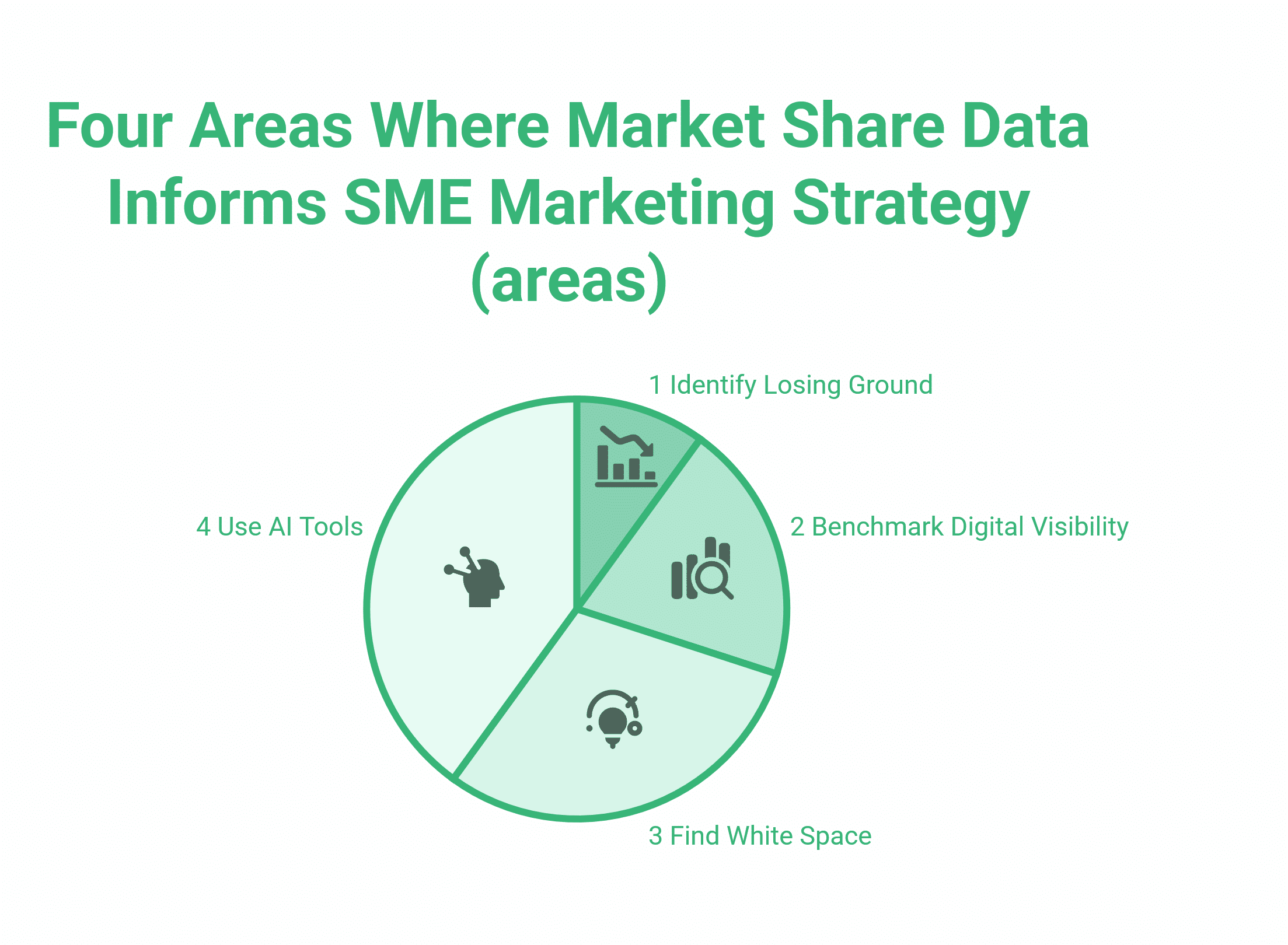
Knowing your market share — or estimating it — is only useful if it informs decisions. These are the four areas where market share data has the most direct application for SME marketing strategy.
Identify Where You Are Losing Ground
If your revenue has held steady but your share has fallen, competitors are growing faster than you. This is a common pattern for established local businesses in sectors being disrupted by digital-first competitors. Monitoring competitor search visibility with tools like Semrush’s Market Explorer or Google’s Search Console gives you an early signal of these shifts before they appear in your revenue figures. ProfileTree’s guide to digital marketing strategy for attracting investors covers how to frame this type of competitive data in a business-planning context.
Benchmark Your Digital Visibility Against Competitors
A simple competitive audit covering the top five to ten keywords your potential customers use to find your type of business, and checking where you and your main competitors rank for each, gives you a practical digital market share snapshot. This is the starting point for any SEO or content marketing programme.
Find the White Space Your Competitors Are Missing
Market share data often reveals gaps: search queries with meaningful volume that no competitor is addressing effectively, geographic areas with thin digital visibility, or customer questions that nobody is answering with useful content. These are the opportunities that a well-planned content marketing programme can claim before competitors identify them. The business analytics tools guide on ProfileTree covers the free and low-cost tools that make this kind of analysis accessible to businesses without dedicated research budgets.
Use AI Tools for Faster Competitive Intelligence
AI tools have significantly reduced the time required to build a competitive market picture. Large language models can analyse competitor content, summarise industry positioning, and identify thematic gaps across a sector far faster than manual research. For SMEs in Northern Ireland and Ireland, this means that competitive intelligence work that previously required either specialist consultants or significant staff time is now accessible to in-house teams with basic digital skills. ProfileTree’s AI implementation work with SME clients focuses specifically on making these tools operational rather than theoretical.
Market Share Trends to Watch in 2026
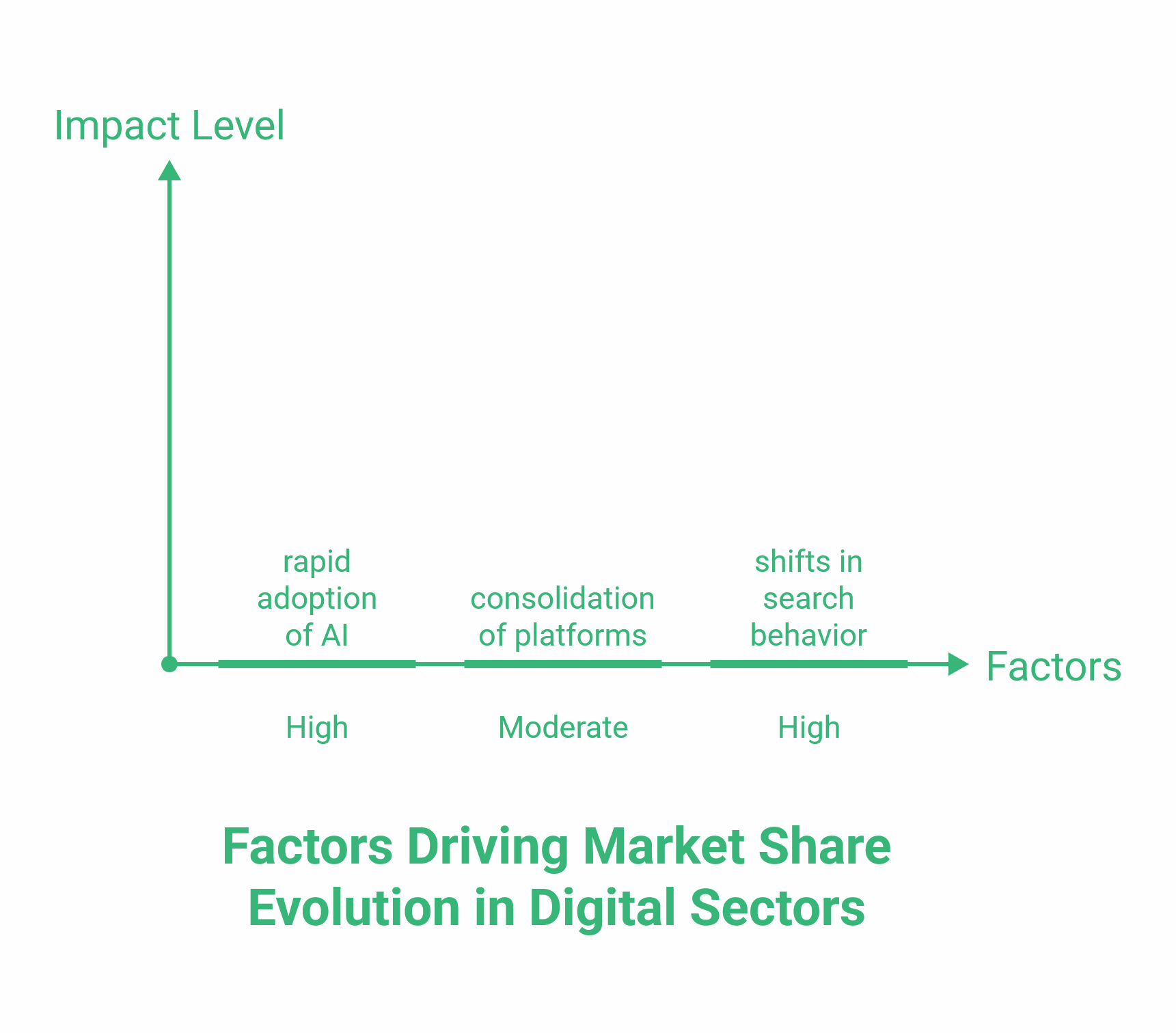
Market share in digital sectors is shifting faster than in most traditional industries, driven by AI adoption, platform consolidation, and changing search behaviour.
AI-powered search features from Google, Microsoft, and independent tools like Perplexity are beginning to change how users find businesses. Pages cited in AI Overviews and Copilot responses are gaining a new form of visibility that does not show up in traditional click-based market share metrics. For businesses investing in content quality and topical depth, this represents an opportunity to build share through AI citation before the competitive field catches up.
Video continues to grow its share of total time spent online, with YouTube maintaining its position as the second-largest search engine globally. For SMEs that have invested in video content, this represents an addressable channel where production quality and relevance can overcome the advantage of larger advertising budgets.
How Digital Agencies Use Market Share Data to Build Better Strategies
Market share statistics are not just a tool for in-house analysts or large corporate strategy teams. For SMEs working with a digital agency, this data forms part of the discovery and planning process that shapes every recommendation — from which keywords to target in an SEO campaign to how much content investment a given sector requires to become competitive.
When ProfileTree begins a digital strategy engagement, competitive visibility analysis sits at the centre of the initial audit. That means mapping where a client currently ranks relative to their nearest competitors for commercially relevant search terms, identifying which channels competitors are investing in, and identifying gaps in their content coverage that represent realistic quick wins. This process uses the same market share logic as any traditional business analysis — it simply applies it to digital signals rather than revenue data.
For SMEs in Northern Ireland, Ireland, and the UK, this kind of analysis is particularly valuable because local and regional markets behave differently to national ones. A business that looks invisible at a UK-wide level may be highly competitive within a 30-mile radius or a specific industry vertical. Defining the right market before measuring your share of it is what separates a useful strategic audit from a discouraging comparison against players you are never going to displace.
If your business has never mapped its digital position against competitors, ProfileTree’s digital marketing analysis services are a practical starting point.
Summary: Turning Market Share Data into Action
Market share statistics are not just a measure of where you stand today. They are diagnostic tools that tell you where your digital strategy needs to focus. For UK and Irish SMEs, the most actionable versions of market share are digital: search visibility, share of voice in your sector’s content landscape, and positioning in AI-generated responses.
If your business is losing digital ground to competitors or struggling to translate online activity into enquiries, ProfileTree’s team works with SMEs across Northern Ireland, Ireland, and the UK on the full range of digital strategy, SEO, content marketing, and AI implementation. Get in touch with the team to discuss where your business currently stands and what a realistic improvement looks like.
FAQs
What is market share, and why does it matter for small businesses?
Market share is the percentage of total industry revenue that a single business captures. For small businesses, it provides a practical benchmark for understanding competitive position and identifying where to direct marketing investment.
How do you calculate market share statistics?
Divide your company’s revenue by the total market revenue for your sector over the same period, then multiply by 100. For SMEs without access to precise industry figures, proxy measures such as search visibility data or competitor revenue estimates from Companies House filings are a practical alternative.
What is the difference between market share and market size?
Market size refers to the total value of a market (e.g. the UK digital marketing sector is worth approximately £X billion annually). Market share is your percentage of that total. Both figures are needed to assess whether your share represents meaningful scale.
Where can I find free market share data for UK industries?
The Office for National Statistics (ONS), Companies House, NISRA (for Northern Ireland), and sector trade associations publish reliable free data. Statista and IBISWorld offer more detailed paid reports. Google Trends and Search Console data provide a free proxy for digital market share within your sector.