
Paid Ads vs Organic SEO: A Growth Guide for UK SMEs
Table of Contents
Every business owner in Belfast, Dublin or the wider UK asks the same question sooner or later: pay for visibility today, or build it for free over the next six months? Paid Advertising vs Organic SEO isn’t really a debate with a single right answer. It’s a decision that depends on your cash flow, your patience, and whether your website can convert the traffic either channel sends you.
A tradesperson with a gap in next week’s diary can’t wait for organic rankings to develop. A startup with an £800 monthly budget might waste every penny on ads that never generate enough data to optimise properly. This guide sets out a practical framework for choosing between paid advertising and organic SEO, designed for SMEs across Northern Ireland, Ireland, and the UK, rather than for global enterprise budgets.
The Core Difference: Speed vs Long-Term Equity
The fundamental difference between these two channels comes down to timing and ownership.
Paid advertising buys your way to the top of the results page immediately. You set a budget, write an ad, and your business appears in front of searchers within hours. Stop paying, and you disappear just as quickly, because you’re renting the position rather than owning it.
Organic SEO works the opposite way. You invest in website quality, technical foundations and content that improves your ranking gradually, and once established, that position keeps generating visits without a daily spend. The trade-off is time: competitive commercial terms typically take four to six months before they reach page one, and that timeline stretches further in crowded sectors like legal services or estate agency.
Neither approach is inherently better. A business launching a new product this month has different needs to one planning where it wants to be in eighteen months. Paid Advertising vs Organic SEO only becomes the wrong question when you try to pick a winner rather than match the right channel to your stage of growth.
Comparison at a Glance
Rather than treating Paid Advertising vs Organic SEO as an abstract debate, it helps to see the two channels side by side. The table below breaks down how paid advertising and organic SEO compare on the factors that actually matter to a small business owner, from how quickly you’ll see movement to what you’re actually measuring month to month.
| Factor | Paid Advertising | Organic SEO |
|---|---|---|
| Speed of results | Live within hours | Typically 4-6 months |
| Cost structure | Ongoing spend per click | Upfront plus ongoing content cost |
| Sustainability | Stops when spending stops | Continues with minimal upkeep |
| Search intent level | Matches active searches precisely | Matches active searches and builds awareness over time |
| Primary metric | Cost per click, cost per acquisition | Keyword ranking, organic traffic share |
Search intent is worth a closer look, because it is the factor most guides skip. Paid search matches people who are actively typing your service into Google right now, which is why conversion rates on branded or high-intent terms tend to be strong from day one. Organic SEO captures that same active intent once you rank, but it also builds awareness among people who aren’t searching yet, through content that answers questions earlier in their research. That’s a slower win, but it compounds in a way paid spend never does.
Why Your Website Is the Silent Partner in This Debate
Neither paid advertising nor organic SEO can compensate for a website that doesn’t work properly. Whichever channel you choose first, the page it sends traffic to decides whether that investment turns into an enquiry or a bounce.
Why Paid Traffic Won’t Fix Poor User Experience
Sending paid traffic to a slow, cluttered or non-responsive site is one of the most common ways Northern Ireland SMEs waste ad spend. Someone who clicks a Google Ad for “emergency plumber Belfast” expects to land on a page with your emergency number visible immediately, not a homepage listing every service you offer.
If your site takes more than a few seconds to load on a phone, or the contact form breaks on mobile, you’re paying for clicks that never convert. This is where ProfileTree’s web design work usually starts: auditing whether the site can actually hold up under paid traffic before a single pound goes into a campaign.
Before committing budget to either channel, it is worth checking a handful of basics on your own site:
- Does the page load in under three seconds on a mobile connection?
- Is there a working analytics setup that tracks enquiries, not just visits?
- Does the contact form or phone number appear without scrolling?
- Is the page you’re sending traffic to actually about what the ad or keyword promises?
- Would you personally trust this page enough to hand over your details?
A page that fails two or more of these usually needs attention before either paid advertising or organic SEO spend will show a fair return.
Technical SEO: The Bridge Between Design and Organic Rank
Technical foundations matter just as much for organic SEO, though the damage is slower and less visible. Site speed, mobile usability, a clean URL structure and a working XML sitemap all affect whether Google can properly crawl and rank your pages.
Businesses that skip this step often find their content simply doesn’t move, no matter how well it’s written. ProfileTree’s website development team builds these technical foundations into every new site from launch, avoiding the costly retrofitting that catches out businesses who bolt on SEO after the fact.
The Real Cost: Budgets for UK and Irish Businesses
One of the most persistent myths in this debate is that organic SEO is free. It isn’t. Understanding the real cost of both channels, including a tax detail most guides skip entirely, gives you a fairer basis for comparison.
Paid advertising costs are visible and immediate. Belfast service businesses typically need £800-£2,000 a month for a Google Ads campaign with enough data to optimise properly, plus £200-£500 for management if you’re not running it in-house. Retailers often see better results from Meta Ads, typically £500- £1,500 per month.
Anything under £500 spread across several keywords tends to deliver few conversions, because no single campaign gets enough spend to learn from. The advertised spend rarely covers the full picture either: landing page development, creative production, and the management time required for weekly optimisation all sit alongside the media budget itself, and businesses that only plan for the headline ad spend regularly find the true monthly cost considerably higher.
Organic SEO’s costs are less visible but no less real. Technical foundations typically run £1,500-£4,000 as a one-off, local SEO setup (Google Business Profile, citations, location pages) adds £800-£1,500, and ongoing content and optimisation costs £400-£1,200 a month. None of that is free; it’s simply not paid to a platform per click.
There’s also a detail most comparison guides ignore: VAT. UK and Irish businesses that are VAT-registered can generally reclaim the VAT charged on advertising spend and on agency fees for both channels, but the invoice needs to show VAT separately and the spend has to be wholly for business use. GOV.UK’s guidance on VAT rates sets out which supplies are affected, and it’s worth checking with your accountant before committing a full year’s budget, since the VAT treatment of ad spend can affect your actual cash cost.
Content creation is where the “free SEO” myth breaks down fastest. A single well-researched, properly structured article can take several hours to plan, write and optimise, and most businesses need a steady flow of them to build topical authority. ProfileTree’s content marketing service exists because most SME owners don’t have the spare time to produce that volume of content while running their businesses.
The return profile differs too, and it is worth setting expectations early. Well-run paid campaigns tend to return somewhere between two and five pounds of revenue per pound spent within three to six months. Organic SEO tends to start slowly and finish strong, often returning considerably more once rankings stabilise over 12 to 18 months, because the marginal cost of each additional visitor keeps falling. Paid spend stops working the moment you stop paying for it. Organic SEO, once established, keeps working with comparatively little upkeep.
| Business age | Suggested budget split |
|---|---|
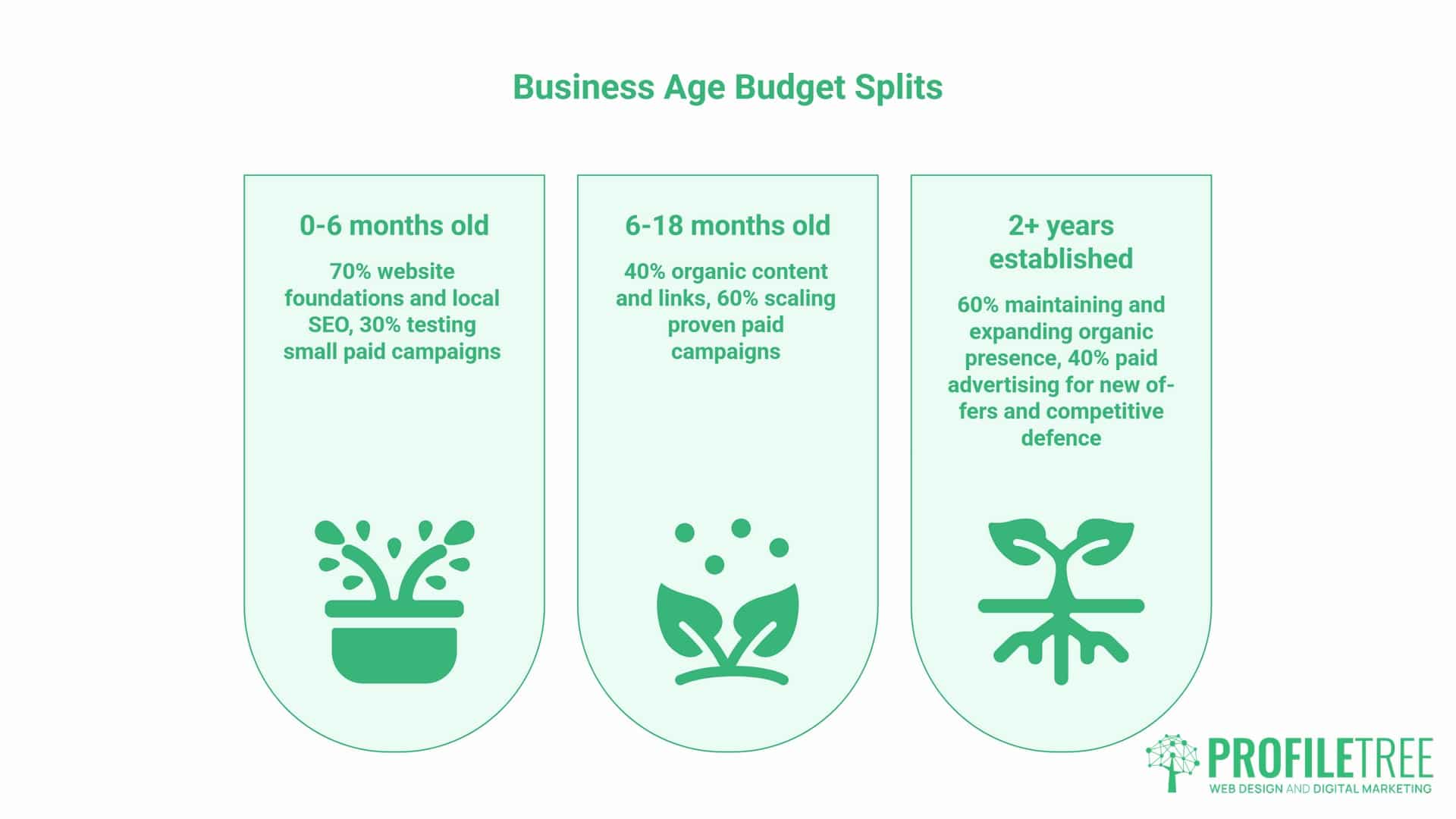
| 0-6 months old | 70% website foundations and local SEO, 30% testing small paid campaigns |
| 6-18 months old | 40% organic content and links, 60% scaling proven paid campaigns |
| 2+ years established | 60% maintaining and expanding organic presence, 40% paid advertising for new offers and competitive defence |
The Decision Framework: Which Should You Fund First?
Rather than asking which channel is better in the abstract, it’s more useful to ask which one your business needs first. The scenarios below cover the three situations we see most often among SMEs across Northern Ireland, Ireland and the UK, and each points to a different starting channel.
Scenario A: The New Product Launch
A business launching a new product or service has no organic history to draw on, so ranking takes time it doesn’t have. Paid social ads on Meta or search ads on Google generate awareness and enquiries within days, while organic content builds in parallel for the months ahead. This is a case where paid advertising should lead and organic SEO supports it, not the reverse. Once the launch settles and you know which messages actually convert, that data becomes the starting point for the organic content you build next.
Scenario B: The Local Service Provider
Plumbers, solicitors, accountants and similar service businesses benefit enormously from organic SEO because people search for these services continuously, not just once. Once you rank for “solicitor Belfast” or “emergency plumber Lisburn”, that position keeps generating leads without ongoing spend. ProfileTree’s SEO services prioritise Google Business Profile optimisation and local citation building first, because these are usually the fastest wins for this type of business, often showing movement within weeks rather than months. A modest budget can still run alongside this, targeting only the handful of keywords where someone is ready to book today.
Scenario C: The High-Growth Scale-Up
A business scaling quickly across Northern Ireland, Ireland and the UK usually needs both channels running at once. Paid campaigns defend market share and test new locations quickly, while organic content compounds in the background and gradually reduces reliance on ad spend. This is the point where a phased digital strategy matters more than picking one channel over the other, since the right split shifts as the business grows. Expanding into a second city or a new service area works the same way: test with paid spend first, then build the organic content once you know the demand is real.
Common Pitfalls in Paid Advertising vs Organic SEO
After auditing plenty of Belfast SME websites and ad accounts, the same mistakes turn up again and again in this Paid Advertising vs Organic SEO decision. Most of them come from treating the choice as permanent rather than a stage-appropriate call.
Running paid ads to a homepage instead of a dedicated landing page wastes spend before the campaign even starts. Choosing a channel based on what a competitor does, rather than your own numbers, is another common error; you don’t know their margins or whether their campaigns even work.
Abandoning a channel too early is just as costly. Paid campaigns typically need two to three months of testing before they settle down, and organic SEO needs a minimum of four to six months before results show. Giving up on either before that point usually means starting again from scratch later.
Tracking revenue rather than vanity metrics is the pitfall that costs businesses the most over time. Many owners monitor website visitors, ad impressions and social followers instead of the figures that actually matter: which keywords produce paying customers, what percentage of visitors convert, and which traffic source delivers the highest lifetime value. Without proper conversion tracking in place from the outset, every budget decision becomes a guess rather than a calculation.
“Most SMEs ask us which channel is better when they should be asking which one they need first,” says Ciaran Connolly, founder of ProfileTree. “We regularly see businesses chasing vanity metrics, rankings and clicks, instead of the metrics that actually matter: leads and sales. A page one ranking for the wrong keyword isn’t worth anything if it doesn’t convert.”
Training your own team to read the data properly helps here too. ProfileTree’s digital training sessions cover exactly this: interpreting Search Console and Google Ads reports so decisions are based on what’s actually working, not what looks impressive in a screenshot.
Integrating Both for Maximum Market Share
Paid advertising and organic SEO work best as allies rather than rivals. Data from one channel routinely improves performance in the other, provided someone is actually looking at it.
Using Paid Data to Find Organic Keywords
Google Ads reporting shows exactly which search terms convert into enquiries, at the individual keyword level, well before organic content could tell you the same thing. A term that converts well in paid campaigns is usually worth building a dedicated page or article around organically, since you already have evidence it drives business rather than just traffic.
The relationship runs the other way too. A page ranking well organically tends to improve the quality score of a paid ad targeting the same term, because Google’s ad quality guidance weighs landing page relevance alongside expected click-through rate. Better quality scores tend to lower your cost per click, which is one of the few ways paid and organic genuinely reinforce each other rather than compete for the same budget line.
Over time, this feeds a genuinely useful cycle for growing businesses. Paid campaigns surface the exact phrases that convert, organic content is then built around those proven phrases, and as that content starts to rank, the paid budget can shift toward newer keywords and locations instead of defending the ground the organic content now holds on its own. Few marketing decisions compound this reliably, which is why treating paid advertising and organic SEO as separate budgets, managed by separate people with no shared reporting, tends to waste the value each one could add to the other.
Making the Investment Decision
Paid Advertising vs Organic SEO was never really a question of picking a winner. It’s a question of matching the right channel, or the right blend of both, to where your business actually is right now.
A tradesperson needing calls this week should lean on paid search. A local service provider with six months of patience should build organic foundations first. A scaling business usually needs both running together, with the balance shifting as organic traffic takes on more of the load.
Based in Belfast, ProfileTree has delivered over 1,000 digital projects for SMEs across Northern Ireland, Ireland, and the UK, maintaining a 5-star Google rating based on client reviews. Whichever channel you start with, get in touch to talk through which delivers the better return for where your business is today.
Frequently Asked Questions
Is organic SEO really free?
No. There’s no ad spend, but content creation, technical work and tools all cost time or money. The difference is that organic SEO builds an asset you keep, rather than a position you rent.
How long does it take for organic SEO to outperform paid advertising on ROI?
Typically six to twelve months, depending on competition in your sector. Paid advertising usually delivers faster returns early on, but organic SEO tends to overtake it once rankings stabilise, because the ongoing cost per lead falls to near zero.
Does running Google Ads help my organic ranking?
Not directly. Google has confirmed paid and organic results use separate systems, though running ads can indirectly support organic growth through brand awareness and by revealing which keywords actually convert.
Which is better for a small business in Northern Ireland?
It depends on your timeline and budget. A local service business with a modest budget usually benefits most from local SEO first, while a business needing leads this month should lean on paid search or social ads instead.
How much should a UK SME spend on paid advertising versus organic SEO?
Most established businesses operate with a split close to 60/40 or 40/60, depending on how mature their organic presence is. Newer businesses often start closer to 70/30 in favour of website foundations and local SEO.