
How to Conduct a Competitive Analysis: A UK and Ireland Guide
Table of Contents
When a business decides to conduct a competitive analysis, it’s usually prompted by something: a new competitor appearing in local search, pricing pressure that doesn’t make sense, or a marketing campaign that isn’t landing as it should. The instinct to look outward is right. The problem is that most SMEs do it once, get a rough picture, and then move on without changing anything.
That’s where the value gets lost. A properly structured competitive analysis doesn’t just tell you who your rivals are. It tells you why certain competitors are winning, where their customers are frustrated with them, and which market gaps neither of you is filling yet. Used well, it improves your website brief, your content strategy, your SEO priorities, and your positioning: not as a one-off exercise, but as an ongoing input into how you run the business.
This guide walks through the full process, with a focus on data sources and tools that are actually available to UK and Irish business owners. Most guides on this topic are written for the US market and overlook the resources available here, such as Companies House, the Meta Ad Library, and UK consumer data providers. These give businesses in Northern Ireland, Ireland, and the UK a genuine edge when used properly.
What Competitive Analysis Actually Covers
A competitive analysis is a structured process of researching the businesses competing for your customers, then using that information to identify where you have an advantage, where you’re falling behind, and where gaps exist that neither of you is filling.
It’s more than just a list of your rivals. At its most useful, it tells you why certain competitors are winning, what their customers are saying about them, how visible they are online, and where their weaknesses are large enough to exploit.
Three terms get used interchangeably and shouldn’t be. A market analysis looks at the broader industry: size, growth trends, customer demographics, regulatory conditions. A competitive analysis focuses on the businesses you’re directly competing with. A SWOT analysis is a framework you apply within a competitive analysis to organise what you’ve found. Market analysis tells you whether an opportunity exists. Competitive analysis tells you whether you can beat the people already chasing it. SWOT turns both into a decision.
The version of this work aimed at online channels is often called competitive analysis for digital marketing, and the distinction matters in practice. A general competitor review might cover premises, staffing, and product range. A digital marketing competitor analysis narrows to what happens online: search rankings, content, backlinks, paid campaigns, social activity, and increasingly, how often a brand gets named inside AI-generated answers. For most SMEs, that narrower version is the one that changes the quarterly plan.
Start With Your Own Position, Not Theirs
Looking at competitors before you understand your own position produces analysis without a baseline. You cannot judge whether a rival’s content strategy is outperforming yours if you don’t know what your own performance looks like. The audit starts inward, and it takes about half a day.
Google Search Console is the most accurate source available for this. It shows which queries trigger impressions for your pages, where your average position sits, and which pages earn clicks against which earn visibility with no action attached. Pull the last six months, sort by impressions, and look for pages sitting on high impressions with zero clicks. Those pages are being served and ignored.
That exercise regularly surfaces a problem businesses don’t know they have. ProfileTree’s own Search Console data for this topic showed six separate articles on competitor research competing against each other, drawing 8,136 impressions between them across six months and not a single click, with average positions between 62 and 86. The demand was real. The site was answering it six times, weakly, and Google had no clear signal about which page to rank. That is keyword cannibalisation, and a self-audit is how you catch it.
Benchmarking Your Own Content and Channels
Absolute follower counts mean very little in isolation. What matters is engagement rate relative to reach, the content formats that consistently beat your own average, and whether your publishing has quietly drifted from weekly to monthly.
Do this before reviewing anyone else. Without a calibrated frame of reference, you risk mistaking a competitor’s large audience for evidence of an effective strategy, when reach and commercial outcomes are often only loosely connected.
Step 1: Identify Your Competitors
Before you can analyse competitors, you need to know who they actually are. Most businesses get this wrong by focusing only on the obvious names they already know, and identifying competitors properly is the step that most often changes the shape of everything that follows.
| Competitor type | What it means | How to find them |
| Direct | Same service, same audience | Search your main service plus your location |
| Indirect | Different route to the same outcome | Search the problem your service solves |
| Replacement | Removes the need for your service entirely | Ask what customers do instead of buying |
| Digital / informational | Ranks for your queries without selling what you sell | Search your keywords and note who appears |
Direct competitors sell the same product or service to the same audience. A Belfast-based web design agency competes directly with other web design agencies serving businesses in Belfast and Northern Ireland.
Indirect competitors solve the same underlying problem through a different means. A business owner who might hire a web design agency might also consider a freelancer, a website builder like Wix or Squarespace, or someone in-house. None of those is an agency, but all are competing for the same budget decision.
Replacement competitors make your service unnecessary. If your audience decides they don’t need a new website at all and puts the budget into paid advertising instead, that advertising agency becomes a replacement competitor.
The fourth category is the one most frameworks miss. Digital competitors, sometimes called informational competitors, rank for the queries your buyers type before they are ready to buy. A Belfast agency competes informationally with any content site answering “how much does a website cost” or “WordPress or Wix”. Those sites will never pitch your client. They still capture the attention that precedes the enquiry, and a business headquartered in London or Dublin can occupy your local results without ever meeting a customer in your postcode.
How to Find Competitors You Don’t Know About
Start with keyword research. Search the terms your customers use, not your industry jargon, and record every domain that appears in the top ten across five to ten of your most important queries. Run the searches in a private window. The domains that appear repeatedly are your priority set.
For local and regional businesses, Google Maps results matter just as much. A competitor ranking in the map pack for your primary service area is competing with you daily, even if their website is thin. Local SEO for service businesses shapes who gets found first, and knowing who occupies that map pack tells you what it would take to displace them.
For UK businesses, Companies House is an underused resource. You can search by SIC code, view abbreviated accounts, and see when a company was incorporated. That gives you a factual baseline on a competitor’s financial health that no American competitive analysis guide mentions, because the equivalent public filing data doesn’t exist in the same form in the US.
One caution on scope. Five to eight active competitors is the right number. A list of twenty produces shallow coverage of all of them and useful coverage of none.
Search Disruptors
UK results increasingly feature Reddit threads, YouTube videos, and TikTok clips alongside conventional websites. These aren’t competitors in a commercial sense, but they occupy space and suppress click-through on organic listings. Note them separately. A query where forum content dominates the top five usually means searchers want peer experience rather than brand guidance, which is useful when you’re deciding whether a keyword is worth chasing at all.
Building a Competitor Profile
Once the list is set, give each competitor a single record rather than scattered notes. A workable competitor profile holds: what they sell and how it’s packaged, published pricing or the pricing signals you can infer, their primary positioning claim, their strongest ranking pages, their review volume and average score, their publishing frequency, and one line on what they’re visibly weak at.
Pricing is often public. Where it isn’t, language gives it away. A competitor talking about “enterprise clients” over corporate photography is not chasing the same buyer as one whose homepage says “for small businesses starting out”.
Step 2: Analyse Their Digital Presence
Once you know who your competitors are, build a detailed picture of their online footprint. This is the longest stage of any competitive analysis for digital marketing, and it covers six areas: their technical set-up, search visibility, content quality, backlinks, paid and social activity, and how well their site converts.
Website Performance and Technical Set-Up
Visit each competitor’s site as a customer would. Note the load speed, the clarity of navigation, how quickly you can find pricing or contact details, and how it behaves on a phone.
Competitor website analysis starts here, and it gets specific quickly. Google’s Core Web Vitals measure how fast the largest element loads (Largest Contentful Paint), how quickly the page responds to an interaction (Interaction to Next Paint), and how much the layout shifts while loading (Cumulative Layout Shift). PageSpeed Insights runs against any public URL, including your competitors’. If a rival’s site loads in under two seconds and yours takes over four, that gap is measurable and fixable.
Site architecture matters alongside speed. Look at how competitors structure URLs, whether they group content into topic clusters or leave it as disconnected posts, and how many clicks it takes to reach a service page from the homepage. A site with a clear cluster structure accumulates topical authority faster than one without, and you can read the architecture directly from its navigation and sitemap. Browser extensions such as BuiltWith or Wappalyzer reveal the CMS, hosting, and marketing tools behind the site.
In Northern Ireland and Ireland, a large number of SME websites still have real technical problems: slow load times, poor mobile experiences, unclear calls to action. If your competitors have weak websites, that’s a tangible opening. A well-built site that loads quickly and converts visitors into enquiries will outperform a slow, confusing one regardless of traffic volume. Professional web design is one of the most direct ways to turn a competitor’s technical weakness into your advantage, and where the comparison shows your own site is the bottleneck, website development work focused on performance and crawlability usually produces faster ranking movement than any amount of content published on a slow foundation.
Search Visibility and Keyword Gap Analysis
A keyword gap is any term a competitor ranks for that you do not. Some gaps exist because you have no relevant page. Others exist because you have the page and it isn’t optimised. Both are fixable; they need different responses.
At a basic level you can do this manually. Search a term, note who ranks, then check whether your site appears in the first three pages. If it doesn’t, that’s a gap. Google Search Console covers your side of the comparison for free. Paid platforms export competitor keyword portfolios in bulk, and if you use one, filter for UK traffic only. The default view in most tools is global, which inflates volume and hides the local picture.
Not every gap is worth chasing. Two filters do most of the work:
Commercial intent. “SEO agency Northern Ireland” carries direct commercial intent. “What does SEO stand for” does not. Close the commercial gaps first.
Difficulty relative to your current authority. If every page-one result is a national publication or a high-authority directory, that term will take years. Find the terms where smaller sites similar to yours are ranking. Those are winnable inside a realistic budget. Understanding how secondary keywords support your primary targets helps here, because the aim isn’t a single ranking; it’s a cluster of related pages reinforcing each other.
Competitor Content Analysis: Quality, E-E-A-T and Voice
Quantitative data tells you who is winning. A competitive content analysis tells you why, and whether you can do something different rather than merely better. This is the layer tools cannot automate, and it is usually where the clearest opening sits.
Read three to five of each competitor’s strongest articles critically and ask four questions. Does the content include real, specific examples from direct experience, or generic advice anyone could have written? Are the author’s credentials verifiable through a LinkedIn profile, speaking history, or bylines elsewhere? Are factual claims sourced to original research or official documentation? Does the piece take a position, or present every option as equally valid without recommending anything?
Content answering yes to all four is difficult to displace. Content answering no is vulnerable no matter how many links it has accumulated. Google evaluates Experience, Expertise, Authoritativeness and Trustworthiness at site level as well as page level, so a competitor with one strong article and forty thin ones is weaker than the article alone suggests.
Structure matters as much as quality. Ahrefs’ analysis of AI Overview citations found that pages covering several sub-questions within a topic are far more likely to be cited than pages answering only the headline query. If a rival’s article handles “what is competitor analysis”, “how often should I run one” and “which tools are compliant” inside one page, it will beat yours on citation share even if your keyword usage is heavier. Content length follows from that rather than driving it: informational queries tend to reward depth, transactional queries tend to reward focus.
Then there’s voice, which no tool measures. Two articles can hold the same position for the same query while only one builds a returning audience. The difference is usually whether the writing sounds like a specific person with a point of view or a well-researched reference document. Check also whether competitors write for a UK audience at all. Content built on a US frame of reference uses different terminology, references different tools, and omits Companies House, UK GDPR, and local funding schemes entirely. Where that localisation is missing, it’s a straightforward gap to take.
Backlinks and Digital PR
Backlinks remain among the strongest ranking signals for competitive terms, and a competitor with a much stronger link profile will be hard to outrank for shared keywords regardless of content quality.
Competitor backlink analysis has two uses. The first is finding high-authority domains that link to rivals but not to you, which becomes an outreach list. The second, more revealing, is reading what the link profile says about their strategy. A competitor earning links mainly from guest posts on marketing directories is doing something fundamentally different from one earning editorial coverage in industry publications, trade bodies, and national outlets. The second kind of authority is genuinely hard to replicate quickly.
Sort a competitor’s backlinks by domain rating and read the top twenty. That tells you the calibre of site you’d need to earn links from. Then look at anchor text: branded mentions and natural editorial phrases are healthy, while repetitive exact-match keyword anchors across many links suggest a pattern Google may discount. For UK-targeted queries, links from .co.uk domains, regional chambers of commerce, local news and UK industry associations carry geographic relevance that international links do not.
Social Media and Paid Advertising
Check competitors’ social profiles for what they post, how often, what actually earns engagement rather than passive reach, and whether they’re running paid campaigns. The goal is not to copy their calendar. It’s to identify which formats and topics consistently work with an audience you share.
The Meta Ad Library (ads.facebook.com/ads/library) requires no account and shows every active and recent Facebook and Instagram ad for any page, including creative, copy, and how long each has been running. Google’s Transparency Centre does the same for Search and Display. A competitor running identical creative for six months is almost certainly running it because it converts, and that is a signal worth testing against your own messaging.
Share of AI Voice
Share of AI Voice measures how often your brand is cited in AI-generated answers, whether in Google’s AI Overviews, Copilot, ChatGPT or Perplexity, relative to how often competitors are cited for the same queries. Most UK SMEs are not tracking it yet, which is precisely why it’s worth tracking now.
To measure it manually, take your twenty most commercially important queries and run each through the AI tools your buyers use. Record which brands are named, how often, and in what context. Repeat quarterly. That tells you whether your content investment is building AI visibility or whether competitors are consolidating position in AI answers while you sit on page three of conventional results.
Bing Webmaster Tools also publishes an AI Page Stats report showing how many times each of your pages has been cited in Copilot answers. It’s free, it’s first-party, and it remains one of the most underused data sources available to UK marketing teams.
Conversion and Offer Analysis
Competitor website analysis usually stops at traffic and rankings. That’s half the picture. A competitor with lower traffic and a stronger offer may be generating more enquiries than one with high traffic and a weak one.
Look at where calls to action sit on the page, what language they use, and whether anything is offered in return for contact details. Note the specificity. “Contact us for a quote” is generic. “Get a free 30-minute SEO consultation for your Northern Ireland business” is specific and lower-commitment, and specific offers usually convert better because they reduce uncertainty. If competitors are making specific offers and you are not, that’s an easy test to run.
Transparent pricing is worth reading as a strategy rather than a detail. Some businesses publish prices to qualify leads, attracting buyers who are ready and filtering out those who aren’t. Look too at whether competitors lead with features or outcomes. Outcome-led copy tends to connect better with owners making a purchasing decision, because it speaks to what they want rather than how the service works.
Step 3: Benchmark the Right Metrics
Benchmarking means setting reference points you can measure your own performance against. The most useful benchmarks come from what the strongest performers in your competitive set are actually achieving, then working backwards to understand how.
| Dimension | What to measure | Where to find it |
| Search visibility | Keyword rankings, organic traffic estimates | Paid SEO platforms, manual Google searches |
| Traffic value | Estimated commercial value of organic traffic, not volume | Paid SEO platforms |
| Website performance | Page speed, Core Web Vitals, mobile score | Google PageSpeed Insights |
| Content output | Publishing frequency, topic coverage | Competitor blog and sitemap |
| Content freshness | How recently key pages were updated | Page “last updated” dates, Wayback Machine |
| Backlink velocity | New links earned in the last 30 to 90 days | Backlink tools, filtered by date |
| Social engagement | Average engagement per post relative to reach | Platform profiles |
| Reviews | Volume, average score, recency, response rate | Google Business Profile, Trustpilot |
| Ad presence | Active ads, messaging themes, creative longevity | Meta Ad Library, Google Transparency Centre |
| AI citations | Times cited in AI answers for your key queries | Bing Webmaster Tools, manual query checks |
Domain authority scores deserve a note of caution. They’re headline figures that overstate a site’s real position on any specific topic. A high-authority site with thin coverage of a niche subject is regularly outranked by a focused, lower-authority site with genuine depth.
The point of benchmarking is not to copy competitors. It’s to understand the baseline you need to exceed. If the leading business in your market has 120 Google reviews and you have 14, that gap is visible to every customer comparing options.
Step 4: Run a SWOT Analysis (Theirs, Then Yours)
A SWOT analysis applied to a competitor gives you a structured way to summarise what you’ve found and decide where to act.
| Helpful | Harmful | |
| Internal | Strengths | Weaknesses |
| External | Opportunities | Threats |
Strengths are things the competitor does measurably well: a strong Google rating, high search visibility, clear pricing, fast response times, a well-built website.
Weaknesses are things they do poorly: a poor mobile experience, no content marketing, a thin social presence, slow load times, or a pattern of negative reviews about a specific issue like communication or delivery.
Opportunities are gaps you could fill: a service they don’t provide, a location they don’t cover, a customer question nobody in your market answers.
Threats are areas where their strengths could limit your growth if left alone. If they dominate local search, you need a real SEO plan rather than a hope.
The discipline that makes this work is specificity. “Their website is slow” is useful. “They have a weak digital presence” is not. Once you’ve built the picture for two or three key competitors, run the same analysis on your own business. The comparison usually reveals priorities that weren’t obvious before, and the intersections, where your strengths meet their weaknesses, are where you should compete hardest.
Step 5: Turn the Analysis Into Decisions
This is where most competitive analysis falls apart. Businesses collect the data, produce a document, and don’t act on it. The entire value of the exercise comes from what changes afterwards.
Ciaran Connolly, founder of ProfileTree, makes the point directly with SME clients: “The businesses that get the most from a competitor audit are the ones that come in knowing what they want to do with the information. The analysis is not the strategy. It is the evidence you use to build one.”
A useful test: if you can’t finish the sentence “because we found X, we will do Y”, the finding has no strategic value. A well-run competitive analysis should produce at minimum a list of specific gaps to address, a revised keyword and content plan, a clearer positioning statement, and a schedule for repetition.
The competitive recommendations that come out of it usually cluster into four types. If competitors have poor mobile websites, commission a mobile-first redesign. If they aren’t answering common customer questions, build a content programme around those questions. If their reviews reveal consistent service complaints, make the opposite your explicit selling point. If a rival is cheaper, the action is not automatically to cut prices; identify the quality or service gaps that justify yours and make them visible.
Sorting by Impact and Effort
Rate every identified action on likely impact and effort required, then work the quadrants in order.
High impact, low effort comes first, and these are your opening six to eight weeks. Pages already ranking on page two where the gap is thin content rather than an authority problem sit here. Adding depth and improving structure can move them without new links.
High impact, high effort goes into months two to four: new pillar pages targeting commercial keyword gaps, which take time to write, link to, and gain traction.
Low impact, low effort gets batched: technical fixes, meta description improvements, internal linking adjustments.
Low impact, high effort is deprioritised or dropped. The resource cost rarely justifies the return. A marketing audit tends to surface the same priorities from the inside, and running both in parallel is worth the time.
Building the 12-Month Content Plan
Content opportunities differ in how long they take to pay back, and a plan that doesn’t separate them will disappoint someone in month three.
| Track | Criteria | Time to results | Typical content |
| Quick win | Low to medium difficulty, competitor content thin or outdated, close to your services | 60 to 90 days | Localised how-to guides, FAQ pages, UK-specific comparison content |
| Long-term authority | High-value competitive queries needing original research or real depth | 6 to 18 months | Pillar pages, original research, full service guides |
A team publishing two to four pieces a month might put roughly 70% into quick wins for the first two quarters, with the remaining 30% going to authority content that compounds later. The content audit framework used to assess your own pages complements the competitor view: one is inside-out, the other outside-in.
Keeping It Current
A quarterly deep-dive captures the picture. A short weekly check catches shifts before they compound. Thirty minutes covers it: five minutes on Google Alerts for your three to five key competitor names, ten minutes running your primary commercial queries and recording ranking movement, ten minutes in the Meta Ad Library looking for new creative, and five minutes noting one change and one possible response. Over a year that log becomes more valuable than most tool subscriptions.
AI tools now handle a good share of the monitoring. Services that track mentions, keyword movement and content publication can alert you to competitor activity without a manual review every quarter, and page-change monitors will tell you the moment a competitor updates pricing or rewrites a landing page. For SMEs in Northern Ireland and Ireland this is particularly useful for local search movement: which businesses are gaining or losing visibility in your service area, and what they changed to cause it. AI implementation for SMEs has moved well past chatbots, and applied here it means responding to market shifts in weeks rather than discovering them months later. The right business analytics tools turn a one-off audit into a continuous feed.
The UK and Ireland Data Advantage
UK and Irish businesses have access to competitive intelligence resources that most guides skip, because most guides are written for the US market.
Companies House. Free access to abbreviated accounts, director information and filing history for any registered UK company, searchable at find-and-update.company-information.service.gov.uk. If a competitor is a limited company you can see broad revenue bands, whether they’re growing or contracting, and how long they’ve traded.
The Companies Registration Office and Solocheck.ie. The Irish equivalents. Basic company information is free, with detailed accounts available per document for a small fee, giving comparable visibility into an Irish competitor’s scale.
Google Business Profile. Competitor reviews are public and often specific. Reading a rival’s one- and two-star reviews tells you exactly what their customers are unhappy about, which is one of the fastest routes to a genuine service differentiator.
The Meta Ad Library. Every active Facebook and Instagram ad from any business, with creative and messaging visible.
Google Trends. Useful for comparing search interest in your brand against a competitor’s over time and by region, which matters in Northern Ireland and Ireland where regional behaviour sometimes diverges from national UK patterns.
Mintel and YouGov. Paid, but available through many UK public libraries, providing sector-level consumer data for UK and Irish markets.
Cross-Border Analysis for Northern Ireland Businesses
Generic frameworks assume clean geographic boundaries. Northern Ireland doesn’t have them. A business here often competes against UK and Irish rivals simultaneously, and the two sets behave differently. UK competitors price in sterling, reference the ICO, and optimise for GB search intent. Irish competitors price in euro, reference the Data Protection Commission, and target Irish-specific queries.
Where both audiences are in play, and that covers professional services, software, hospitality and most e-commerce, the keyword set needs analysing across both markets. A term returning different results on google.co.uk and google.ie represents a different competitive picture and a different content requirement. Segment your target keywords by geographic intent before you start: some are genuinely national and need national authority to compete for, while others are inherently local and far more achievable. A solicitor in Derry competing against national directories for “family solicitor Northern Ireland” has a real chance, because local relevance and proximity carry weight that domain authority alone doesn’t overcome.
Mapping both competitor sets, and understanding where they diverge, is an advantage global tools simply don’t provide.
Staying Within Legal and Ethical Limits
Most of what a competitive analysis requires is public: published pages, public ad libraries, filed accounts, site speed metrics, visible pricing. None of that raises data protection questions. Problems start when analysis extends to gathering personal data at scale, monitoring named individuals’ profiles systematically, or accessing gated content through false identities or shared credentials.
The practical guideline is simple. If the data is genuinely public and your collection method doesn’t require accessing systems without authorisation, you’re on defensible ground. Bulk scraping in breach of a platform’s terms, or collecting contact-level personal data without a lawful basis, is a different matter, and worth checking against your own digital marketing ethics position before you deploy any automated tool. If you’re unsure about a third-party tool that collects personal data, check its data practices before it goes anywhere near your workflow.
Common Pitfalls
Most competitive analysis fails through predictable errors rather than missing information.
Watching competitors instead of your own data. Search Console and Analytics tell you what’s already working, what customers search to find you, and which pages they abandon. Competitor data gives context. Your own data gives direction. Both are needed; the order matters.
Treating a one-off analysis as permanent. A competitor with no content strategy six months ago may have hired a team and published thirty articles since. A single analysis has a shelf life of about a quarter.
Confirmation bias. This is the most damaging error and nobody admits to it. You notice weaknesses and overlook strengths, and interpret ambiguous data in whichever way flatters your own position. The antidote is to actively look for evidence against your assumptions. If you believe a competitor’s product is inferior, write down what it does better than yours. A SWOT only works if the threats and weaknesses quadrants are filled in honestly.
Reacting to what competitors do rather than what customers need. A rival’s decision to invest in TikTok says something about their margins and capacity, not yours. The question is always what your customer needs, and whether someone else is meeting that need better than you are.
Analysing without acting. Research producing a document nobody reads is the most expensive kind. Build the analysis with a specific output in mind: a pricing decision, a content plan, a service redesign.
Presenting Your Findings
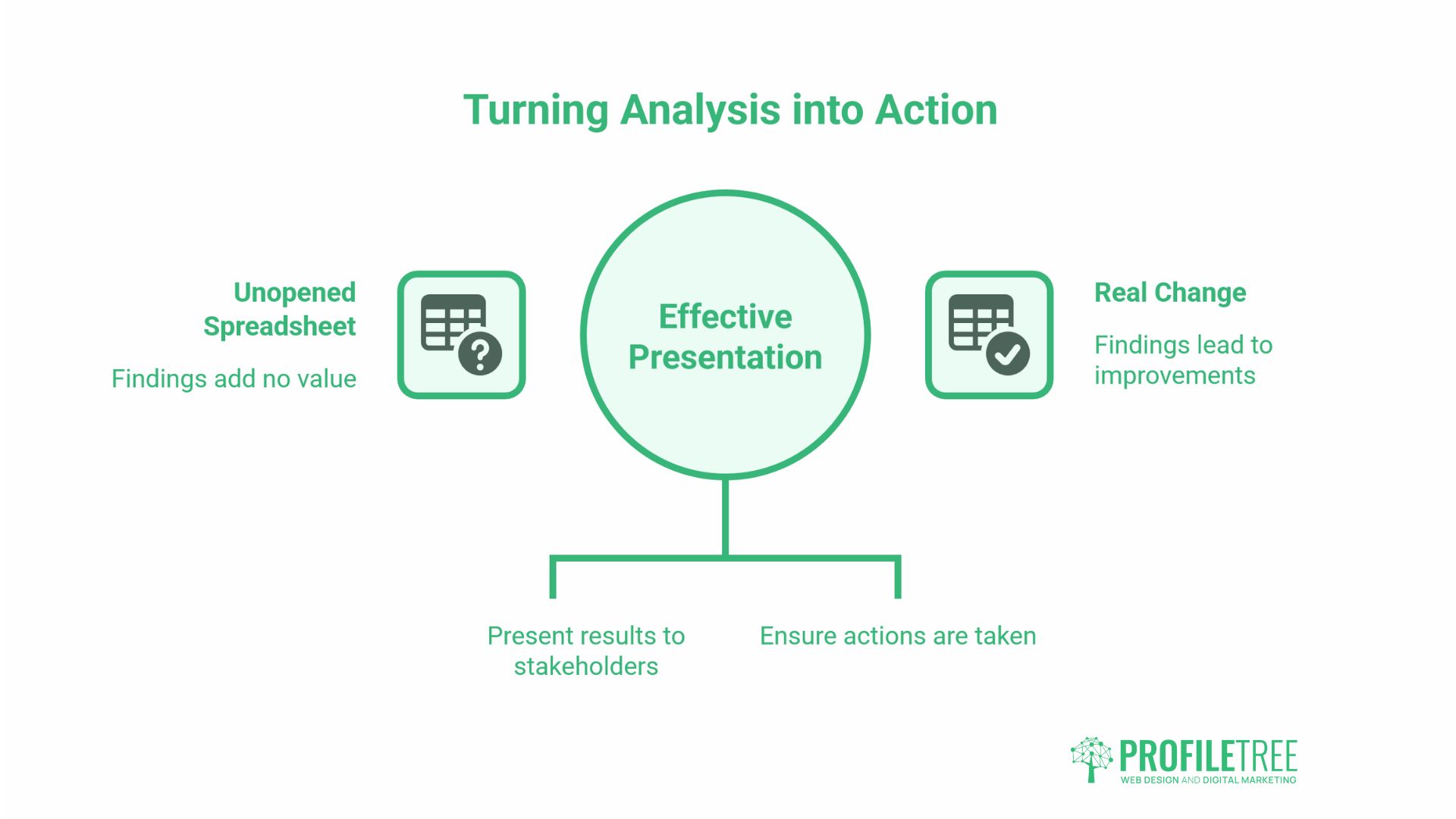
Conducting the analysis is only half the job. If the findings sit in a spreadsheet nobody opens, they add nothing. How you present the results determines whether anything changes.
Keep it short and decision-focused. The most effective summaries run to one or two pages, not twenty. Lead with the three to five findings that carry the clearest implications: a competitor dominating local search for your primary keyword, a repeated service complaint in their reviews you could address, a content gap nobody in your market is filling. Follow each finding immediately with a recommended action rather than more analysis. Presenting a competitor’s full profile as though it were the finding is the common mistake. The finding is what that profile means for your next decision.
Format for the audience. For an internal team, a simple table works: competitor name, key strength, key weakness, recommended response. For a board, frame everything around commercial impact and what growth opportunity the work reveals. If you’re presenting to a client as part of a digital marketing strategy engagement, structure around priority rather than completeness. Clients don’t need everything you found; they need to know what to do first, second and third.
Then keep it alive. Build a light review into quarterly planning: update the benchmarking table, check whether competitor weaknesses have been fixed, flag new entrants. Fifteen minutes a quarter keeps the document useful without repeating the whole exercise.
Running It In-House or Bringing In a Team
The process above is genuinely self-contained. If you have a marketing manager with some SEO knowledge, a clear keyword list, and the time to run it properly once a quarter, running it in-house works well.
It breaks down at the point where analysis has to become production. Knowing a competitor has 400 links from relevant UK publications tells you the size of the gap; closing it needs a content and outreach programme running over months. That’s an execution problem, not an analytical one. Where competitor analysis reveals you need ten new articles or a cluster of service pages, external content production is often faster than trying to produce it internally alongside everything else.
Three situations specifically justify commissioning a professional audit rather than running your own.
The first is unexplained ranking loss or a recent migration. A specialist audit goes deeper into crawl behaviour, indexation, structured data and server-side performance than free tools can reach.
The second is entering a new market or launching a service. Analysis conducted before the investment decision is worth more than analysis conducted after it, because it shapes both the content plan and the budget.
The third is when findings need to go to leadership or a board. An external review carries a credibility an internal one sometimes lacks, particularly when the recommendation requires real money.
ProfileTree works with SMEs across Northern Ireland, Ireland and the UK on exactly these situations: technical SEO audits, competitor analysis, and the content strategies that follow from both. For businesses that would rather build the capability internally, digital training covers competitive research methodology alongside SEO and analytics, so ongoing monitoring stays in-house.
What Changes After the Analysis
The businesses that get the most from competitive analysis are not the ones that do it most thoroughly. They’re the ones that act on it. The data is widely available, the tools are largely free, and UK-specific sources like Companies House give you a factual edge most competitors aren’t using. What separates useful research from a filing exercise is whether it changes a decision: a website brief, a content plan, a positioning shift, a keyword target. Start with three to five competitors, run the five steps, and book the next review before you close the document. If you’d like support turning competitor research into a strategy that works for your market, talk to the ProfileTree team.
FAQs
What are the five steps of a competitive analysis?
Identify your competitors across four types (direct, indirect, replacement, and digital or informational); analyse their digital presence covering technical set-up, search visibility, content, backlinks, paid activity and conversion; benchmark their performance against measurable metrics; run a SWOT analysis for each key competitor; then translate the findings into specific decisions. Audit your own position before step one so you have a baseline to compare against. The process only adds value if the final step results in changes to your plan.
What is a digital marketing competitor analysis, and how is it different?
A digital marketing competitor analysis narrows the general exercise to online channels: search rankings, keyword gaps, content quality, backlink profiles, paid campaigns, social activity, and how often each brand is cited in AI-generated answers. A general competitive analysis might also cover premises, staffing and supply chain. For most SMEs the digital version is the one that changes the quarterly plan, because almost all of the data is public and most of the actions it recommends are things you can start within a fortnight.
How do I analyse a competitor’s website?
A competitor website analysis works through four layers. Technical: run their key pages through PageSpeed Insights, check Core Web Vitals, and test the site on a phone rather than a desktop. Structural: look at how their URLs and navigation group content, and how many clicks it takes to reach a service page. Content: read three to five of their strongest pages and assess depth, sourcing, author credentials and whether they take a position. Conversion: note where calls to action sit, how specific their offers are, and whether pricing is published. Record the same fields for your own site so the comparison is like for like.
What is competitor backlink analysis?
It’s the review of which external sites link to a competitor, how authoritative those sites are, and what the pattern says about how the competitor earns coverage. Sort their links by domain rating, read the top twenty, and check the anchor text. Editorial links from publications, trade bodies and regional press indicate a business earning genuine coverage. A profile dominated by directories and low-quality placements is a structural weakness you can compete against. For UK-targeted queries, links from .co.uk domains and UK institutions carry geographic relevance that international links don’t.
How often should I conduct a competitive analysis?
For digital channels, quarterly is a practical minimum, since rankings and ad strategies shift meaningfully within a few months. Pair the quarterly deep-dive with a 30-minute weekly pulse-check covering competitor alerts, ranking movement and new ad creative. A deeper strategic review covering financials and positioning suits an annual cycle for most SMEs. Trigger a full review early if you see an unexplained traffic drop, a new competitor entering the market, or a Google core update that affects your rankings.
Is there a competitor analysis template worth using?
You can build one in a spreadsheet in twenty minutes, and doing so is better than adopting a generic download. Give each competitor a row and use these columns: URL, competitor type, services offered, published pricing, positioning claim, top three ranking pages, estimated organic traffic, page speed score, review count and average rating, publishing frequency, referring domain count, active ads, and two free-text fields for their clearest strength and clearest weakness. Add your own business as the final row. The value is in the comparison, not the formatting.
What is the difference between competitive analysis, market research and SWOT?
Market research examines the wider market: sector size, trends, customer segments and demand patterns. Competitive analysis examines the specific businesses competing for your customers, their pricing, positioning and vulnerabilities. SWOT is a framework you apply within a competitive analysis to organise findings into strengths, weaknesses, opportunities and threats. Market research tells you whether an opportunity is worth pursuing. Competitive analysis tells you how to pursue it better than the businesses already there. SWOT turns both into a shortlist of actions.
How do I find competitors’ financial data in the UK and Ireland?
For UK limited companies, Companies House provides annual accounts including broad revenue indicators and employee numbers, free of charge, which is enough to tell you whether a competitor is growing or contracting. For Irish companies, the Companies Registration Office holds the equivalent filings, with Solocheck.ie offering free basic company data and detailed accounts for a per-document fee. For sector-level market share, Mintel and IBISWorld produce UK reports, both paid, though Mintel is often accessible through public libraries.
Is competitor website analysis legal?
Yes. Reviewing publicly available data (indexed pages, published content, filed accounts, public ad libraries, freely accessible tool reports) is lawful and standard business practice. Data protection law applies to personal data, not to reading a competitor’s public website or checking their search rankings. The lines to watch are bulk scraping in breach of a platform’s terms, gathering contact-level personal data without a lawful basis, and accessing gated content under a false identity.
What is the final step in a competitive audit?
Setting the review date. Most businesses treat the action list as the end point, which is why the exercise decays into a one-off. The last step is deciding when you’ll run it again, who owns it, and which three to five signals get checked weekly in the meantime. Without that, the analysis has a shelf life of about a quarter and no mechanism for noticing when it has expired.