
Secondary Keywords in 2026: The UK Guide to Semantic Search and AI Visibility
Table of Contents
Secondary keywords are the supporting terms that give a page its context, and they now carry more weight than the single phrase you built the page around. Search engines stopped matching strings years ago. They read entities, relationships and topic coverage, while AI answer systems pull individual sections of content rather than whole pages. That change alters how you research, place and manage secondary keywords.
This guide is written for business owners, marketing managers and in-house teams who need pages that earn qualified traffic rather than vanity impressions. It covers what secondary keywords are, how they shape AI-generated answers, where to find them without paying for software, where to place them, and the mistakes that quietly cap performance. ProfileTree has applied this method across more than 1,000 projects for clients in Belfast, Northern Ireland, Ireland and the UK since 2011.
What Secondary Keywords Actually Do
Secondary keywords prove the depth of a page. A primary keyword tells a search engine which topic you are competing for; the supporting terms decide whether the page reads as a thorough answer or a thin one. Google’s systems assess how completely you cover a subject, and the vocabulary you use is the main signal available to them. Get the supporting terms right and one page can rank for dozens of related queries instead of a single exact phrase.
Primary Keywords Set the Topic
You usually target one primary keyword per page. It belongs in the page title, the H1, the URL slug and the opening paragraph, then appears naturally through the body copy. That consistency confirms the page’s main subject.
When we handled the professional website design for a Belfast solicitor, the homepage targeted “solicitors Belfast”. Each service page then took its own distinct primary keyword: “family law Belfast”, “conveyancing Northern Ireland”, “employment law advice Ulster”. One page, one clear subject.
Secondary Keywords Build the Context
Secondary keywords are semantic variations of your primary target, related subtopics, and the longer phrases real people type. They express the same ideas in different words and signal relevance to the wider topic.
On that same family law page, the supporting terms included “divorce solicitors Northern Ireland”, “child custody advice Belfast”, “separation agreements Ulster” and “family mediation services”. Each captures a different way a client might search for the same service.
Long-tail secondary keywords work particularly well as H2 and H3 subheadings, because search engines often lift direct answers from well-structured headings that match a specific query.
Tertiary Keywords and Topical Reach
Most guides stop at two tiers. A third one matters for building authority: tertiary keywords are broader industry terms you mention in passing to demonstrate full command of the subject.
For a page selling search engine optimisation services and targeting “SEO Belfast”, tertiary terms might include “web analytics”, “conversion rate” or “content strategy”. In content marketing for a Derry hotel client, terms like “Causeway Coast tourism” and “Walled City attractions” appeared naturally, connecting the hotel to the wider tourism picture without diluting the main focus.
| Tier | Purpose | How many per page | Example for “SEO Belfast” |
|---|---|---|---|
| Primary | Identifies the page topic | 1 | SEO Belfast |
| Secondary | Proves depth and captures variations | 4 to 8 | Local SEO Northern Ireland, technical SEO audit |
| Tertiary | Builds topical reach | Unlimited, used naturally | Web analytics, conversion rate |
How Secondary Keywords Support AI Search Results
AI answer systems do not read pages the way a ranking algorithm once did. They retrieve chunks of text that answer a specific question, then summarise them. Your secondary keywords are what make a chunk retrievable, because they carry the specific vocabulary a question contains. A section headed with a supporting term stands a far better chance of being quoted than a wall of prose built around one repeated phrase.
Why Retrieval Reads Sections, Not Pages
When someone asks an assistant a detailed question, the system looks for a passage dense with the concepts in that question. If you write about mortgages for first-time buyers, supporting terms cannot stop at “cheap mortgages”. They need to include “agreement in principle”, “stamp duty land tax” and “loan to value ratio”, because those are the phrases inside the real questions people ask.
This is the practical test we apply when auditing client pages. Take each H2, read it in isolation, and ask whether it answers one question completely. The same rule applies to AI-powered marketing content and the answer sets behind AI chatbot development: a passage has to stand alone to be usable.
Zero-Click Searches and the Business Case
More searches now end without a click, which sounds like bad news until you look at who still clicks. Traffic that arrives after an AI summary tends to be further along and closer to buying. Being the source a summary draws from puts your brand in front of that reader even when they do not visit. That is why keyword mapping sits inside our digital strategy services rather than at the end of a copywriting brief.
“Most SMEs are still optimising for a single phrase and wondering why competitors get quoted in AI answers instead,” says Ciaran Connolly, founder of ProfileTree. “The pages that get cited are the ones that cover the full vocabulary of a topic, section by section. Secondary keywords are how you build that coverage without writing filler.”
How to Find Secondary Keywords Without Expensive Tools
Good research does not require a subscription. Keyword generators expand a primary term into suggestions using search data, competitor analysis and trend information, but every automated list needs human review. You decide which terms match your commercial intent, not the tool.
Google Search Console for Hidden Queries
Search Console is the strongest free source of secondary keywords because it shows the terms you already appear for. Export your query data, filter to the URL you want to improve, then sort by impressions. Read Google’s guidance on clicks, impressions and position first, since average position is impression-weighted and easy to misread.
Look for queries with reasonable impressions and an average position between 11 and 50. Those are terms Google already associates with your page but does not yet trust you to answer. One pattern we see constantly: a page collects several hundred impressions a month, sits in position 40 or worse, and records zero clicks for months. That is not a traffic problem, it is a coverage problem.
Add a dedicated section for each of those queries, written as a direct answer with its own subheading. It is the first move on any SEO recovery project we take on.
Free Google Features Worth Ten Minutes
Google’s own interface gives you a working list quickly:
- Autocomplete: start typing your primary keyword and note every suggestion
- People also ask: expand several boxes, then expand the new ones that appear
- Related searches: scroll to the bottom of the results page for semantic variations
Ten minutes of this produces 20 to 30 candidates for review. We teach the same routine on our digital training programmes, because an in-house team can repeat it monthly without a budget.
Paid Tools and What Each One Is Good For
Paid platforms earn their place when you need volume data, difficulty scores and competitor comparison.
- Google Keyword Planner: free with a Google Ads account, with UK-specific volumes once you set the United Kingdom as your location
- Ahrefs Keywords Explorer: difficulty scores, click estimates and competitor gaps, plus a questions report that produces ready-made subheadings
- Semrush Keyword Magic Tool: filtering by volume, difficulty, intent and question format
- AnswerThePublic: noisy, but strong for finding how non-experts phrase a subject you know well
Analysing the British Lexicon
UK search behaviour differs from US search behaviour in ways most guides ignore, and this is where regional research pays. A property site needs “flat” alongside “apartment”. A financial site needs “ISA”, “HMRC” and “tax-efficient”. A recruitment page needs “CV”, not “resume”.
The same applies to place names and regulation. Content for Northern Ireland businesses often needs both “Derry” and “Londonderry”, and terminology that reflects UK rules rather than imported US practice. The wrong variant costs rankings and signals to the reader that you are not local.
Where to Place Secondary Keywords for Maximum Effect
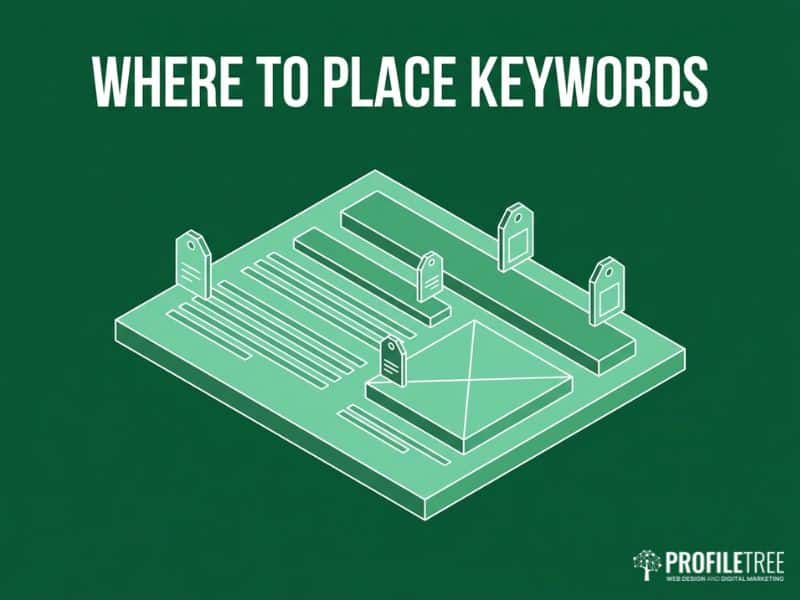
Placement decides how much work each term does. The aim is not density, it is structure: put supporting terms where they define what a section is about, and search engines and AI systems both get a clear map of your page. Every placement below serves readers first.
H2 and H3 Subheadings
Your most important secondary keywords belong in H2 headings. Use H3s for the more specific variations underneath. A workable structure looks like this:
- H1: Web Design Belfast: Professional Websites for Northern Ireland Businesses
- H2: WordPress Web Design Belfast
- H3: Custom WordPress Themes for NI Businesses
- H3: WordPress SEO Setup
- H2: Ecommerce Website Development
- H3: Shopify Store Setup
- H3: WooCommerce Solutions
- H2: Responsive Web Design Services
For a 2,500-word guide on WordPress web design in Belfast, we targeted six supporting terms: WordPress development Northern Ireland, custom WordPress sites, WordPress SEO setup, WordPress maintenance Belfast, WordPress security and responsive WordPress design. Each became a section, and the same map shaped the website development services brief for that build.
Body Copy and Natural Context
Write for the reader first, then review for coverage. Modern algorithms understand synonyms and paraphrase, so exact repetition adds nothing once the term appears in context.
If a secondary keyword will not sit naturally in a paragraph, that is useful information. Either the phrasing is wrong or the term belongs on a different page. The terms that do survive are also the ones to reuse in social media marketing posts and paid ad copy.
Alt Text and Meta Descriptions
Include supporting terms in image alt text where they genuinely describe the image, which serves accessibility as well as search. In a meta description, a variation or two widens the range of queries your snippet can match: “ProfileTree provides SEO services in Belfast and across Northern Ireland. Our search engine optimisation work helps businesses improve Google rankings and attract local customers.”
The same list should shape titles and descriptions for video marketing content, which competes in its own set of results.
Internal Linking Anchor Text
Use secondary keywords as anchor text when linking between related pages. It reinforces the relationship and tells search engines what the destination covers. Descriptive anchors beat “click here” every time, and varying them stops one phrase doing all the work.
Mapping Secondary Keywords Across Your Site
Research is only half the task. The other half is deciding which page owns which terms, because two pages chasing the same phrases compete with each other and neither wins. A simple map prevents that, and it takes an afternoon.
One Page, One Intent
List every page, assign one primary keyword, then allocate 4 to 8 secondary keywords beneath it. If a term genuinely fits two pages, one keeps it and the other links across using it as anchor text. Mapping at this level belongs in strategic digital planning, not in a tidy-up after the pages exist.
Our own service pages follow the pattern. The main SEO page targets “SEO Belfast”, while supporting pages take “local SEO Northern Ireland”, “technical SEO services”, “SEO audits Belfast” and “Google Business Profile optimisation”.
Semantic Exclusion: The Negative Keyword Trap
Some terms actively confuse search engines about your subject. If you write about apples the fruit, vocabulary borrowed from consumer technology will muddy the page. If you sell commercial cleaning, domestic cleaning terms will pull you into the wrong results.
Decide what a page is not about and keep those phrases off it. When consolidation means retiring pages, the redirects and technical tidy-up sit with whoever handles your managed WordPress hosting.
| Symptom | Likely cause | Fix |
|---|---|---|
| Two pages swapping positions for one query | Overlapping secondary keywords | Consolidate or reassign terms |
| Impressions rising, clicks flat | Terms match, content does not answer | Add direct-answer sections |
| Ranking for irrelevant queries | Wrong supporting vocabulary | Remove off-topic terms |
Common Mistakes with Secondary Keywords
Even a well-researched list fails when it is implemented badly. These are the problems we find most often when auditing sites for clients across Northern Ireland and the UK, and all four are quick to correct.
Keyword Stuffing
Forcing terms where they do not fit damages readability and can trigger penalties. If one secondary keyword appears more than two or three times in a 500-word section, you are overdoing it. Readability is a layout question as much as a copy question, which is why user-focused web design and keyword work belong in the same brief.
Drifting From Search Intent
Similar wording does not mean similar intent. A page targeting “SEO services Belfast” is transactional; “what is SEO” and “how does SEO work” are informational and belong in a separate article. Mixing them confuses search engines and frustrates both audiences.
Using Competitor Brand Names
Never target a competitor’s brand or a trademarked term unless you are writing a genuine comparison. You will not rank for it, and you may create a legal problem.
Ignoring Search Volume Reality
Terms with no search volume waste effort unless they answer a real client question. Terms with overwhelming competition waste more, and so does chasing rankings on a slow site, where website maintenance and hosting does the unglamorous work. The most productive secondary keywords for local markets sit in the moderate range, roughly 50 to 500 monthly searches.
Secondary Keywords for Local and Cross-Market SEO
Geography changes your supporting list. Businesses serving a defined area need location vocabulary alongside service vocabulary, and businesses selling across borders need to account for spelling and terminology differences. Both are straightforward once you know what to look for.
Local Secondary Keywords
For local search, effective secondary keywords combine neighbourhood names, regional variants and broader geographic terms. A Belfast restaurant might work from:
- Primary: restaurants Belfast city centre
- Secondary: Cathedral Quarter dining, fine dining Belfast, Northern Ireland restaurants, best restaurants Ulster, Belfast food scene
- Tertiary: Titanic Quarter, Belfast nightlife, Northern Irish cuisine
For a Derry hotel: “Londonderry accommodation”, “city centre hotels”, “Walled City lodging” and “Causeway Coast hotels”. When we optimise Google Business Profiles for local clients, we match the services listed there to the H1 headings on the matching website pages, which reinforces the location and service relationship for local pack rankings.
UK and US Spelling Variations
Spelling differences act as ready-made secondary keywords for anyone selling into more than one English-speaking market. A page written in UK English around “optimisation” will still pick up American searches for “optimization”, because search engines treat the pair as the same concept. The reverse also holds.
If both markets matter commercially, separate landing pages, delivered as part of your custom website builds, let each one use its native vocabulary: “colour” and “optimisation” on the UK page, “color” and “optimization” on the US page. For most Northern Ireland businesses, UK spellings as the default cover local, Republic of Ireland and UK-wide searches.
Your Next Steps With Secondary Keywords
Secondary keywords are how a single page earns visibility across dozens of related queries instead of one. The work is repeatable, and you can start it this week without buying anything.
- Export your Search Console query data and filter it to one underperforming URL
- Pull every query with impressions and an average position between 11 and 50
- Group them into 4 to 8 themes, and write one section per theme with the term in the heading
- Check no other page on your site already owns those terms
- Update the meta description and internal anchor text to reflect the new sections
- Recheck position and clicks after six to eight weeks, then repeat
ProfileTree has built keyword strategies for SMEs across Belfast, Northern Ireland, Ireland and the UK since 2011, holding a five-star Google rating from more than 450 reviews. If your pages are collecting impressions without clicks, the supporting vocabulary is usually where the answer sits.
FAQs
What are secondary keywords?
Secondary keywords are terms closely related to your primary keyword that add specificity and context. They let one page rank for many related queries rather than a single exact phrase.
What is the difference between primary and secondary keywords?
A primary keyword is the main subject of the page, and you target one per page. Secondary keywords are supporting terms, semantic variations and subtopics that prove you have covered the subject fully.
How many secondary keywords should I use on a page?
Four to eight for most pages. Go beyond ten and you dilute the focus, which makes the page’s purpose harder for search engines to read.
Are secondary keywords the same as LSI keywords?
In practice, yes. LSI was the older technical label for semantically related terms, and the industry now says secondary keywords instead.
Do secondary keywords help with AI Overviews and chatbots?
Yes. AI systems retrieve individual sections, so supporting terms in your subheadings make specific passages easier to find and quote.
How often should I review my secondary keywords?
Twice a year for commercial pages, and after any noticeable change in Search Console impressions or position. Query patterns shift faster than most content calendars assume.
Can two pages target the same secondary keywords?
Avoid it. Overlapping terms make pages compete with each other, so assign each term to one page and link between them using it as anchor text.