
Mastering AI in Predicting Search Success
Table of Contents
Search engines no longer just match keywords. They interpret what a searcher actually wants, forecast how demand will shift, and increasingly personalise the answer to the person asking. For businesses across Northern Ireland and the wider UK, understanding how AI drives these three things (intent, prediction and personalisation) is now a genuine part of doing SEO well, not a separate specialism reserved for large enterprises.
A decade ago, this kind of behavioural analysis needed a data science team and a large budget. Much of it’s now available through mainstream SEO and analytics platforms, which has narrowed the gap between what a large competitor can do and what a small or medium-sized business can do with the right tools and a clear plan.
This guide works through the practical side of that shift: how AI classifies search intent, how it forecasts trends before they peak, how natural language processing and semantic search have changed what “relevant” means, and how personalisation affects what different searchers see for the same query. Taken together, these five areas are the clearest current picture of the role of AI in search success for a UK business, whatever its size.
How AI Reads and Classifies Search Intent

Search intent recognition is one of the clearest examples of the role of AI in search success today. Modern algorithms interpret the purpose behind a query rather than matching it word for word, generally sorting searches into four broad categories: informational (someone looking for an answer), navigational (someone looking for a specific site), transactional (someone ready to buy) and commercial investigation (someone comparing options).
This classification happens through machine learning models trained on large volumes of search data, which pick up on the linguistic patterns that tend to signal each type of intent. A search containing “compare” or “versus” usually signals commercial investigation, for example, which is why comparison content tends to perform well against those terms. A search phrased as a question, such as “how much does website hosting cost,” usually signals someone earlier in the research stage, before they’re ready to talk to a supplier.
“The businesses achieving the greatest SEO success today are those that align their content strategy with actual search intent rather than focusing exclusively on keywords,” says Ciaran Connolly, founder of ProfileTree. “Understanding what your potential customers truly want when they type a query helps you create content that genuinely serves their needs.”
For a Belfast retailer, this might mean recognising that “compare” or “versus” searches call for a detailed comparison page rather than another generic product listing, timed for the point in the buying journey when a customer is actively weighing up options. A business that only ever publishes broad, top-of-funnel content will keep missing the searchers who are already deciding between suppliers, simply because nothing on the site speaks directly to that stage of the decision.
Mapping content against these four intent categories is a useful audit exercise on its own. Most SME websites are heavy on informational content and light on commercial investigation content, which leaves a gap at exactly the point where a searcher is closest to making a purchasing decision.
| Intent Type | What It Looks Like | Content That Matches |
|---|---|---|
| Informational | “How does AI classify search intent” | Explainers, guides, definitions |
| Navigational | “ProfileTree SEO services” | Clear service and brand pages |
| Transactional | “Book AI training in Belfast” | Booking pages, clear calls to action |
| Commercial investigation | “AI SEO tools compare” | Comparison pages, criteria-based guides |
A simple version of this audit works well even without specialist tools. List the pages that currently exist, note which of the four intent categories each one serves, and look for where the coverage thins out. A business with dozens of blog posts answering general questions but only one page comparing its own service against alternatives has an obvious, fixable gap, and closing it’s usually a smaller job than the initial audit makes it feel.
Predicting Search Trends Before They Peak
Prediction is where the role of AI in search success becomes most visible, often before a trend has peaked at all. AI systems are well-suited to spotting patterns across large volumes of search data, which makes them useful for forecasting demand rather than only reacting to it. Google Trends, for example, already surfaces rising search terms before they become mainstream, and the same underlying pattern-detection approach can flag seasonal fluctuations, emerging topic clusters, and shifts in how a query gets worded over time.
For businesses with seasonal products or services, this kind of forecasting can shift marketing timing from reactive to proactive: building content and campaigns ahead of a demand peak, rather than competing for attention once everyone else has noticed it too. A business that waits until search volume for a seasonal term is already climbing has usually missed the window to rank ahead of that demand; a business tracking the same pattern a few weeks earlier can publish before the competition catches up.
Regional variation matters here as well. A trend showing nationally across the UK won’t always appear in the same shape across Northern Ireland, so relying only on UK-wide data can mask genuine local differences in timing or demand. A national campaign calendar built purely from UK-wide search data risks launching a few weeks off the mark for a Belfast or Derry audience, where local events, school terms or regional weather patterns can shift demand earlier or later than the national curve.
A digital strategy that incorporates this kind of forecasting tends to get more value from a content calendar than one built purely around historical performance, since it plans for where demand is heading rather than only where it has already been. This works best as a habit rather than a one-off exercise: checking emerging query data on a regular cycle, rather than only when planning a big seasonal campaign, tends to catch smaller shifts before they show up in a competitor’s content first.
This same forecasting approach extends beyond seasonal planning. Tracking how a query’s wording changes over several months, rather than treating it as fixed, can reveal when an audience is starting to ask a more advanced version of a question, which is often the point at which existing content needs a genuine update rather than a light edit. AI-enhanced marketing support can help build this kind of ongoing tracking into a regular habit rather than a one-off exercise.
Natural Language Processing and Search Behaviour
Natural language processing (NLP) is central to the role of AI in search success, because it’s the technology behind search engines’ understanding context and phrasing rather than matching exact keywords. Modern natural language processing models recognise topic relevance beyond exact wording, interpret conversational and question-based queries, and pick up on relationships between terms that are not obviously connected on the surface.
This has a direct effect on how content needs to be written. A page has to address a topic thoroughly rather than repeat a target phrase as often as possible, because search engines match on meaning rather than density. Content that reads naturally, covering the questions a person would actually ask about a subject, tends to perform better under NLP-driven matching than content stuffed with a single phrase repeated at every opportunity, which is exactly the kind of pattern search engines are now built to see through.
The rise of voice search has pushed this further still, since spoken queries are typically longer and more conversational than typed ones. Someone typing might search “Belfast web design cost,” while someone using voice search is more likely to ask “how much does it cost to get a website built in Belfast.” An AI system has to extract the same underlying request from both, despite the difference in phrasing, sentence length and structure.
NLP advances also help local search directly. A search engine that understands regional terminology, such as local place names or colloquial phrasing common in Belfast or Derry, can match a searcher to a relevant nearby business more reliably than one relying on exact keyword matches alone. A business writing genuinely in its own regional voice, rather than a generic, keyword-optimised version of it, is often better placed to be matched correctly by this kind of language understanding.
This has a knock-on effect for FAQ content specifically. Questions phrased the way a real customer would ask them, rather than the way a keyword tool suggests, tend to match voice and conversational search more reliably, simply because they’re closer to how the underlying NLP model was trained to interpret a genuine question in the first place.
Semantic Search and Entity Understanding
Semantic search extends the role of AI in search success beyond simple keyword matching by connecting a query to a broader knowledge graph rather than treating it as an isolated string of words. Google’s own documentation on how Search works confirms that this kind of matching sits alongside crawling and indexing as a core part of how results get served, rather than a separate, optional layer. This lets a search engine recognise conceptual relationships between topics, understand synonyms, identify entities such as people, places and organisations within content, and disambiguate terms that could mean more than one thing depending on context.
For content strategy, this means a page written narrowly around a single keyword will generally underperform a page that addresses the related questions, subtopics and terms a searcher would reasonably expect to be covered in the same place. Search engine optimisation work has shifted accordingly, with topic clusters and internal linking used to signal how a business’s content connects across a subject rather than treating each page as standalone.
A business covering its industry with this kind of semantic depth, rather than targeting a narrow set of keywords, tends to build stronger visibility over time, because it gives a search engine more ways to recognise the business as a relevant source across a whole topic rather than a single query. In practice, this often means a handful of well-connected pages covering a subject from different angles outperform a single page trying to cover everything at once, provided each page links clearly to the others and to a central hub page on the topic.
Getting the entities right also matters for anything approaching a brand or a named person. A business name, a founder’s name, and a location used consistently across a website help a search engine build a clear, unambiguous picture of who’s being discussed, rather than treating each mention as a separate, disconnected fact.
This consistency needs to run through the whole site rather than a single “about” page alone. A founder’s name, job title and the business name should read the same way in an author bio, a press mention and a social profile, since inconsistent versions of the same entity make it harder for a search engine to confidently connect them into a single, trusted picture.
Search Personalisation and Local Relevance
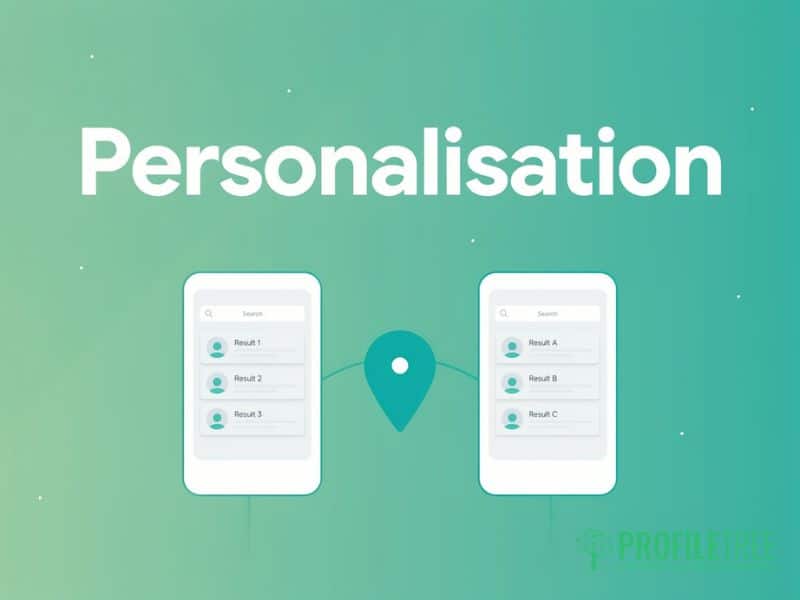
Personalisation is the sharpest edge of the role of AI in search success, because it’s the point where a search engine stops treating every searcher the same way. Search results increasingly reflect an individual searcher’s history, location and context, so two people typing an identical query rarely see exactly the same results. This personalisation runs on machine learning models that continually refine their understanding of an individual searcher’s preferences, based on factors including location, device, time of day and past search behaviour.
Local businesses benefit from this directly when a customer searches for a service “near me,” since AI systems weigh business relevance, reputation and prior user engagement alongside pure proximity. A well-reviewed local business with clear, consistent listing information can outperform a larger competitor for these searches, even without a bigger marketing budget, because personalisation rewards relevance and trust signals rather than size alone.
It also changes how performance gets measured. A single keyword ranking report has limited value when results vary by searcher, so tracking a broader set of signals, including branded search and engagement by audience segment, gives a more accurate picture of real visibility than a position report checked in isolation. Two campaigns can show identical average rankings while performing very differently in practice, simply because personalisation is serving each one to a different mix of searchers.
This is also where a joined-up content marketing approach helps, since content built for a specific audience segment tends to hold up better across these personalised variations than content written for a generic reader. A page written for “accountants in Belfast switching software providers” will keep matching that specific searcher reliably, while a page written for “accounting software” alone is more exposed to whatever personalisation happens to serve up on a given day.
None of this means abandoning broader keyword targets altogether. It means treating them as a starting point rather than the finished brief, and building in the specific audience, location or use case that personalisation is already using to decide who sees what.
Putting This Into Practice
None of the sections above works in isolation, and that’s really the point. The role of AI in search success isn’t one technique but five working together: search intent shapes what to write, prediction shapes when to publish it, NLP and semantic search shape how thoroughly to cover it, and personalisation shapes who actually sees it. A business that treats these as a single connected picture, rather than as separate technical concerns handled by different tools, tends to get more value from its search strategy than one that addresses each in isolation.
The starting point doesn’t need to be complicated. Auditing existing content against the four intent categories, checking whether seasonal or cyclical demand is being tracked at all, and reviewing whether pages are written to answer a topic thoroughly rather than to repeat a phrase, will surface most of the obvious gaps without needing new tools or a large budget.
Small, regular checks tend to outperform a single large audit repeated once a year. A quarterly review of intent coverage, seasonal timing and entity consistency catches drift early, before a competitor has quietly closed the same gaps first.
For a UK SME without an in-house specialist, AI training support is often the fastest way to build this understanding across a marketing team, without needing to hire a dedicated AI specialist. ProfileTree works with businesses across Northern Ireland, Ireland and the UK on exactly this kind of practical, AI-aware search strategy, from an initial content audit through to ongoing planning and training.
FAQs
1. How does AI recognise what a searcher actually wants?
AI models classify queries by intent (informational, navigational, transactional or commercial investigation) based on linguistic patterns learned from large volumes of search data. This intent-matching is one of the clearest parts of the role of AI in search success, since it lets search engines match content to the right stage of a searcher’s decision rather than just the words typed.
2. Can AI genuinely predict search trends before they happen?
AI can detect early patterns in rising search volume and topic clusters, similar to how Google Trends surfaces emerging terms. It’s useful for proactive planning, but it works best alongside human judgment about a specific market or industry.
3. What’s the difference between NLP and semantic search?
NLP focuses on understanding language itself, including context, phrasing and conversational queries. Semantic search goes further, connecting a query to a broader knowledge graph of related entities, concepts and topics.
4. Why do two people see different results for the same search?
Search personalisation factors in location, device, search history and time of day, so results are tailored to the individual rather than fixed for a given query. This is one reason a single rankings report doesn’t tell the full story of visibility.
5. How should a small business start using AI in its search strategy?
Start with one clear application, such as intent-based content planning or basic trend tracking, rather than attempting everything at once. It’s usually more practical to partner with a specialist for initial training than to build AI expertise from scratch.