
7 Critical Factors to Consider When Hiring a Copywriter
Table of Contents
Most businesses excel at delivering their products or services but struggle to communicate that value effectively in written form. A technically superior offering can be overshadowed by competitors simply because their website copy, marketing materials, or content strategy articulates benefits more clearly. Hiring a copywriter addresses this fundamental challenge by transforming your expertise into persuasive, search-optimised content that attracts customers and drives conversions.
Professional copywriters do more than construct grammatically correct sentences. They translate technical features into customer benefits, structure content for search engine visibility, and craft messaging that resonates with your target audience. For business owners and marketing managers, the right copywriter becomes a strategic partner who understands both the creative and technical demands of modern digital marketing. Whether you need website content, blog articles, case studies, or sales materials, quality copywriting directly influences how potential customers discover and perceive your business.
However, hiring a copywriter involves more complexity than many businesses anticipate. Experience levels vary dramatically, pricing structures differ between freelancers and agencies, and not all writers possess the necessary SEO knowledge to ensure content ranks competitively. This guide examines six essential factors—availability, experience, pricing, portfolio quality, SEO expertise, and business understanding—that will help you select a copywriter capable of delivering measurable results for your Northern Ireland, Irish, or UK-based business.
Why Copywriter Selection Matters
Professional copywriting sits at the intersection of persuasion, technical precision, and search optimisation. The right writer doesn’t simply produce grammatically correct sentences—they create content that ranks on search engines, resonates with your target audience, and drives specific business outcomes.
Research shows that businesses prioritising content marketing generate 67% more leads than those that don’t. For SMEs competing in saturated markets, well-crafted copy provides a competitive advantage that extends far beyond basic communication. Your copywriter becomes a strategic partner in building online visibility and establishing market authority.
ProfileTree works with businesses across Northern Ireland, Ireland, and the UK to develop content strategies that balance creative storytelling with data-driven search optimisation. The selection process determines whether your investment in content delivers returns or simply adds to the noise.
Scheduling, Availability and Project Management
The most talented copywriter delivers little value if they cannot meet your deadlines or accommodate your project timeline. Availability considerations extend beyond simple scheduling to encompass workload management, communication patterns, and long-term reliability.
Understanding Freelance Writer Schedules
Freelance copywriters manage their own time, often juggling multiple clients simultaneously. Before committing to a writer, establish clear expectations about availability, turnaround times, and communication protocols.
When approaching a prospective copywriter, provide a detailed scope of work outlining:
- Total word count requirements
- Number of pieces needed
- Preferred delivery dates
- Revision expectations
- Communication preferences
This initial clarity helps writers assess whether they can accommodate your timeline whilst maintaining quality standards. Some copywriters work full-time jobs alongside freelancing, which may limit their availability for urgent projects or extensive revisions.
Creating Effective Editorial Calendars
Developing an editorial calendar before engaging a copywriter streamlines the working relationship and controls costs. A well-structured calendar specifies:
- Content topics and formats
- Publishing deadlines
- Keyword targets
- Internal linking opportunities
- Seasonal considerations
This framework allows writers to plan their workload efficiently, potentially reducing hourly costs through batch processing. For ongoing content requirements, consider establishing monthly retainers with agreed-upon deliverables rather than project-by-project arrangements.
Continuity and Style Consistency
Writers develop distinctive voices and approaches. If your business relies heavily on a specific tone or style, losing a freelancer mid-campaign creates consistency challenges. New writers require time to understand your brand guidelines, previous content, and audience expectations.
Consider whether you need:
- Single Writer Dependency: Higher quality but increased vulnerability to availability changes
- Writing Team Approach: Better continuity, but requires stronger brand guidelines and editing processes
For businesses building long-term content strategies, documenting style preferences, approved terminology, and brand voice characteristics minimises disruption when writers transition.
Experience and Industry Knowledge
A copywriter’s experience level directly influences both the quality of their output and the efficiency of your working relationship. Beyond years in practice, industry-specific knowledge can dramatically reduce revision cycles and improve content relevance from the first draft.
Assessing Writer Experience Levels
Copywriter experience directly correlates with pricing, but also with efficiency, strategic thinking, and content effectiveness. Experience levels typically break down as:
Junior Copywriters (0-2 years): Suitable for straightforward blog posts, social media content, and basic web copy. Require detailed briefs and more extensive editing. Cost-effective for businesses with tight budgets and internal editorial oversight.
Mid-Level Writers (3-5 years): Handle complex topics, understand content strategy fundamentals, and require less direction. Appropriate for landing pages, comprehensive guides, and thought leadership content.
Senior Writers (5+ years): Bring strategic insight, industry expertise, and sophisticated understanding of conversion psychology. Ideal for high-stakes projects like sales pages, white papers, and executive content.
ProfileTree’s copywriting team includes specialists across experience levels, matching writer expertise to project complexity and business objectives. A product description requires different capabilities than a technical white paper or strategic case study.
Industry Specialisation Benefits
Writers with industry-specific experience deliver immediate value through:
- Established Knowledge Base: No learning curve on basic industry concepts
- Appropriate Terminology: Natural use of sector language without over-explanation
- Audience Understanding: Insight into customer pain points and decision factors
- Compliance Awareness: Knowledge of regulatory requirements (fundamental in finance, healthcare, and legal sectors)
If your business operates in a technical or regulated industry—accountancy, financial services, healthcare, legal; hiring a writer familiar with that landscape reduces research time and improves content accuracy.
Testing Writer Capabilities
Before committing to a large project, test prospective writers with:
- Sample Brief Exercise: Provide a typical brief and assess their approach
- Portfolio Review: Examine published work in your industry or similar contexts
- Strategy Discussion: Evaluate their understanding of content marketing principles
A 500-word test piece costs less than discovering incompatibility after commissioning extensive work. Look for writers who ask clarifying questions, demonstrate curiosity about your business, and offer strategic suggestions beyond fulfilling brief requirements.
Understanding Pricing Structures
Copywriting costs vary dramatically across experience levels, project types, and regional markets. Understanding pricing structures helps you budget appropriately whilst avoiding the false economy of choosing writers based solely on low rates.
Investment vs. Cost Perspective
Quality copywriting represents an investment in business growth, not merely an operational expense. Websites with professional copy typically see:
- Higher conversion rates on landing pages
- Improved search engine rankings from optimised content
- Better engagement metrics (time on page, bounce rate)
- Stronger brand perception and authority
Businesses invest substantial sums in website design and development, yet often undervalue the words that actually persuade visitors to take action. Your copywriter has a direct impact on whether your digital presence generates leads or languishes unnoticed.
Typical UK Copywriting Rates
UK freelance copywriting rates vary based on experience, project complexity, and deliverable type:
Hourly Rates:
- Entry-level: £25-£75 per hour
- Mid-level: £50-£150 per hour
- Senior: £100-£250 per hour
- Expert: £200-£400+ per hour
Project-Based Pricing:
- Short-form content (under 500 words): £50-£250
- Medium-form (500-1,500 words): £250-£1,000
- Long-form (1,500+ words): £1,000-£5,000+
- Ongoing retainers: Typically, a 10-20% discount on standard rates
Technical content, urgent turnarounds, and niche specialisations command premium rates. Belfast-based ProfileTree structures pricing based on project complexity, research requirements, and the expected business impact, rather than simply word counts.
Balancing Budget and Quality
Lower rates don’t consistently deliver better value. An experienced writer producing high-converting copy at £150 per hour often provides better ROI than a junior writer at £30 per hour, requiring extensive revisions and delivering mediocre results.
Consider the total cost of ownership:
- Direct Writing Costs: The quoted rate
- Revision Time: Additional rounds often indicate poor initial understanding
- Editing Requirements: Internal time spent improving substandard work
- Opportunity Cost: Poor content that fails to generate leads or rankings
For budget-conscious SMEs, working with mid-level writers on a retainer basis often delivers an optimal balance between cost control and quality output.
Portfolio Review and Writing Samples
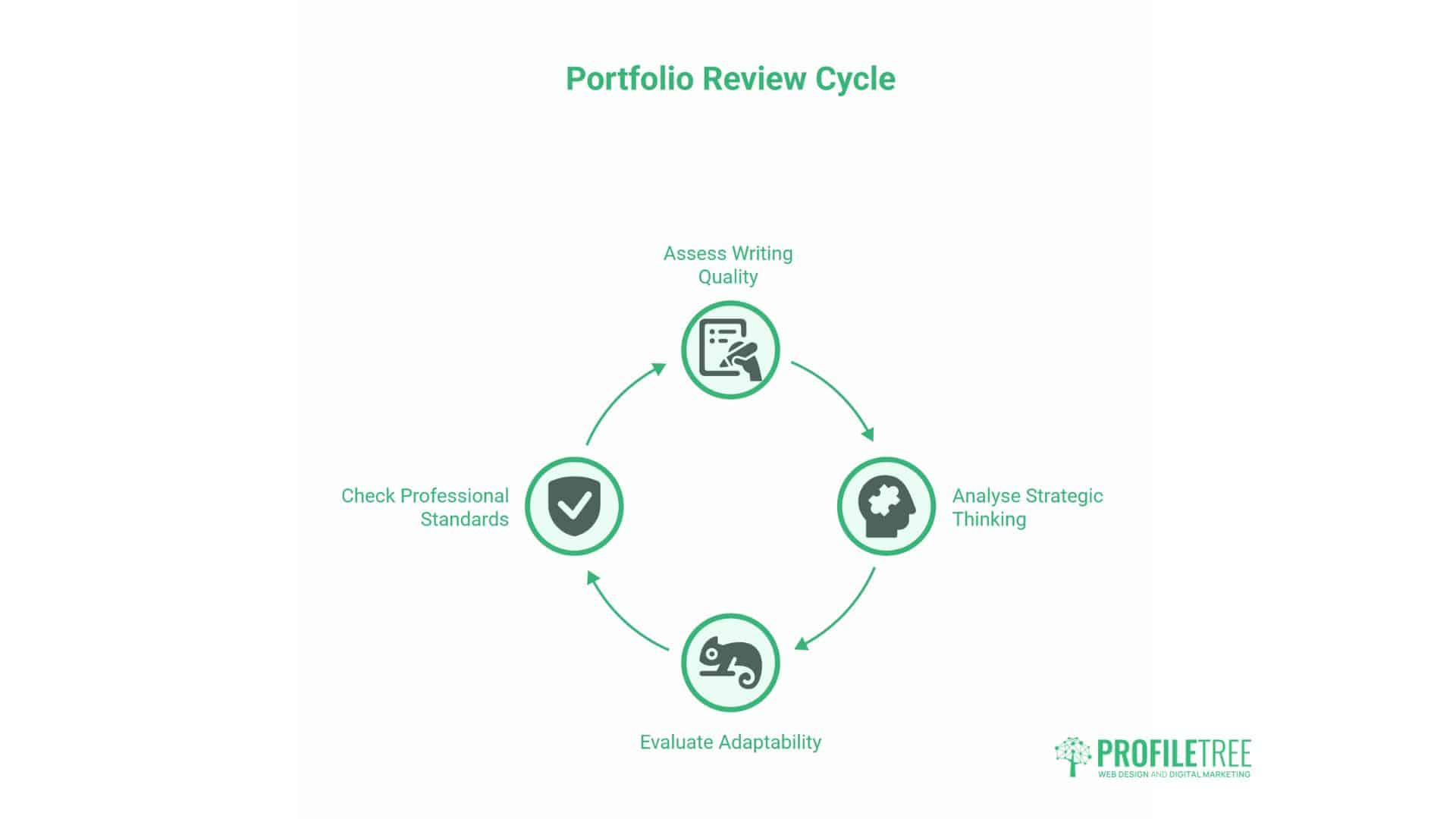
Past work provides the most transparent window into a copywriter’s capabilities, versatility, and stylistic approach. A thorough portfolio review reveals not just writing quality, but strategic thinking, adaptability, and professional standards.
Evaluating Previous Work
A writer’s portfolio reveals more than their ability to construct sentences. Look for:
- Versatility: Can they adapt tone for different audiences and formats?
- Clarity: Do they communicate complex ideas accessibly?
- Engagement: Does the writing maintain interest throughout?
- Results Orientation: Do samples demonstrate understanding of conversion principles?
Request samples relevant to your industry or content type. A writer with an impressive blog portfolio may struggle with technical white papers or persuasive sales copy. Each format requires distinct skills and approaches.
Identifying Style Compatibility
Even experienced writers maintain individual styles that may or may not align with your brand voice. Some writers excel at conversational, personality-driven content, while others produce more formal, authoritative material.
Before committing, assess whether their natural style matches your requirements:
- Review tone consistency across multiple samples
- Check sentence structure preferences (long vs. short)
- Evaluate personality integration (first-person vs. objective voice)
- Assess visual formatting approaches (subheadings, lists, paragraph length)
If you appreciate their expertise but not their style, establish detailed brand guidelines. Comprehensive style documentation helps writers adapt while maintaining quality. ProfileTree develops brand voice frameworks that allow multiple writers to produce cohesive content across all business communications.
Red Flags in Portfolio Assessment
Be cautious of:
- Generic, templated content that could apply to any business
- Excessive promotional language without substantive information
- Poor grammar or spelling in published samples
- Lack of industry variety if you need specialised knowledge
- No published work (only spec samples)
Writers should demonstrate published content in professional contexts, not just practice pieces. Request URLs where their work appears live, rather than accepting PDF samples that may not accurately represent actual client projects.
SEO Knowledge and Technical Skills
Modern content exists primarily to be found through search engines. A copywriter without SEO knowledge produces content that may read beautifully but fails to attract the organic traffic that drives business growth.
Why SEO Matters for Copywriters
Search engine optimisation has evolved from keyword insertion to a sophisticated understanding of how search engines evaluate content quality, topical authority, and user satisfaction. A copywriter without SEO knowledge may produce content that reads well, but it fails to attract organic traffic.
Modern SEO copywriting requires understanding:
- Entity-Based Optimisation: Moving beyond keyword density to semantic relationships and topic clustering.
- Search Intent Matching: Aligning content format and depth to what searchers actually want.
- Technical Structure: Proper heading hierarchy, internal linking, and schema markup.
- E-E-A-T Principles: Demonstrating expertise, experience, authority, and trustworthiness
For businesses investing in content marketing as a growth channel, hiring writers who understand these principles proves essential. Content that ranks on page one delivers exponentially more value than identical content buried on page five.
Essential Technical Capabilities
Competent SEO copywriters should demonstrate familiarity with:
- Keyword research tools (SEMrush, Ahrefs, Google Keyword Planner)
- Search console data interpretation for identifying opportunities
- Competitive content analysis to identify gaps and opportunities
- Basic HTML for proper heading structure and formatting
- Content management systems (WordPress, particularly)
They needn’t be technical specialists, but should understand how content structure affects both search visibility and user experience. Ask prospective writers about their approach to:
- Keyword integration without over-optimisation
- Internal linking strategies
- Meta description writing
- Image optimisation practices
ProfileTree’s content services integrate SEO strategy from initial planning through publication, with writers collaborating with technical specialists to maximise both readability and search performance.
Local SEO Considerations
For businesses serving regional markets, particularly in Northern Ireland, Ireland, and the UK, local SEO expertise adds significant value. Writers should understand:
- Location-specific keyword targeting
- Local business schema implementation
- Regional terminology and cultural references
- UK spelling and grammar conventions
Content targeting “Belfast web design” requires different strategic approaches than generic “web design” content. Local market knowledge helps writers naturally incorporate geographic signals whilst maintaining authentic, non-spammy language.
Business Understanding and Brand Alignment
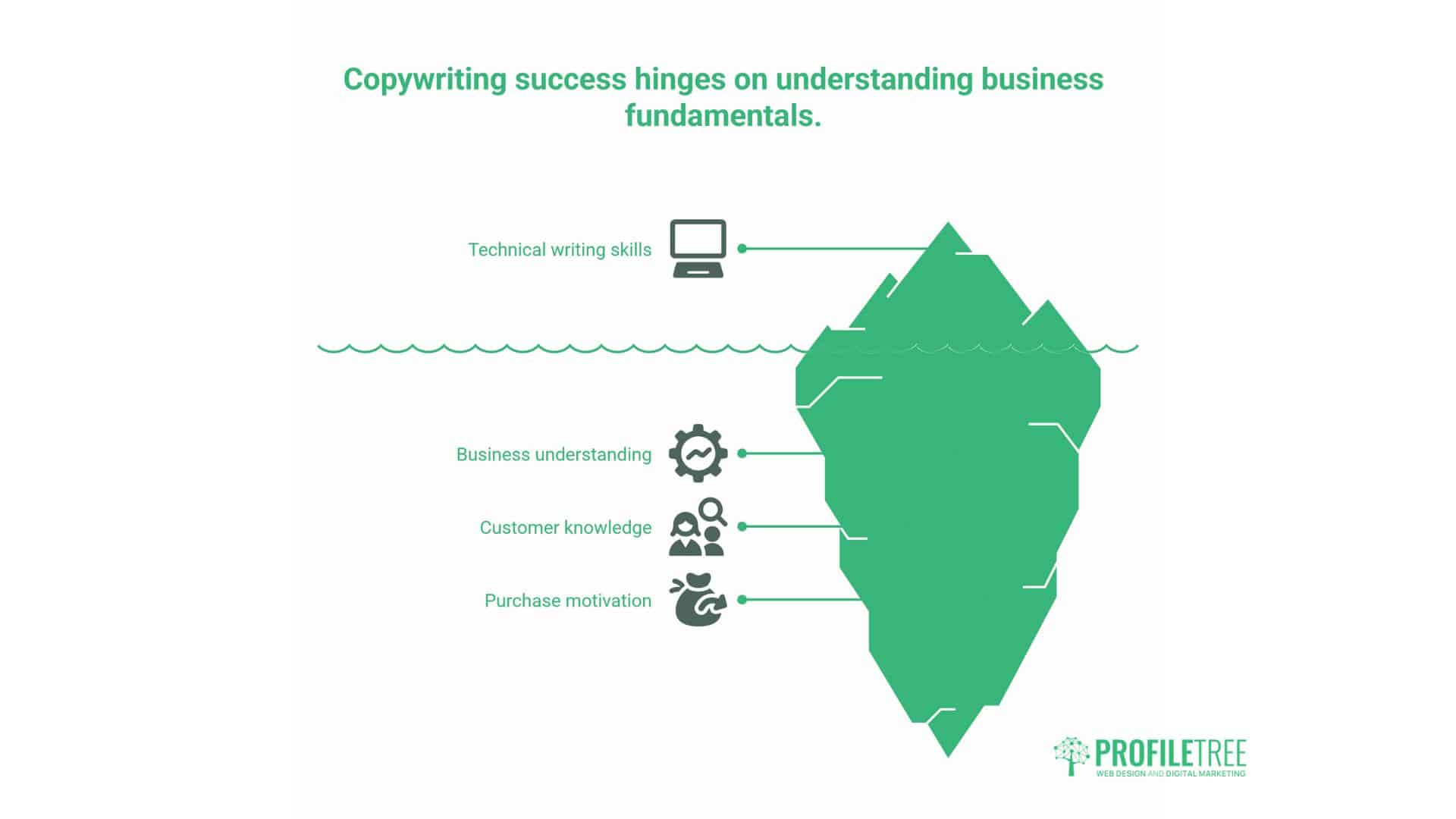
Technical writing skills and SEO knowledge are meaningless if a copywriter fails to understand what makes your business distinctive, who your customers are, and what motivates purchasing decisions in your market.
The Value of Industry Familiarity
Writers who understand your business model, competitive landscape, and customer base deliver superior results from the first draft. This understanding manifests through:
- Appropriate Positioning: Knowing how to differentiate your business from competitors.
- Customer Pain Points: Understanding What Keeps Your Audience Awake at Night.
- Decision Factors: Recognising what information influences purchasing decisions.
- Industry Trends: Awareness of current developments affecting your sector
When writers grasp your business context, they produce content that resonates authentically with your audience rather than generic material applicable to any company.
Developing Brand Voice Guidelines
If you’ve identified a talented writer whose style doesn’t perfectly match your brand, comprehensive guidelines bridge the gap. Adequate brand voice documentation includes:
- Tone descriptors (professional but approachable, technical but accessible)
- Language preferences (industry jargon usage, formality level)
- Prohibited terms or phrases
- Example passages demonstrating the desired voice
- Audience profiles describing who you’re addressing
For businesses working with multiple writers or agencies, documented guidelines maintain consistency across all communications. ProfileTree develops brand voice frameworks in conjunction with content strategy, enabling companies to establish a distinctive market position through consistent messaging.
Collaborative Working Relationships
The most effective copywriting relationships function as partnerships rather than transactional arrangements. Look for writers who:
- Ask strategic questions about business objectives
- Offer content recommendations beyond brief requirements
- Share performance insights from previous projects
- Demonstrate curiosity about your industry and customers
- Suggest improvements to briefs or strategy
Writers invested in your success contribute ideas, challenge assumptions constructively, and help refine your content approach over time. This collaborative dynamic delivers far greater value than simply executing assignments as specified.
Additional Considerations for UK Businesses
Beyond the six primary factors, UK-based businesses face specific considerations regarding regulatory compliance, cultural sensitivity, and regional market nuances that influence the selection of copywriters.
Compliance and Regulatory Awareness
Specific industries are subject to strict advertising and content regulations. If you operate in financial services, healthcare, legal, or other regulated sectors, your copywriter must understand relevant compliance requirements:
- FCA regulations for financial promotions
- ASA guidelines for advertising standards
- GDPR implications for data handling in content
- Professional body standards (SRA, ICAEW, GMC, etc.)
Non-compliant content creates legal risk and reputational damage. Verify that prospective writers have experience navigating your industry’s regulatory environment or a willingness to research requirements thoroughly.
Cultural and Regional Sensitivity
UK businesses often serve diverse markets across England, Scotland, Wales, Northern Ireland, and the Republic of Ireland. Effective copywriters recognise cultural nuances and avoid assumptions about:
- Regional terminology differences
- Historical and political sensitivities (particularly in Northern Ireland)
- Cultural reference appropriateness
- Spelling and grammar preferences (UK vs. US English)
ProfileTree’s Belfast base offers a unique perspective on Northern Ireland’s business landscape, while serving clients throughout the UK and Ireland. Regional awareness prevents embarrassing missteps and helps content resonate more authentically with local audiences.
Making Your Final Selection
With thorough evaluation complete across all six factors, synthesising your findings into a clear hiring decision requires balancing competing priorities against your specific business context and objectives.
The Hiring Decision Framework
After evaluating availability, experience, pricing, portfolio quality, SEO knowledge, and business understanding, synthesise your findings:
Essential Requirements:
- Demonstrates relevant experience through portfolio
- Understands basic SEO principles for your content type
- Available within your timeline requirements
- Pricing aligns with your budget parameters
Differentiating Factors:
- Industry-specific knowledge
- Strategic thinking beyond execution
- Communication style and responsiveness
- Cultural fit with your organisation
- Enthusiasm for your business or sector
No writer will excel across all dimensions. Prioritise factors most critical to your specific situation. A startup with a limited budget might emphasise cost-effectiveness and availability, whilst an established firm producing technical content prioritises industry expertise regardless of premium pricing.
Trial Projects and Performance Assessment
Rather than immediately committing to extensive content programmes, consider:
- Small test project (2-3 pieces) to evaluate working relationship
- Clear success metrics (traffic, engagement, conversions)
- Feedback process for continuous improvement
- Gradual expansion based on demonstrated results
This approach minimises risk whilst allowing both parties to assess compatibility. Track content performance through analytics to determine whether the investment generates measurable business value.
“When evaluating copywriting partners, businesses often focus exclusively on writing quality,” notes Ciaran Connolly, Director of ProfileTree. “The most successful engagements happen when writers understand both the technical requirements of search optimisation and the strategic business objectives behind each piece of content. We approach every project by first understanding what success looks like for that specific client.”
FAQs
How much should I expect to pay for professional copywriting services?
UK copywriting rates vary significantly based on experience and project complexity. Entry-level writers charge £25-£75 per hour, whilst senior specialists command £100-£250+ per hour. Project-based pricing ranges from £50 to £250 for short content to £ 1,000 to £ 5,000+ for comprehensive, long-form pieces.
Do I need a copywriter with specific industry experience?
Industry experience accelerates project timelines and improves content quality, particularly in technical or regulated sectors. However, talented generalist writers with strong research skills can often produce excellent content across diverse industries. For complex B2B services, financial products, healthcare, or legal content, industry specialisation typically justifies premium rates.
How do I know if a copywriter understands SEO?
Ask prospective writers to explain their approach to keyword integration, content structure for search visibility, and how they balance optimisation with readability. Request examples of content they’ve written that ranks well organically. Competent SEO copywriters should discuss search intent, semantic keywords, heading hierarchy, and internal linking without resorting to outdated tactics, such as keyword stuffing or exact-match repetition.
What’s the difference between a copywriter and a content writer?
Traditional distinctions position copywriters as persuasive specialists (for sales pages, advertisements, and direct response) and content writers as information-focused (for blogs, guides, and articles). However, these boundaries have become increasingly blurred. Modern businesses need writers who combine both skill sets—producing informative content that also persuades and converts. Evaluate writers based on demonstrated capabilities across formats rather than arbitrary title distinctions.
Taking Action: Hiring a Copywriter
Selecting a copywriter represents a strategic business decision that influences your market visibility, brand perception, and customer acquisition effectiveness. Rather than treating content as a commodity, approach writer selection with the same rigour you apply to other professional service providers.
Before beginning your search:
- Define your content objectives beyond “we need blog posts”
- Establish success metrics to evaluate performance
- Develop brand guidelines if they don’t already exist
- Allocate a realistic budget based on the business impact potential
- Create project briefs that communicate requirements clearly
The copywriter who understands your business, demonstrates technical proficiency, and shares your commitment to measurable results becomes an invaluable partner in business growth rather than simply a vendor fulfilling orders.
For Northern Ireland, Irish, and UK businesses seeking copywriting services that integrate strategic thinking with technical optimisation, ProfileTree offers comprehensive content solutions. Our team combines industry expertise across digital marketing, SEO, web design, and AI implementation with professional writing capabilities to deliver content that ranks, resonates, and converts.
Contact ProfileTree to discuss how professional copywriting services can strengthen your digital presence and drive measurable business outcomes.