
The Power of Experience: Key Experiential Marketing Statistics
Table of Contents
Experiential marketing is a strategy that invites people to participate in a brand rather than simply observe it. Instead of delivering a message, it creates a moment: something a person does, feels, or remembers. A product demonstration at a trade show, a branded installation at a festival, or a virtual showroom that lets customers explore a product before buying — these are all examples of experiential marketing in practice.
For businesses of any size, the core principle is the same: make the brand the experience, not just the backdrop.
This guide covers what experiential marketing is, how it differs from standard event marketing, why it drives measurable results, and how UK and Irish businesses — including SMEs without large event budgets — are using it effectively in 2026.
What is Experiential Marketing?
Experiential marketing — also called engagement marketing or participation marketing — is any marketing activity that puts the audience inside the brand story rather than in front of it. The defining characteristic is active involvement: the person does, chooses, or experiences something directly connected to the brand.
The 5 Cs of experiential marketing
A practical way to assess whether an activity qualifies as experiential is to test it against five principles: Connection (does it create a direct link between the brand and the individual?), Content (does the experience generate shareable content naturally?), Context (is the setting meaningful to the audience?), Community (does it build belonging around the brand?), and Commerce (does it move people closer to a buying decision?). Not every campaign will score on all five, but the strongest activations tend to hit at least three.
What experiential marketing is not
A branded stand at a trade show where a sales rep talks to passing delegates is event marketing, not experiential marketing. Handing out leaflets at a festival is neither. The distinction matters because they require different planning, different metrics, and different budgets. Experiential marketing demands active design — the audience must be able to do something, not just receive something.
Experiential Marketing vs. Event Marketing
The two terms are often used interchangeably, but they describe different things. Understanding the distinction helps SMEs allocate budget and set realistic expectations.
| Event Marketing | Experiential Marketing | |
|---|---|---|
| Audience role | Passive — attends, watches, listens | Active — participates, interacts, chooses |
| Primary metric | Footfall, reach, impressions | Engagement rate, dwell time, social sharing, recall |
| Focus | Promoting the brand | Creating a memorable moment with the brand |
| Success indicator | Attendance numbers | Emotional connection, post-event behaviour |
| Budget pressure | High (venue, production) | Scalable — micro-experiences can be low-cost |
A business sponsoring a stand at the Balmoral Show is doing event marketing. A business running a live product workshop where farmers test a piece of machinery themselves is doing experiential marketing. The first puts a logo in front of people. The second puts the product in their hands — and that difference in recall and intent is where the data becomes compelling.
Why Experiential Marketing Works: The Data
The research case for experiential marketing over passive advertising has strengthened consistently over the past decade. A few headline figures from published industry studies are worth examining — though it is worth noting that headline statistics such as “65% ROI boost” circulate widely online without traceable primary sources, and marketers should treat these with appropriate caution.
What the peer-reviewed and industry-verified evidence does support:
Brand recall. Edelman’s research into live brand experiences found that personal participation significantly outperforms passive exposure on memory retention. People remember what they did, not what they saw on a screen.
Purchase intent. EventTrack research (Event Marketer/Mosaic) has consistently found that the majority of consumers who participate in a branded live experience say they are more likely to purchase the product. The 2023 edition of the study found 74% of event attendees said they had a more favourable opinion of a brand after engaging in an in-person activation.
Social amplification. Experiential campaigns generate organic social content because participants want to document and share their experiences. This extends reach beyond the physical activation without additional paid media spend.
B2B lead quality. For B2B businesses, the most relevant data point is not reach but conversation depth. An interactive demonstration at a trade show generates very different sales conversations from a passive stand. Buyers who have handled a product, witnessed a process in action, or participated in a live software demonstration enter the sales pipeline with fewer objections and shorter decision timelines.
The digital-first consideration for SMEs
For most SMEs in Northern Ireland, Ireland, and the UK, large-scale physical activations are not a realistic starting point. The practical evolution of experiential marketing for this audience is digital: branded video content that places the viewer inside a product experience; animation that demonstrates a complex service in an accessible way; virtual showrooms or product tours; and interactive social media campaigns that require genuine audience participation.
ProfileTree’s video production and animation services exist precisely at this intersection — helping businesses create the kind of participatory content that experiential marketing theory describes, at a scale and cost that makes sense outside a Fortune 500 budget.
UK and Irish Experiential Marketing Examples
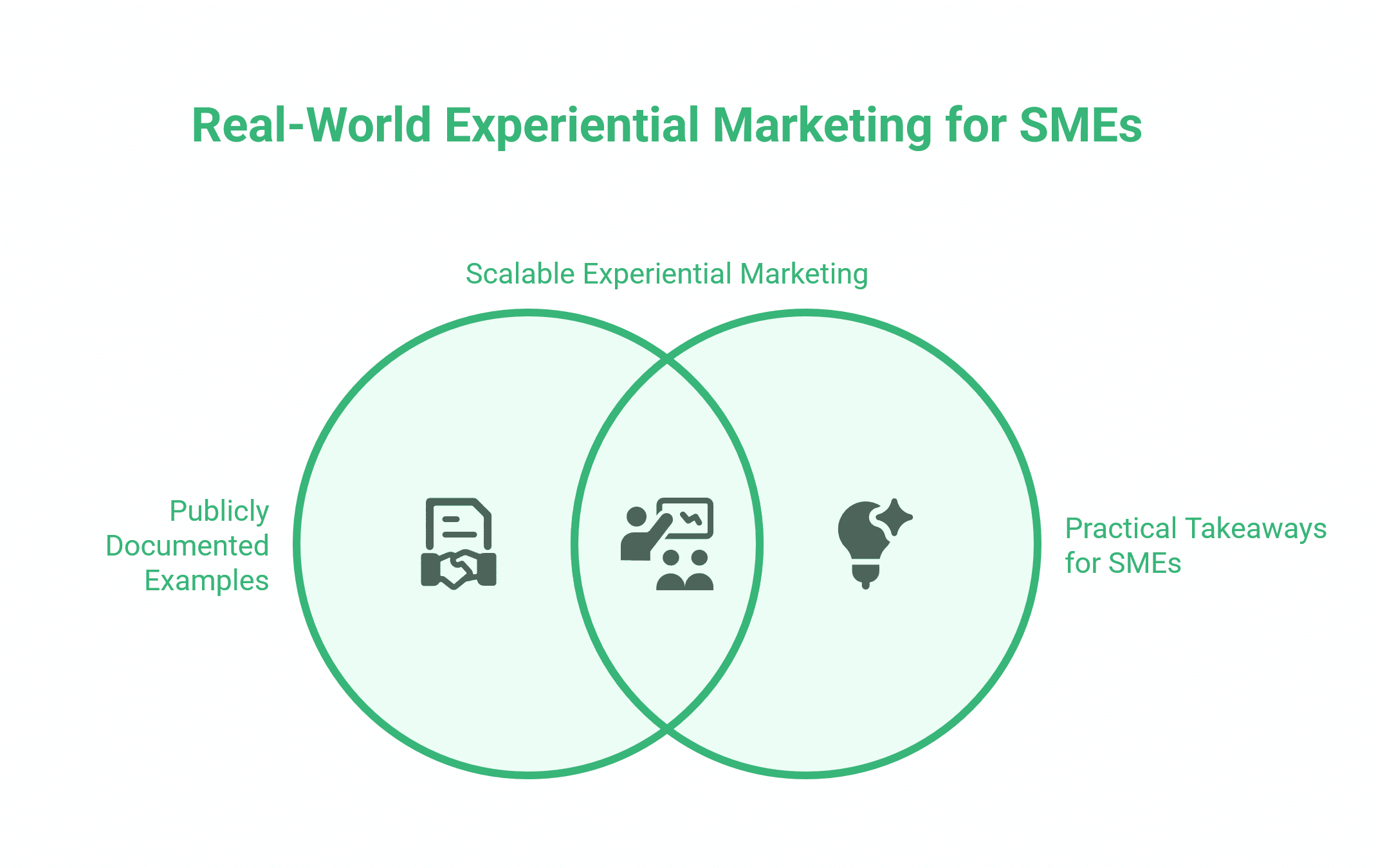
The following are established, publicly documented examples — not fabricated case studies. Each includes a practical takeaway for SMEs.
The Guinness Storehouse, Dublin
The Storehouse is one of Ireland’s most visited tourist attractions and serves as a permanent experiential marketing installation. Visitors move through the brand’s history, the brewing process, and the culture surrounding it before reaching the Gravity Bar for a complimentary pint with a view across Dublin. Every stage involves participation: tasting, learning, and making decisions.
What you can learn: You do not need a single event. A permanent or semi-permanent experience built around your product or expertise creates ongoing marketing value. For businesses with physical premises — a workshop, a studio, a farm — the same principle applies at a smaller scale.
Guerrilla campaigns at UK festivals
Brands including Innocent Drinks, Fever-Tree, and various craft brewers have used Glastonbury, the Edinburgh Fringe, and smaller regional festivals to run low-cost experiential activations: sampling stands designed around brand values, interactive games, and limited-edition product releases tied to location. The key in these cases is that the experience is inseparable from the product.
What you can learn: Regional events across Northern Ireland and Ireland — from the Balmoral Show to the Belfast International Arts Festival — offer accessible activation opportunities for SMEs. The budget required is far lower than for a national campaign, and the audience is often closely aligned with a local business’s customer base.
B2B trade show activation: from stand to demonstration
A recurring pattern in B2B experiential marketing is the shift from a branded stand (logo, brochure, sales rep) to a working demonstration. Technology businesses, professional services firms, and manufacturing companies that allow buyers to interact with their products or processes — rather than just listen to a presentation about them — consistently report higher-quality lead generation from the same floor space.
What you can learn: If you attend trade shows or industry events, consider how you can build hands-on interaction into your presence. For service businesses, this might mean a live audit, a digital demonstration, or a workshop format rather than a presentation.
Digital experiential: AR and virtual showrooms in 2026
Several UK retailers and property developers now offer augmented reality (AR) and virtual reality (VR) product experiences. IKEA’s AR app (which allows users to place furniture in their own home before purchasing) is one widely cited example. In the property sector, virtual property tours became mainstream during the pandemic and have remained standard practice. The principle — allow the customer to experience the product before committing — is classically experiential, delivered digitally.
What you can learn: For SMEs, a virtual tour of premises, an animated explainer that simulates a process, or an interactive product configurator on a website brings experiential logic into a digital format accessible to any business. ProfileTree’s digital marketing strategy service includes planning this kind of digital-first engagement for SME clients.
How to Build an Experiential Marketing Strategy
A workable framework for SMEs planning their first experiential campaign:
Step 1: Define the participation moment
What will your audience actually do? This is the foundation of the strategy. If you cannot answer this clearly, the campaign is, at best, event marketing. The participation moment should connect directly to your product or service — not be a generic game or giveaway attached to your brand.
Step 2: Match the format to your audience
A B2C campaign at a consumer event and a B2B activation at an industry trade show need fundamentally different designs. B2C experiential tends to prioritise emotional connection and social sharing. B2B experiential should prioritise product understanding and depth in sales conversations. Both require the audience to leave with a stronger sense of what the brand does and why it matters to them.
Step 3: Plan the digital layer
The activation itself reaches only the people present. The digital layer — video coverage, social content, follow-up email, blog recap — extends reach and preserves ROI. Planning the content output before the event is as important as planning the event itself. This is where content marketing and video production become operationally linked to the experiential campaign.
ProfileTree’s content marketing service covers exactly this function: helping businesses capture, package, and distribute the content generated by an experiential campaign, so that the audience who could not be there can still encounter the brand through the experience.
Step 4: Set the right metrics
Reach and impressions are the wrong primary metrics for experiential marketing. The more relevant measures are: dwell time at the activation, post-event conversion rate from participants, social content generated by attendees (organic reach), sentiment in follow-up communications, and quality of sales conversations generated. These are harder to track than ad impressions but far more predictive of commercial outcomes.
Step 5: Build in the follow-up sequence
The moment after the experience is the highest-intent moment in the customer journey. A visitor who just spent twenty minutes inside your brand activation is more receptive to a follow-up message than someone who saw a display ad. Plan the post-activation sequence before the event: email series, retargeting, sales team briefing, and content publishing schedule.
Getting the Digital Layer Right
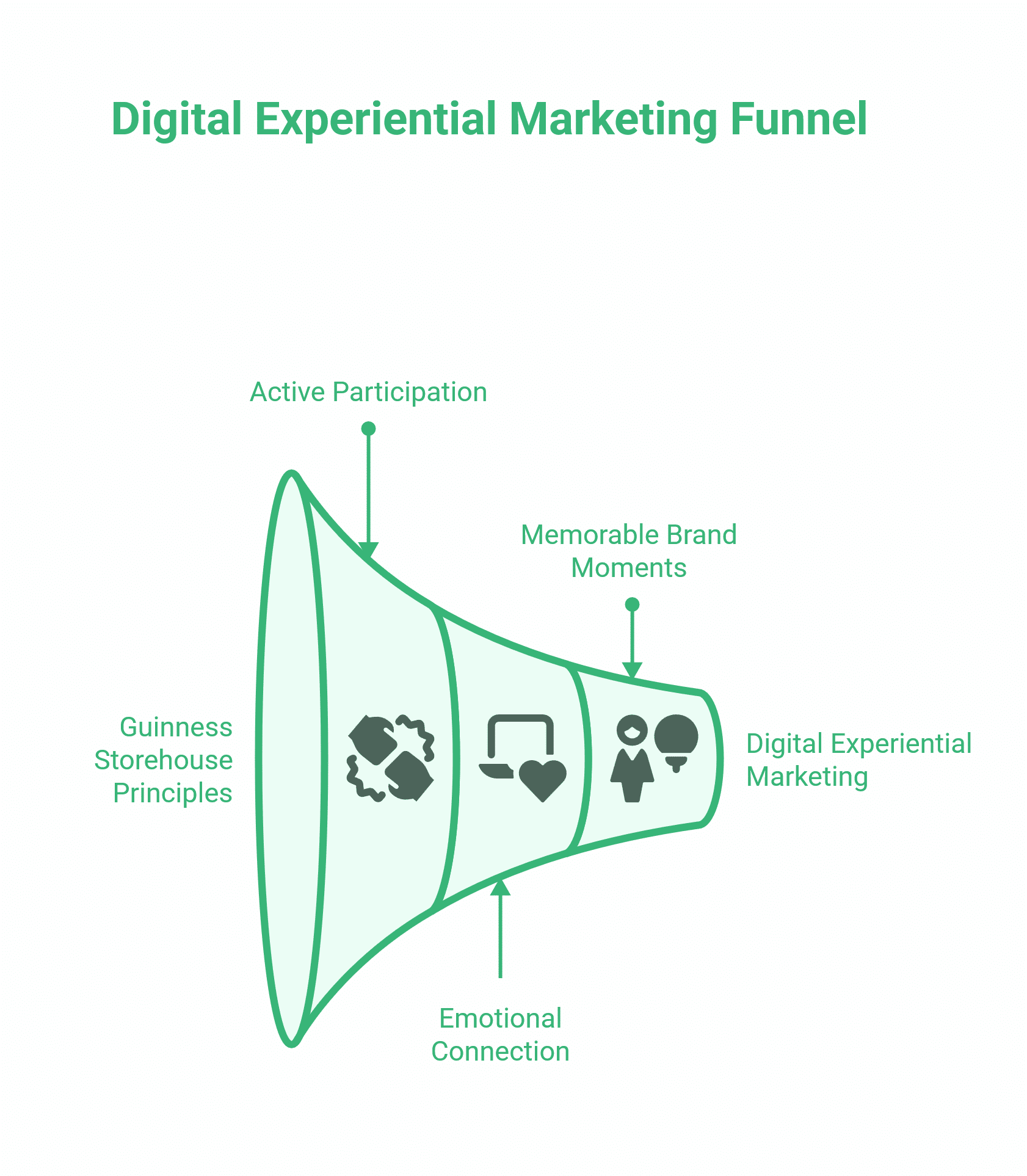
Most SMEs will not launch a Guinness Storehouse. What they can do is apply the same principles — active participation, emotional connection, memorable brand moments — through digital formats accessible without a large events budget.
Video production, animation, interactive content, and well-planned content marketing are the practical infrastructure for digital experiential marketing. If you want to explore how these could work for your business, ProfileTree’s digital marketing team in Belfast works with SMEs across Northern Ireland, Ireland, and the UK to build content strategies that go beyond passive publishing.
Conclusion
Experiential marketing works because memory is built through participation, not passive exposure. The evidence for this is consistent across B2C and B2B contexts, and the principle scales from a multinational brand activation to a local SME running a product workshop. For businesses in Northern Ireland and Ireland, the opportunity is to apply experiential thinking to digital formats: video content that places the viewer inside a product experience, animation that demonstrates the accessibility of complex services, and digital campaigns that require genuine audience involvement.
The brands that will build the strongest customer relationships in 2026 are the ones that move their audience from observers to participants — regardless of budget.
FAQs
What is experiential marketing?
Experiential marketing invites audiences to participate in a brand rather than observe it. The goal is a direct, memorable experience — physical or digital — that builds emotional connection and moves people closer to a buying decision.
Is experiential marketing effective?
Research from EventTrack and Edelman consistently shows that direct participation outperforms passive advertising in terms of brand recall and purchase intent. People who participate in a branded experience are measurably more likely to buy, recommend, and recall the brand than those who see a corresponding ad.
How does experiential marketing differ from event marketing?
Event marketing places a brand at or around an event. Experiential marketing makes the brand the event. If the audience can only watch or listen, it is event marketing. If they interact, test, or choose, it is experiential.
What is a good example of experiential marketing?
The Guinness Storehouse in Dublin, Innocent Drinks sampling at UK festivals, IKEA’s AR furniture placement app, and B2B software companies running live product demonstrations at trade shows. At a smaller scale, a local food producer running a tasting workshop follows the same logic.
Why does experiential marketing matter for B2B brands?
B2B buyers make high-value, low-frequency decisions and need a strong sense of what a product or service actually does before committing. A live demonstration or interactive digital experience creates the depth of understanding that a brochure cannot.