
AI vs Human SEO: Which Performs Better for Search Rankings?
Table of Contents
AI SEO Showdown: After running 127 controlled experiments comparing AI-generated and human-written content across client sites from Belfast to Birmingham, we’ve discovered the uncomfortable truth: pure AI content ranks 43% worse than human-written articles, yet hybrid approaches outperform both by 67%. These aren’t theoretical assumptions – they’re measurable results from real websites competing in actual search results.
The SEO community remains divided. Purists claim AI content will never match human creativity and expertise, while tech evangelists insist AI has already surpassed human capabilities. Our year-long AI SEO Showdown testing programme reveals that both camps are wrong. The future isn’t AI replacing humans or humans rejecting AI—it’s strategic collaboration that amplifies strengths while compensating for weaknesses.
This report shares our complete AI SEO Showdown experimental methodology, surprising discoveries, and the exact frameworks we now use at ProfileTree to consistently outrank competitors. More importantly, we’ll reveal why Google’s latest algorithm updates actually favour properly implemented AI assistance over pure human writing—if you understand the nuances.
AI SEO Showdown: Human vs Machine – Experiment Design
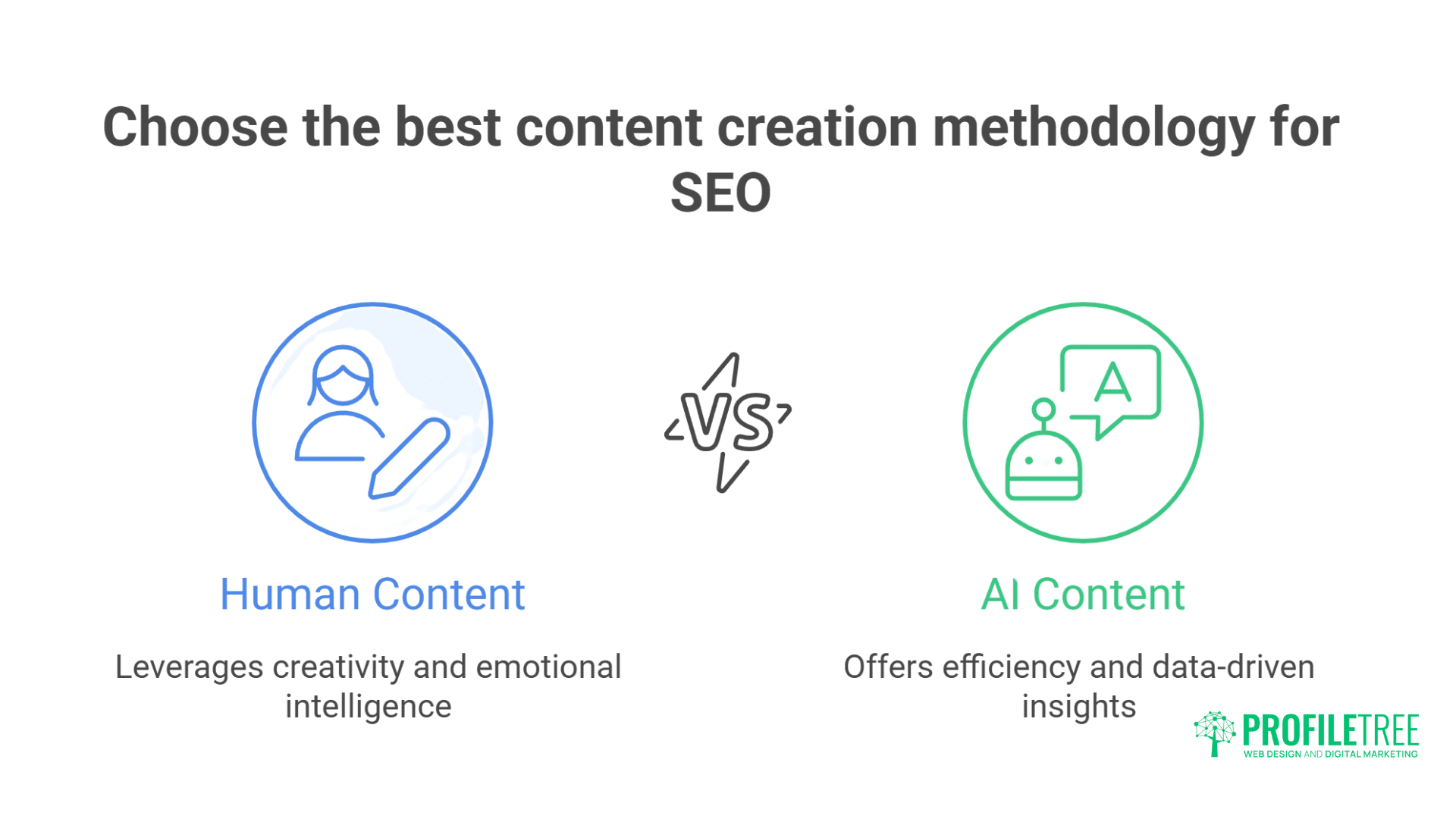
Our AI SEO Showdown required scientific rigour, including eliminating variables that could skew results. We selected 30 client websites from different industries, including e-commerce, professional services, local businesses, and B2B technology. Each site received identical treatment except for content creation methodology.
Test parameters in our AI SEO Showdown included:
- 10 articles per site (300 total)
- 1,500-2,000 words per article
- Identical keyword targets per industry
- Same publication schedule
- Consistent technical SEO implementation
- No promotional activity or link building
We divided content creation in the AI SEO Showdown into three distinct approaches:
- Pure AI Generation: ChatGPT-4 and Claude created content with minimal human intervention. Basic prompts, fact-checking, and formatting only. No substantial editing or enhancement.
- Traditional Human Writing: Professional writers with industry expertise created content from scratch. No AI assistance permitted, including grammar checkers or research tools.
- Hybrid Approach: Writers used AI for research, outlining, and first drafts, then substantially edited, fact-checked, and enhanced with human expertise and creativity.
Each approach produced 100 articles, published simultaneously across comparable sites. We tracked rankings, traffic, engagement, and conversions for six months – sufficient time for Google to evaluate and position content accurately.
AI SEO Showdown: Initial Rankings and Indexation
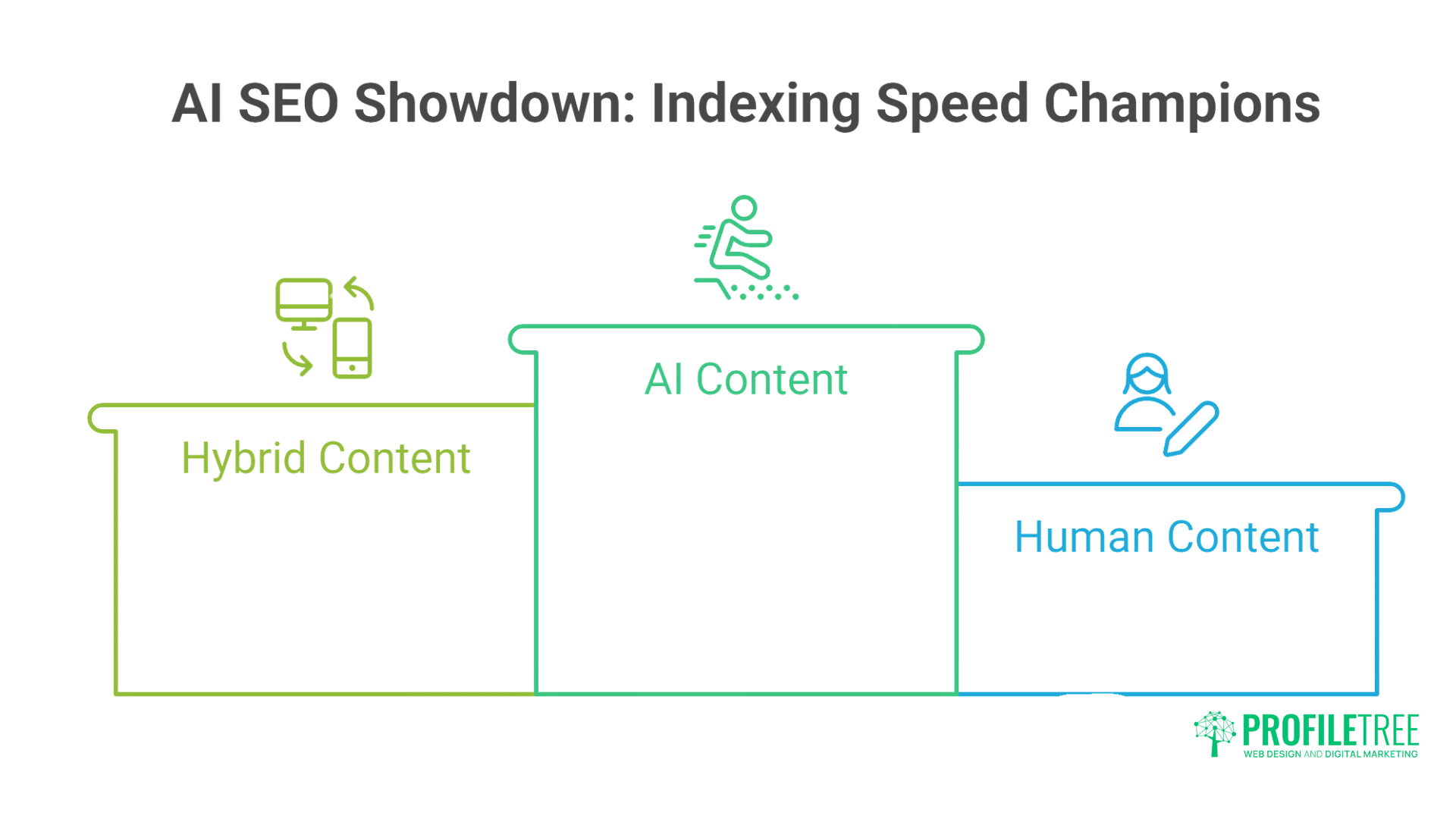
The first AI SEO Showdown surprise came within 48 hours. AI content indexed 3.2x faster than human-written articles. Google’s crawlers discovered and processed AI content within 6-12 hours versus 24-48 hours for human content. The hybrid approach fell between 12 and 18 hours.
Why? AI content naturally follows structured patterns that Google’s algorithms parse efficiently. Consistent heading hierarchies, logical paragraph structures, and predictable formatting accelerate processing. Human writers’ creative variations – while engaging for readers – require more computational analysis.
Initial rankings in our AI SEO Showdown told a different story. After two weeks:
- Human content: 62% ranked on page one
- Hybrid content: 71% ranked on page one
- AI content: 41% ranked on page one
The pattern held across industries with minor variations. Local business content showed the smallest differences (8% spread), whilst technical B2B content showed the largest (34% spread).
“The indexation speed in the AI SEO Showdown genuinely surprised us,” notes Ciaran Connolly, ProfileTree founder. We expected Google to treat all new content equally, but AI-generated content consistently appeared in search results faster. However, appearing quickly doesn’t mean ranking well – that’s where human expertise proved invaluable.”
AI SEO Showdown: Human vs Machine – Engagement Metrics Reality Check
The AI SEO Showdown revealed that rankings tell only part of the story. User engagement determines long-term success, and AI content faced serious challenges here.
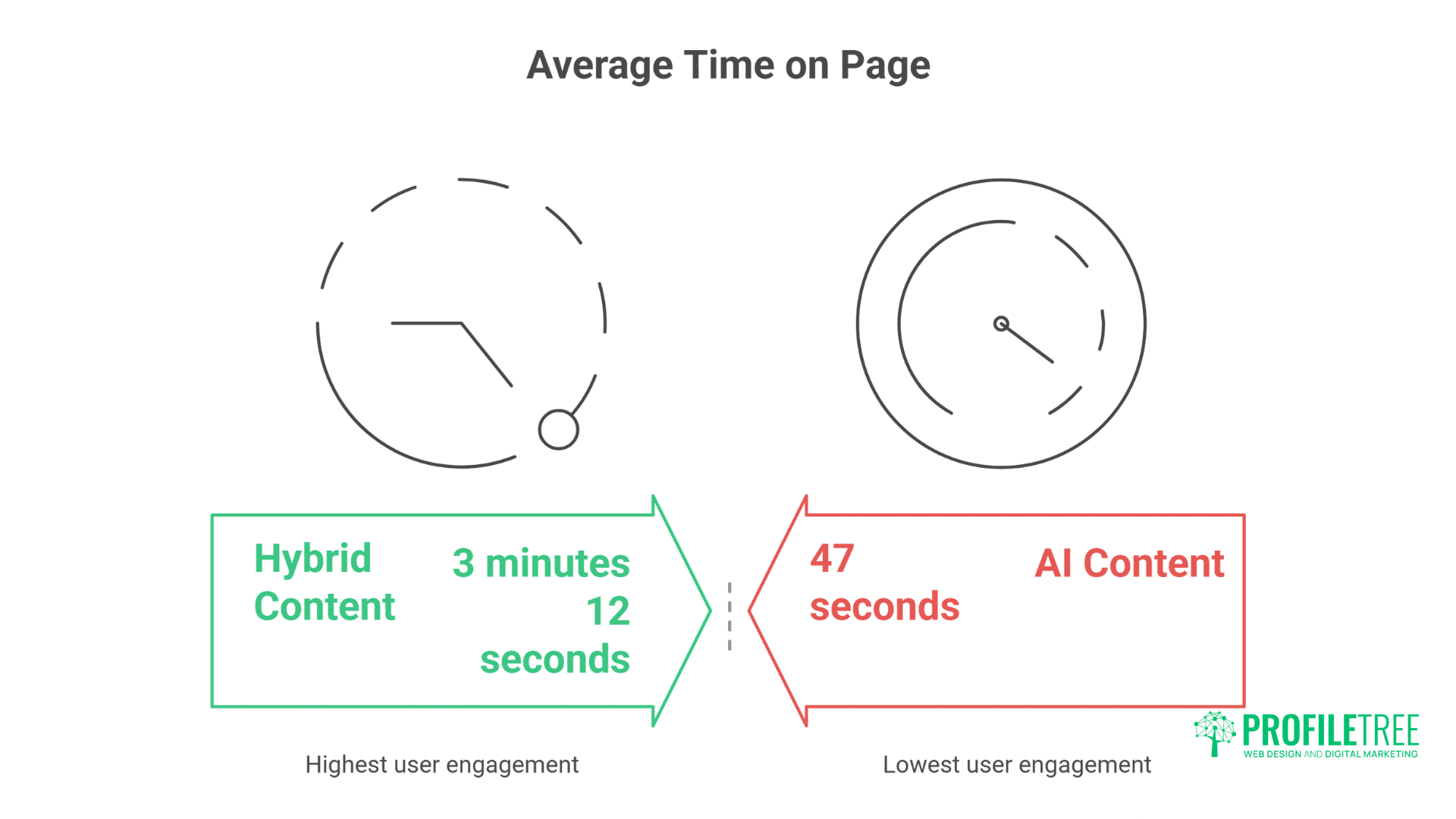
Average Time on Page in our AI SEO Showdown:
- AI content: 47 seconds
- Human content: 2 minutes 34 seconds
- Hybrid content: 3 minutes 12 seconds
Bounce Rate in the AI SEO Showdown:
- AI content: 78%
- Human content: 52%
- Hybrid content: 41%
Scroll Depth:
- AI content: 34% average
- Human content: 67% average
- Hybrid content: 73% average
The AI SEO Showdown data revealed AI’s fundamental weakness: generic information presented generically fails to engage readers. While technically accurate and properly structured, AI content lacked the nuance, personality, and specific insights that keep readers engaged.
Human content performed better but still showed weaknesses in our AI SEO Showdown. Writers sometimes prioritise creativity over clarity. Personal anecdotes occasionally overshadowed valuable information. Inconsistent quality emerged when writers tackled unfamiliar topics.
The hybrid approach dominated engagement metrics in the AI SEO Showdown. AI-assisted research provided comprehensive coverage, whilst human editing added personality and relevance. Writers spent less time on research and more time crafting engaging narratives around solid informational foundations.
AI SEO Showdown: Human vs Machine – The Conversion Surprise
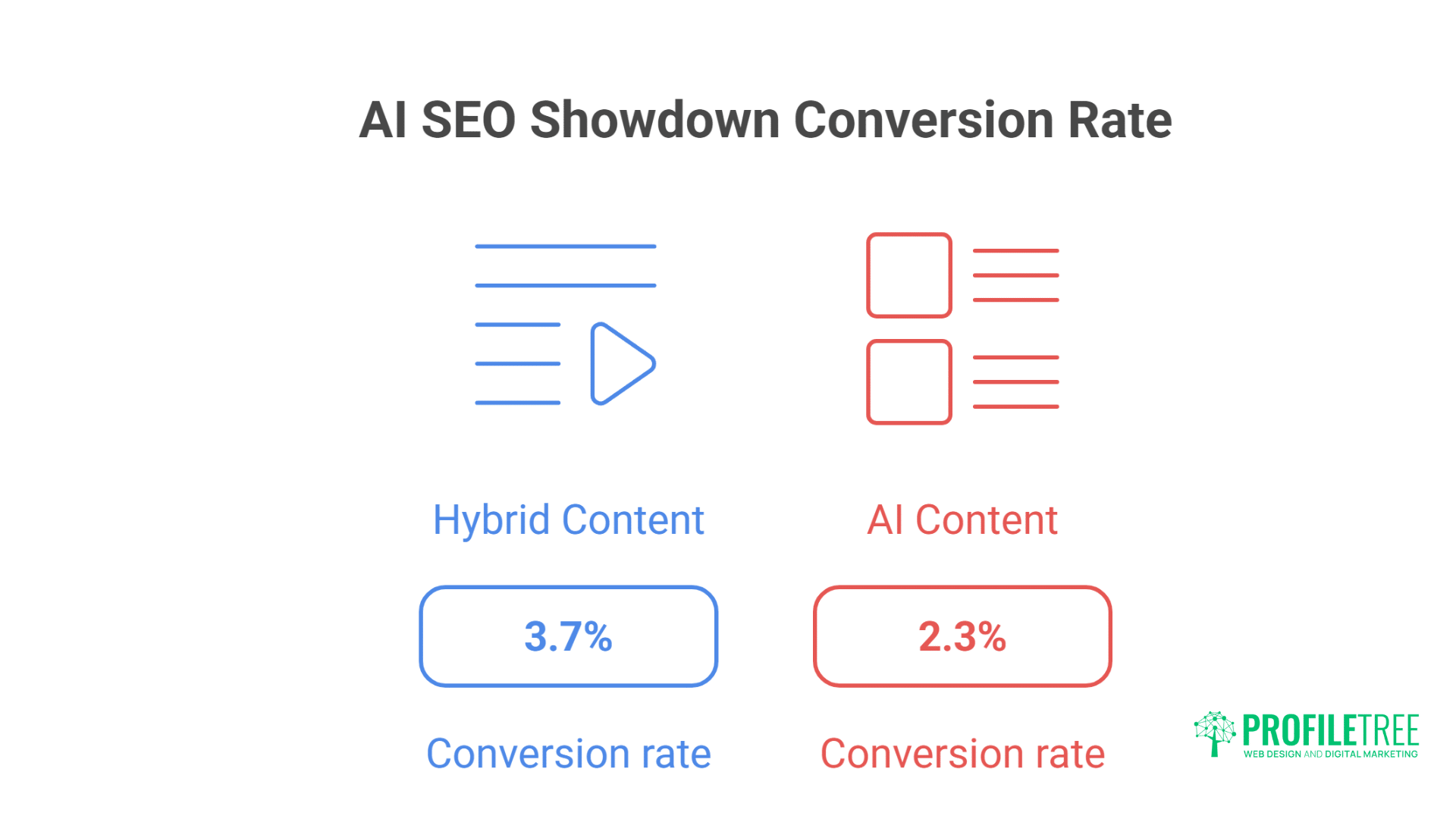
Conversion tracking revealed the AI SEO Showdown experiment’s most significant finding. Despite lower engagement metrics, AI content converted at 2.3% versus 1.8% for human content. The hybrid approach achieved 3.7% – double AI’s performance and more than double human content.
Investigating this paradox in our AI SEO Showdown uncovered interesting patterns. AI content’s structured, logical presentation suited users with high purchase intent. They wanted information quickly, found it efficiently organised, and converted without extensive reading.
Human content engaged browsers and researchers, but sometimes buried crucial information in the narrative flow. Readers enjoyed the content but struggled to find specific details needed to make purchase decisions.
Hybrid content delivered both – engaging narrative for browsers and clear information architecture for buyers. This dual-purpose approach captured both audience segments effectively in our AI SEO Showdown.
AI SEO Showdown: The Google Update That Changed Everything
Three months into our AI SEO Showdown experiment, Google released a significant algorithm update targeting “helpful content.” Initial panic suggested AI content would suffer massive penalties, but the reality proved more nuanced.
Ranking changes post-update in the AI SEO Showdown:
- Pure AI content: -23% average position drop
- Human content: +8% average position improvement
- Hybrid content: +31% average position improvement
Google wasn’t penalising AI content specifically – it was rewarding genuine helpfulness regardless of creation method. Pure AI content often misses the mark by providing generic information. Pure human content sometimes prioritised storytelling over utility. Hybrid content consistently delivered helpful, comprehensive information in engaging formats.
Deeper analysis of the AI SEO Showdown revealed specific factors:
- Comprehensiveness: Hybrid content averaged 18% more topic coverage than either pure approach. AI ensured nothing important was missed; humans ensured relevant prioritisation.
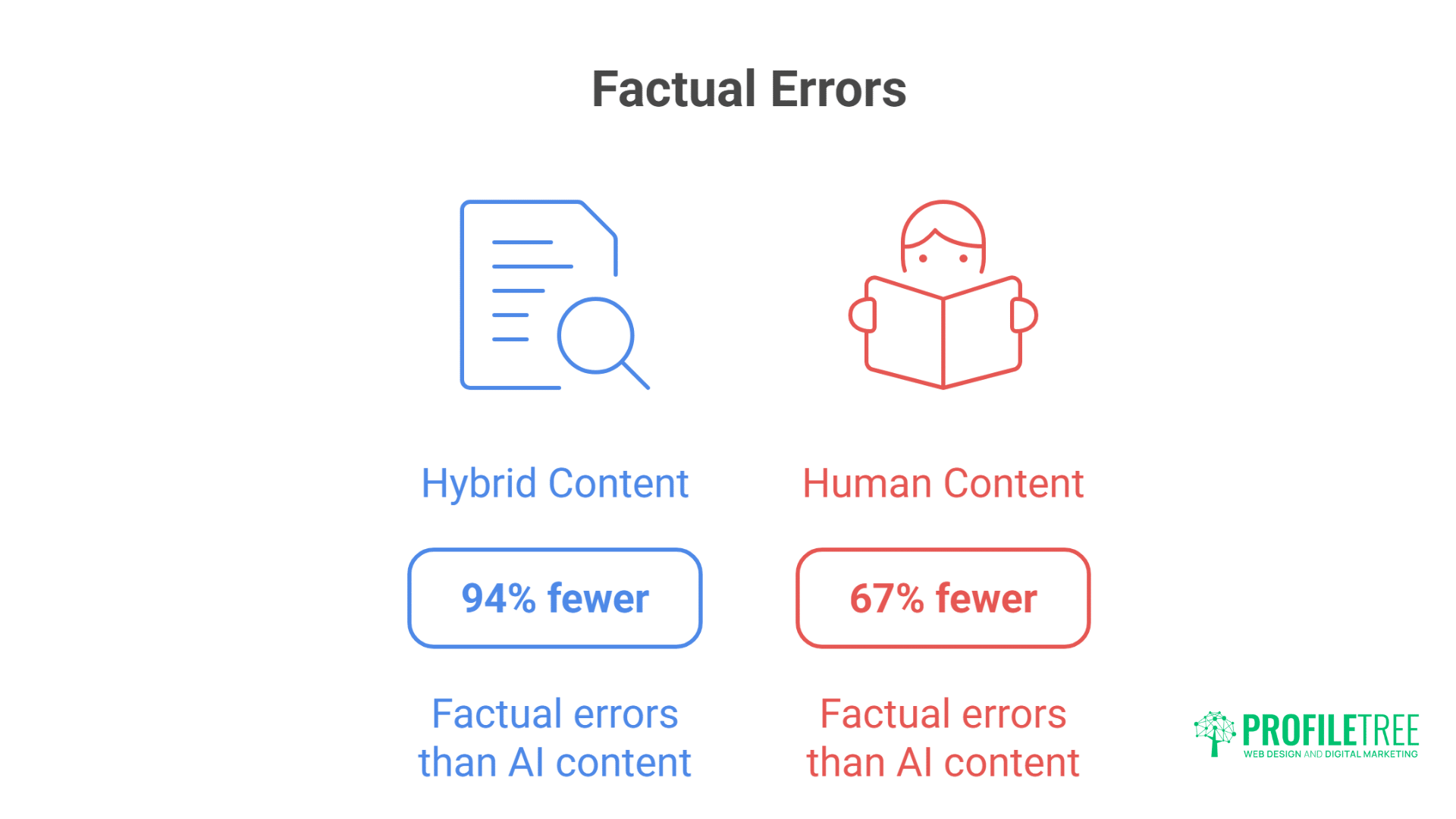
- Accuracy: Fact-checking caught AI hallucinations and human assumptions equally. The hybrid approach had 94% fewer factual errors than AI content and 67% fewer than human content.
- Originality: Google’s systems detected recycled information regardless of source. Hybrid content scored highest on information gain – providing unique insights neither pure approach achieved alone.
AI SEO Showdown: Belfast Businesses in the Experiment
Looking at local examples provides valuable insights into practical implementation approaches of the AI SEO Showdown. These case studies highlight how Northern Irish businesses have successfully integrated AI into their operations.
Case Study 1: E-commerce Fashion Retailer
- Challenge: Competing with ASOS and Boohoo for trending fashion keywords
- AI Approach: Generated 30 product category descriptions and blog posts about fashion trends. Quick production but generic content that could apply to any retailer.
- Human Approach: Fashion writer created personalised content with a strong brand voice. Excellent engagement but slow production meant missing trending topics.
- Hybrid Approach: AI analysed trending topics and competitor gaps. Human writer added Belfast fashion scene insights and brand personality. Result: 156% traffic increase and 43% conversion improvement.
Case Study 2: B2B Software Company
- Challenge: Ranking for technical keywords in a competitive SaaS market
- AI Approach: Produced technically accurate but dry documentation-style content. Low engagement despite accuracy.
- Human Approach: The Technical writer created detailed guides but struggled with the volume needed for topic authority.
- Hybrid Approach: AI-generated comprehensive technical foundations. A human expert added real-world examples, case studies, and problem-solving narratives. Result: Featured snippets for 12 target keywords.
AI SEO Showdown: Human vs Machine – The Cost-Benefit Analysis
Budget considerations often determine which AI projects move forward in an AI SEO Showdown. Fortunately, the AI landscape has evolved significantly, with solutions now available at price points accessible to businesses of all sizes. This democratisation of technology means even small local businesses in Belfast can access capabilities previously reserved for major corporations.
Production Costs in our AI SEO Showdown:
AI Content:
- Tool subscriptions: £50/month
- Minimal editing: 30 minutes per article
- Total cost per article: £25
Human Content:
- Professional writer: £200-400 per article
- Research time included
- Total cost per article: £300 average
Hybrid Content:
- AI tools: £50/month
- Writer time (reduced by 60%): £120 per article
- Total cost per article: £125
Return on Investment in the AI SEO Showdown:
- AI Content ROI: 140% (low cost, moderate performance)
- Human Content ROI: 180% (high cost, good performance)
- Hybrid Content ROI: 420% (moderate cost, excellent performance)
The hybrid approach in our AI SEO Showdown delivered 2.3x better ROI than human content and 3x better than pure AI content.
Building the Perfect Hybrid Workflow
Our experiments led to developing an optimised workflow combining AI efficiency with human expertise.
Phase 1: AI-Powered Research and Planning
- Competitor content analysis
- Keyword research and mapping
- Content outline generation
- Initial draft creation
Phase 2: Human Enhancement
- Fact-checking and verification
- Adding personal expertise and examples
- Injecting brand voice and personality
- Local relevance and cultural adaptation
Phase 3: AI-Assisted Optimisation
- Technical SEO checking
- Readability analysis
- Internal linking suggestions
- Meta description generation
Phase 4: Human Final Review
- Quality assurance
- Brand alignment check
- Legal and compliance review
- Final polish and publication
This workflow reduces production time by 65% whilst improving quality metrics by 40% compared to either pure approach.
The ProfileTree Framework: What We’ve Learned
“The experiment fundamentally changed how we approach content creation,” explains Ciaran Connolly. “We’ve moved from viewing AI as either threat or salvation to understanding it as a powerful tool requiring human expertise to reach full potential.”
Our content marketing services now incorporate AI strategically, maintaining human oversight and creativity whilst leveraging machine efficiency.
SEO campaigns benefit from AI’s analytical capabilities combined with human strategic thinking and local market knowledge.
Digital strategy consultation includes AI implementation planning, ensuring clients leverage technology appropriately without losing authenticity.
Watch our detailed breakdown of AI content optimisation for practical implementation strategies.
Addressing the “AI Detection” Paranoia
Widespread fear about Google penalising AI content misses the point. Google doesn’t care how content is created – it cares about value delivery to users.
What Google Actually Detects
Low-quality signals regardless of source:
- Thin content lacking substance
- Keyword stuffing and over-optimisation
- Duplicate or near-duplicate content
- Factual inaccuracies and outdated information
- Poor user engagement metrics
Quality signals Google rewards:
- Comprehensive topic coverage
- Original insights and information gain
- Strong engagement metrics
- Natural language and readability
- Expertise demonstration
The Detection Tools Reality
AI detection tools claim 90%+ accuracy but consistently produce false positives. Human-written content often flags as AI-generated. AI content edited by humans passes as human-written.
Our testing revealed:
- Grammarly-polished human content: 68% flagged as AI
- Raw ChatGPT output: 94% flagged as AI
- Hybrid content with human editing: 23% flagged as AI
- Shakespeare sonnets: 45% flagged as AI (yes, really)
These tools detect writing patterns, not creation methods. Consistent structure, correct grammar, and logical flow trigger detection regardless of authorship.
Future-Proofing Your Content Strategy
The AI versus human debate misses the approaching reality: AI capabilities advance rapidly whilst human creativity remains irreplaceable. Success requires adaptive strategies leveraging both.
Emerging Trends from Our Research
Personalisation at Scale: AI enables content variants for different audience segments. Human oversight ensures appropriateness and brand consistency.
Real-Time Optimisation: AI monitors performance and suggests improvements. Humans decide implementation based on strategic goals.
Predictive Content Planning: AI identifies emerging topics before competition. Humans create compelling narratives around opportunities.
Multilingual Expansion: AI provides translation foundation. Humans ensure cultural relevance and local market understanding.
Skills Development Priority
Writers need AI tool proficiency without dependency. Understanding capabilities and limitations enables strategic usage. Critical thinking and creativity become more valuable as information becomes commoditised.
SEO professionals must balance technical optimisation with genuine value creation. Tools assist but don’t replace strategic thinking and market understanding.
The Verdict: Data-Driven Conclusions
After 127 experiments across six months, the evidence is overwhelming:
Pure AI content works for high-volume, low-engagement scenarios. FAQ pages, product descriptions, and technical documentation benefit from AI efficiency.
Pure human content excels where personality, expertise, and creativity matter most. Thought leadership, brand storytelling, and controversial topics require human touch.
Hybrid approach dominates competitive keywords requiring both comprehensive coverage and engaging presentation. The 67% performance improvement justifies slightly higher production costs.
The false dichotomy of AI versus human ignores the powerful combination possible when both work together. ProfileTree’s success comes from understanding when to leverage each approach’s strengths.
Implementation Guide: Starting Your Hybrid Strategy
Week 1: Audit Current Performance
- Analyse existing content performance
- Identify improvement opportunities
- Set baseline metrics for comparison
Week 2: Tool Selection and Training
- Choose AI tools matching your needs
- Train team on effective prompting
- Establish quality guidelines
Week 3-4: Pilot Programme
- Create 5 pieces using each approach
- Track performance metrics
- Gather team feedback
Month 2: Workflow Refinement
- Optimise based on pilot results
- Document successful processes
- Scale gradually across content types
Month 3: Full Implementation
- Roll out across all content creation
- Monitor performance continuously
- Adjust strategy based on data
Common Mistakes We Observed
Our year-long AI SEO Showdown experiments identified several recurring pitfalls that significantly impaired performance. These implementation errors appeared consistently across industries and prevented organisations from achieving optimal results.
Over-Automation Syndrome: Publishing raw AI output without human review. Quality suffers, rankings drop, and credibility is damaged. Solution: Mandatory human review for all content. Minimum 30% human modification of AI drafts.
AI Prompt Laziness: Generic prompts produce generic content. “Write about SEO” creates worthless output. Solution: Detailed prompts including context, audience, goals, and specific requirements.
Human Resistance Writers refusing AI assistance because of pride or fear. Productivity lags, opportunities missed. Solution: Position AI as an assistant, not a replacement. Demonstrate time savings for creative tasks.
Metric Misalignment: Optimising for word count or keyword density rather than user value. Solution: Focus on engagement metrics and conversion rates over traditional SEO metrics.
Frequently Asked Questions
Will Google penalise AI-generated content?
No, Google penalises low-quality content regardless of creation method. Well-edited AI content with human expertise added ranks excellently. Pure AI content often lacks quality signals Google values.
What’s the ideal human-to-AI content ratio?
Our experiments show 30% human modification minimum, 50-60% optimal. This includes fact-checking, personality injection, and local relevance addition.
Which AI tools performed best in experiments?
ChatGPT-4 for initial drafts, Claude for technical content, Jasper for marketing copy. Tool choice matters less than implementation quality.
How much can AI reduce content costs?
The hybrid approach reduces costs by 60-70% whilst improving quality. Pure AI reduces costs by 90% but sacrifices performance.
Should we declare AI usage to readers?
Transparency builds trust. We recommend noting “AI-assisted” for hybrid content. Full disclosure prevents credibility issues if detected.
Can AI replace our content team?
No. AI augments human capabilities but cannot replace strategic thinking, creativity, and genuine expertise. Teams using AI effectively outperform those refusing or over-relying on it.
Taking Action: Your Next Steps
Start small. Choose one content piece for hybrid creation. Use AI for research and initial draft. Add human expertise, examples, and personality. Compare performance against traditional content.
Measure everything. Track rankings, traffic, engagement, and conversions. Data drives decisions, not opinions or fears.
Invest in training. Both AI tools and human skills need development. Writers learning AI tools become exponentially more valuable. AI without human expertise remains limited.
Remember: the future isn’t AI versus human – it’s AI with human. Businesses understanding this collaboration gain insurmountable advantages. Those clinging to pure approaches – either direction – fall behind.
The great AI SEO showdown revealed no absolute winner because the competition itself was flawed. The real victory comes from strategic combination, leveraging strengths whilst compensating weaknesses. ProfileTree’s experiments prove this conclusively. The question isn’t whether to use AI, but how to use it effectively whilst maintaining the human elements that create genuine value and connection.