
Seasonal Marketing: Australian Seasons and Holidays Explained
Table of Contents
Seasonal marketing built around Australian seasons and holidays is one of the most reliable ways to drive predictable revenue throughout the year. The challenge for most businesses is that Australia’s consumer calendar doesn’t follow the Northern Hemisphere template most marketing guides are written around. Christmas is a summer event. The financial year ends in June. Easter arrives in early autumn. Getting these timing details wrong costs you the moments when your audience is most ready to spend.
“Most businesses treat seasonal marketing as a list of dates to tick off,” says Ciaran Connolly, founder of ProfileTree. “The ones that get real results treat it as a planning framework. They understand which Australian seasons and holidays actually matter for their audience, and they build their content and digital presence around those moments deliberately, not reactively.”
This guide covers how to read the Australian seasonal calendar, set measurable campaign goals, build a practical 12-month marketing plan, and execute across the digital channels that convert.
Understanding Australian Seasons and Holidays
The starting point for any seasonal marketing strategy aimed at Australian consumers is getting the calendar right. Australian seasons and holidays follow a pattern that regularly catches out businesses applying a Northern Hemisphere marketing template without adjusting for local timing.
How Australian Seasons Shape Consumer Behaviour
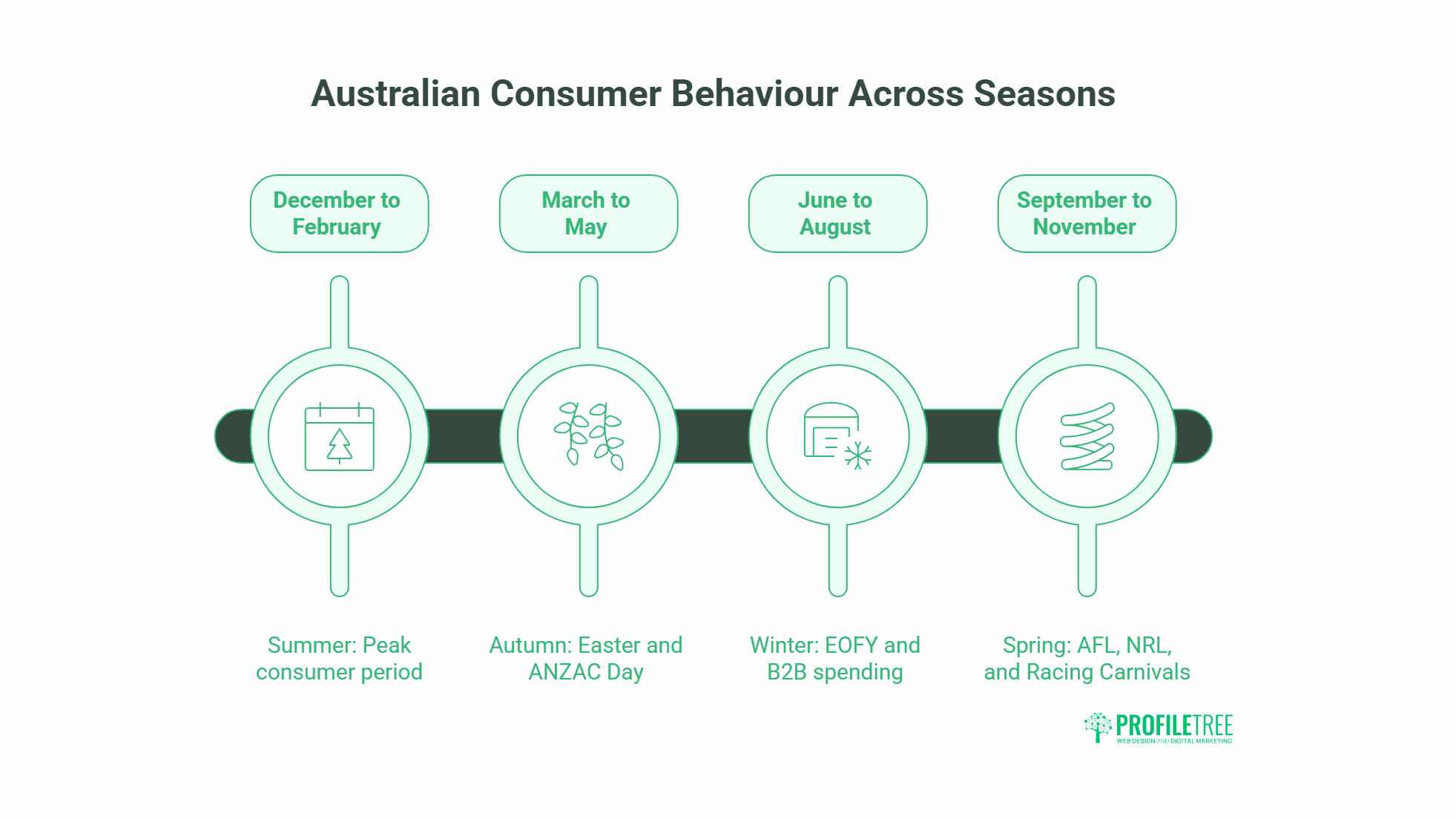
Summer (December to February) is the peak consumer period. Christmas, New Year, and the long school holiday window all overlap, creating a concentrated burst of spending across retail, travel, food, and experience categories. Businesses that aren’t campaign-ready by late November miss a significant share of this window.
Autumn (March to May) slows the retail pace but delivers Easter, one of Australia’s most commercially active long weekends. Spending spans food, travel, and gifts. ANZAC Day in April sits within this period and requires a different approach: acknowledgement rather than promotion. Brands that handle it respectfully build genuine goodwill; those that treat it as a discount trigger typically face public criticism.
Winter (June to August) is quieter for consumer retail but extremely active for B2B. The end of the financial year (EOFY) in June is a genuine spending window for businesses purchasing services, equipment, and software before budget cycles close. Service businesses often underestimate this period relative to retail-focused holidays.
Spring (September to November) builds momentum back toward the summer peak. The AFL Grand Final, NRL Grand Final, and Spring Racing Carnival all land here. Consumer confidence rises through October and November, making this the right time to rebuild awareness and warm up your email list before the Christmas rush begins.
Key Australian Holidays and Their Marketing Implications
| B2B services, tax-time offers, and equipment | Key Date | Type | Marketing Approach |
|---|---|---|---|
| January | 26th – Australia Day | National holiday | Themed outdoor and lifestyle promotions |
| April | Easter long weekend | Cultural/religious | Food, travel, gifts, experiences |
| April | 25th – ANZAC Day | Commemorative | Respectful acknowledgment only |
| June | End of Financial Year | Financial | B2B services, tax-time offers, equipment |
| November | Melbourne Cup | Sporting event | Fashion, hospitality, lifestyle |
| November | Click Frenzy | Online shopping | E-commerce discounting |
| December | Christmas (25th) | Major retail | Gifts, experiences, year-end promotions |
| December | Boxing Day (26th) | Post-Christmas | Clearance sales, travel bookings |
Not every seasonal marketing opportunity on this list will suit every business. An accounting firm has a clear case for EOFY campaigns. A fashion retailer gains more from the Spring Racing Carnival than from Australia Day. Trying to activate every Australian holiday dilutes your effort and budget across too many fronts. Pick the four or five that genuinely align with your audience’s behaviour and build those properly.
Setting Goals for Seasonal Campaigns
Seasonal marketing produces better results when you set specific, measurable goals before a campaign launches. Vague intentions like “increase brand awareness over Christmas” are not goals. Their hopes.
Brand Awareness and Audience Growth Goals
If your business is newer or entering a new segment, the right seasonal goal might be to reach: getting in front of people who don’t yet know you. Australian summers, with their high social media activity and gift discovery behaviour, are a reasonable window for this kind of awareness push. You’d measure it through impressions, social reach, and new visitor traffic to your site.
A well-built website is the conversion layer beneath all of this. If someone clicks through from a seasonal campaign and lands on a slow or confusing page, you’ve paid for traffic that goes nowhere. ProfileTree’s web design and development services are built with exactly this in mind: pages that perform under seasonal traffic spikes and turn visits into enquiries.
Revenue and Conversion Goals
For established businesses, seasonal campaigns should tie directly to revenue targets. Set a specific number before the campaign starts: “We want 40 new enquiries in December” or “We want to clear a specific value of stock by Boxing Day.” Without a target, you can’t judge whether the campaign worked or know what to change next time.
The most reliable seasonal marketing campaigns combine a clear offer, a landing page built for conversion, an email sequence that warms up your list in the weeks before the event, and social content that keeps the offer visible. This requires planning 6 to 8 weeks ahead of the target date, not the week before.
Building Your Seasonal Marketing Calendar
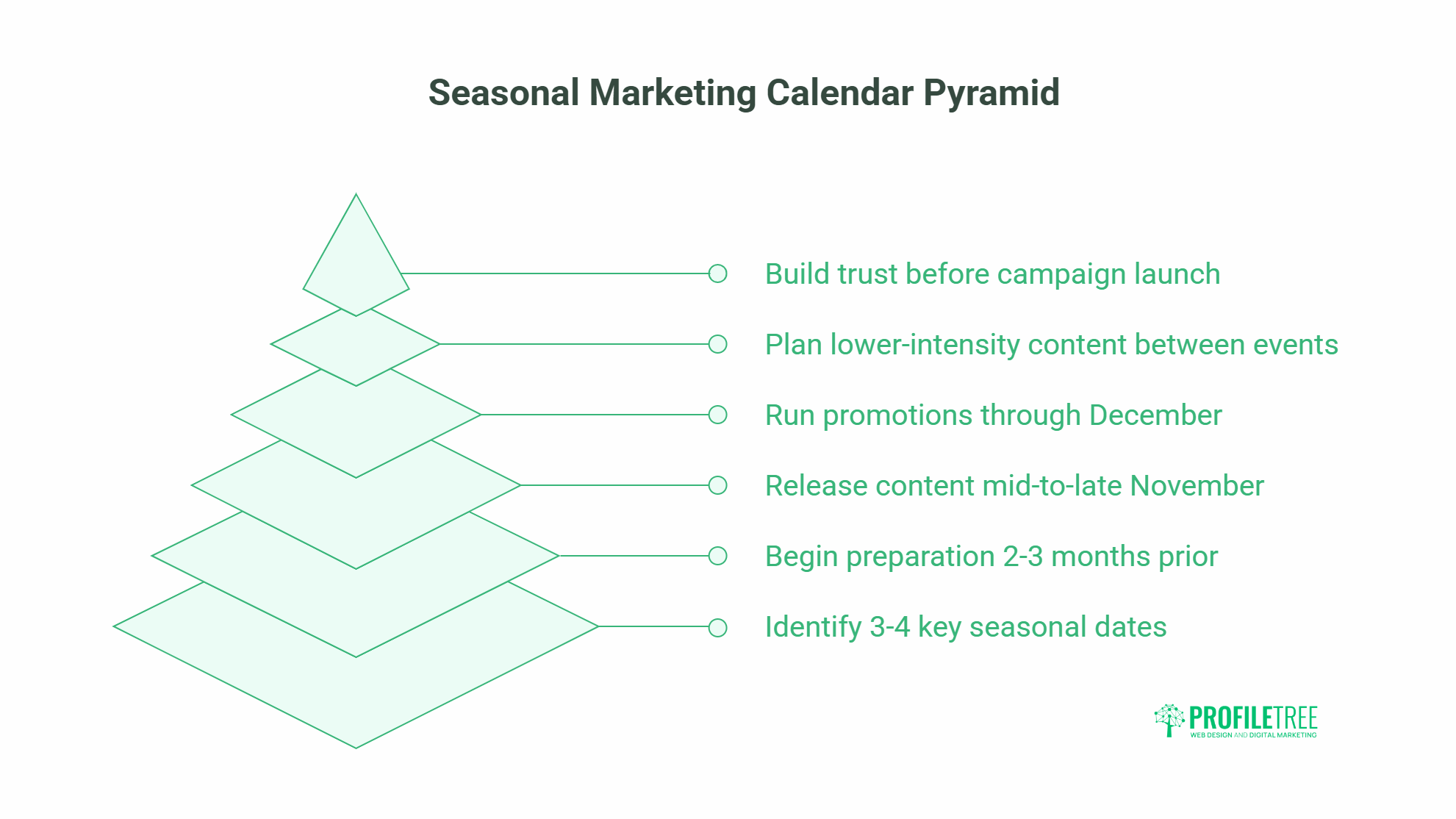
A seasonal marketing calendar is a 12-month plan that maps your content, campaigns, and promotions to the Australian holidays and seasonal moments that matter for your business. It removes the reactive scramble that happens when a public holiday is two weeks away, and nothing is prepared.
Planning Around Australian Dates
Start with your three or four peak seasonal events and work backwards. If the Australian Christmas summer period is your biggest window, your calendar should show campaign preparation beginning in October, launch content going out in mid-to-late November, and peak promotional activity running through December.
Between major seasonal events, plan lower-intensity content that keeps your audience engaged: educational articles, customer stories, social posts that build familiarity without asking for anything. The brands that perform best during Australian holiday periods are the ones their audience already trusts before the campaign goes live.
ProfileTree’s content marketing services support exactly this kind of sustained, planned content output: building the editorial foundation that makes seasonal campaigns land harder because your audience is already warm.
Incorporating Australian Sporting and Cultural Events
Australia’s sporting calendar sits alongside the holiday calendar as a reliable source of seasonal marketing moments. The AFL Grand Final, NRL Grand Final, Australian Open, and Melbourne Cup each generate significant social engagement and consumer spending in specific categories.
For businesses in hospitality, fashion, food, or lifestyle, these events create natural hooks for themed content and limited-time offers. For others, the connection is less direct, and forced attempts to tie unrelated products to major sporting events tend to feel hollow. The test is straightforward: would your customer recognise the connection as genuine, or would it read as opportunistic?
Using AI Tools in Seasonal Marketing Planning
AI tools have a practical role in seasonal marketing calendar management. They can analyse past campaign performance data, identify which content types worked best in previous Australian seasons, and generate first drafts of email sequences or social captions at scale. They won’t replace strategic judgement, but they reduce the time cost of executing a full seasonal content plan considerably.
If your business hasn’t yet considered how AI can improve your marketing operations, ProfileTree’s AI transformation services offer a practical entry point, designed for SMEs rather than enterprise budgets.
Digital Channels and Campaign Execution
Planning your Australian seasonal marketing calendar is only half the work. The other half is executing across the right digital channels with enough lead time for the campaign to perform.
Social Media: Timing and Relevance
Social media rewards timing and relevance above most other variables. A post about Christmas gifting lands better on 5 December than on 20 November. That sounds obvious, but many businesses schedule seasonal content either too early, before their audience is in the right mindset, or too late, when attention has already moved on.
A practical framework for Australian seasonal campaigns on social media:
- Teaser content 3 to 4 weeks before the event
- Promotional content in the 10 to 14 days before the date
- Follow-up content (results, thank-yous, next steps) in the week after
Hashtags tied to specific Australian holidays and events increase discoverability when your content is genuinely relevant. Using an ANZAC Day hashtag for a discount promotion consistently generates negative responses. Use event hashtags only when the connection is real.
Email Marketing: The Highest-Converting Seasonal Channel
For most businesses, email outperforms social media for seasonal marketing conversion. The audience has opted in, which means they’re already warm. The message arrives directly, without an algorithm deciding whether to show it.
Effective seasonal email strategies in Australia segment by past behaviour. Customers who bought from you last Christmas get a different message from people who joined your list in March. Personalisation at this level consistently improves open rates and click-throughs in ways that broadcast emails rarely match.
A basic seasonal email sequence looks like this:
- Announcement (3 to 4 weeks before): “Here’s what we have planned for [season/holiday]”
- Value (2 weeks before): A useful piece of content related to the season, no direct sell
- Offer (7 to 10 days before): The promotion with a clear deadline
- Reminder (2 to 3 days before): Short, specific, one call to action
- Last chance (day of or day before close): Brief and direct
ProfileTree’s digital marketing services include email strategy and campaign management for businesses that want to run structured seasonal execution without building it internally from scratch.
Website and Landing Page Readiness
Your website needs to be ready before a seasonal campaign launches. Slow load times, confusing navigation, and landing pages that don’t match the campaign message will lose you conversions regardless of how strong your social or email activity is.
Three checks before any major Australian seasonal campaign:
- Page speed: Run key landing pages through Google PageSpeed Insights. A mobile score below 70 needs addressing before launch.
- Mobile layout: Most Australian consumers browse on mobile. Check seasonal landing pages on an actual device, not just a desktop browser preview.
- Conversion path: From ad or email click to purchase or enquiry, count the steps. Every unnecessary step costs you a percentage of conversions.
Measuring Seasonal Marketing Performance
Seasonal marketing gets more effective over time if you track the right metrics and compare year-on-year rather than month-on-month. Year-on-year comparisons are more meaningful for seasonal businesses because they match like-for-like consumer intent rather than natural traffic variation.
What to Track Per Campaign
For each seasonal marketing campaign, record at a minimum:
- Total leads or sales generated during the campaign window
- Cost per acquisition if paid media was involved
- Email open rate and click-through rate
- Website conversion rate on the campaign landing page
- Social media reach and engagement rate
Keep these figures in a simple tracking document. After two or three cycles of consistent measurement, you’ll have a clear picture of which Australian seasons and holidays generate real returns for your business and which are worth less of your budget.
Adjusting Strategy Based on Results
Seasonal marketing underperformance usually comes down to one of three causes: wrong timing (the offer went out too early or too late), wrong audience (the campaign reached people who were unlikely to buy), or wrong message (the offer didn’t match what the audience wanted at that moment).
Attribution matters here. Identifying which of these caused the underperformance means you fix one specific variable in the next campaign rather than changing everything and losing track of what actually worked.
Conclusion
Seasonal marketing tied to Australian seasons and holidays is a planning discipline as much as a creative one. Businesses that perform consistently well across the Australian calendar are not necessarily the ones with the biggest budgets. They plan further ahead, build content steadily between peaks, and measure what works rather than repeating the same approach out of habit.
Australia’s holiday calendar offers clear windows of elevated consumer intent across all four quarters of the year. The work is in identifying which windows genuinely matter for your audience, building campaigns with real lead time, and executing across digital channels in a way that’s ready before the moment arrives rather than scrambling to catch it.
FAQs
What is seasonal marketing?
Seasonal marketing is the practice of planning campaigns, content, and promotions around specific times of year when consumer intent and spending are elevated. For Australian businesses, this means building a campaign calendar around Australian holidays, seasonal shifts, and major cultural and sporting events rather than applying a generic Northern Hemisphere template.
How do Australian seasons differ from UK or US seasons for marketing purposes?
Australian seasons run opposite to those in the Northern Hemisphere. Christmas falls in summer (December to February). Easter arrives in early autumn. The financial year ends in June rather than December, creating a distinct B2B spending peak. Any seasonal marketing strategy aimed at Australian consumers needs to reflect these timing differences in its imagery, messaging, and campaign scheduling.
Which Australian holidays have the biggest impact on consumer spending?
Christmas and Boxing Day in December drive the highest overall retail spend. Easter generates significant travel and food spending across the long weekend. EOFY in June is the most important period for B2B services and business purchasing. The Melbourne Cup in November and Australia Day in January create meaningful spikes in specific categories including hospitality, fashion, and outdoor products.
How far in advance should I plan a seasonal marketing campaign in Australia?
For major holidays like Christmas and EOFY, plan 8 to 12 weeks ahead. This gives you time to prepare content, set up email sequences, brief any paid media, and make sure your website landing pages are ready. Smaller seasonal moments can be planned with 3 to 4 weeks’ lead time, but less than that typically produces rushed output with weaker results.
What digital channels work best for Australian seasonal campaigns?
Email marketing delivers the highest conversion rate for seasonal campaigns because the audience has already opted in. Social media is more effective for reach and awareness, particularly during high-engagement events like the Melbourne Cup or Australia Day. Your website landing pages determine whether that traffic actually converts. All three need to be working in coordination.
Can small businesses benefit from seasonal marketing?
Yes. Small businesses can often build more authentic seasonal marketing than larger brands because they can connect genuinely with local events, regional festivals, and community moments that national brands can’t replicate at scale. The key is focus: identify the three or four Australian seasonal moments that genuinely matter for your audience and build those campaigns properly rather than spreading effort across every date on the calendar.
How do I measure whether a seasonal marketing campaign worked?
Track leads or sales during the campaign window, email open and click-through rates, website conversion rate on campaign landing pages, and cost per acquisition if paid media was involved. Compare results year-on-year rather than month-on-month for an accurate read on seasonal performance. Two to three years of consistent tracking gives you reliable data to make meaningful budget decisions.