
Is SEO Worth It? Evaluate the Investment in Search Engine Optimisation
Table of Contents
Search engine optimisation is one of those investments that sounds straightforward until you try to put a number on it. You want to know whether the money — and the time — will actually come back to you. The short answer is yes, but the return depends entirely on how SEO is approached, what expectations are set, and whether the strategy fits the business it’s applied to.
This guide works through the real cost of SEO, what results look like at different investment levels, and how to decide whether organic search is the right channel for your situation right now.
What Search Engine Optimisation Actually Costs in the UK
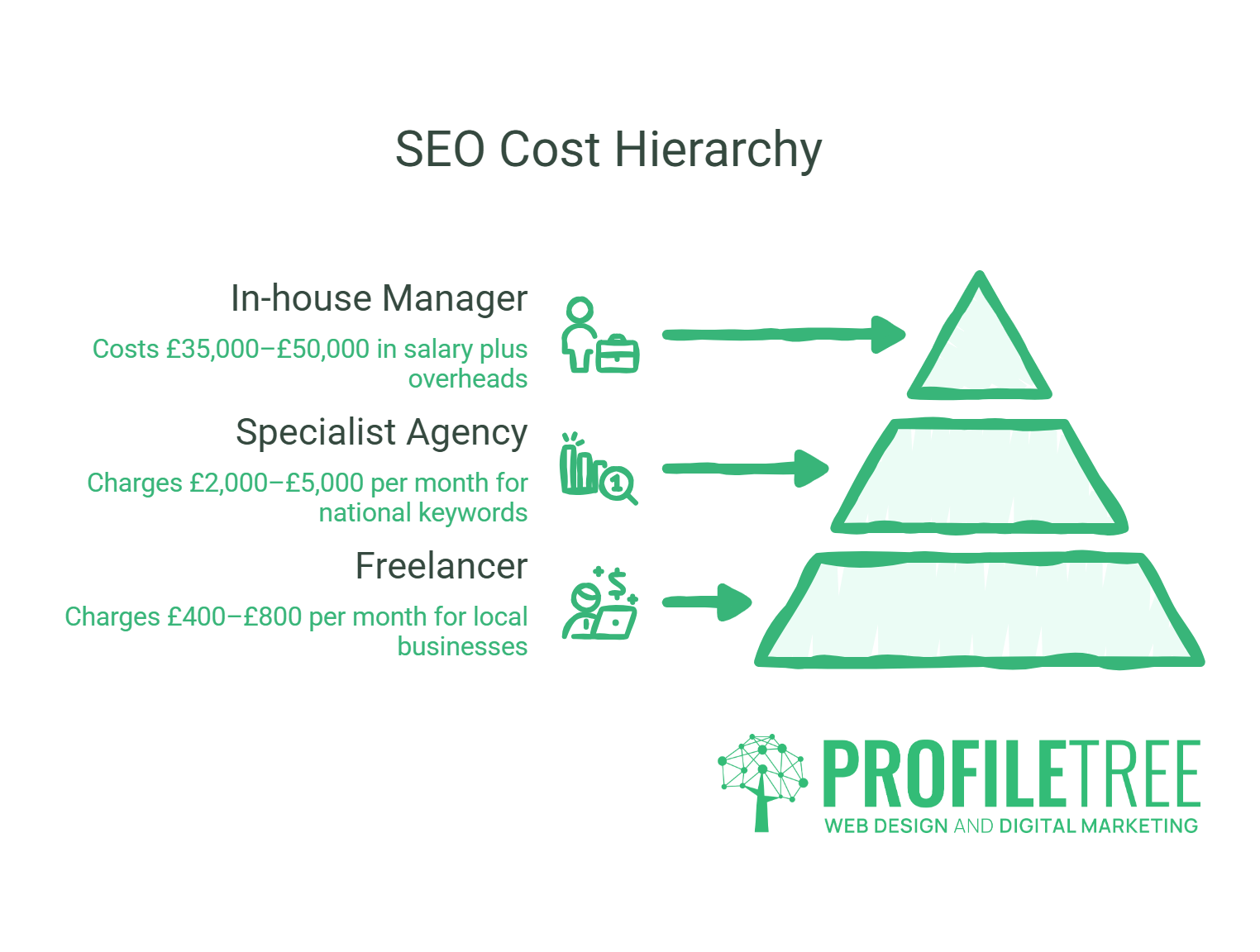
The price range for SEO services in the UK is wide enough to be genuinely confusing. A freelancer working with local businesses might charge £400–£800 per month. A specialist agency working on competitive national keywords could charge £2,000–£5,000 per month or more. An in-house SEO manager with two to three years’ experience costs £35,000–£50,000 in salary before tools and overheads.
None of those figures is inherently right or wrong. The appropriate investment depends on the competitive landscape of the target keywords, the current state of the website’s technical health, and how quickly the business needs to see returns.
For most SMEs across Northern Ireland and the wider UK, a realistic starting point with a specialist agency is £800–£1,500 per month for a managed programme that includes technical auditing, on-page optimisation, and content production. That figure rises sharply if link acquisition is needed in a competitive sector.
What you’re actually paying for
SEO spend breaks down into three areas: technical work (site structure, speed, crawlability), content (articles, service pages, landing pages written to rank), and authority building (links, mentions, citations that tell Google the site is credible). A cheap monthly retainer that only touches one of those three areas will produce limited results regardless of how well it’s executed.
The hidden cost that most businesses underestimate is time. Someone internally needs to brief the agency, review content, approve changes, and coordinate with the developer. That overhead is real, even when the SEO work is fully outsourced.
A note on ROI calculations
The standard ROI formula — gain minus cost, divided by cost — works well in theory. In practice, attributing revenue cleanly to organic search requires proper conversion tracking, which many SME websites lack. Before signing any SEO contract, it’s worth establishing what “success” looks like in measurable terms: is it rankings, traffic, leads, or sales? Each requires different tracking and a different timeframe to evaluate fairly.
At ProfileTree, the first conversation with any new client centres on what a qualified lead is worth and how many the business can realistically handle. That shapes how aggressively to pursue organic growth and which keywords are actually worth chasing.
How Long Does SEO Take to Work?
Three to six months for early movement. Twelve to eighteen months for meaningful commercial results. That’s the honest answer, and it holds across most sectors and most markets.
The timeline varies based on three factors: the authority of the existing domain, the competitiveness of the target keywords, and the volume of work being done each month. A site with a strong existing backlink profile in a low-competition niche can rank new content in weeks. A brand-new domain competing for national financial services terms could take two years or more before organic traffic becomes commercially significant.
Why the delay?
Google’s systems evaluate content over time. A new page needs to be crawled, indexed, and assessed for relevance and trustworthiness before it starts appearing in results. Even after it appears, it typically ranks outside the top ten until Google has enough data — click behaviour, dwell time, backlink growth — to determine whether it deserves a higher position.
This is the structural tension at the heart of the “is SEO worth it” question. The investment starts immediately. The returns arrive later.
Month-by-month expectations
Months one to three are mostly technical and foundational: fixing crawl errors, consolidating duplicate content, building the keyword and content strategy, and beginning to produce optimised pages. Traffic movement in this phase is modest.
Months four to six typically show the first meaningful ranking movements on longer-tail, lower-competition queries. These won’t drive high volume, but confirm the strategy is working.
Months seven to twelve are where compound growth begins. Content published in month two starts earning links and authority. Rankings on mid-competition terms begin to solidify. Organic leads start to become a consistent part of the pipeline.
“An effective SEO strategy combines technical precision with creative content marketing to not only draw visitors in but also to engage and convert them into loyal customers,” says Ciaran Connolly, founder of ProfileTree.
For businesses that need immediate traffic while SEO builds, a parallel PPC campaign covering the highest-value terms is often the most practical bridge. That brings us to the comparison most business owners eventually make.
SEO vs PPC: Which Delivers Better ROI?
The honest answer is that they do different things, and for most growing businesses the question isn’t which one but in what ratio.
| SEO | PPC | |
|---|---|---|
| Time to first results | 3–6 months | 24–48 hours |
| Cost structure | Fixed monthly investment; traffic is free once rankings are established | Short-term campaigns, product launches, lead generation, while SEO builds |
| Traffic quality | High intent (people searching for what you offer) | High intent, but click costs rise in competitive sectors |
| Long-term value | Compounds over time; established rankings continue driving traffic | No residual value; rankings don’t carry over |
| Ideal use case | Long-term brand and pipeline building | Short-term campaigns, product launches, lead generation while SEO builds |
PPC delivers faster results and is easier to measure. If a business needs leads within thirty days, organic search cannot help. But PPC traffic has no residual value. The moment the budget stops, the traffic stops. Organic rankings, once established, continue driving visits even during quiet periods.
For UK SMEs with a twelve-month or longer horizon, organic search typically produces a lower cost per acquisition than paid advertising once rankings are established. The crossover point — where the cumulative cost of SEO becomes lower than the equivalent PPC spend for the same volume of traffic — usually arrives somewhere in the second year of a properly funded programme.
The businesses that get the worst ROI from SEO are those that stop after six months because they haven’t seen the results they expected. The investment made in those six months is partially wasted because the compounding effect never had time to develop.
What the AI Search Era Means for Your Investment
The way people find businesses online has changed materially in the past two years. AI-powered tools — Google’s AI Overviews, ChatGPT, Perplexity — now answer a significant proportion of search queries directly, often without the user clicking through to a website at all.
This creates a new layer to the “is SEO worth it” question. It’s no longer sufficient to rank on page one. Content now needs to earn citations in AI-generated answers. That requires a different content structure: clear, self-contained answers to specific questions, evidence of genuine expertise, and the kind of depth that AI systems can extract and cite.
The good news is that the fundamentals that earned traditional rankings still apply. Authoritative, well-structured content on a technically sound website performs well in both traditional search and AI citation. The shift is one of emphasis rather than direction.
What changes practically
Structured FAQ sections matter more than before. AI systems are disproportionately likely to cite pages that answer specific questions in clear, contained paragraphs. Pages covering multiple sub-questions within a topic are significantly more likely to appear in AI Overviews than pages that address only one dimension of a topic.
E-E-A-T (Experience, Expertise, Authoritativeness, Trustworthiness) has moved from a background quality signal to a front-and-centre ranking factor. Google now evaluates author credentials as a first-class input. A business owner’s 15 years of experience in their sector, properly documented on the website, carries genuine weight.
For Northern Ireland and Irish businesses specifically, there’s an underserved opportunity. The volume of SEO content targeting this market is considerably lower than in London or Dublin, which means well-structured content from a credible local source can establish meaningful AI visibility faster than it could in more saturated markets.
The Four Pillars of a Strong SEO Strategy
Regardless of budget or timeline, any SEO programme that delivers consistent results needs to address four areas. Missing one will cap what the other three can achieve.
Technical SEO
This covers everything that affects how search engines crawl, index, and understand a website. Site speed is the most visible element, but technical SEO also includes URL structure, internal linking, crawl budget, duplicate content, schema markup, and mobile performance. Most SME websites have at least a handful of technical issues limiting their ability to rank. An audit typically surfaces these within the first four weeks of an engagement.
A site that loads in under two seconds, has a logical page hierarchy, and correctly marks up its content with structured data will outperform a slower, poorly structured competitor on otherwise equivalent content.
Content
Content is what earns rankings, but not all content has equal value. Pages that answer specific queries with genuine depth, written by someone with demonstrable expertise, outperform thin or generic pages regardless of how many keywords they contain.
For SMEs, the most valuable content investments are typically: a well-optimised set of service pages, a small number of in-depth guides targeting queries their customers actually use, and a consistent approach to FAQ content that addresses the questions their sales team fields every day. The content that ranks is almost always the content that most accurately matches what the searcher is trying to understand or accomplish.
Ciaran Connolly, ProfileTree founder, notes that content strategy for SMEs in Northern Ireland often fails not because of poor writing but because businesses try to rank for the same terms as national competitors with far greater domain authority. “Targeting the right queries at the right competitive level is more valuable than producing large volumes of content that will never rank.”
Authority
Links from other credible websites remain one of the strongest signals Google uses to assess whether a page deserves to rank. For most SMEs, link acquisition comes from a combination of editorial coverage, industry directories, partnerships, and well-targeted content that other sites naturally reference.
The quality of links matters considerably more than quantity. A single link from a respected industry publication carries more weight than fifty links from low-quality directories.
Local signals
For businesses serving specific geographic areas, local SEO adds a fourth layer. Google Business Profile optimisation, consistent NAP (Name, Address, Phone) data across the web, and localised content all influence how prominently a business appears in map results and local search queries.
For a Belfast or Northern Ireland business targeting local customers, local SEO often delivers the fastest and most commercially direct results of any SEO investment. Searches like “web design Belfast” or “accountant Lisburn” produce a map pack result — and appearing in that three-business shortlist can drive consistent enquiry volume within weeks of proper optimisation.
ProfileTree’s SEO services for Northern Ireland businesses cover all four areas, from technical audits through to content production and local visibility campaigns.
When SEO Is and Isn’t the Right Investment
SEO is the right investment when a business has a twelve-month or longer planning horizon, when the target customers are using search to find the products or services being sold, and when the business can sustain the monthly investment through the period before returns arrive.
SEO is not the right investment when a business needs leads within thirty days, when the target market uses referral and word-of-mouth almost exclusively, or when the website itself needs fundamental rebuilding before any content work can succeed.
A business that has never done any SEO and has a website with significant technical issues is usually better served by a two-stage approach: fix the technical foundation first, then invest in content and authority building. Starting to produce content on a technically broken site wastes the content budget.
For businesses that are genuinely unsure whether their website is limiting their rankings, a technical SEO audit provides a clear picture of what’s working, what isn’t, and what the priority fixes are. That’s a much better starting point than committing to a twelve-month programme without understanding the baseline.
Measuring SEO Success
Setting the right metrics before a programme starts is more important than the metrics themselves.
Organic traffic volume is the most commonly tracked figure, but it’s also the one most prone to misinterpretation. A spike in traffic from a non-commercial query doesn’t produce business value. A modest increase in traffic from high-intent queries can produce significant revenue.
The metrics that most reliably connect to commercial outcomes are: organic traffic from transactional and commercial queries (not informational traffic), ranking positions for the specific terms that describe what the business sells, and organic conversions — enquiries, calls, purchases, or sign-ups that can be attributed to organic search.
Measuring ROI across digital marketing campaigns requires a conversion tracking setup that most SME websites don’t have out of the box. Google Analytics 4, with properly configured goals, combined with call tracking if phone enquiries are a primary conversion, gives a workable attribution picture.
The question to ask any SEO agency at the start of an engagement is: what will we be measuring, how will we measure it, and what does success look like at three months, six months, and twelve months? An agency that can’t answer that question clearly is one to avoid.
FAQs
What is the difference between SEO and Generative Engine Optimisation (GEO)?
SEO focuses on earning rankings in traditional search engine results pages through technical optimisation, content quality, and link authority. GEO (Generative Engine Optimisation) is the emerging practice of structuring content so that AI systems — Google’s AI Overviews, ChatGPT, Perplexity — cite it when answering queries. The two disciplines share most of their fundamentals but GEO places greater emphasis on self-contained answer formats, clear entity associations, and demonstrable first-hand expertise.
How much does a monthly SEO package cost in the UK?
Monthly SEO packages in the UK range from around £400–£800 with a freelancer for local, low-competition work, to £1,500–£3,000 with a specialist agency for a full programme covering technical, content, and authority. Highly competitive national or e-commerce campaigns can run considerably higher. The most important question is not what the monthly fee is but what’s included and how success will be measured.
Is search engine optimisation still relevant with AI search?
Yes. AI search tools pull their answers from web content, which means well-structured, authoritative pages are now being cited in AI responses as well as appearing in traditional rankings. The businesses most likely to lose out are those with thin, generic content that adds little value in traditional search and adds none in AI search. The businesses that benefit are those with genuine expertise, well-documented on a technically sound site.
What are the four main types of SEO?
Technical SEO covers site structure, speed, crawlability, and schema markup. On-page SEO covers the content, headings, and keyword targeting of individual pages. Off-page SEO covers links, citations, and mentions from external sources. Local SEO covers the specific signals — Google Business Profile, NAP consistency, location pages — that influence visibility in geographically targeted searches.
How long does SEO take to work in 2026?
The timeline has not changed materially: three to six months for early movement on lower-competition queries, twelve to eighteen months for strong commercial results on competitive terms. What has changed is that the quality bar for content has risen. AI tools have flooded the web with low-value content, which means Google’s systems are working harder to identify genuine expertise. Well-researched, experience-backed content now tends to earn rankings faster than generic AI-produced articles covering the same topics.
For businesses in Northern Ireland and across the UK that are ready to invest in organic search, ProfileTree’s digital marketing team can assess your current position and build a programme matched to your timeline, budget, and commercial goals.