
The Complete Guide to Healthcare CRM for UK and Irish Providers
Table of Contents
A healthcare CRM is a software platform that helps medical practices, clinics, and hospitals manage patient relationships, communication, and administrative workflows. Unlike an Electronic Health Record (EHR), which stores clinical data, a CRM tracks interactions: appointment history, follow-up communications, patient feedback, and marketing touchpoints.
For private clinics, GP practices, dental groups, and healthcare SMEs across Northern Ireland, Ireland, and the wider UK, choosing and implementing a CRM correctly is not simply a technology decision. It is a data governance decision, and getting it wrong carries real regulatory consequences under UK GDPR and, for practices in Ireland, under the Data Protection Act 2018 and HSE guidance.
This guide covers what healthcare CRM is, how it differs from EHR systems, what features matter for UK and Irish providers, how to implement one without compromising compliance, and where a digital agency fits into the process.
What is a Healthcare CRM?
A healthcare CRM is a centralised platform for managing the non-clinical aspects of patient relationships: appointment scheduling, communication history, patient satisfaction tracking, referral management, and targeted outreach. It does not replace your clinical records system. It sits alongside it, handling everything a patient management system does not.
For a small private clinic or dental group, a CRM might log every phone call, email, and online enquiry alongside the patient’s appointment history, flag patients who have not re-booked for twelve months, and automate appointment reminder messages. For a larger healthcare group, it might track referral sources, measure campaign performance, and segment patients by treatment type for targeted communications.
The key distinction is this: your EHR records what happened clinically. Your CRM records the relationship around it.
Healthcare CRM vs. EHR: The Core Difference
This is the question that comes up in nearly every healthcare technology conversation, and it is worth answering clearly before going further.
| Healthcare CRM | Electronic Health Record (EHR) | |
|---|---|---|
| Primary purpose | Patient relationships and communication | Clinical records and care delivery |
| Data stored | Contact history, appointments, preferences, feedback | Diagnoses, prescriptions, test results, clinical notes |
| Who uses it most | Marketing, admin, reception teams | Clinicians, GPs, nursing staff |
| Compliance focus | UK GDPR, marketing consent, data security | NHS DSPT, CQC standards, clinical governance |
| Example systems | HubSpot, Salesforce Health Cloud, Creatio | EMIS Web, SystmOne, Vision |
The two systems can and often do integrate, but they serve fundamentally different purposes. A practice that conflates them typically results in an EHR being used clumsily for administrative tasks, or a CRM accessing clinical data it should not.
Key Features of a Medical CRM
Not every CRM marketed to healthcare businesses is built with clinical workflows in mind. Before comparing platforms or speaking to vendors, it helps to know which features genuinely matter for a UK or Irish practice and which are standard CRM functionality dressed up in healthcare language.
Patient relationship and pipeline management
At its core, a healthcare CRM should give your admin team a clear view of where every patient or prospect sits in the relationship: new enquiry, booked, attended, post-care follow-up, or lapsed. For private practices that compete for patients, this pipeline view is as commercially relevant as it is for any other service business.
Omnichannel communication
Patients contact practices by phone, email, online form, and increasingly via website chat. A CRM that consolidates these channels into a single contact record means that whoever answers the phone next week has the full context of every previous interaction, without having to ask the patient to repeat themselves.
Automated appointment scheduling and reminders
Missed appointments cost NHS and private practices significant time and revenue. Automated SMS and email reminders, integrated with your booking system, reduce no-show rates in a straightforward, measurable way.
Regulatory compliance and data security
Any CRM used in a healthcare context must meet UK GDPR requirements as a minimum. This means a lawful basis for processing patient data, clear consent records for marketing communications, data minimisation principles, and the ability to respond to subject access requests. More on this below.
Healthcare CRM Compliance in the UK and Ireland
This is where most generic guides fall short. The top-ranking CRM articles online are written almost entirely for a US audience, referencing HIPAA compliance as the relevant standard. If you are running a clinic in Belfast, Dublin, or Birmingham, HIPAA does not apply to you. The following frameworks do.
UK GDPR and the Data Protection Act 2018
Any personal data relating to a patient’s health is classified as special category data under UK GDPR, which means it receives a higher level of protection than standard personal data. Using a CRM to store or process this data requires an explicit legal basis, clear data processing records, and a documented data protection impact assessment (DPIA) before implementation. Marketing communications to patients require a separate consent record. Relying on “legitimate interests” for health-related marketing is high risk and should be discussed with a Data Protection Officer before you proceed.
The NHS Data Security and Protection Toolkit (DSPT)
NHS-connected organisations and those handling NHS patient data must complete an annual DSPT assessment covering data security standards, staff training, and incident reporting. If your CRM stores data that touches NHS pathways, your implementation must be scoped to meet the DSPT requirements. Standard off-the-shelf CRM configurations, including popular platforms like HubSpot, are not DSPT-compliant out of the box. Compliance depends entirely on how the system is configured, what data is stored, and how access controls are set up.
HSE compliance for Irish providers
Healthcare providers in Ireland operate under the Data Protection Act 2018, which implements GDPR at the national level, alongside HSE data governance frameworks. The same principles apply: special category data processing requires explicit consent or another qualifying legal basis, a DPIA is mandatory before deploying a new CRM system, and data residency (where your data is stored) must be considered when selecting a cloud-based platform.
If you are selecting a CRM vendor for a healthcare organisation in Ireland, EU-based data residency is a material consideration. Some US-headquartered platforms offer EU hosting regions; others do not. This needs to be confirmed in the vendor agreement, not assumed.
What this means practically
A private dental group in Belfast implementing HubSpot without specialist configuration will likely be non-compliant on day one. The platform itself is not the problem; the architecture around it is. CRM implementation in healthcare requires either a specialist healthcare IT vendor or a digital agency with documented experience of configuring CRM systems within UK GDPR frameworks. The cost of getting it wrong is not just regulatory: a data breach involving patient information carries ICO fines of up to £17.5 million or 4% of the company’s annual global turnover, whichever is higher, under the UK GDPR.
Integrating Your CRM with UK Clinical Systems
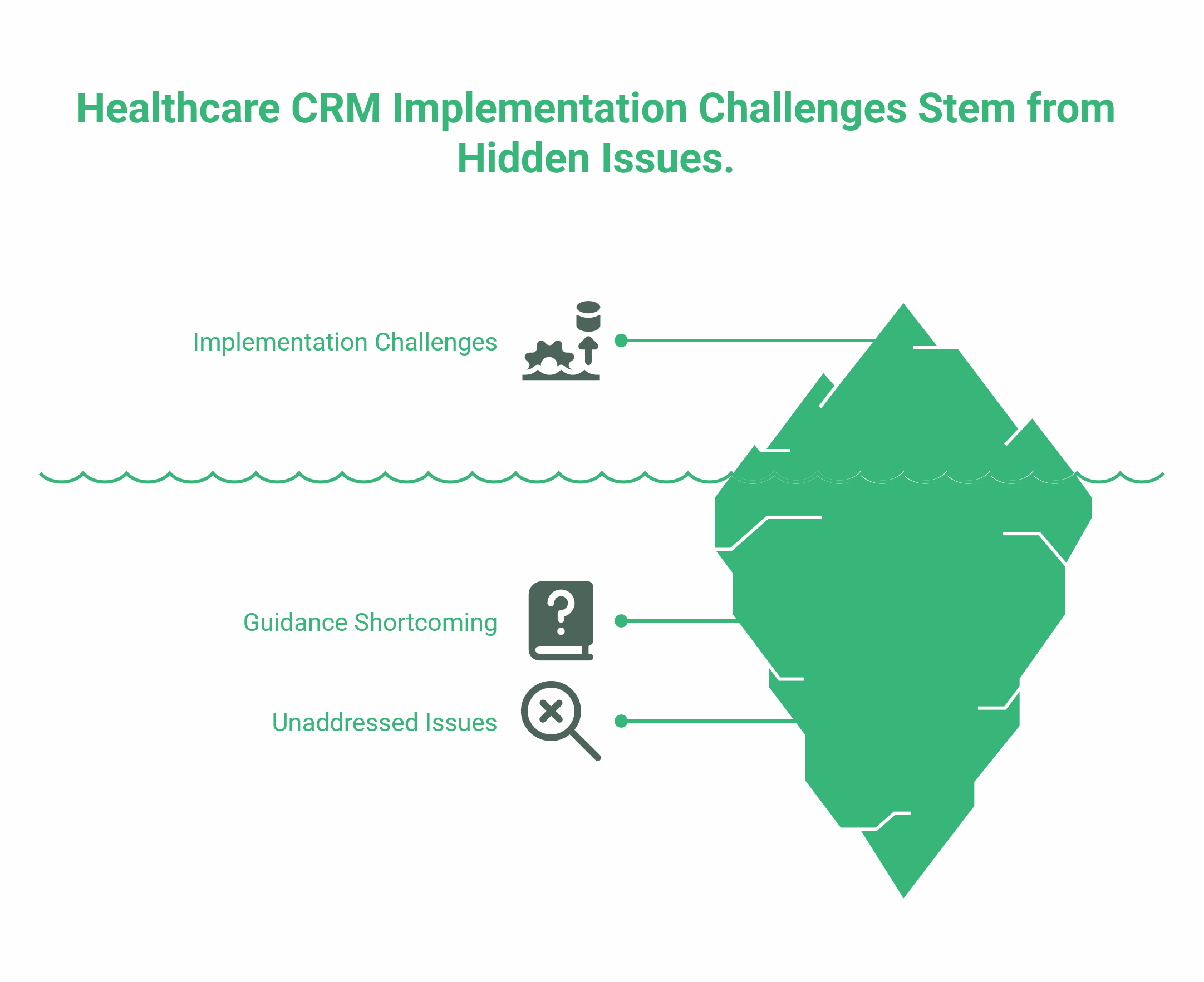
This is a critical gap in most healthcare CRM guidance, and it is where many implementations run into difficulty.
The dominant clinical systems in UK primary care are EMIS Web, SystmOne, and Vision. These hold the clinical record. A CRM integration with these systems needs to be approached carefully: you generally want the CRM to read appointment data from the clinical system (to trigger follow-up communications, for example), but you do not want the CRM writing clinical data back into the patient record.
Standard CRM platforms do not offer native integrations with EMIS Web or SystmOne. Integration typically requires middleware or a bespoke API layer built by a developer with experience in healthcare data standards. NHS Digital’s FHIR (Fast Healthcare Interoperability Resources) standard is increasingly the mechanism for these integrations, but implementation requires technical expertise.
For smaller private practices that do not use NHS-connected clinical systems, the integration challenge is simpler but still requires careful data mapping to avoid duplication or conflict between the practice management system and the CRM.
This is one area where working with a web development agency that understands both CRM configuration and API integration, rather than buying a SaaS tool and self-implementing, makes a material difference to the outcome. ProfileTree’s development team works with healthcare clients on exactly this kind of custom integration work, scoping the data architecture before any platform is selected.
The Three Categories of Healthcare CRM
Healthcare CRM software typically falls into three operational types, and understanding the distinction helps narrow down what your practice actually needs.
Analytical CRM focuses on data. It aggregates patient data to surface patterns: which treatments generate the most enquiries, which referral sources convert, and which patient segments have the highest lifetime value. For larger private healthcare groups, analytical CRM supports strategic decisions. For a single-site clinic, it is often more than is needed.
Collaborative CRM supports communication across teams and departments. In a hospital or multi-site group, this means patient information and interaction history flow across reception, clinical coordinators, and billing without manual handoffs. For smaller practices, a simpler operational CRM often covers this without the added complexity.
Operational CRM handles the day-to-day: appointment scheduling, communication automation, contact management, and follow-up workflows. This is the starting point for most UK healthcare SMEs and the type most commonly implemented in private clinics and dental or physiotherapy practices.
Most small to mid-sized healthcare providers in Northern Ireland and Ireland start with operational CRM and add analytical capability as their data matures.
A Practical Implementation Roadmap
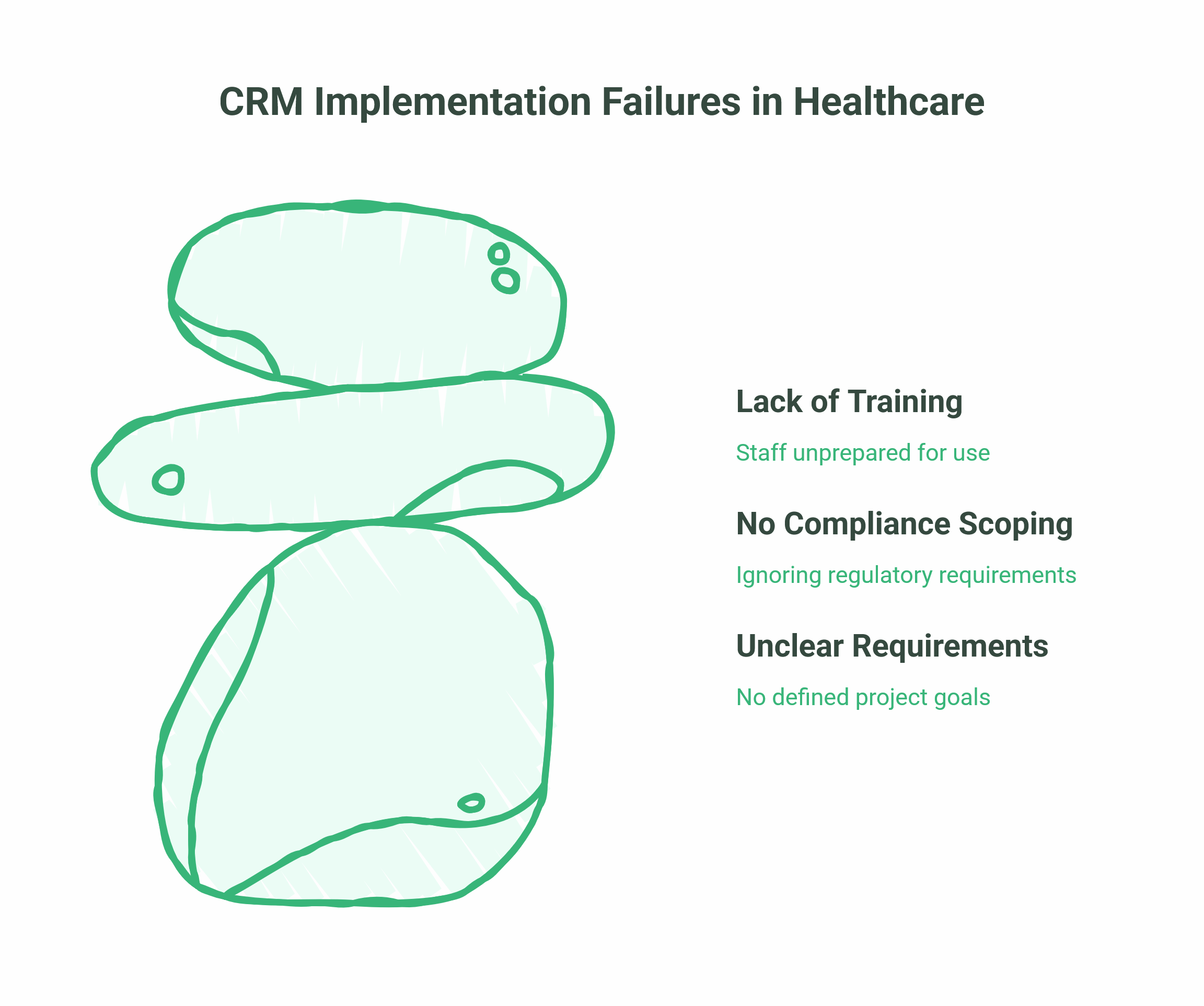
Most CRM implementations that fail in healthcare settings do not fail because of the software. They fail because the practice skipped the groundwork: unclear requirements, no compliance scoping, and staff were handed a login without training. The five steps below will not guarantee a smooth rollout, but skipping any of them significantly increases the risk of a problem.
Step 1: Needs assessment and stakeholder input
Before selecting a platform, document what you actually need it to do. Which teams will use it? What data will it hold? How does it need to connect with existing systems? Involve clinical leads, practice managers, and your Data Protection Officer at this stage, not after you have signed a vendor contract.
Step 2: Vendor selection — bespoke versus off-the-shelf
Off-the-shelf platforms (HubSpot, Salesforce, Zoho) offer faster deployment and lower initial cost. Bespoke builds offer tighter compliance configuration and direct integration with your existing systems. For most healthcare SMEs, a well-configured off-the-shelf platform is the pragmatic choice, provided it is configured by someone who understands the compliance requirements.
Step 3: Compliant data migration
Migrating patient contact data from a legacy system to a new CRM requires an initial data audit. What data do you currently hold? Is there a documented lawful basis for each category? Is any of it out of date? Running a DPIA at this stage is not optional under UK GDPR; it is a legal requirement when the processing involves special category data.
Step 4: Staff training and adoption
CRM implementation fails most often not at the technical stage but at adoption. Admin and marketing staff need training not just on the software but on their compliance obligations when using it. ProfileTree’s digital training programmes have covered exactly this for healthcare and professional services clients, combining platform training with the data governance context that makes it stick.
Step 5: Ongoing monitoring and support
A CRM is not a set-and-forget tool. Data quality degrades, consent records expire, and staff change. Build in a quarterly review process to verify data accuracy, consent status, and whether the system remains configured correctly for any regulatory changes.
Healthcare CRM Costs: What to Budget in the UK
Pricing varies significantly by platform and implementation complexity. As a general guide for UK healthcare providers:
| Approach | Typical Cost Range |
|---|---|
| Off-the-shelf CRM (SaaS licence) | £30–£150 per user per month |
| Implementation and configuration (agency) | £2,000–£10,000 depending on complexity |
| Bespoke healthcare CRM development | £15,000–£50,000+ |
| Ongoing support and management | £500–£2,500 per month |
These are industry estimates, not ProfileTree-specific figures. Your actual cost will depend on the number of users, the level of integration required, and whether you need a custom compliance configuration. Any agency quoting a flat fee for healthcare CRM without first scoping your data architecture and compliance requirements should be treated with caution.
Where a Digital Agency Fits
A digital agency is not a CRM vendor. But for healthcare SMEs, the gap between buying a CRM and using it effectively is often a technology and capability gap, not a software gap.
ProfileTree, a Belfast-based digital agency working with businesses across Northern Ireland, Ireland, and the UK since 2011, supports healthcare clients at the intersection of web design, CRM integration, content marketing, and digital training. That means a private clinic might engage the team to build a GDPR-compliant website with integrated appointment capture, configure a CRM to receive and manage those enquiries, develop the content strategy to drive patient acquisition through organic search, and train the admin team on the tools.
That combination of services, delivered as a joined-up programme rather than separate projects, is where smaller healthcare businesses often get more consistent results than from buying tools individually and trying to connect them themselves.
To support patient engagement, healthcare providers are increasingly using short-form video across their websites and social channels. ProfileTree’s video production team works with healthcare clients to create explainer, staff introduction, and patient testimonial videos that comply with the ASA guidelines for healthcare marketing.
Choosing the Right CRM Approach for Your Practice
Healthcare CRM is not a difficult concept, but implementation in the UK and Irish context requires more care than generic guides suggest. The compliance landscape differs from the US; clinical systems are different, and the consequences of data-handling errors in a healthcare setting are serious.
For private clinics, dental groups, physiotherapy practices, and healthcare SMEs across Northern Ireland and Ireland, the practical path is usually a well-configured, off-the-shelf platform implemented by a team that understands both the technology and the regulatory context, rather than a self-service setup that leaves compliance gaps for you to discover later.
If you are scoping a CRM project for your practice and want to understand what a compliant, integrated implementation looks like, ProfileTree’s team is happy to talk through the options.
FAQs
What is the difference between a healthcare CRM and an EHR?
A CRM manages patient relationships, communications, and administrative workflows. An EHR stores clinical information: diagnoses, prescriptions, and treatment histories. The two systems operate in parallel and can be integrated, but they serve different purposes and are used by different staff.
Can practices use HubSpot or Salesforce for healthcare CRM in the UK?
Yes, but not without specialist configuration. Standard implementations are not compliant with UK GDPR requirements for special category health data out of the box. If your practice is NHS-connected, you also need to consider NHS DSPT requirements before deploying any platform.
Is a DPIA required before implementing a CRM in a healthcare setting?
Yes. Under UK GDPR, a Data Protection Impact Assessment is mandatory before processing special category data in a new system. Patient contact information combined with health-related data qualifies. Skipping this step exposes the ICO to legal liability.
What should I look for when choosing a CRM for a small healthcare practice?
Focus on four things: integration with your existing practice management system, UK or EU data residency, consent management capability, and documented healthcare sector experience from the vendor. Compliance capability matters more than cost per user.