
Maximising ROI with Commercial Video for Irish Businesses
Table of Contents
Maximising ROI with commercial video starts before anyone picks up a camera. Plenty of businesses across Ireland and Northern Ireland spend well on production, then post the result and hope. The return comes from the work around the video: a clear goal, an audience you actually understand, and a way to connect views to enquiries and sales.
“Maximising ROI from video is about more than production quality. It comes down to strategy, distribution, and measurement,” says Ciaran Connolly, founder of ProfileTree. “Our clients see the best results when every video is built with a purpose and backed by data, not guesswork.”
This guide covers how to plan, produce, distribute, and measure commercial video so the spend pays back. If you want the underlying numbers behind the case for video, the companion piece on the ROI of video marketing sets out the supporting data, and ProfileTree’s video marketing services cover the production side end to end.
The numbers behind the video’s ROI potential
Video is now the format pulling budgets in Ireland, which is part of why ROI questions matter more than they used to. According to the IAB Ireland 2025 Online Adspend report, total digital advertising spend in Ireland reached €1.146 billion in 2025, up 8% year on year, with video growing 14% and now making up 39% of total digital adspend. That shift tells you where attention and competition sit.
Spending more on video does not guarantee a return, though. The businesses that see payback treat each video as an investment with a measurable goal, not a one-off cost. The sections below walk through how to do that at each stage.
Strategic planning: the foundation of video ROI
The campaigns that pay back tend to start with a strategy long before production. This planning stage is where most of the eventual return is won or lost.
Define clear business objectives
Every video should map to a specific goal. Sales-focused work includes product demonstrations, customer testimonials, and shoppable videos that shorten the purchase journey. Brand-building work covers company story videos, thought leadership, and culture content. Retention work includes onboarding clips, tutorials, and FAQ videos that cut support load. ProfileTree’s digital strategy team sets these objectives with clients before filming, so each video has a job to do.
Research and target the right audience
Knowing exactly who a video is for is what separates a sharp campaign from a generic one. Identify the audience segments that matter, research how they consume video, and map content types to the stage of the buying journey they sit in. Then check where they actually watch, on which device, and for how long, before committing budget. Testing a concept on a small group first saves money on the full shoot.
Allocate the budget where it earns its keep
Match production quality to the goal. Evergreen content with a long shelf life justifies more investment than a one-week promo. Batch-filming several videos in a single session, planning for repurposing across formats, and building templates for recurring content all stretch the budget. ProfileTree’s video marketing services include this planning, so spend tracks expected value rather than guesswork.
Professional production: quality that drives results
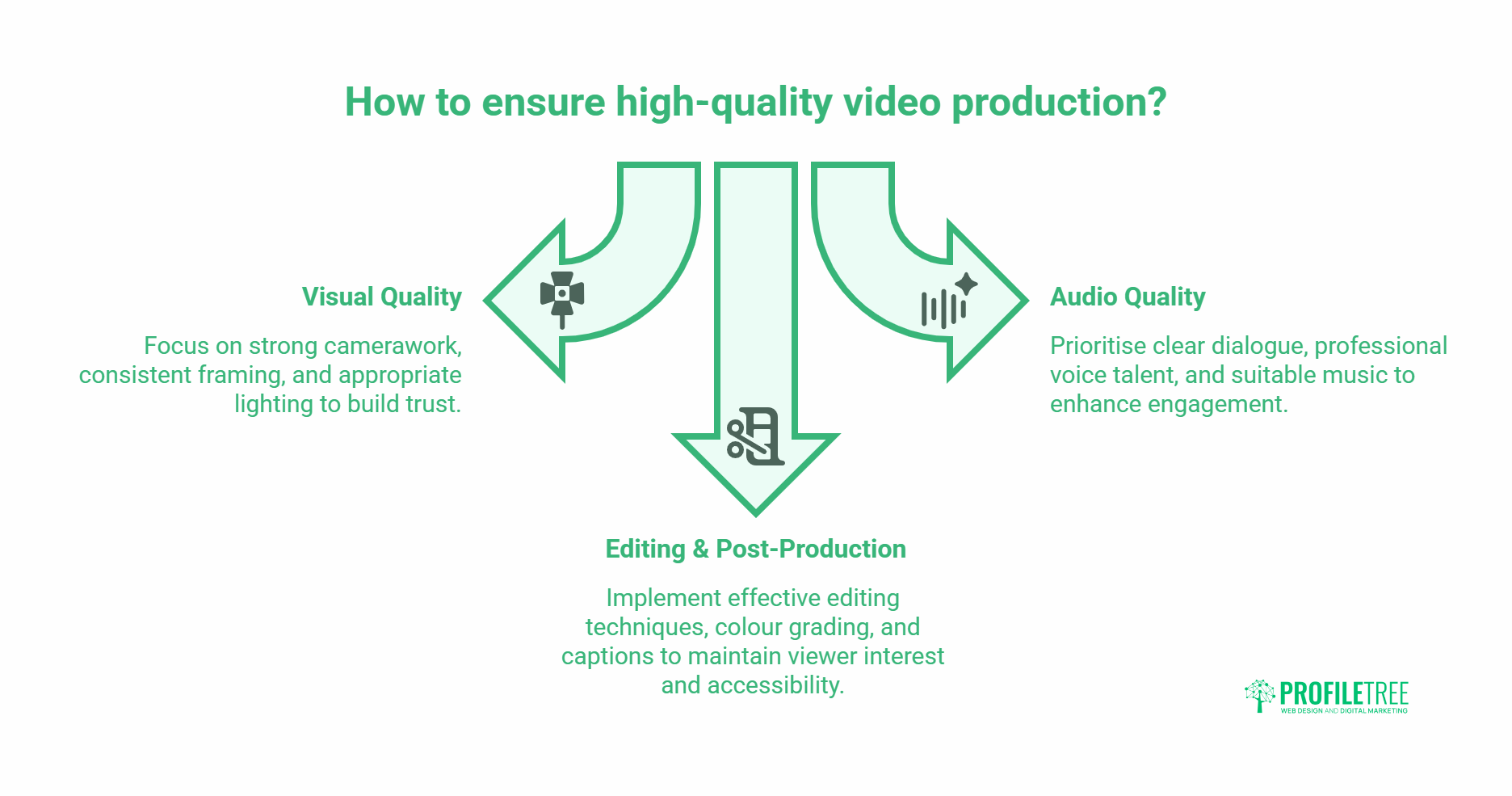
Planning sets the foundation, but production quality decides whether the message lands. Professional execution builds credibility and keeps viewers watching.
Visual quality
Strong camerawork, consistent framing, and lighting that suits the subject all signal a brand worth trusting. Location matters too: authentic Irish settings build local relevance, while a studio gives full control. Keep visual branding consistent (colour, logo placement, typography) without overbranding to the point of distraction.
Audio quality
Sound is what often separates polished work from amateur output. Clear dialogue, professional voice talent suited to the brand, and music chosen to support the emotional goal all add up. Clean capture on set reduces fixing in post, and proper mixing keeps dialogue intelligible across devices.
Editing and post-production
Editing shapes how the message is received. A strong opening hook, sensible pacing, and a clear call to action at the end keep viewers engaged. Colour grading sets the mood, captions improve accessibility and silent-feed viewing, and format adaptation handles different platforms. Where video sits on a website, ProfileTree’s website development team handles the embedding so playback stays fast and mobile-friendly.
Cross-channel distribution: getting the video seen
Even a strong video needs a distribution plan to earn its return. Reaching the right audience through the right channels is what turns production spend into results.
Website integration
On your own site, placement drives performance: homepage video for first impressions, product-page video to lift conversion, landing-page video to support a campaign. Use mobile-optimised players, sensible autoplay rules, and video schema markup so search engines understand the content. A transcript helps both accessibility and indexing.
Social platforms
Each channel needs its own treatment: format and length tuned to the platform, native uploads rather than links, captions for sound-off viewing, and custom thumbnails. Posting when your audience is active and engaging with comments both extend reach. ProfileTree’s social media marketing and content marketing services cover distribution across these channels.
Email and direct marketing
Video lifts email performance. A thumbnail with a play button encourages clicks, and adding “video” to a subject line tends to improve open rates. Link through to a landing page with the full clip rather than trying to embed playback in the email itself. The ProfileTree guide to email marketing covers how to build these sequences.
Paid amplification
Paid promotion extends organic reach when targeting is tight. Allocate budget by where your audience actually engages, A/B test variations and thumbnails, and use retargeting based on who watched. Sequenced ads can build a fuller narrative across multiple touchpoints. This sits within ProfileTree’s wider digital marketing services.
Performance analysis: measuring and improving ROI
You cannot improve what you do not measure, and you cannot prove ROI without it. Tracking performance across the funnel is what makes the case for continued investment.
Key metrics that matter
Awareness metrics include views, impressions, and unique reach. Engagement quality shows in retention rate, watch duration, shares, and click-through. Conversion metrics are the ones that justify spend: conversion rate after viewing, leads attributed to video, revenue linked to campaigns, and cost per acquisition compared with other channels. Search optimisation helps the same video content earn organic visibility over time.
Attribution and the ROI calculation
Connecting video to outcomes needs an attribution approach that fits how your customers actually buy. First-touch credits awareness, last-touch credits the final nudge, and multi-touch models spread credit across the journey. The core calculation stays simple: ROI = (revenue attributed to video minus total video cost) divided by total video cost. Total cost should include production, distribution, internal time, and the value of the content’s longer-term use, not just the shoot.
Continuous improvement
Video ROI compounds when you review and refine. Regular analysis of the metrics above, A/B testing of creative, and reallocating budget toward higher-performing placements all push returns up over time. The point is to treat video as an ongoing programme, not a single project.
Practical recommendations for Irish businesses
Maximising ROI with commercial video comes down to a few habits: tell a clear story, guide viewers to a specific next step, and measure everything.
Focus on storytelling and clear calls to action
A single core message per video beats trying to say everything at once. Build the message around a real problem and its solution, keep terminology consistent across the campaign, and place a clear call to action at the point in the video where intent is highest.
Test different formats
Short-form clips under 60 seconds suit social and quick product highlights. Testimonials and case studies build credibility and reduce purchase uncertainty. Explainer and how-to content give practical value and tend to earn longer watch time. Testing across these formats shows you which ones move your specific audience.
Work with experienced producers
Production partners bring more than camera skills. The value is in aligning video with business objectives, working efficiently within budget, and analysing performance to improve the next round. When choosing one, look for a portfolio in your sector, a clear process from brief to delivery, and a focus on commercial outcomes rather than just the edit.
Conclusion
Commercial video earns its place when it is planned, produced, distributed, and measured as one connected process rather than a single shoot. Irish and Northern Irish businesses that take this approach get a video that builds the brand and brings in enquiries. If you want help making video payback, ProfileTree’s video marketing team works from concept through to measurement. Get in touch to talk it through.
Frequently asked questions
How do I prove ROI for video production?
Track revenue and leads attributed to the video, then apply ROI = (revenue attributed minus total cost) divided by total cost. Include production, distribution, and internal time in the cost, and use an attribution model that matches your buying journey.
How do you measure the impact of a testimonial video?
Measure watch-through rate, click-through to the next step, and conversion rate among viewers who saw it. Compare the conversion for visitors who watched the testimonial against those who did not.
What is a realistic budget for ROI-driven video?
Match the budget to the goal and shelf life. Evergreen content that runs for years justifies more than a short promo. Batch-filming and repurposing across formats lowers the cost per usable video.
Which video formats give the best return?
It depends on the goal. Short-form suits awareness and social media, testimonials build trust at the decision stage, and explainer content earns longer engagement. Testing across formats is the only reliable way to know what works for your audience.
How does video support wider digital marketing?
Video feeds social, email, paid, and website performance from one asset. Repurposing a single shoot across channels is one of the most direct ways to improve overall ROI.