
How the First Programming Language Was Created
Table of Contents
Have you ever found yourself pondering the origins of programming languages, those quintessential cogs that set in motion our digital universe? Like a cup of tea brewing on a foggy London morning, there’s something inherently captivating about these intricate creations of the first programming languages and their history.
The question “what was the first programming language?” takes us back to 1843, when Ada Lovelace collaborated with Charles Babbage on one of the first computing machines, creating what many consider the world’s first computer program. This groundbreaking work laid the foundation for everything that followed, from the COBOL systems still processing banking transactions today to the Python and JavaScript code powering your business website.
This article aims to unfold this fascinating journey from its unsophisticated beginnings to pivotal milestones and evolution, like unfolding an intricately penned letter from history. So, prepare yourself for a riveting jaunt into tech history.
Early Development of Programming Languages

Programming didn’t emerge from a vacuum. It evolved from a fundamental need to automate calculations and solve complex problems more efficiently than humans could manage manually.
Ada Lovelace’s Machine Algorithm (1843)
Ada Lovelace is widely recognised as the world’s first computer programmer. Working with Charles Babbage’s proposed Analytical Engine, Lovelace wrote detailed notes that included an algorithm designed to calculate Bernoulli numbers. This algorithm, created in 1843, is considered the first computer program, even though the machine it was designed for was never built.
What made Lovelace’s work revolutionary wasn’t just the algorithm itself. Her notes demonstrated an understanding that machines could go beyond pure calculation. She envisioned computers manipulating symbols and creating music or graphics, concepts that wouldn’t be realised for another century.
Plankalkül by Konrad Zuse (1944-45)
Between 1942 and 1945, German engineer Konrad Zuse developed Plankalkül (German for “Plan Calculus”), the first high-level programming language. Unlike machine code, which required programmers to work directly with the computer’s native binary language, Plankalkül allowed developers to write instructions in a more human-readable format.
Zuse created Plankalkül to solve engineering problems, specifically for his Z4 computer. The language supported structured programming with procedures and data types, features that wouldn’t become standard in other languages until decades later. Plankalkül included support for arrays, records, and even basic exception handling.
However, Plankalkül remained largely unknown outside Germany until the 1970s because Zuse couldn’t publish his work during and immediately after the Second World War. This highlights an important lesson for businesses: timing and communication matter as much as innovation itself. This is a principle we apply to digital marketing and SEO at ProfileTree.
Assembly Language (1949)
Assembly language emerged in 1949 as a bridge between human thinking and machine execution. Developed for the Electronic Delay Storage Automatic Calculator (EDSAC) at Cambridge University, assembly used mnemonic codes (short, memorable abbreviations) instead of binary numbers.
For example, instead of writing 10110000 01100001 to move a value into a register, programmers could write MOV AL, 61h. This seemingly small change dramatically reduced programming errors and development time.
Assembly language is still used today for tasks requiring precise hardware control. While most businesses won’t need developers writing assembly code, understanding its role helps explain why some programming tasks remain complex, particularly when optimising website performance or improving Core Web Vitals scores for better SEO results.
Shortcode (1949)
Also in 1949, John Mauchly developed Shortcode, one of the first high-level languages or HLLs. William Schmitt implemented this system, creating what many consider the first practical compiler. This is a program that translates human-readable code into machine instructions automatically.
This democratised programming, making it accessible to scientists and engineers who understood mathematics but not the intricacies of computer hardware.
This trend towards accessibility continues today with visual website builders and low-code platforms. At ProfileTree, we help businesses navigate these options, understanding when platforms like WordPress, Wix, or Shopify meet their needs and when custom development provides better long-term value.
Milestones in Programming Language History

The 1950s and 1960s saw an explosion of programming language development as computers moved from research laboratories into businesses. These languages created the foundation for modern software development.
Fortran (1957)
John Backus and his team at IBM created Fortran (Formula Translation) in 1957, making it the oldest programming language still in widespread use today. Fortran was designed specifically for scientific and engineering calculations, areas where computers offered enormous potential but remained difficult to program.
Fortran has changed a lot since then. However, despite all these changes, people still find it very helpful today. What makes it great is that it was the first high-level programming language ever created. This means even if you are not a scientist or engineer, you can use it too.
ALGOL (1958)
In 1958, ALGOL, short for Algorithmic Language, burst onto the scene thanks to an international committee that designed it for scientific use, and this was no small task. While ALGOL never achieved commercial success, it played a big part in shaping many of our modern languages.
Some of the fundamental programming concepts that originated in ALGOL include the block structure, lexical scoping, and the distinction between statements and expressions. Languages like C, Java, JavaScript, and PHP, all essential for modern web development, trace their lineage to ALGOL’s design principles.
Lisp (1958)
Lisp is a star in the history of programming languages. It came to life in 1958, thanks to John McCarthy. Lisp stands for list processing and was the first language to use tree data structures. This made Lisp an important invention at that time. Lisp also introduced automatic storage management.
Lisp’s influence on AI development makes it particularly relevant for businesses exploring AI transformation in 2026. Many concepts in modern AI frameworks, the machine learning tools we use for content optimisation, chatbot development, and predictive analytics, trace back to Lisp innovations.
COBOL (1959)
Created in 1959 by Dr. Grace Murray Hopper, COBOL is a significant milestone in the history of programming languages. It was the first high-level programming language created specifically for business-oriented applications. COBOL was revolutionary because it used English-like syntax, making programs readable by business managers, not just technical specialists.
The US Department of Defence supported the development of COBOL, ensuring its compatibility with all types of computers. Estimates suggest that 70-80% of business transactions worldwide today still touch COBOL systems. Major banks, insurance companies, and government agencies continue operating critical systems written in COBOL decades ago.
For business owners, COBOL represents both the value of stable technology and the risk of technical debt. When ProfileTree helps businesses plan their digital transformation, migrating from outdated systems to modern websites or implementing new marketing automation, we apply lessons from COBOL’s story, balancing stability with flexibility and maintainability.
BASIC (1964)
BASIC stands for Beginners’ All-purpose Symbolic Instruction Code. Created in 1964 by John G. Kemeny and Thomas E. Kurtz at Dartmouth College, it was one of the first high-level programming languages. Its accessible syntax made it hugely popular in education and the personal computer revolution.
With BASIC, people could write programs using simple and symbolic instructions instead of complicated machine code or Assembly Language. This proved that programming wasn’t an arcane skill reserved for specialists but something anyone could learn.
C (1972)
Dennis Ritchie created C at Bell Labs between 1972 and 1973. As one of the first high-level programming languages, C’s influence on modern computing, and by extension, web development, cannot be overstated. Unix and its descendants (Linux, macOS, Android) are written primarily in C. Most operating systems, databases, web servers (like Apache and Nginx), and programming language interpreters are implemented in C.
For businesses with websites, C’s legacy is everywhere. The server hosting your WordPress site likely runs Linux (written in C). The web server processing requests uses Apache or Nginx (written in C). The database storing your content uses MySQL or PostgreSQL (written in C).
When ProfileTree builds high-performance websites for clients, we’re working with technologies built on C’s foundation. The speed and reliability businesses expect, instant page loads, handling thousands of simultaneous visitors, all depend on the efficiency C provides.
“Programming languages aren’t just technical curiosities; they’re the foundation of how businesses operate digitally,” says Ciaran Connolly, Director of ProfileTree. “Whether we’re building a WordPress website for a Belfast retailer, implementing AI training for a Dublin firm, or creating a content marketing strategy for a Manchester agency, we’re working with technologies built on decades of programming language evolution.”
Modern Programming Languages for Business Websites and Digital Marketing
The languages we use for web development, digital marketing, and business applications in 2026 evolved directly from these historical foundations. Understanding which languages power your business technology helps you make informed decisions about website development, marketing automation, and digital transformation.
HTML and CSS: The Foundation of Every Business Website
HTML (Hypertext Markup Language) and CSS (Cascading Style Sheets) are the fundamental languages of the web. Every website you visit uses HTML to structure content and CSS to control appearance.
While HTML and CSS aren’t programming languages in the traditional sense, they’re essential for web design and directly impact business results. Well-structured HTML improves SEO, helping Google understand and rank your content. Properly implemented CSS creates responsive designs that work beautifully on smartphones, tablets, and desktops, crucial when mobile traffic dominates most industries.
When ProfileTree designs websites, we write clean, semantic HTML that search engines can easily interpret. We use modern CSS techniques to create engaging, professional designs that reflect brand identity while loading quickly.
JavaScript: For Interactive Web Experiences
JavaScript makes websites interactive. Every dropdown menu, image slider, form validation, or content update without a page reload uses JavaScript. For businesses, JavaScript enables the engaging experiences customers expect from modern websites.
JavaScript’s importance has expanded dramatically. Originally limited to simple browser interactions, JavaScript now powers complete web applications. For e-commerce businesses, booking systems, or customer portals, JavaScript is essential.
At ProfileTree, we use JavaScript to create interactive features for client websites: lead capture forms with real-time validation, video players optimised for engagement, dynamic content loading, and booking systems. However, JavaScript requires careful implementation; poorly optimised JavaScript can dramatically slow page loads, harming both user experience and SEO.
PHP: Powering WordPress and Business Websites
PHP powers approximately 77% of websites with known server-side programming languages. WordPress, Drupal, and many custom business applications use PHP. For businesses investing in web development, PHP is one of the most practically important languages.
WordPress, our primary platform for client websites at ProfileTree, is built entirely in PHP. When you publish a blog post, update a product page, or process a contact form, PHP code executes on the server, generates the appropriate HTML, and sends it to the visitor’s browser.
PHP’s dominance in web development comes from its specific design for web applications. It integrates seamlessly with HTML, connects easily to databases, and scales from small business websites to high-traffic platforms.
Python: The Language of AI and Marketing Automation
Python has become the default language for AI, machine learning, and data analysis, making it increasingly relevant for businesses implementing marketing automation, predictive analytics, or AI transformation.
Marketing teams use Python for data analysis and automation, customer segmentation, content optimisation and SEO analysis, and social media monitoring. At ProfileTree, we use Python for AI implementation projects, helping businesses automate repetitive marketing tasks, analyse customer behaviour, and personalise customer experiences.
When we provide AI training for SMEs across Northern Ireland and the UK, we often start with Python-based tools. This gives business professionals hands-on experience with the technologies transforming their industries.
SQL: Accessing Your Business Data
Every business generates data: customer information, sales transactions, inventory levels, website analytics. Most of this data lives in relational databases, and SQL (Structured Query Language) is how you access it.
SQL lets you answer business questions directly: Which products generated the most revenue? Which customers haven’t purchased recently? How do conversion rates differ across marketing channels?
Understanding SQL helps business owners appreciate what their websites can track and what insights are possible from their digital operations.
Choosing Programming Languages for Your Business Website
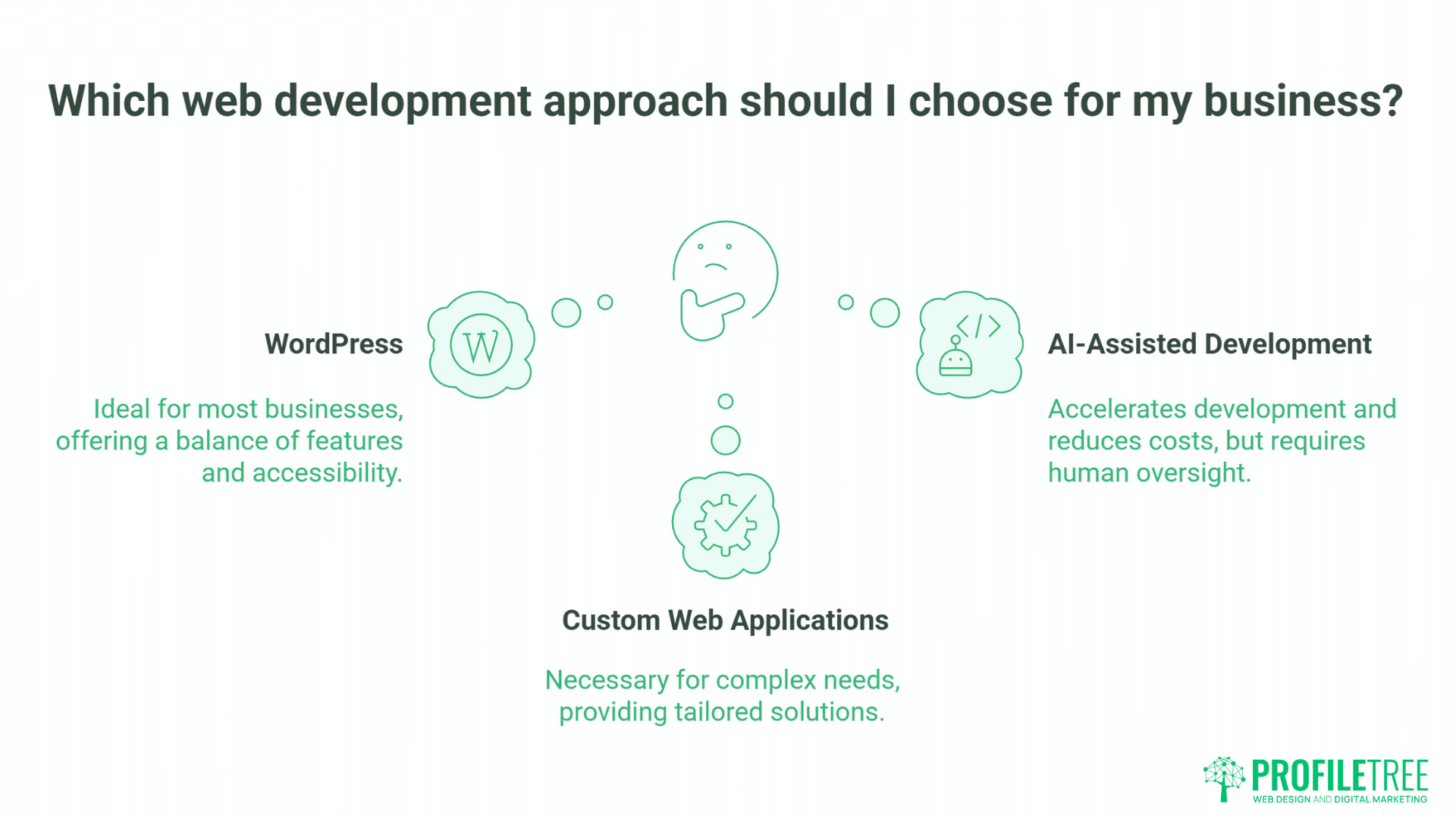
For business owners commissioning web design, hiring developers, or investing in digital training, understanding which languages suit your needs helps you make informed decisions and set realistic expectations.
WordPress: The Business-Focused Platform
WordPress powers over 43% of all websites globally, including many sites across Northern Ireland, Ireland, and the UK. Built with PHP, HTML, CSS, and JavaScript, WordPress offers an ideal balance between professional capability and business user accessibility.
For most businesses, WordPress provides everything needed for effective digital marketing: content management that non-technical teams can handle, SEO capabilities built-in and extensible through plugins, responsive design across all devices, e-commerce functionality through WooCommerce, and marketing integration with email platforms and analytics.
At ProfileTree, we specialise in WordPress website design focused on business results. We build sites that rank well in search engines, convert visitors into customers, load quickly on mobile devices, and integrate with marketing systems.
Custom Web Applications: When WordPress Isn’t Enough
Some business requirements exceed what WordPress can efficiently deliver. Complex web applications, unique workflow automation, or specialised customer portals might need different approaches.
For these projects, we might use Python with Django for data-intensive applications, Node.js with React for highly interactive interfaces, or Laravel (PHP) for custom business applications. Custom development costs more initially but provides exact solutions for unique business needs.
The AI Factor: How Modern Tools Change Development
AI coding assistants like GitHub Copilot and ChatGPT have transformed programming in 2026. These tools generate code from natural language descriptions, debug errors automatically, and suggest optimisations.
For businesses, AI tools mean faster development, lower costs for certain projects, and better code quality. However, AI doesn’t replace professional developers. Projects still require human understanding of business requirements, system architecture, security considerations, and integration with existing systems.
At ProfileTree, we use AI tools to accelerate development while maintaining the quality and strategic thinking that deliver business results. When we provide AI training for businesses, we teach teams to effectively direct these tools, understanding what’s possible and when human expertise remains essential.
Conclusion
Understanding the evolution of programming languages, from Ada Lovelace’s pioneering algorithm to today’s sophisticated web development tools, provides valuable context for making informed technology decisions. Whether you’re investing in a new website, implementing AI solutions, or training your team in digital skills, this knowledge helps you evaluate options, communicate with developers, and choose technologies that align with your business objectives. The languages powering your digital presence aren’t just technical details; they directly impact your website’s performance, search rankings, user experience, and ultimately, your ability to attract and convert customers.
At ProfileTree, we bridge the gap between complex programming technologies and practical business outcomes. Our expertise spans the full digital landscape, from WordPress web design and SEO optimisation to AI implementation and content marketing strategy. We help businesses across Northern Ireland, Ireland, and the UK transform their digital presence, combining technical excellence with strategic thinking that drives measurable growth. Whether you’re starting from scratch or improving existing systems, we provide the guidance and implementation expertise to make technology work for your business.
FAQs
What was the first programming language ever created?
Ada Lovelace’s algorithm for Charles Babbage’s Analytical Engine in 1843 is considered the first computer program, though the machine was never built. The first implemented high-level programming language was Plankalkül, developed by Konrad Zuse between 1942-1945. Fortran, created in 1957, was the first widely used high-level language and remains in use today.
What were some challenges faced in creating the first programming language?
Some of these challenges included designing a system that could accurately understand human commands and translate them into machine code.
How did the creation of the first programming language impact technology?
The creation of the first programming languages paved the way for advancements in technology, making computers more accessible and enabling software development on a larger scale.
Which programming languages does my business website use?
Most business websites use multiple languages working together. HTML structures content, CSS controls appearance, JavaScript adds interactivity, and server-side languages like PHP (for WordPress) or Python handle business logic and database connections. Understanding this helps you appreciate what professional web development involves.
Should my business use WordPress or custom development?
WordPress suits most businesses excellently, providing professional capabilities, SEO optimisation, and content management that marketing teams can handle. Custom development makes sense when you need highly specialised functionality or unique competitive advantages through technology. ProfileTree helps businesses evaluate which approach delivers the best long-term value.
How is AI changing programming and web development?
AI tools accelerate certain development tasks, generate code from descriptions, and make some programming more accessible. However, AI doesn’t replace professional developers; it changes what development work looks like. Businesses still need human expertise for strategy, security, and system architecture. ProfileTree uses AI tools to work more efficiently while maintaining the quality and strategic thinking that deliver business results.
Ready to Transform Your Digital Presence? ProfileTree specialises in web design, WordPress development, SEO, AI training, and digital marketing strategy for businesses across Northern Ireland, Ireland, and the UK. Our team combines technical expertise with business focus to deliver websites that rank well, convert visitors, and support your growth objectives. From initial strategy to ongoing optimisation, we’re your partner in digital success. Contact us today to discuss how we can help your business thrive online through smart technology choices and expert implementation.