
Local SEO Management: A Framework for UK & Ireland
Table of Contents
Nearly half of all Google searches carry local intent, yet most small businesses still treat local search as a one-off setup task. It is not. It is an ongoing management discipline, and the rules shifted again in 2026 with AI Overviews now sitting above the map pack.
This guide skips the theory and gives you a working system. You will find the four pillars of day-to-day management, the verification problem facing service-area businesses, how rankings differ across Belfast, Dublin and London, and a 30-day roadmap you can run yourself.
Whether you run a single shopfront or a multi-location operation, the framework below is built to be repeated month after month.
The State of Local Search in 2026
Local search no longer ends at the three-pack. AI assistants now answer many “near me” queries before a user ever scrolls to a map. That changes what businesses must optimise for, and it rewards structured, verifiable information over keyword stuffing. A quick read of Northern Ireland cities shows how varied local markets can be, even within one region.
How AI Overviews Changed Local Intent
When someone asks an AI assistant for a “reliable plumber in Belfast”, the answer is assembled from structured data, reviews and citations, not a ranked list of blue links. Businesses with consistent, machine-readable information get pulled into those answers. Those without it disappear.
The practical takeaway is simple. Your Google Business Profile, your schema markup and your review profile now feed two systems at once: the traditional map pack and the AI layer above it. Strong search engine optimisation work supports both.
Entity Authority Over Keywords
Ranking in 2026 leans on entity authority: how clearly search engines understand who you are, where you operate and what you do. A business named identically across its website, profile and directories builds a stronger entity than one with scattered variations.
This is why naming consistency matters more than repeating a keyword ten times. It also feeds directly into the management work that follows, because every pillar below reinforces the same entity signals.
Practically, that means deciding on one exact business name, one address format and one phone format, then enforcing them everywhere: the website footer, the profile, every directory and every social bio. Small variations such as “Ltd” versus “Limited” or “St” versus “Street” seem trivial, but dilute the entity over hundreds of listings.
Why Local SEO Management Is a Process
A profile set up once and left alone decays. Competitors add reviews, Google changes profile features, and citations drift out of date. Treating local search as a live channel, with weekly attention, is what separates businesses that hold the top spots from those that slip.
The Four Pillars of Local SEO Management
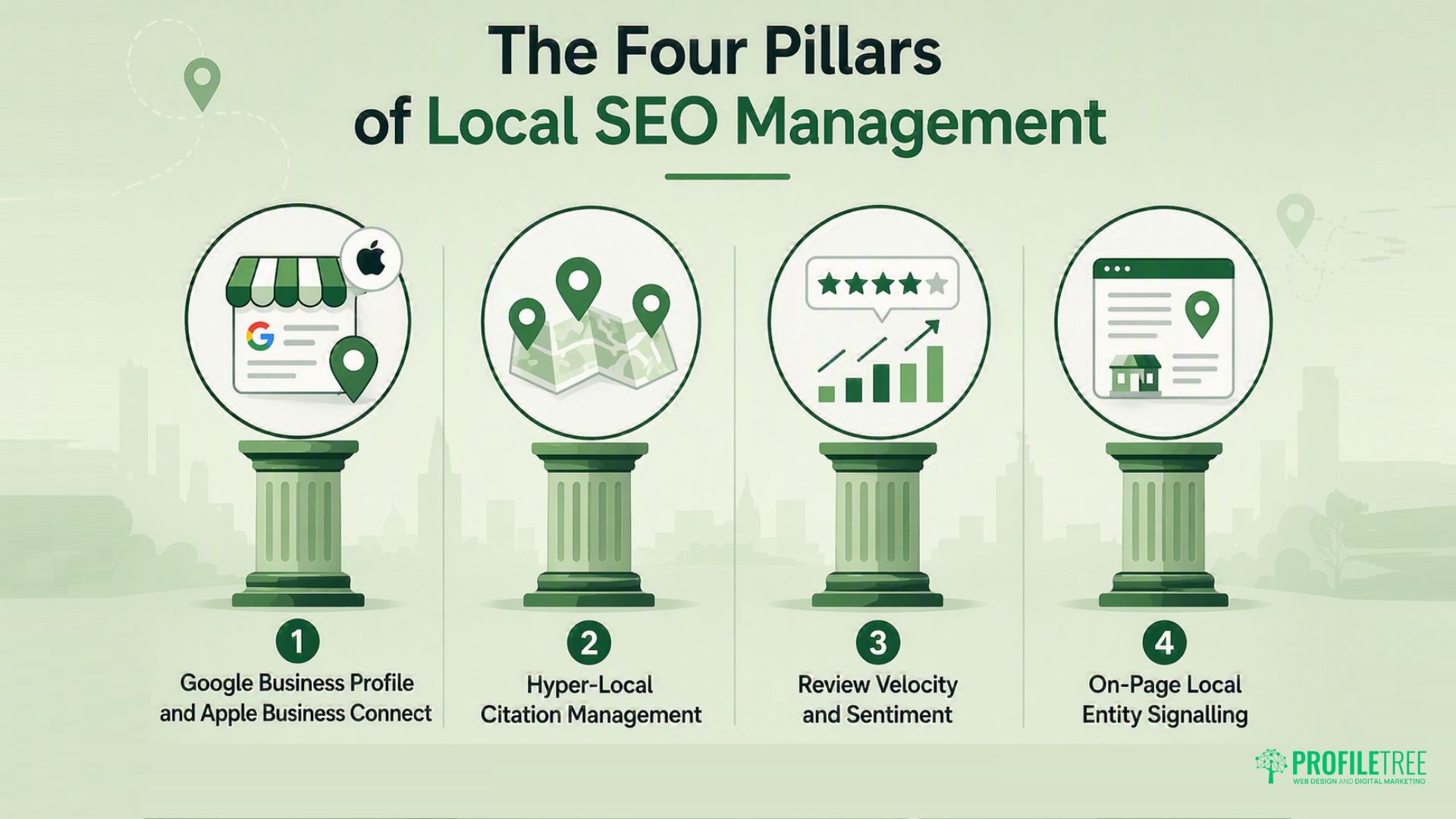
Effective local search management rests on four areas you work on continuously. Get these right, and the rest follows. Neglect any one and visibility suffers, regardless of how well the others perform.
Google Business Profile and Apple Business Connect
Your Google Business Profile is the single most influential local asset you own. Complete every field, choose accurate primary and secondary categories, and post weekly updates with fresh photos. Businesses that treat the profile as a live channel consistently outperform those that set it and forget it.
Apple Business Connect now deserves the same care, since Apple Maps and Siri pull from it directly. For a deeper view of the numbers behind profile performance, this set of business profile statistics breaks down what drives engagement.
Use the profile features that most businesses ignore: the products and services sections, the Q&A area, and booking links where relevant. Each filled field adds another structured detail that both the map pack and AI assistants can read. Add new photos weekly, because Google reads recency as a sign the business is active and attended to.
Hyper-Local Citation Management
Citations are mentions of your name, address and phone number across the web. Search engines use them to verify that your business is real and operating where you claim. Inconsistent details undermine that trust quickly.
Focus on authoritative general directories alongside niche and regional platforms. This guide to free listing sites covers the UK and Ireland directories worth claiming first, including Yell and Thomson Local.
Audit citations quarterly. Phone numbers change, businesses move, and old listings linger with stale details that quietly contradict your current information. A short spreadsheet tracking every platform, the exact name, address and phone format used, and the date last checked keeps the work manageable rather than overwhelming.
Review Velocity and Sentiment
Reviews now influence both rankings and the AI answers above them. What matters is not only the star rating but the steady flow of recent reviews, known as review velocity, and how you respond to them. Reply to every review, positive or negative, within 48 hours.
A consistent pattern of fresh, well-handled reviews signals an active, trusted business. That signal carries weight far beyond a static average score, and it feeds the sentiment analysis AI systems now run.
On-Page Local Entity Signalling
Your website must reinforce the same entity story your profile tells. Use LocalBusiness schema, keep your name, address and phone number visible on every page, and write genuinely localised content rather than templated city swaps. A well-built website gives these signals a stable home, which is where solid website design services earn their value.
The Hidden Challenge of Service-Area Businesses
Plumbers, electricians, locksmiths and mobile traders face a problem most guides ignore. They serve a city but have no shopfront to verify, and Google’s 2026 verification rules are stricter than ever.
Ranking Without a Physical Office
Service-area businesses can rank, but they must hide their address, define accurate service areas, and lean harder on reviews and area-specific content. Video verification is now common, where Google asks for a recorded walkthrough proving the business operates as described.
The businesses that win here build dedicated, genuinely useful pages for each area they cover, rather than thin duplicates. Pairing that with video marketing content can also satisfy verification and engagement at once.
Area Pages That Actually Help
An area page only works if it tells a local reader something real: which neighbourhoods you cover, typical jobs in that patch, and local conditions that affect the service. Swapping a town name into a template page is the fastest way to get filtered out in 2026.
Strong area pages include genuine specifics: nearby landmarks, the kinds of properties common in that area, response times you can realistically offer, and a short note on local conditions that shape the work. That detail is hard for a competitor to copy and easy for a search engine to trust.
Building Trust Without a Storefront
Trust signals replace the missing shopfront. Verified reviews, a clear about page, consistent citations and visible credentials all tell both Google and a wary customer that you are legitimate. The more of these you stack, the easier verification and ranking become.
Regional Nuance Across the UK and Ireland
Ranking difficulty is not uniform. The same effort produces very different timelines depending on where you compete, and most generic UK guides overlook the markets closest to home for many readers.
London Versus Belfast Versus Dublin
London is brutally competitive, often demanding six months or more to crack the three-pack in saturated sectors. Belfast and Derry are far less contested, where a well-managed profile can reach the map pack in a matter of weeks. Dublin sits between the two.
This matters for expectation setting. A business in a quieter regional market that benchmarks itself against London timelines will wrongly assume its work is failing when it is simply ahead of schedule.
The Irish and Northern Irish Landscape
Search behaviour and directory ecosystems differ across the island. Claiming listings on Irish-specific platforms and referencing genuine local detail builds relevance that a London-centric strategy misses entirely. This breakdown of marketing across Ireland goes deeper into this point.
Setting Realistic Timelines
Across most UK and Irish markets, expect early movement within four to eight weeks and a meaningful three-pack presence within three to six months. AI-driven discovery can accelerate this for businesses with strong, structured data, but it rewards patience and consistency over quick fixes.
The table below sets rough expectations by market competitiveness. Treat it as a planning guide, since difficulty within a city varies enormously by sector.
| Market | Competition | Typical time to three-pack |
|---|---|---|
| London | High | Six months or more in saturated sectors |
| Dublin | Medium to high | Four to six months |
| Manchester / Birmingham | Medium | Three to five months |
| Belfast | Low to medium | Six to twelve weeks |
| Derry / regional towns | Low | Often within weeks |
Optimising for AI Local Answers
The biggest gap in most local search guides is how to earn a mention inside an AI answer, not just a map listing. This is where businesses can pull ahead in 2026, because few competitors have adapted to it yet.
Structured Data That Machines Can Read
AI assistants assemble local answers from data they can parse with confidence. LocalBusiness schema is the foundation: it states your name, address, phone, opening hours, service area and price range in a format built for machines. Add it to your key pages and keep it matched to the visible text, since mismatches between schema and on-page content erode trust rather than build it.
Layer in review and FAQ schema where appropriate. A page that answers the specific questions local customers ask, marked up so an assistant can extract each answer cleanly, stands a far better chance of being quoted in an AI response. Solid website development work makes this reliable rather than patchy.
Becoming a Recognised Local Entity
AI systems weigh businesses they recognise as established entities. Mentions in local news, consistent profiles across reputable platforms, and a clear, factual about page all build that recognition. The goal is for an assistant to treat your business as a known, verifiable answer rather than an unknown name it cannot confirm.
This is slow, cumulative work. A single press mention will not tip the balance, but a steady accumulation of consistent, credible references across the web gradually establishes the kind of authority these systems reward.
Answer-First Content for Extraction
Write the way assistants like to read. Lead each section with a direct, self-contained answer of roughly forty to sixty words, then expand with detail. A reader skimming gets what they need quickly, and an AI system can lift a clean, complete answer without stitching fragments together. Pages that cover several related local questions in this format tend to get cited more often than those built around a single keyword.
The shift is worth internalising. Optimising purely for ten blue links leaves traffic on the table when a growing share of local queries are answered before a single result is clicked. Building for extraction protects visibility as that share keeps climbing, and it costs little more than writing clearly and properly marking up content.
Build Versus Buy, and a 30-Day Roadmap
Once the strategy is clear, the question becomes how to run it: in-house with software, with a freelancer, or through a managed agency. Each suits a different stage of business, and the roadmap that follows works whichever route you choose.
Software, Freelancer or Agency
Automated tools are cheap and fast but blunt, and over-reliance on bulk citation automation now risks tripping Google’s quality filters. Freelancers add judgment at a moderate cost. A managed service brings strategy, accountability and time savings, which suits businesses without internal marketing capacity. If outsourcing appeals, a clear digital strategy plan should come before any tool purchase.
The comparison below weighs the three routes on the factors that usually decide the choice.
| Approach | Cost | Time demand on you | Best for |
|---|---|---|---|
| Automated software | Low monthly fee | High, you run it | Hands-on owners, single location |
| Freelancer | Moderate | Medium | Growing businesses need judgment |
| Managed agency | Higher | Low | Multi-location or time-poor teams |
All prices and figures in this guide are indicative UK examples and correct at the time of writing; use them as a benchmark rather than fixed quotations.
The 30-Day Management Roadmap
Week one: audit and complete your Google Business Profile, fix every citation inconsistency, and add LocalBusiness schema. Week two: launch a review request process and respond to all existing reviews. Week three: publish or rewrite the area and service pages with real local detail. Week four: measure, then set the weekly cadence you will repeat indefinitely.
This cycle is not a one-time campaign. The fourth week simply becomes the template for every month that follows, with audits and content refreshed on a rolling basis.
The discipline is in the repetition. A profile post each week, a fresh photo, a handful of review requests after completed jobs, and one updated page a month compound quietly. Most competitors will not keep this up, which is precisely why it works.
Measuring What Matters
Track profile views and actions, local keyword positions, review velocity, citation accuracy, and conversions such as calls and direction requests. Reading this data correctly is its own skill, and this guide to Search Console shows how to turn the numbers into decisions.
Conclusion
Local search in 2026 rewards businesses that manage it as a continuous process rather than a single setup. Focus on the four pillars, address service-area verification head-on, respect regional differences, and run the monthly cycle without fail. Done consistently, this framework turns high-intent local searchers into paying customers and protects your visibility as search behaviour and AI-driven discovery keep reshaping how people find businesses near them.
Ready to grow your local visibility? Speak to the ProfileTree team about a local search plan built for your market.
FAQs
How much does local SEO management cost in the UK?
Costs vary widely by market and scope. A single-location small business typically sees monthly management in the lower hundreds of pounds, mid-sized businesses in the mid-hundreds, and multi-location operations considerably more. The figure depends on competition, the number of locations, and whether content and link work are included. Treat any quoted range as an indicative benchmark rather than a fixed price, since a competitive city market demands more work than a quiet regional one.
Can I manage my own local SEO for free?
Yes. The core tools, chiefly Google Business Profile, cost nothing, and a determined owner can claim citations and gather reviews unaided. The real cost is time and consistency. Most owners start well, then let the work slide once daily operations take over, which is where visibility erodes.
How long does it take to see results in the three-pack?
In most UK and Irish markets, expect early movement within four to eight weeks and a meaningful three-pack presence within three to six months. Competitive cities like London take longer; quieter markets such as Belfast or Derry can move faster. Strong, structured data and steady reviews can speed AI-driven discovery, but there is no genuine overnight route.
Do I need a physical office to rank in a specific city?
No. Service-area businesses can rank without a shopfront by hiding their address, defining accurate service areas, and building area-specific pages and reviews. Google’s 2026 verification, often by video walkthrough, is stricter, so accurate information and genuine trust signals matter more than ever for non-office-based businesses.
What is the most important local ranking factor now?
Entity authority and review velocity now lead. Consistent, structured information about who you are and where you operate, paired with a steady flow of recent, well-handled reviews, outweighs older tactics. Naming consistency has quietly become more decisive than raw keyword repetition.