
E-commerce SEO Services for UK and Irish Online Stores
Table of Contents
Most online retailers do not have a traffic problem. They have a visibility problem hiding inside thousands of product pages that search engines either cannot reach or do not trust. The fix is rarely a single tactic. It is a set of decisions about architecture, content and authority that compound over months.
This page sets out what e-commerce SEO services actually cover, what UK retailers should expect to pay, and how the work plays out across platforms like Shopify, WooCommerce and Adobe Commerce.
You will find a clear breakdown of the core pillars, the platform-specific traps that cost stores revenue, and a realistic view of timelines and returns. Read it as a buyer’s guide, not a sales pitch.
Why E-commerce SEO Works Differently from Standard SEO
A brochure site has perhaps twenty pages. An online store can have fifty thousand, most generated automatically, many near-identical, and almost all competing with each other for the same terms. That scale changes every decision an SEO team makes, from how a site is crawled to how a single product description is written.
For UK and Irish retailers, a second layer sits on top: currency display, shipping logic across Great Britain and the island of Ireland, and data rules that affect how performance is even measured. These are not footnotes. They decide whether a store ranks in the right market at all.
The Difference Between SEO and E-commerce SEO
Standard SEO optimises a fixed set of pages around a content goal. E-commerce SEO manages a constantly changing catalogue around a revenue goal, where products appear and disappear, prices shift, and stock levels change daily. The discipline is closer to inventory management than to blogging.
That difference shows up most in search engine optimisation for category pages, which carry most of the commercial intent yet are the pages retailers most often neglect.
Product pages get the attention because they feel like the point of sale. In reality, a shopper searching “men’s waterproof jackets” lands on a category, not a single product, so the category is where the ranking battle is won or lost.
Where Online Stores Lose Search Visibility
Three failures account for most lost rankings: duplicate or thin product copy lifted from manufacturers, category pages with no supporting content, and faceted navigation that spawns thousands of crawlable variants. Each one quietly drains the crawl budget and dilutes relevance.
None of these is visible from the shop front. They surface only in a technical audit, which is where any serious engagement should begin.
The UK and Ireland Context
Selling across the UK and the Republic of Ireland means handling two currencies, two tax regimes and, since the Windsor Framework settled Northern Ireland’s trading position, distinct shipping and display logic for NI customers. A store that ignores this either shows the wrong prices or ranks in the wrong country.
Retailers weighing the wider regional picture can read this overview of e-commerce in Ireland for the market backdrop these technical choices sit within.
The Core Pillars of E-commerce SEO Services
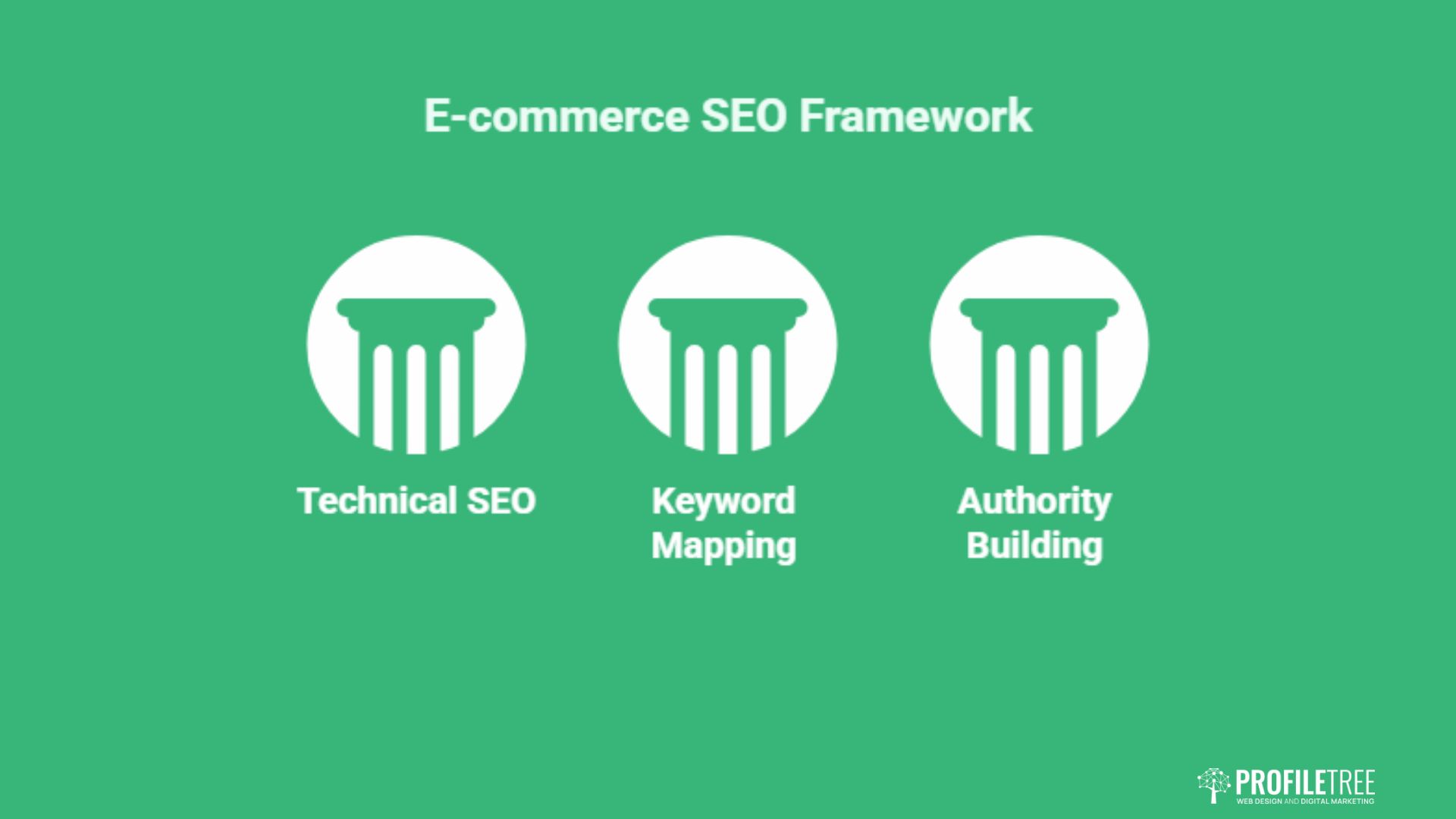
Every credible e-commerce SEO programme rests on three pillars: technical health, search-mapped content, and earned authority. Skip one, and the other two underperform. A fast, well-structured store with weak content still loses to a slower competitor that answers buyer questions properly.
The sections below cover what each pillar involves in practice, with the catalogue scale of a real store in mind rather than a tidy ten-page demo.
Technical SEO for Large Catalogues
On a SKU-heavy site, technical work centres on crawl budget and duplication. The goal is to make sure search engines spend their limited crawl on pages that can rank, not on filtered URL variants that should never have been indexed in the first place.
Faceted navigation is the usual culprit. Filters for size, colour and price can generate tens of thousands of URLs from a single category, each a near-duplicate. Canonical tags, parameter handling and selective noindexing bring that back under control. Site speed and Core Web Vitals sit alongside this, since slow product pages suppress both rankings and conversions.
Internal linking matters just as much at scale. A flat structure, where every product sits one click from the homepage, confuses search engines about which pages are most important. A clear hierarchy of homepage, category, sub-category and product tells crawlers exactly where the commercial value sits.
Mapping Keywords to Categories and Products
Search intent splits cleanly in e-commerce. Category pages serve broad commercial terms (“women’s running shoes”), while product pages serve specific, lower-volume queries (“Brooks Ghost 16 size 8”). Mapping the wrong intent to the wrong page is one of the most common and most expensive mistakes a store makes.
Done well, this mapping shapes the whole site structure. It also feeds directly into content marketing services that build supporting guides around high-value categories.
The pattern repeats across the catalogue. Brand pages, seasonal collections and use-case landing pages each target a distinct slice of demand, and a clear map stops them from competing with one another. Without it, three pages chase the same term, and none of them rank, a problem known as keyword cannibalisation.
Building Authority for Online Retailers
Product and category pages rarely earn links on their own. Authority comes from assets worth citing: original buying guides, data studies, and digital PR that place the brand in trade and consumer press. The aim is a small number of relevant, high-quality links rather than volume.
Cheap, high-volume link building remains the fastest route to a manual penalty. A brand-led approach costs more per link and protects the store far better over time.
Trade publications, supplier features and genuinely useful tools tend to earn the strongest links. A single citation from a respected industry title carries more weight than dozens of low-quality directory entries, and it rarely puts the site at risk.
Original data is the most reliable hook. A retailer that publishes its own findings, say, seasonal buying patterns from its order data, gives journalists a reason to link that a product page never will. The asset does the outreach work, rather than the outreach chasing links that do not want to be given.
Platform-Specific SEO Challenges
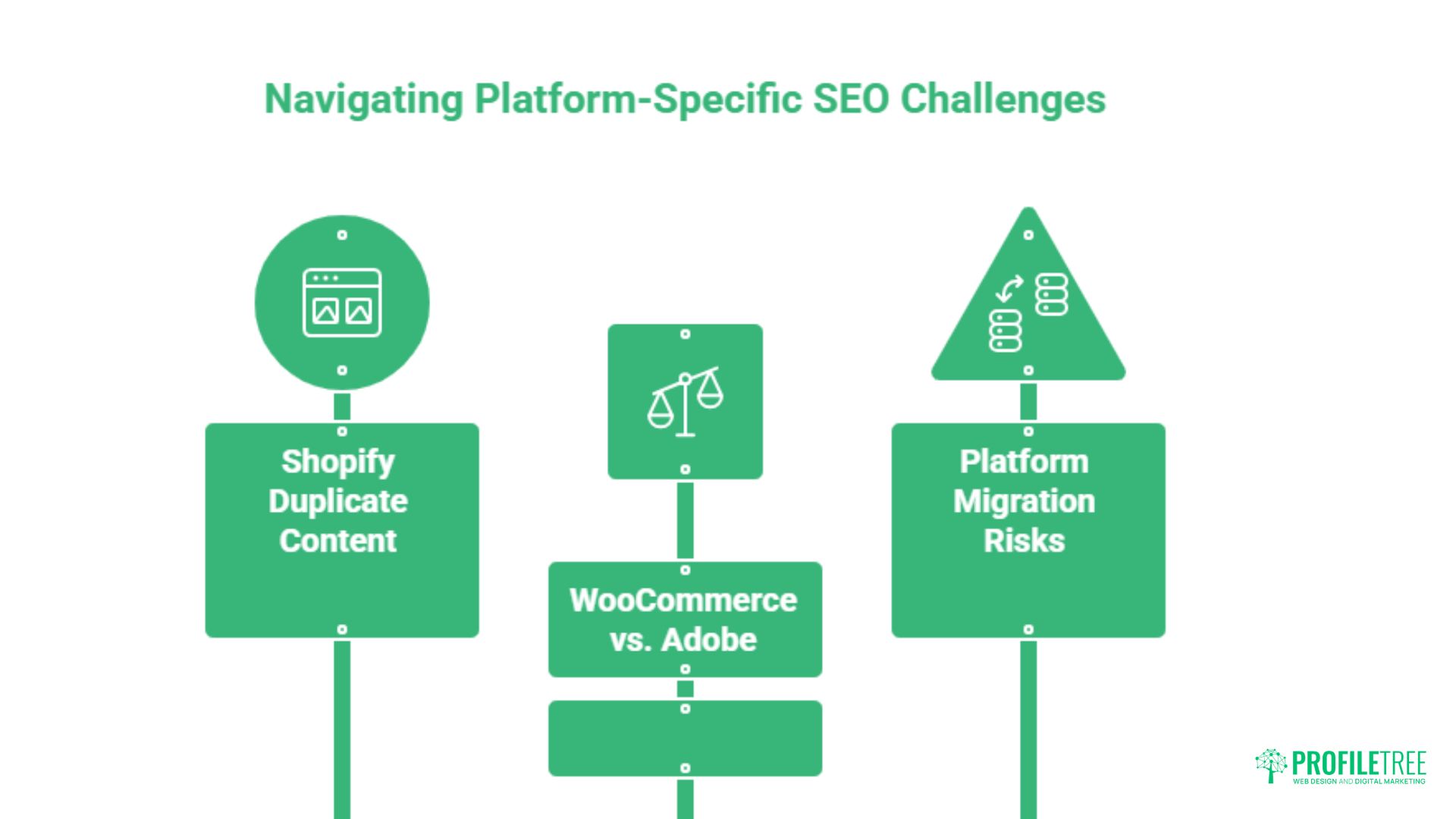
The platform a store runs on sets the boundaries of what its SEO team can do. Shopify, WooCommerce and Adobe Commerce each handle URLs, duplication and technical access differently, and a fix that works on one can be impossible on another.
Knowing these limits before quoting work is part of what separates a specialist from a generalist. The sections below cover the three platforms UK retailers ask about most.
The Shopify Duplicate Content Problem
Shopify automatically creates two URLs for many products: one under the collection path and one under the canonical product path. Left unmanaged, this splits ranking signals across duplicate pages. The fix is to confirm that canonical tags point to the single product URL and to keep internal links consistent with that canonical.
It is a small change with a large effect, and it is one of the first things any audit of a Shopify store should check.
The same principle extends to Shopify’s tag and vendor pages, which can generate thin, near-empty listings that compete with stronger collection pages. Pruning or noindexing these keeps ranking signals concentrated where they belong.
WooCommerce and Adobe Commerce Trade-offs
WooCommerce offers near-total control through WordPress, which suits retailers who want to shape every technical detail and have the resources to maintain it. Adobe Commerce (formerly Magento) handles very large catalogues and complex pricing well, but demands genuine developer support to keep it fast and crawlable.
Neither is universally better. The right choice depends on catalogue size, internal skills and budget, which is a question worth settling before any rebuild rather than after.
De-risking a Platform Migration
Moving platforms is the single fastest way to undo years of ranking equity. URL changes without redirects, lost metadata and altered site structure can erase organic revenue overnight. SEO has to be involved before the rebuild starts, not called in once traffic has already dropped.
ProfileTree’s guidance on website migration walks through the redirect mapping and pre-launch checks that protect rankings through a move.
Optimising for AI Search and the UK Market
Two shifts now sit on top of traditional e-commerce SEO: the rise of AI-driven answers in Google, ChatGPT and Perplexity, and the regional demands of selling across the UK and Ireland. Competitors largely ignore both, which is exactly why they matter.
The sections below cover how to structure product data for AI citation and how to handle the currency, shipping and measurement realities of a UK and Irish store.
Structuring Product Data for AI Overviews
AI systems pull from structured, self-contained content. Clean Schema.org product markup, clear specifications and concise answer-style copy give a store a far better chance of being cited in an AI answer than a wall of marketing prose. The work overlaps heavily with good technical SEO, so much of it pays double.
This connects directly to how AI is reshaping buyer behaviour, a theme covered in this article on AI conversion rates.
Currency, Shipping and the Windsor Framework
A store serving Belfast, Dublin and London needs to show the right currency, apply the right tax, and reflect shipping rules that differ for Northern Ireland under the Windsor Framework. Search engines should see clean signals for each market, usually through hreflang and consistent regional URLs.
Get this wrong and a Dublin shopper sees sterling prices, or a Google result points an Irish buyer at a UK-only checkout. Both quietly cost sales.
The cleanest approach is usually to separate, clearly signposted pages or domains for each market, with hreflang tags telling search engines which version to show where. Trying to serve every region from a single ambiguous page tends to leave the store ranking strongly in none of them.
Measuring Organic Performance Under GDPR
UK and EU consent rules, including Consent Mode, mean analytics platforms now model a share of organic data rather than recording all of it. Honest reporting acknowledges this gap instead of presenting modelled figures as exact. Retailers should expect their agency to be transparent about what is measured and what is estimated.
Sound measurement underpins any sensible digital strategy, since decisions built on misread data tend to compound the original error.
Costs, Returns and Choosing an Agency
Buyers want two honest answers that most agencies dodge: what does this cost, and what does it return? This section gives indicative UK benchmarks, a realistic timeline, and the warning signs worth watching for when comparing providers.
All prices and figures in this guide are indicative UK examples and correct at the time of writing; use them as a benchmark rather than fixed quotations.
What E-commerce SEO Services Cost in the UK
Managed e-commerce SEO in the UK typically runs from around £1,500 to £10,000 per month, driven by catalogue size, competition and how much technical and content work the store needs. A small Shopify store sits at the lower end; an enterprise Adobe Commerce catalogue sits well above it.
Beware fixed-price packages that promise specific rankings. Search outcomes cannot be guaranteed, and any provider claiming otherwise is selling on a false premise.
It also helps to understand what sits inside a monthly retainer. A credible scope usually covers technical monitoring, a set number of optimised categories or product pages, ongoing content, link acquisition and clear reporting. If a quote is vague about deliverables, that vagueness tends to show up later as work that never quite happens.
Timelines and Return on Investment
Technical fixes often show within three to six months. Content and authority gains usually take six to twelve months to mature, then keep compounding. Compared with paid search, where traffic stops the moment spend stops, organic visibility behaves like an asset that holds its value.
That contrast, immediate cost-per-click against long-term organic equity, is the real case for treating SEO as an investment rather than an expense. ProfileTree, a Belfast-based digital agency, frames every engagement around that distinction.
Red Flags When Choosing a Provider
Watch for guaranteed rankings, vague methodology, pricing based purely on content volume, and heavy reliance on automation with no human review. Each point leads to an approach that tends to age badly once an algorithm update lands.
Strong providers explain their reasoning, report against revenue rather than vanity metrics, and back their work with credentials. For teams that want to build skills in-house alongside an agency, digital training can close the knowledge gap.
How ProfileTree Approaches E-commerce SEO
ProfileTree, the Belfast digital agency, works with retailers across Northern Ireland, Ireland and the UK, combining technical SEO, content and digital PR around the regional realities most agencies overlook. The starting point is always an audit, never an assumption.
Ciaran Connolly, founder of ProfileTree, puts it plainly: “A store ranking at position seventy is invisible. The job is not to nudge it up two places. It is to fix the architecture, answer real buyer questions, and earn the authority that moves a page onto the first screen where customers actually look.”
Retailers can compare options across cities and regions in this guide to the top cities to visit in Northern Ireland, which provides useful context for stores building local relevance across the region.
Conclusion
E-commerce SEO is less about chasing rankings and more about building a store search engines can read, trust and recommend. Technical health, search-mapped content and earned authority do the heavy lifting, while platform choice and UK market specifics decide whether the work lands in the right place. Treat it as a long-term asset, hold providers to honest measurement, and start every engagement with an audit rather than a promise.
Ready to find out why your product pages are not ranking? Talk to the ProfileTree team.
FAQs
How much do e-commerce SEO services cost in the UK?
Managed e-commerce SEO in the UK generally ranges from around £1,500 to £10,000 per month. The figure depends on catalogue size, how competitive the market is, and the balance of technical and content work required. A small Shopify store with a few hundred products sits at the lower end, while a large Adobe Commerce catalogue with complex pricing and multi-market needs sits considerably higher. Treat any fixed-price package promising specific rankings with caution.
How long does it take to see sales growth from SEO?
Technical wins often appear within three to six months as crawl issues and duplication are resolved. Content and authority gains usually take six to twelve months to mature, then continue compounding well beyond that.
Can you do SEO for a site with 50,000 or more products?
Yes. Large catalogues are managed through crawl budget control and category-level structure rather than optimising each product by hand. The focus shifts to silos, faceted navigation handling and template-level improvements that scale across thousands of pages at once.
Is Shopify or Magento better for SEO?
Both can rank well. Shopify is easier to run and handles most SEO needs out of the box, though it limits deep technical control and creates duplicate URLs that need managing. Adobe Commerce (Magento) offers far greater control and suits very large catalogues, but needs developer support to stay fast and crawlable. The right choice depends on catalogue size, internal skills and budget.
Does SEO work for international stores selling in the UK?
Yes. International stores use hreflang tags and, where appropriate, country-specific domains to signal which market each page serves, so UK shoppers see UK pricing and currency in search results.