
How to Get Your Business Read Out by Voice Search
Table of Contents
Voice search SEO is the practice of structuring website content so it gets picked up as the spoken answer when someone asks Google Assistant, Siri, Alexa, or an AI voice interface a question. ProfileTree, a Belfast-based web design and digital marketing agency, has watched this shift accelerate over the past two years, and the businesses winning voice visibility now are rarely the ones with the biggest budgets. They’re the ones that write clear answers to real questions and structure their pages so search engines can lift those answers cleanly.
Voice search SEO doesn’t sit apart from the rest of a site’s SEO work, either. It’s an extension of the same technical and content foundations that any solid SEO services engagement should already be covering, not a separate checklist bolted on afterwards.
Unlike typed search, where ten results compete for a click, voice search returns one answer. Either your business is that answer, or it isn’t in the conversation at all. For SMEs across Northern Ireland, Ireland, and the UK, that’s both a challenge and a genuine opening, because most local competitors still aren’t approaching voice search SEO with any real system.
This guide covers what voice search SEO actually involves, how it differs from typed SEO, the strategies that produce results, and where voice search now overlaps with AI-driven answer engines.
What Is Voice Search SEO?
Voice search SEO is the process of writing and structuring web content so that a voice assistant, or an AI system generating a spoken answer, can extract it directly. When someone types a query, they scan a list and choose a link. When they ask the same question aloud, one result gets read out. There’s no second place, no page two, and no browsing.
The Three Types of Voice Search Queries
Voice queries fall broadly into three categories, and understanding which one you’re targeting shapes how you write.
- Discovery searches carry local intent: “coffee shop near me,” “web designer in Derry,” “who does SEO in Belfast.” These rely on your Google Business Profile and local SEO signals rather than blog content.
- Informational searches are question-based: “how does SEO work,” “what is structured data,” “how long does a website redesign take.” This type rewards content that gives a direct, plain-language answer early.
- Transactional searches show intent to act: “book a consultation with a digital agency” or “get a quote for web design in Northern Ireland.” These need clear contact information and a fast, mobile-friendly site behind them.
Most pages targeting voice search try to cover all three at once and end up serving none of them well. Pick the category that matches the page’s actual purpose, then write for it deliberately.
From Smart Speakers to Conversational AI
A lot of voice SEO advice still describes the technology as it worked five years ago, when Alexa and Google Home were the whole story. That’s no longer accurate. ChatGPT’s voice mode, Gemini Live, and similar tools don’t search the web the way a smart speaker does. They generate answers from a language model, supplemented by live retrieval, which means the question a user asks doesn’t trigger a keyword match at all; it starts a conversation with a system that draws on everything it knows about relevant businesses and services.
Ciaran Connolly, founder of ProfileTree, puts it plainly: “We’re moving from optimising for ten blue links to optimising for a single spoken answer, and now to making sure an AI model has your business in its knowledge base. These are three different challenges that all have to be solved simultaneously.”
This is increasingly referred to as Answer Engine Optimisation (AEO), and it sits alongside classic voice search SEO rather than replacing it. The structural work is the same either way: clear entity signals, direct answers, and content built so a machine can lift a section out and use it as a standalone.
Voice Search vs Traditional SEO: The Key Differences
Most guides treat voice search as a minor variation on standard SEO. It isn’t. Voice queries carry different intent signals, and three differences matter most in practice: phrasing, local intent, and answer format.
Query Length and Conversational Phrasing
A typed search tends to be short and fragmented. Someone wanting to know if their page loads fast enough might type “page speed score.” The same person asking a voice assistant might say, “what’s a good page speed score for a small business website?”
That shift changes which keywords deserve your attention. Voice queries tend to run longer and more conversational than typed searches, leaning on words like “how,” “what,” “where,” “near me,” and “which.” The table below sets typed and spoken versions of the same intent side by side.
| Typed Query | Voice Query | Intent Category |
| SEO agency Belfast | Which SEO agency should I use in Belfast? | Discovery |
| What is voice SEO | How does voice search SEO work? | Informational |
| Website design cost NI | How much does a website cost in Northern Ireland? | Transactional |
| Digital marketing agency near me | Is there a digital marketing agency near me open now? | Discovery/Local |
If your content only exists in the fragment version, it will struggle for the voice version of the same query. FAQ headings, subheadings, and intro paragraphs should be written as full questions and direct answers, not keyword-stuffed labels.
Local and Proximity Intent
A large share of voice searches carries local intent. Someone searching hands-free in the car or through a smart speaker is often looking for something nearby, and “near me” queries skew heavily toward voice rather than typed search.
If your Google Business Profile is incomplete or your site lacks clear location signals, voice assistants won’t surface you for local queries, no matter how well the content is written. Local SEO and voice search optimisation aren’t separate disciplines; they’re the same work seen from different angles.
The Single-Answer Format
Text results allow lists, paragraphs, tables, and images, but voice results demand a single, speakable paragraph. Your content needs concise answer blocks that reach the point in one or two sentences before adding supporting detail, an approach usually called BLUF (Bottom Line Up Front).
This also matters because screenless devices read out exactly one winner. There’s no scrolling past a weak result to find a better one, which means the click-through-rate models built around ten blue links simply don’t apply here.
The Voice Assistants Shaping Search
Each voice platform pulls its answers from a different source, so knowing which assistant your audience actually uses helps determine where to focus.
Google Assistant and Siri
Google Assistant draws its answers from Google Search, so every factor that improves your Google rankings, including page speed, structured data, and Business Profile completeness, improves your voice visibility too. The UK smartphone market itself is close to an even split between the two major platforms: mid-2026 market-share data (StatCounter) puts iOS narrowly ahead at just over half of UK mobile devices (53.93%), with Android close behind (46.06%). That means a voice strategy built around only one assistant leaves a meaningful share of the market uncovered.
Siri handles the Apple device range and switched its default search engine to Google some years ago. So the same ranking factors largely apply, with Apple Maps mattering alongside your Business Profile for local queries.
Alexa and Cortana
Amazon Alexa works differently. Rather than searching the open web, it prioritises Amazon’s own product data and approved skills. So for businesses selling through Amazon, product listing optimisation carries more weight than website SEO.
Microsoft Cortana searches through Bing rather than Google, which is worth noting if a meaningful share of your audience works in Windows-heavy environments.
AI-native Voice Interfaces
Layered on top of all of this now are the AI-native voice interfaces: ChatGPT Voice Mode and Gemini Live. They draw from retrieval-augmented generation rather than a fixed index and reward the same entity-rich, well-structured content that wins classic voice results.
Voice Search SEO Strategies That Actually Work
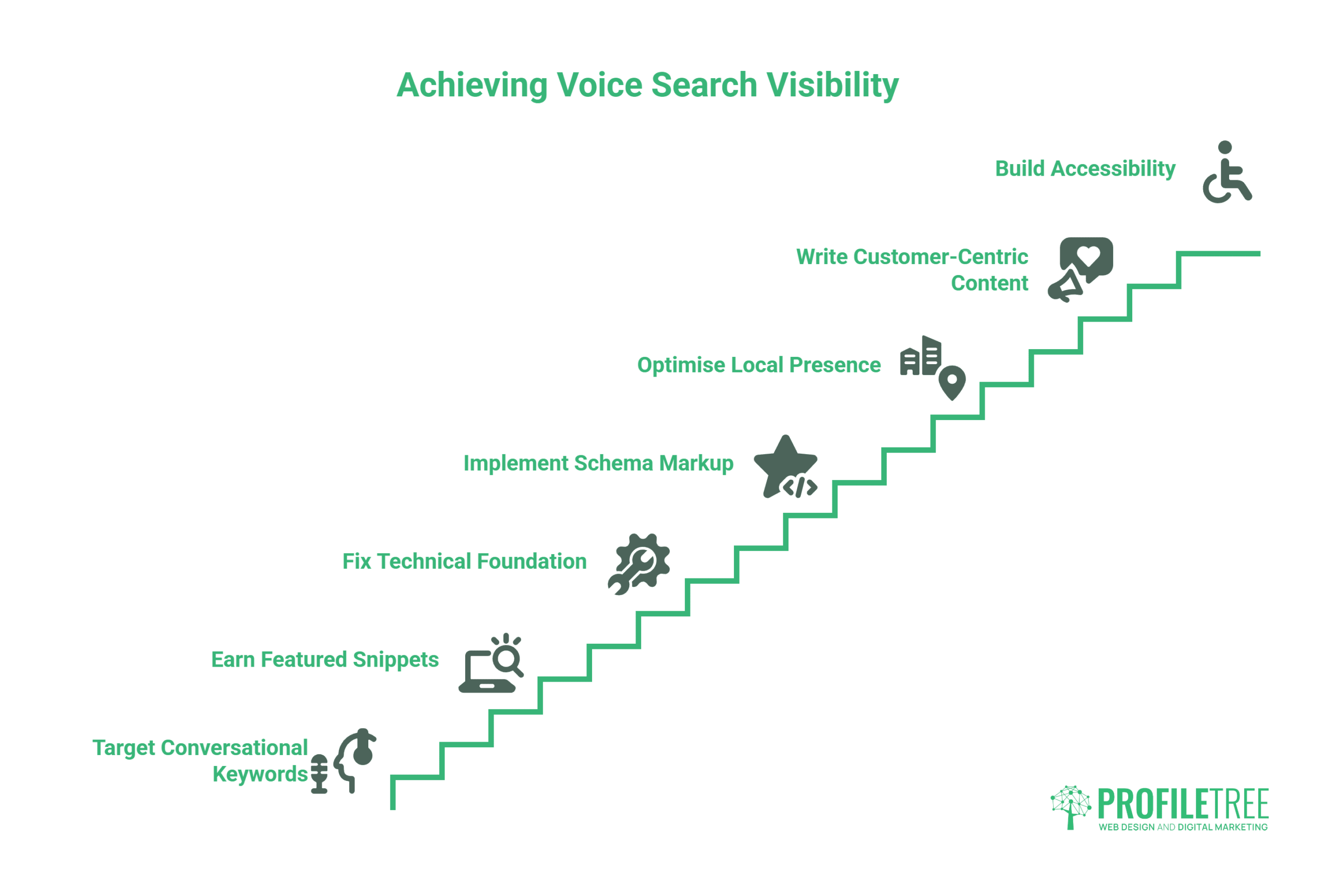
The strategies below are ordered roughly by impact. None require specialist tools or large budgets; they require deliberate structure and content that answers real questions clearly.
Target Conversational, Question-Based Keywords
Shifting from short fragments to natural-language questions is the single most useful change you can make to your keyword strategy for voice search. “How much does a new website cost for a small business in Belfast?” is a stronger target than “website cost Belfast” because it matches how people speak.
Google Search Console is one of the most useful free tools here. Filtering your queries report for terms of seven words or more, or for queries starting with “who,” “what,” “where,” “when,” “why,” and “how,” gives a workable proxy for conversational intent, since Search Console doesn’t separate voice queries from typed ones directly.
A regular expression such as ^(who|what|where|when|why|how)\s pasted into the query filter will isolate most of them in one pass. SEMrush’s Keyword Magic Tool (filtered by “Questions”) and Google’s own People Also Ask boxes are worth checking too, using the UK version of PAA rather than US data.
Write Content That Earns Featured Snippets
Featured snippets are the primary gateway to voice search visibility on Google and Siri. When a voice assistant reads an answer aloud, it draws almost exclusively from the snippet position for that query, so winning the snippet means winning the voice result. ProfileTree’s content marketing team builds this structure into every major article and service page as a standard practice, connecting directly to the SEO services we provide for clients who want to compete for these positions.
Structure your content around direct question-and-answer pairs. Every heading phrased as a question should be followed immediately by a concise answer, before any supporting detail, so Google can extract it cleanly. Definition snippets, numbered step lists, and comparison tables all appear regularly in voice results, and answer length matters here too. ProfileTree’s guide to content length and search ranking covers how word count interacts with snippet eligibility in more depth.
Fix the Technical Foundation First
Voice search is almost entirely mobile and hands-free. A slow or unstable site won’t be used as a voice source, regardless of how well-written the content is. Core Web Vitals in the green, a page load time under 2.5 seconds on mobile, HTTPS throughout, and a properly responsive design are the minimum technical requirements. A practical starting point is Google’s PageSpeed Insights, which flags specific fixes alongside a score; the most common quick win for UK SMEs is switching images to WebP format at responsive sizes rather than full desktop resolution.
Accelerated Mobile Pages (AMP) is worth a mention here, too. It strips a page down to a lightweight format that loads almost instantly. It still has a place for editorial content such as guides and blog posts, though it makes far less sense for commercial service pages with forms and calculators. If you publish a high volume of informational content, it’s worth evaluating as one piece of a wider mobile performance strategy, rather than treating it as a fix on its own.
Implement Schema Markup
Structured data tells search engines precisely what a page contains, and it meaningfully improves your odds of appearing in rich results and voice answers. FAQPage, LocalBusiness, and Article are the schema types that matter most for voice search rankings. FAQPage marks up your question-and-answer pairs so Google can lift them out cleanly; LocalBusiness confirms your name, address, phone number, and hours in a format voice assistants can use directly for local queries.
Schema markup isn’t only for bots, either. It’s effectively the structured script that lets an AI system read a business’s key details back to a potential customer, which is exactly why FAQPage and LocalBusiness carry so much practical weight for voice visibility.
Google also supports a Speakable property that marks sections of content as suitable for text-to-speech. It’s currently restricted to licensed news publishers, so most SME sites won’t be able to use it yet. However, the FAQPage and LocalBusiness schemas are open to everyone and carry real voice-search weight. For WordPress sites, Rank Math and Yoast both generate FAQPage schema without manual JSON-LD.
Optimise Your Google Business Profile and Local Pages
For any business serving local customers, the Google Business Profile is the single strongest lever for voice search rankings. When someone asks “who does web design near me,” Google draws the answer primarily from Business Profile data rather than website content. Keep your name, address, phone number, opening hours, services, and category accurate and complete, respond to reviews, and keep your NAP data identical across your site, your profile, and directories such as Yell, Bing Places, and Apple Maps.
City-level pages only capture part of this. A page built for “web design Belfast” misses the voice query “web designer who works with small businesses in Antrim,” because standard city pages rarely carry that level of specificity. Building genuinely differentiated pages for the towns and areas where you actually work, not just the main city, is one of the more overlooked ways to increase local voice coverage. For a Belfast-based agency, that means content that names Lisburn, Newtownabbey, and Bangor specifically, with real local detail rather than the same service page with a place name swapped in.
Write How Your Customers Actually Speak
This is where UK and Irish businesses hold a real advantage over global content written for a US audience. Voice recognition has improved considerably at handling regional accents, including Northern Irish, Scottish, and Irish English syntax, and the way someone in Belfast phrases a query differs from how someone in Chicago would phrase the same one.
In practice, that means using the terms your customers actually use rather than the formal industry ones. If people in your area say “wee business” or “local tradesman,” those phrases belong in your FAQ answers and body copy, written the way you’d explain something to a customer face-to-face.
Reading content aloud is a genuinely useful check: if it sounds unnatural when spoken, it won’t perform well as a voice answer either. Content written without local knowledge tends to underperform here, because generic global copy simply doesn’t match the specific phrasing a Belfast or Cork customer uses.
Build Accessibility Into Your Voice Search Strategy
Voice search has a practical accessibility angle that gets overlooked in most SEO-only advice. For users with visual impairments, motor difficulties, or reading difficulties, voice interaction with a website isn’t a preference; it’s the primary way they access it at all.
Semantic HTML, a correct heading hierarchy, descriptive link text, and proper alt text all serve two purposes at once: they support screen readers and feed the same structured signals that voice search and AI systems depend on. A site built with proper semantic structure from the outset needs far less remediation later to perform well in voice results. So, this is one area where accessibility work and voice search optimisation genuinely reinforce each other rather than competing for the same development time.
Measuring Voice Search Performance
The most actionable proxy metric is featured snippet status. Tools such as SEMrush and Ahrefs both track featured snippet ownership, and since snippets are the primary gateway to voice results, improving your snippet rate is the most reliable leading indicator of improving voice search visibility. A structured baseline assessment that covers snippet eligibility, structured data implementation, Core Web Vitals, and Business Profile completeness is a useful starting point for any site trying to build a voice presence.
Measuring voice search performance directly is difficult because no tool gives you a clean “voice traffic” figure, and Google Search Console doesn’t separate spoken queries from typed ones. The most practical approach in GA4 is to filter for mobile sessions on landing pages that rank for long-tail question queries.
In Search Console, filter your queries report for terms starting with “who,” “what,” “where,” “when,” “why,” and “how” using the regex pattern ^(who|what|where|when|why|how)\b, which gives a reasonable proxy for conversational intent. Track impressions and click-through rate for that segment over time.
Getting Voice Search SEO Right Before Your Competitors Do
Voice search rankings reward the businesses that build featured snippet eligibility, complete their Business Profiles, and structure content around real questions before their competitors do. The same window is open now for the next wave: AI voice interfaces, AEO, and genuinely local UK content that generic global publishers won’t produce.
If you want a clear picture of where your site currently stands and what would move fastest, get in touch with the ProfileTree team. We work with SMEs across Northern Ireland, Ireland, and the UK on SEO, content strategy, and web development work behind voice search visibility.
Frequently Asked Questions
What is voice search SEO?
Voice search SEO is the practice of structuring website content to appear as the spoken answer returned by voice assistants such as Google Assistant, Siri, and Alexa, and increasingly by AI voice interfaces like Gemini Live. It differs from typed SEO because voice search returns a single answer rather than a ranked list.
How is voice search different from traditional SEO?
Voice queries are longer, more conversational, and more often locally focused than typed searches. Traditional SEO competes for a ranked list of results; voice search SEO competes for one spoken answer, which raises the bar for what “ranking” actually means.
Does voice search retrieve answers from Google or Bing?
It depends on the assistant. Google Assistant and Siri both draw primarily from Google’s index, while Amazon Alexa has historically relied on Bing for web-based queries, alongside its own product catalogue for shopping-related ones.
Which keywords work best for voice search optimisation?
Long-tail, question-based phrases that mirror natural speech, such as “how do I…,” “what’s the best…,” or “where can I find… near me.” SEMrush’s question filter, AnswerThePublic, and the UK version of Google’s People Also Ask boxes all help surface these rather than defaulting to US phrasing.
How do I rank for “near me” voice searches in the UK?
Keep your Google Business Profile complete and accurate. Match your name, address, and phone number exactly across your website and directory listings, including Yell and Apple Maps. Use genuinely local language and detail in your content rather than a templated service page.
Do regional UK and Irish accents affect voice search rankings?
Modern voice recognition handles regional accents considerably better than it used to, but writing content in clear, grammatically standard English alongside local schema still helps search engines map accented speech to the right page reliably.
Can voice search optimisation help B2B businesses?
Yes, though the queries look different. B2B voice searches tend to be research-led rather than immediate-intent, such as “what should I look for in a digital marketing agency” rather than “digital marketing agency near me.” FAQ sections and “how to choose” content pick these up well.
How long does it take to see results from voice search SEO?
Google Business Profile improvements can show in local voice appearances within a few weeks. Content and schema changes generally take longer, often a few months, depending on crawl frequency and how competitive the target queries are.