
Local SEO for Belfast Businesses: A Practical Guide
Table of Contents
Local SEO for Belfast businesses determines whether your company appears when someone nearby searches for what you sell, or whether a competitor gets that click instead. For SMEs competing across Belfast, Antrim, and Northern Ireland, local search visibility is one of the most cost-effective ways to win customers who are already looking to buy.
This guide covers the practical local SEO steps that actually move the needle: keyword research, on-page optimisation, Google Business Profile, content, backlinks, and reviews. No filler, just what works.
What Is Local SEO and Why Does It Matter for Belfast
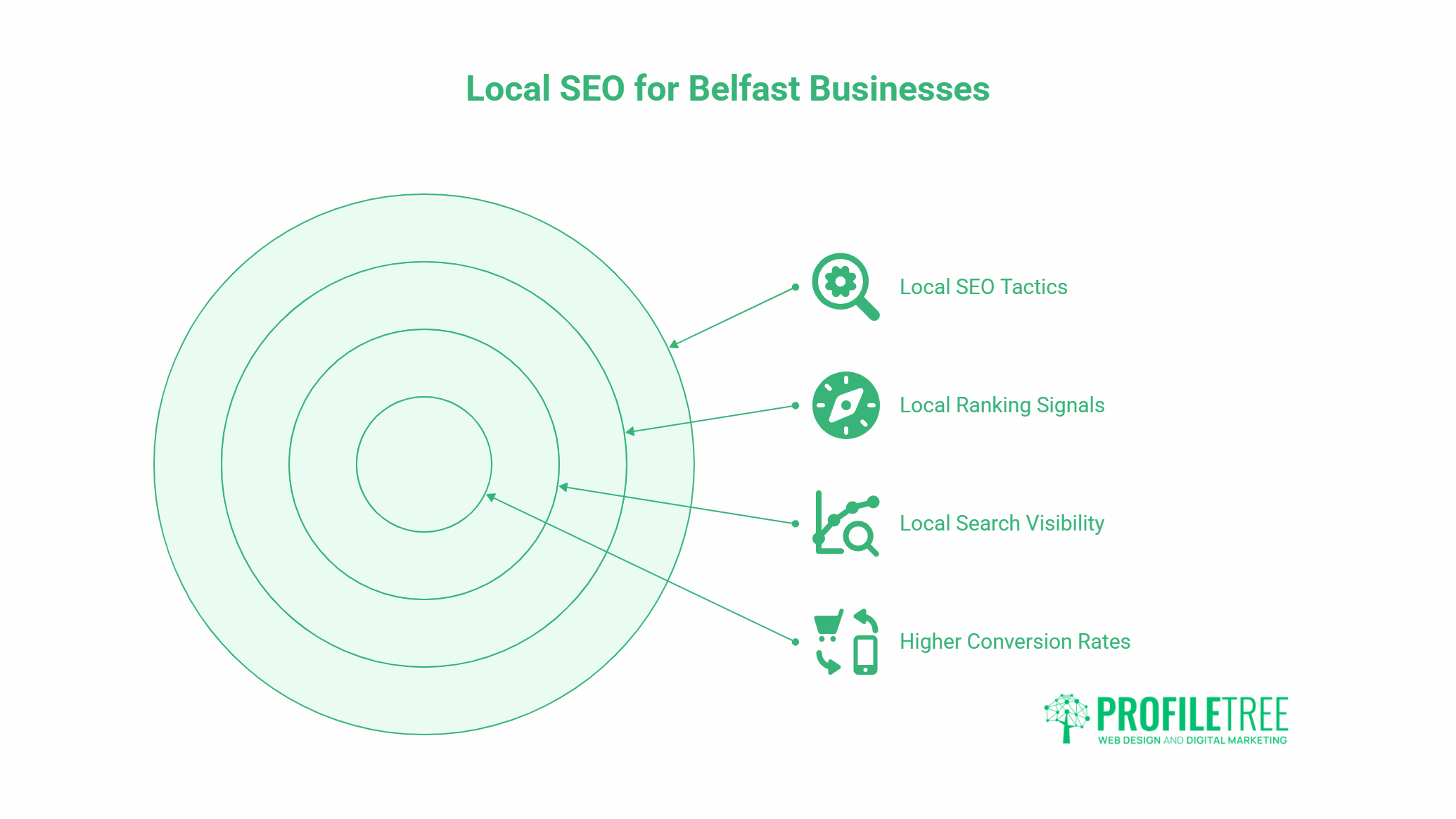
Local SEO is the process of optimising your online presence so that search engines show your business to people searching in your area. When someone types “plumber Belfast” or “café near Victoria Square,” Google uses local ranking signals, including proximity, relevance, and authority, to decide which businesses to show.
For Belfast businesses, this matters because local search traffic converts at a higher rate than most other channels. Someone searching for a Belfast-specific service is typically close to making a decision. They’re not researching for six months; they want to call, visit, or order now.
Why Local SEO Differs from Standard SEO
Standard SEO focuses on ranking for broad terms across national or international audiences. Local SEO targets geography-specific intent. The tactics overlap, but local SEO puts extra weight on your Google Business Profile, local citations, NAP consistency, and content that references Belfast-specific locations, events, and context.
For most Belfast SMEs, local SEO should take priority over national SEO. Ranking locally for ten high-intent searches in your service area is worth more than ranking nationally for a broad term that brings in visitors who’ll never become customers.
Keyword Research for Belfast Businesses
The right local keywords connect your business to people who are already searching for what you offer in Belfast. Getting this wrong means spending time on content that ranks for the wrong audience.
How to Identify Belfast-Specific Keywords
Start with your core service or product, then layer in location modifiers. “Web design” becomes “web design Belfast.” “Accountant” becomes “accountant Belfast” or “accountant North Belfast.” Think about how your customers actually describe what they need; their phrasing often differs from industry terminology.
Go deeper than just the city name. Belfast has distinct areas, each with its own search behaviour: Titanic Quarter, Cathedral Quarter, South Belfast, Lisburn Road, and East Belfast. If your business serves a specific part of the city, or if customers regularly search with neighbourhood qualifiers, include those terms in your keyword set.
Long-tail Local Keywords
Long-tail keywords are more specific phrases with lower search volume but higher purchase intent. “Handmade silver jewellery Belfast” is a long-tail keyword. “Bridal hair stylist Belfast city centre” is another. These terms are less competitive and attract people who are further along in the buying process.
Google Keyword Planner lets you search by location, showing which terms Belfast residents actually use. Google Search Console (if your site is established) shows you the exact queries already bringing people to your pages, which is often more useful than any tool.
Using Keyword Data in Practice
Once you have a keyword list, map terms to specific pages. Your homepage targets broad terms (“web design Belfast”). Individual service or location pages target narrower terms (“WooCommerce development Belfast”). Blog content targets informational queries (“how much does a website cost in Belfast”). One page per intent; don’t try to rank a single page for everything.
On-Page Optimisation for Local Search
On-page optimisation makes it clear to both search engines and users what your page is about, who it serves, and where you operate. For local SEO, this means weaving Belfast-specific signals into your page structure without keyword stuffing.
Title Tags, H1s, and Meta Descriptions
Your title tag is the most important on-page SEO element. For local pages, front-load your primary keyword and include Belfast or your specific area. “Web Design Belfast | ProfileTree” works. “Welcome to Our Web Design Company” doesn’t.
Your H1 should match or closely mirror the title tag. Meta descriptions don’t directly affect rankings, but they drive clicks. Write them for the person scanning search results: state the problem you solve, name Belfast, and give them a reason to click.
Localising your Content
Beyond the title and H1, your body content should reference Belfast naturally. Mention the areas you serve, reference local landmarks where relevant, and write in a way that makes it clear you understand the local context. A plumber’s page that mentions “emergency callouts across Belfast, Lisburn, and Newtownabbey” tells both Google and the reader exactly who the business serves.
Mobile Performance
Google uses mobile-first indexing, meaning it primarily evaluates your mobile site for ranking purposes. If your site is slow or difficult to use on a phone, your local rankings will suffer. Belfast consumers are no different from anywhere else; most local searches happen on mobile, often when someone is already out and about. Fast load times, clear navigation, and a checkout or contact flow that works without pinching and zooming are requirements, not bonuses.
Google Business Profile: Your Most Important Local SEO Asset
Your Google Business Profile (formerly Google My Business) is the listing that appears in Google Maps and the local pack, the three businesses shown at the top of local search results. For most Belfast SMEs, this listing will drive more local visibility than any other single factor.
Setting Up and Verifying Your Profile
Claim your listing at business.google.com if you haven’t already. Google will send a verification code to your business address. Complete every section: business name, address, phone number, website URL, business category, opening hours, and a thorough description that includes your primary keywords and service area.
Choose your primary category carefully. “Web design company” and “internet marketing service” are different categories with different ranking implications. Pick the one that most accurately reflects what most of your customers pay you for.
Keeping your Profile Active
Google rewards profiles that are actively maintained. Post updates regularly, whether that’s service announcements, offers, or blog content. Add photos of your premises, team, and work; listings with photos receive significantly more clicks and direction requests than those without.
Respond to every review, positive and negative. An unanswered negative review tells prospective customers you don’t care. A thoughtful response to a complaint tells them you do.
Local Listings Beyond Google
Your Google Business Profile is the priority, but local citations across other directories reinforce your NAP data and help Google trust your location signals. List your business on Yelp, Yell.com, Bing Places, and any Belfast-specific or Northern Ireland business directories relevant to your sector. The information must be identical across every platform: exactly the same business name, address format, and phone number. Even minor inconsistencies (Ltd vs Limited, Street vs St) can dilute your local authority.
Creating Localised Content
Content is where local SEO compounds over time. A Belfast business that publishes genuinely useful, locally relevant content builds authority that competitors with thin websites simply can’t match.
What Counts as Localised Content
Localised content isn’t just dropping “Belfast” into generic articles. It means writing about topics that specifically matter to Belfast businesses and consumers: local planning regulations, Northern Ireland-specific grant schemes, area-specific market conditions, or case studies featuring Belfast clients.
A law firm might write about employment law changes affecting Northern Ireland businesses. A digital agency might cover how Belfast SMEs are adopting AI tools. A restaurant might blog about locally sourced suppliers in County Down. Each piece builds topical authority and gives Google more signals about who you serve and where.
Blog Posts and Case Studies
Blog posts that answer the specific questions your Belfast customers ask are among the most efficient content investments. Use the query language from your keyword research and from Google’s “People Also Ask” feature to find the exact phrasing your audience uses. Answer the question directly in the first two sentences, then expand.
Case studies from Belfast or Northern Ireland clients are particularly valuable. They demonstrate local experience, include location signals naturally, and provide the kind of first-hand evidence that earns both trust and links. Local marketing in Ireland follows some of the same principles; the core approach of community-specific content applies whether you’re targeting Belfast city centre or a broader regional audience.
Structured Data
Schema markup tells search engines the specifics of your business: type, location, opening hours, services, and reviews. LocalBusiness schema is the most important type for Belfast SMEs. It can help Google display rich results and improve the clarity of your entity signals. Note the requirement for the dev team at the end of this article.
Building a Belfast Backlink Profile
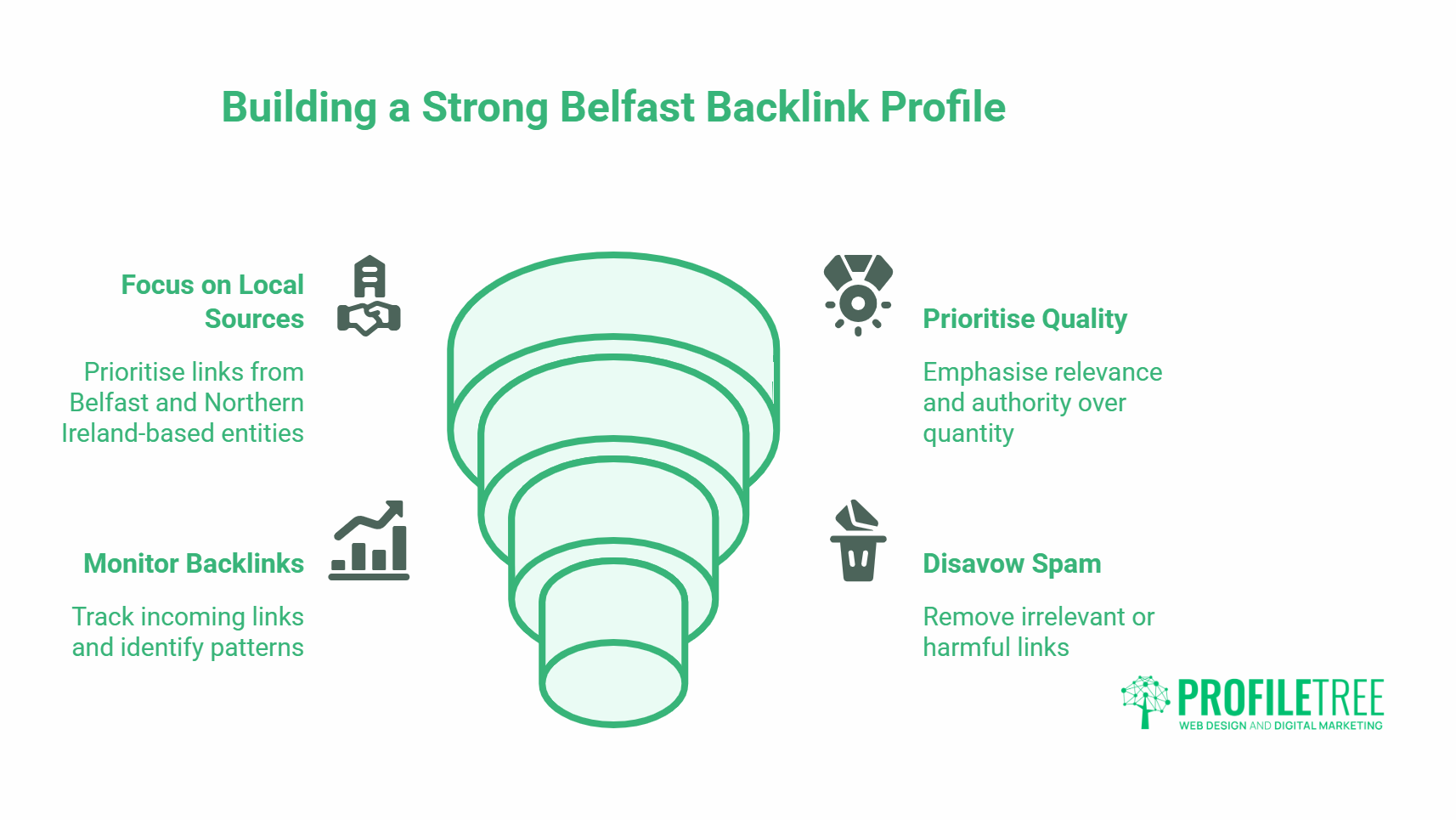
Backlinks from other websites signal to Google that your content is worth referencing. For local SEO, links from Belfast-based or Northern Ireland-based websites carry additional weight because they reinforce your local relevance.
Where to Focus for Local Links
Local links come from several natural sources: Belfast business associations (Belfast Chamber of Commerce, Invest NI partner organisations), local press coverage (Belfast Telegraph, The Irish News, Belfast Live), supplier and partner websites, community organisations, and sponsorships of local events or sports clubs.
Guest articles in local publications are a reliable route. A piece in a Belfast business publication with a link back to a relevant service page builds both authority and entity associations. Our local SEO packages include a link-building strategy as part of the broader local authority work we do for clients across Northern Ireland.
Quality Over Volume
One link from the Belfast Telegraph is worth more than fifty from low-quality directories. Focus on relevance and authority. A backlink from a respected local business association or a genuine editorial mention in a regional publication moves the needle more than bulk directory submissions.
Monitoring your Backlink Profile
Use tools like Ahrefs, SEMrush, or Google Search Console’s links report to track what’s pointing to your site. Look for patterns: which pages are attracting links naturally, and which might benefit from active outreach. If you spot spammy or irrelevant links pointing to your site, Google’s Disavow tool lets you distance yourself from them.
Managing Reviews for Local SEO
Reviews are both a ranking signal and a conversion factor. Belfast consumers read reviews before choosing local businesses, and Google’s algorithm treats a steady flow of genuine positive reviews as a trust signal.
Getting More Reviews
The simplest way to get reviews is to ask. After a positive interaction, a brief follow-up message or email with a direct link to your Google review page removes the friction. Most satisfied customers are willing to leave a review if the process is easy.
Don’t incentivise reviews or ask for them in bulk at one time; both practices violate Google’s guidelines and can result in reviews being removed or your listing being penalised. A steady, organic cadence of reviews over time is what builds authority.
Responding to Reviews
Respond to every review. For positive reviews, a brief, genuine thank-you that mentions your service or location reinforces the keywords and shows prospective customers you’re engaged. For negative reviews, acknowledge the issue, apologise if warranted, and offer to resolve it offline. Keep your tone professional; future customers read your responses as much as the reviews themselves.
One thing we see consistently across Belfast SME clients is that businesses which actively manage their Google reviews outperform those that don’t, not just in rankings but in actual conversion rates from their listing,” says Ciaran Connolly, founder of ProfileTree.
Platforms Beyond Google
Google is the priority, but reviews on Facebook, Trustpilot, and industry-specific platforms (TripAdvisor for hospitality, Houzz for trades, Checkatrade for contractors) all contribute to your overall online reputation and can drive direct traffic of their own.
Measuring Your Local SEO Performance
Without tracking, you don’t know what’s working. Local SEO measurement doesn’t require expensive tools; the free options cover most of what you need.
Google Search Console
Search Console shows which queries bring people to your site, your average position for those queries, and how many clicks you receive. For local SEO, filter by queries containing Belfast or your target locations to see how your local visibility is developing.
Google Business Profile Performance data
Your Google Business Profile dashboard shows how many people found your listing through search, how many requested directions, and how many clicked through to your website. These metrics tell you whether your profile is generating real local interest.
Key Performance Indicators to Track
Set a small number of clear KPIs: rankings for your five to ten most important local keywords, monthly clicks from local searches (Search Console), monthly profile views and direction requests (GBP dashboard), and conversion rate from local traffic (Google Analytics). Review these monthly and adjust your strategy based on what the data shows.
Ciaran Connolly frames it this way: “Local SEO is a compounding investment. The businesses that track their results monthly and make small, consistent improvements are the ones that build durable visibility over time, rather than chasing quick fixes that don’t last.”
For Belfast businesses ready to go further, our local SEO packages detail exactly what’s included in a managed local SEO engagement, from audit through to ongoing optimisation.
Frequently Asked Questions
How long does local SEO take to show results for Belfast businesses?
Most Belfast businesses see measurable improvements in local rankings within three to six months of consistent effort. Your Google Business Profile typically shows results fastest, often within four to eight weeks of optimisation. Organic content rankings take longer, usually six to twelve months, for competitive terms.
How much does local SEO cost for a Belfast business?
Costs vary depending on the level of support you need. A basic local SEO setup (Google Business Profile optimisation, on-page fixes, citation building) can be handled in-house with time and the right guidance. Managed local SEO services for Belfast businesses typically range from a few hundred to several hundred pounds per month, depending on the scope and competitiveness of your market.
Do I need a local SEO specialist, or can I do it myself?
Many of the foundational steps, including Google Business Profile optimisation, NAP consistency, and local content creation, can be done in-house. For competitive local markets in Belfast, or for businesses that want to move faster, working with a specialist removes the learning curve and delivers results more quickly.
What is NAP consistency, and why does it matter?
NAP stands for name, address, and phone number. Search engines cross-reference your business details across directories, social profiles, and your website. If the information is inconsistent, even in small ways, it creates uncertainty about your location and reduces your local authority. Every listing should use exactly the same format.
How important are online reviews for local SEO in Belfast?
Reviews are a confirmed local ranking factor for Google. They also directly affect whether someone chooses your business over a competitor when they see your listing. A business with 80 reviews averaging 4.7 stars will typically outperform one with 10 reviews averaging 5.0 stars, both in rankings and in click-through rate.
Should I create separate pages for different Belfast areas?
Only if you can create genuinely different content for each area, and only if there’s clear search volume for area-specific terms. A generic template with “South Belfast” swapped for “North Belfast” will not rank and may dilute your overall authority. If you can write meaningfully about your work in a specific area, with local references and real examples, a location page adds value.