
Media Consumption Trends: What UK and Irish Businesses Need to Know
Table of Contents
Media consumption trends tell a clear story for anyone marketing a business in the UK or Ireland: attention has moved, and the channel mix that worked five years ago no longer reaches the same people. UK adults now spend four and a half hours online a day outside work, and where that time goes has kept shifting even in the months since this guide first went live.
This guide is written for business owners, marketing managers, and decision-makers who want to know what these media consumption trends mean for their budgets. It looks at where your customers actually pay attention, how AI is changing how content gets found, and what a workable media mix looks like for a smaller team. Working through that shift without an in-house strategist is exactly where dedicated digital strategy support tends to earn its keep, turning trend data into a channel plan rather than another to-do list.
Below you will find verified figures on daily media consumption, a platform-by-platform breakdown of where professionals spend their time, the practical effects of AI discovery, and a section on how media habits differ across Northern Ireland and the Republic.
How Media Consumption Has Shifted for UK and Irish Businesses
The broad direction is consistent across every major study of digital media consumption. People are online for longer, across more devices, and a growing share of that time is spent on video and audio rather than text. What the headline numbers miss is who is paying attention and how much of it a business can realistically reach.
The Numbers Behind the Shift
Recent UK data gives a grounded picture. Ofcom’s Online Nation 2025 report found that UK adults now spend an average of four hours and 30 minutes a day online outside work, up ten minutes on the year before. Time on YouTube alone is rising too: 51 minutes a day on devices other than the television set, up from 47 minutes in 2024, with the platform reaching 94 per cent of UK adults.
Ofcom’s Media Nations 2026 report, published in July, adds the broadcast side of the picture. Daily viewing of broadcaster TV content fell by 11 minutes (8 per cent) year on year to two hours and 19 minutes per person per day, while YouTube’s in-home viewing across all connected devices climbed to 41 minutes a day, up from 33 minutes in 2022. Viewing of YouTube on television sets specifically has doubled over the same period.
| Media consumption measure | Latest figure | Source |
|---|---|---|
| Daily time online outside work (adults) | 4 hours 30 minutes | Ofcom Online Nation 2025 |
| Daily YouTube viewing (excl. TV set) | 51 minutes | Ofcom Online Nation 2025 |
| Adults reached by YouTube | 94 per cent | Ofcom Online Nation 2025 |
| Daily broadcaster TV viewing | 2 hours 19 minutes | Ofcom Media Nations 2026 |
| YouTube in-home viewing (all devices) | 41 minutes a day | Ofcom Media Nations 2026 |
| Weekly UK radio audience | 51.1 million (record high) | RAJAR Q2 2026 |
Streaming Now Beats Broadcast for First Choice
One shift is worth calling out on its own. For the first time, Ofcom found that more UK viewers now turn to Netflix first when deciding what to watch than to the BBC: 26 per cent versus 25 per cent, a reversal from the year before when the BBC led on 28 per cent to Netflix’s 23 per cent.
Public service broadcasters still account for the largest overall share of viewing, and live events continue to draw mass audiences (85 per cent of 2025’s sports viewing was live), but the default starting point for a night in front of the screen has genuinely changed. For any business relying on broadcast-adjacent advertising or sponsorship to reach a UK audience, that default matters more than the overall viewing totals.
Attention Is Fragmenting, Not Just Growing
The most important change in media consumption data over the last two years is not the rise of any single platform. It is the way attention has split across channels, and the growing role of AI systems that sit between your content and the people you want to reach.
A potential customer may never land on your website while researching your services, because an AI summary or a private recommendation has already answered the question. Surface metrics such as impressions and reach describe a smaller and smaller part of what is actually happening.
This matters for planning because two businesses can post identical amounts of content and see wildly different results, depending on whether that content is built to be extracted and shared. Media consumption data now rewards clarity and structure over sheer volume, and the gap between the two widens every quarter.
Why This Matters for a Smaller Budget
For an SME, the response to these shifts is not simply to post more. It means structuring content so it works inside AI discovery, picking channels based on where a specific audience really is, and building the trust signals that community-led media habits now reward. Video sits at the centre of that shift, which is why the rise of short-form video is worth understanding before any budget decisions are made.
The New Discovery Layer: AI, Algorithms and How Content Gets Found
One of the biggest changes in digital media consumption is not happening on social platforms at all. It sits in the gap between someone asking a question and deciding which website, if any, to open. That gap is now the first place where many of your customers form an impression, and the 2026 Reuters Institute Digital News Report found that social media and video platforms have, for the first time, overtaken news websites and apps as the way audiences access news globally: 54 per cent versus 51 per cent.
How AI Overviews Change Search Behaviour
AI-powered search tools, including Google’s AI Overviews, Perplexity and the browse features in ChatGPT, now answer a growing share of informational queries before anyone clicks through. Research by Ahrefs found that pages covering several sub-questions within a single topic are 161 per cent more likely to be cited in AI Overviews.
Content that gives a direct answer in the first 40 to 60 words of a section earns citations that long, winding prose does not. A business owner asking an AI assistant to recommend a supplier in Belfast may receive an answer drawn from several sites, without opening any of them.
As Ciaran Connolly, founder of ProfileTree, puts it: “The businesses winning with content in 2026 are not the ones producing the most. They are the ones whose content is structured so AI systems can understand and cite it. Every page has to answer a specific question clearly, quickly and with enough credibility that a model treats it as a source.”
Structuring Content for AI Citation
Businesses that show up in AI answers tend to share a pattern: clear headings, factual statements with named sources, and descriptions that tell a system exactly what the business does, where it operates and who it serves. That same structure improves ordinary search rankings, which is where search engine optimisation and content design now overlap.
For a business reviewing its own site, the useful question is no longer only whether a page ranks on Google. It is whether the page appears in AI-generated answers when someone asks about the service. Testing that directly, by asking the tools your customers use, is quick and revealing.
Dark Social and the Attribution Gap
Running alongside AI discovery is a quieter change that makes analytics less reliable. Dark social describes content shared through private channels such as WhatsApp groups, Slack workspaces and direct messages, which tracking tools cannot see. A large share of B2B referrals in the UK happen this way.
Two practical points follow. Your content needs to be worth forwarding privately, which usually means it is specific and genuinely useful. And it is worth asking recent customers how they first heard of you, since the answer often differs from what analytics reports. Tools such as AI content detection also matter here, as trust in a source depends partly on whether it reads as human and credible.
Platform by Platform: Where UK and Irish Decision Makers Spend Time
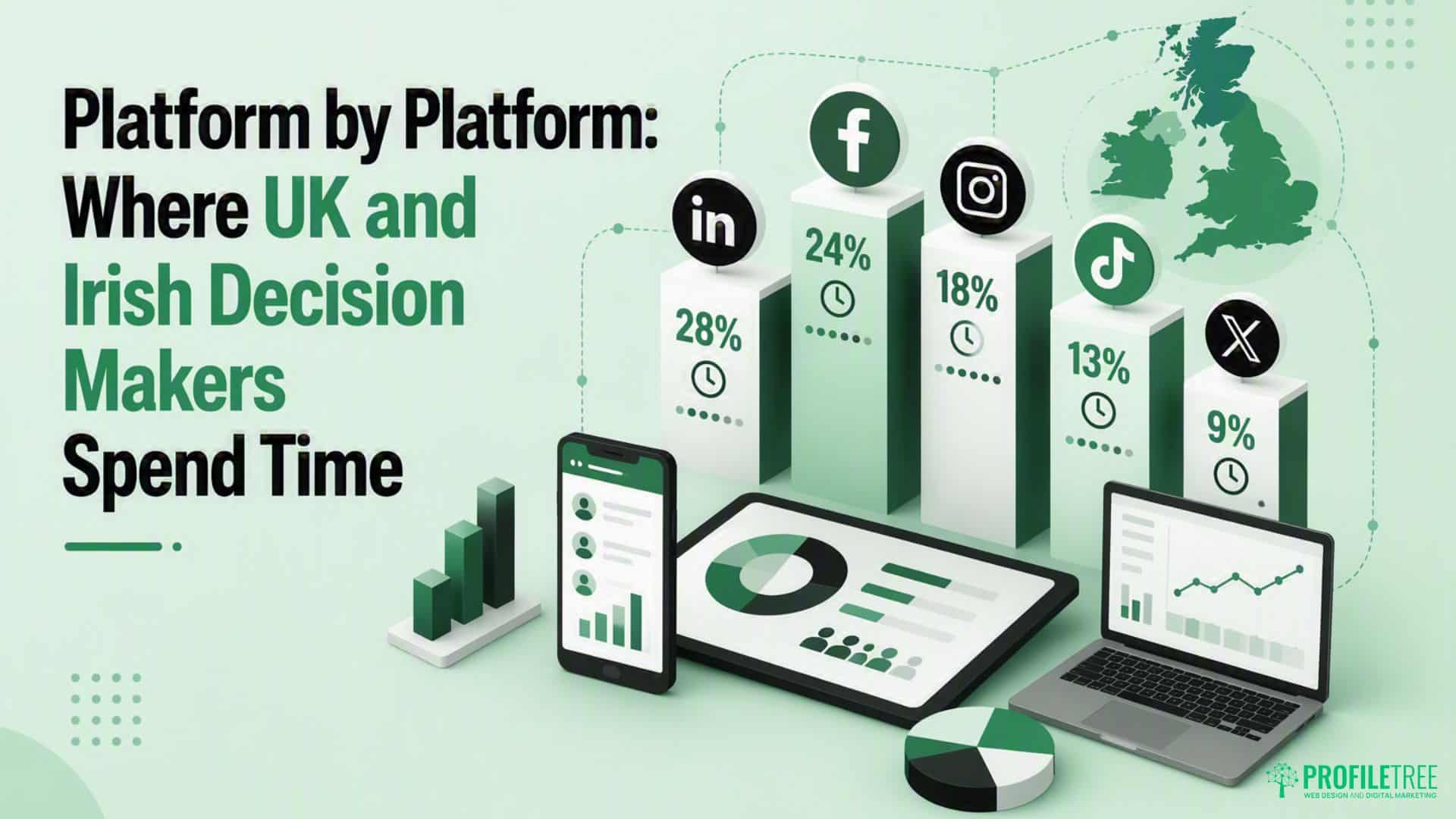
Good channel selection starts with your customers’ media habits, not global user counts. A firm selling commercial fit-out to property developers operates in a different media environment from one selling gifts direct to consumers. With that caveat, the platform-level shifts in digital media consumption are worth reading as context.
LinkedIn and Professional Video
LinkedIn has moved decisively toward video over the past two years, and the platform has reported that video generates more engagement than other formats. For solicitors, accountants, consultants, and agencies, it is a cost-effective way to build credibility with decision-makers who are not yet ready to buy.
Organic reach is still meaningful compared with other platforms, and the bar for production is lower than many owners assume. A short, clear answer to a question your clients ask regularly will usually beat polished brand content with no informational value. There is more detail in this guide to using LinkedIn for business growth.
YouTube as a Long-Term Research Asset
YouTube is often overlooked in SME marketing, yet it serves as the second-largest search engine in the world and feeds into Google’s AI Overviews. A library of useful video content that answers common questions or explains a process becomes an asset that compounds, in a way that a single social post never does. That compounding effect has only strengthened: in-home YouTube viewing across all devices has climbed to 41 minutes a day, and time spent watching on the television set specifically has doubled since 2022.
A well titled video answering a specific customer question can bring in enquiries for years after the shoot is paid for. That principle underpins ProfileTree’s video marketing services, which treat video as a long-lived asset rather than a one-off post.
Audio, Podcasting and Radio’s Resilience
Audio has done more than hold up. RAJAR’s Q2 2026 figures, published in August, show a record 51.1 million UK adults tuning into radio each week, 87 per cent of the population aged 15 and over, up 2 per cent year on year. Commercial radio drove most of that growth, reaching 40.2 million weekly listeners and taking a 55.1 per cent share of all listening compared with 42.6 per cent for the BBC. Online radio now reaches 30.3 per cent of adults weekly, and smart speaker listening accounts for 18.7 per cent of total listening hours.
For sectors such as professional services, manufacturing and construction, a company podcast or guest appearances build familiarity that paid advertising rarely matches over the same period. Listeners tend to stay for a full episode rather than scroll past, so the quality of attention is high even when the audience is small. The data behind this sits in these business podcast growth statistics.
Radio also deserves a second look for local businesses. Its reach across the working day, from the commute to the workshop floor, gives it a steadiness that social feeds lack. For a regional advertiser, a mix of local radio and a modest podcast presence can reach an older, higher-value audience that spends less time on short-form platforms.
Short-Form Video: TikTok and Instagram
The audience is there. TikTok’s UK base has grown among 25 to 44-year-olds, and Instagram Reels still out-reach static posts for most account sizes. For most Northern Ireland and Irish SMEs, though, these platforms suit brand awareness more than lead generation, and only where the business can post consistently.
Sporadic posting rarely builds the momentum these platforms need. The sharper question is not whether to be on TikTok, but whether you can post three or four times a week indefinitely. If the answer is no, a focused YouTube and LinkedIn presence usually returns more for the same effort, as these UK TikTok statistics help show.
What Changing Media Habits Mean for Your Marketing Strategy
Knowing that media consumption trends are shifting only helps if it changes where you put time and money. This section outlines the strategic implications for UK and Irish SMEs, with a brief framework for assessing your own position.
Content Built for AI Performs Everywhere
The same structure that helps AI systems find and cite your content, clear headings, direct answers and named sources, also reads better for humans. Structuring content for AI visibility makes it stronger content for everyone. For a business sitting on long, narrative blog posts, restructuring what already exists often beats writing more.
Email Remains the Algorithm-Independent Channel
As organic social reach declines, email continues to outperform social platforms for B2B conversion. DMA UK benchmarking puts the return at around £38 per £1 spent, with the Marketer Email Tracker 2026 reporting figures of near £41. A maintained list is one of the few marketing assets an algorithm cannot take away.
These email marketing statistics vary by sector, so treat the headline number as a benchmark rather than a promise. The value comes from list quality and relevance, not raw volume, which is where a planned content marketing programme tends to earn its keep.
The Compound Case for Video Production
Short-form video is no longer optional for brand awareness, and the evidence is consistent across platform studies. The practical question in 2026 is how to produce it sustainably. A single planned shoot can supply a YouTube tutorial, a LinkedIn clip, a website explainer and several short social posts, spreading the cost across assets with very different shelf lives.
The economics only work when the plan comes first. Filming without a clear list of questions to answer produces footage that sits unused, while a half-day shoot mapped to real customer queries can feed a content calendar for months. That planning discipline separates video that pays for itself from video that becomes an expensive one-off.
Auditing Your Current Media Mix
Before you move any budget, it is worth checking how your effort aligns with these trends. Do your key service pages answer the question in the first 50 words, or open with a general introduction? Do your video titles match what customers actually search? Have you asked recent customers how they found you? Can you see whether leads arrive through private channels you cannot track?
For a structured version of that review, ProfileTree’s digital strategy works with firms across Northern Ireland, Ireland and the wider UK to assess channel performance and decide where resources should shift. The starting point is always the real media habits of the specific customers a business wants to reach.
The Northern Ireland and Ireland Angle
Most studies of digital media consumption report national or global averages. That context is useful, but it does not capture the habits of decision-makers in Belfast, Derry, Dublin, or Cork. A few things stand out as genuinely different in this market.
Trust in Local Media Runs Higher Here
The picture has shifted since this guide first went live. The Digital News Report Ireland 2026, produced by the Reuters Institute with Coimisiún na Meán, found that trust in news generally fell sharply: 42 per cent of Irish people now say they trust most news most of the time, down from 51 per cent the year before, one of the steepest drops recorded globally.
Despite that fall, trust in specific local brands held up. RTÉ News and local radio news remain the most trusted sources at 71 per cent, followed closely by local newspapers at 69 per cent. Interest in news in Ireland has held broadly steady at 54 per cent, still well above the UK figure of 37 per cent.
For a business investing in content, that carries a direct implication. Coverage in or association with trusted local titles holds more commercial weight here than in markets where institutional trust has eroded further. A mention in the Belfast Telegraph or The Irish Times reads differently from the same claim on a company blog. Local pride in the region, from its cities to its coastline, runs deep.
News Avoidance and the AI Chatbot Shift
Two related trends are worth tracking together. News avoidance in Ireland climbed to 47 per cent, up from 41 per cent the year before, one of the largest increases measured anywhere in the 2026 Digital News Report. At the same time, a small but growing share of Irish respondents, around 7 per cent, now use AI chatbots for news, compared with 4 per cent in the UK.
Neither figure is large on its own, but together they point in the same direction as the AI discovery shift discussed earlier in this guide. Fewer people are actively seeking out news through traditional routes, and a rising share are getting information filtered through an AI system rather than a masthead. For businesses whose visibility has depended on editorial coverage, this reinforces the case for content built to be understood and cited directly by AI systems, not only pitched to journalists.
Cross-Border Habits Are Not Identical
The two jurisdictions differ, and a strategy that treats them as one market leaves engagement on the table. Irish audiences show stronger interest in news and higher trust in local outlets than UK-wide averages, which shapes how PR and content land on each side of the border. Media consumption habits, funding schemes and even preferred broadcasters vary between them.
Practical differences follow. A campaign that leans on a Belfast title will reach a different audience from one placed in a Dublin or Cork outlet, and the language, currency and cultural references need to match each side. Businesses trading across the border do best when they plan two related versions of a message rather than one that tries to serve both at once.
Building Local Capability
For firms building internal marketing skills, reading regional media habits is part of the work, not an afterthought. The aim is for a team to study its own audience’s content consumption data and adjust accordingly, rather than copy a generic playbook. ProfileTree’s digital training builds that habit directly, and this piece on content marketing in Northern Ireland shows where regional demand is heading.
Media consumption trends are less about more time online and more about how attention, discovery and trust now work. Streaming has overtaken broadcast as the default choice, AI discovery has rewritten content structure, and fragmented attention has made channel choice sharper for any business with limited resources. The winners will be the firms that read their own audience data and act on it, rather than chasing every platform.
FAQs
What are the latest digital media consumption statistics for the UK?
UK adults spend about four hours and 30 minutes a day online outside work, with 51 minutes of that on YouTube, according to Ofcom. Weekly UK radio listening hit a record 51.1 million people in the second quarter of 2026, according to RAJAR.
How are media consumption trends changing for UK businesses?
The biggest change is that AI tools and social platforms now answer or surface many informational queries before anyone visits a website. Streaming has overtaken broadcast television as the default first choice for UK viewers, and private sharing makes traditional analytics less reliable.
Is short-form video effective for B2B marketing?
On LinkedIn, yes, especially for credibility with decision makers who are not ready to buy. On TikTok and Instagram, it builds awareness, but B2B conversion stays low, so it works best when it demonstrates specific expertise.
What is dark social and why does it matter?
Dark social is content shared through private channels such as WhatsApp and direct messages that analytics cannot track. A large share of B2B referrals happens this way, so surveying recent customers is the simplest way to see the gap.
How does AI change the way people find businesses?
Decision-makers increasingly ask AI tools for recommendations and receive answers drawn from multiple sources at once. Businesses that appear tend to have clear, structured content that states plainly what they do and where they operate.