
European Accessibility Act: What UK and Irish Sites Need
Table of Contents
If your business sells products or services to customers in the EU, including Ireland, the European Accessibility Act now applies to you. It came into force on 28 June 2025, and it covers websites, apps, e-commerce checkouts and a range of other digital services. Some businesses are exempt. Most aren’t, and the exemption is narrower than most owners assume. That’s true whether you’re based in Belfast, Dublin or Birmingham; the deciding factor is who buys from you, not where your office sits.
What Is the European Accessibility Act?
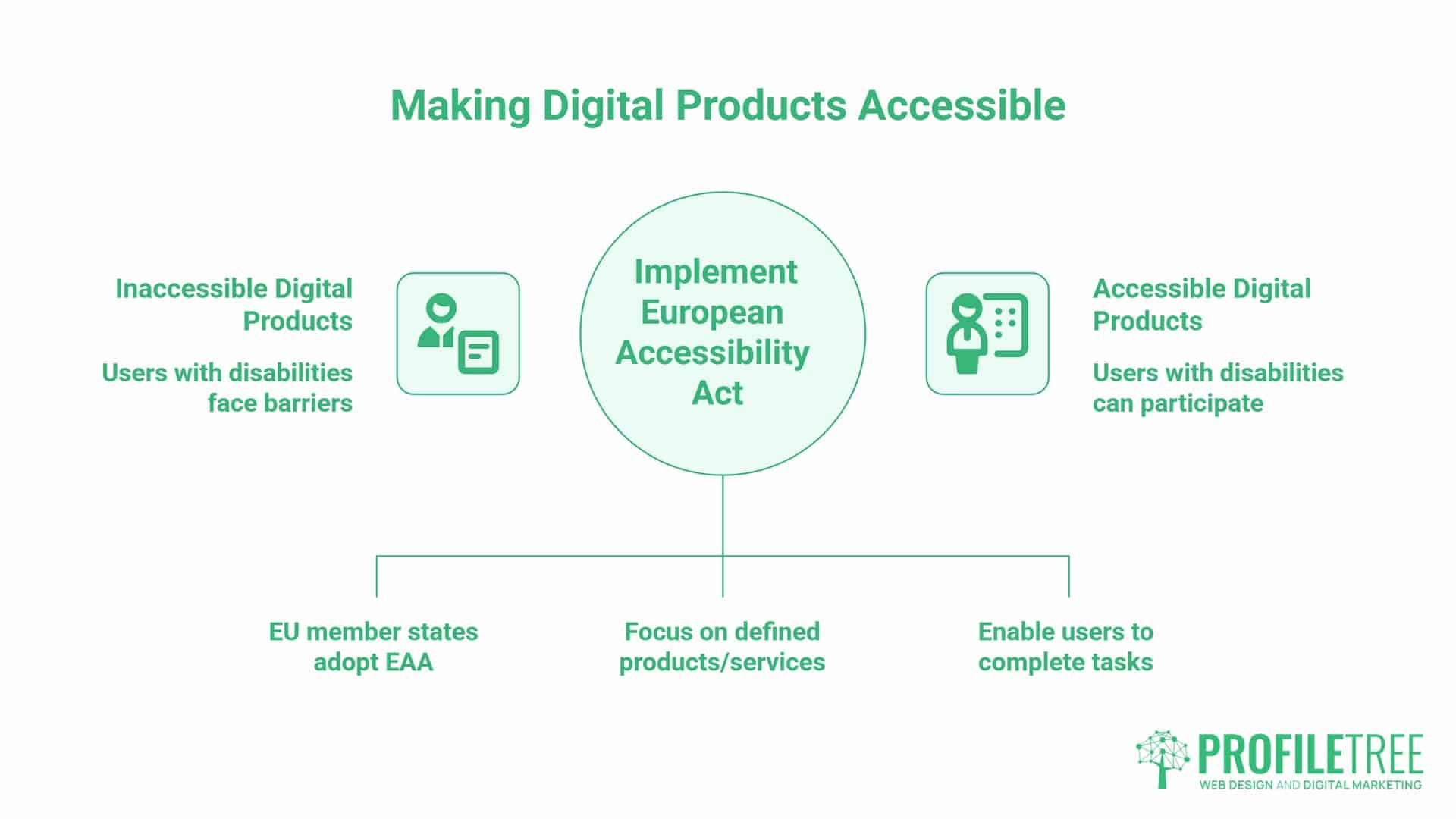
The European Accessibility Act, or EAA, is an EU Directive 2019/882. It sets accessibility requirements for a defined list of products and services sold to consumers across the EU, from e-commerce platforms and banking apps to e-books and transport ticketing. Each EU member state had to incorporate the directive into its own national law, so the exact wording that applies to your business is set out in domestic legislation rather than the directive itself.
The goal is straightforward. Someone using a screen reader, or getting around with a keyboard alone, should be able to complete the same tasks as anyone else: book a flight, open a bank account, buy something online. The European Accessibility Act exists to make that the default rather than the exception.
The list of covered products and services is specific rather than open-ended. It includes computers and operating systems, ATMs, ticketing and check-in machines, e-readers, e-commerce, banking services, air, rail, bus and waterborne passenger transport, and audiovisual media services. If your business doesn’t fall into one of these categories, the European Accessibility Act may not apply at all, regardless of how you sell.
Does the European Accessibility Act Apply to UK Businesses After Brexit?
Brexit didn’t remove the European Accessibility Act from the picture for UK companies. What matters isn’t where a business is registered, it’s whether it sells products or services to consumers in the EU. Sell into Ireland, France or Germany, and the same rules that apply to a business physically based there apply to you too.
This is sometimes called the internal market rule. It has nothing to do with the company headquarters and everything to do with where the customer sits. A UK-only retailer with no EU customers has no EAA obligation. A Belfast retailer shipping to Dublin does. Take two nearly identical online shops, one selling homeware to customers across the UK only and one selling the same products to customers in both the UK and Ireland. The first has no obligation under the European Accessibility Act at all. The second does, on the Irish side of its customer base, even though the two businesses might be run from neighbouring units on the same industrial estate.
The Service Provider Versus Manufacturer Distinction
Most coverage of the European Accessibility Act focuses on software and websites, but the obligation doesn’t stop with the business that built the product. A UK distributor selling an EU-manufactured device, a self-service kiosk or a piece of ticketing hardware, for example, carries its own accessibility obligations as the entity placing that product on the market, separate from whatever the original manufacturer did or didn’t do.
This catches businesses that think of themselves purely as retailers rather than manufacturers. If you import, rebrand, or distribute a covered product into the EU or Ireland, check what the manufacturer has actually documented regarding accessibility compliance before assuming the responsibility lies entirely upstream.
The Northern Ireland Position Under the Windsor Framework
Northern Ireland sits in an odd spot here, and it’s worth being precise about why. The Windsor Framework keeps Northern Ireland aligned with EU rules for goods, so that products can move freely into the EU single market without a hard border on the island of Ireland. That alignment is about goods, not services.
Website accessibility is a service obligation under the European Accessibility Act, not a goods one, so Northern Ireland businesses fall under the same internal market rules as the rest of the UK for that part of the law. Sell services into the EU, and you’re in scope regardless of the Windsor Framework. Where the Windsor Framework does matter is physical products: consumer hardware, e-readers or self-service terminals that a Northern Ireland business places on the market.
Because Northern Ireland stays aligned with EU goods rules, those products may need to meet EU accessibility requirements to move freely in a way that an equivalent product made and sold only in Great Britain wouldn’t. If your business handles accessible hardware as well as a website, it’s worth checking with a legal adviser rather than assuming either way.
The Irish Legal Position: S.I. No. 636 of 2023
Ireland transposed the European Accessibility Act into national law through the European Union (Accessibility Requirements of Products and Services) Regulations 2023, known as S.I. No. 636 of 2023. The regulations commenced on 28 June 2025, the same date on which the EAA itself began applying across the EU.
In Ireland, the Competition and Consumer Protection Commission acts as the main market surveillance authority for most covered products and services, working alongside sector regulators such as the Central Bank of Ireland for financial services. The National Disability Authority supports these bodies with guidance rather than enforcement itself.
For a UK or Northern Ireland business selling into Ireland, this is the piece of legislation that actually governs you, not the EU directive directly. Directives set the floor. Ireland’s regulations are the version with legal teeth.
S.I. No. 636 of 2023 also includes transitional measures. Service providers can keep using products that were already placed on the market before 28 June 2025 until 28 June 2030, and service contracts agreed before the deadline can run to their existing term without immediate remediation. That’s a genuine grace period, but it’s a narrow one: any new page, product, or contract created after the deadline must meet the requirements from day one, so the transitional window shrinks with every update to the site.
Is Your Business in Scope?
Whether the European Accessibility Act applies depends on what you sell and how big your business is. Three groups cover most of what a UK or Irish SME needs to check.
E-commerce and Digital Services
If you sell physical or digital products to consumers online and any of those customers are in the EU, your website and checkout process are subject to the EAA. That includes the shopping cart, payment process, order confirmation and any account area a customer uses after buying. A brochure site with no transactions falls outside this category, though it may still be covered by other rules depending on what else the business does.
Banking, Transport and Media Services
Banking services, e-books, electronic communications and passenger transport services (air, rail, bus and waterborne) all sit in scope where the consumer is in the EU. This matters more for Irish and Northern Ireland businesses than for the average GB company, because banking and transport providers in the Republic of Ireland are subject to the EU regulatory regime by default.
The SME and Micro-Enterprise Exemption
Micro-enterprises, businesses with fewer than 10 employees and annual turnover or balance sheet total under 2 million euro, are exempt from the European Accessibility Act’s service requirements. This is the exemption most owners reach for first, and it’s also the one most commonly misapplied.
Ciaran Connolly, ProfileTree’s founder, sees this misunderstanding often: “The exemption only covers services, not products you place on the market, and it stops applying the moment you employ ten people or turn over more than two million euro. Businesses assume small means exempt. That’s not how the regulation reads.”
If your business grows past those thresholds, or if you sell an accessible product rather than just a service, the exemption may not cover you even if it once did.
There’s a second, narrower exemption worth knowing about: the disproportionate burden clause. A business above the micro-enterprise threshold can, in principle, argue that full compliance would impose a disproportionate burden relative to its size and resources, but this isn’t a self-certifying get-out. It needs a documented assessment weighing the cost of compliance against the benefit to disabled customers and the business’s own turnover, and that assessment needs to be ready to show a regulator on request. Treating it as an automatic excuse rather than a case that has to be proven is one of the more expensive mistakes an SME can make.
What Compliance Actually Requires
Compliance under the European Accessibility Act isn’t a single certificate you obtain once. It’s a working standard, a public statement and a process for handling complaints.
WCAG 2.1 Level AA as the Working Standard
Most digital accessibility obligations under the EAA map onto WCAG 2.1 Level AA, as set out in the European standard EN 301 549. Practically, that means text alternatives for images, keyboard navigation for every function, sufficient colour contrast, clear form labels and captions on video content. If your website development services already follow WCAG for other reasons, most of the heavy lifting is already done.
Beyond the Website: Apps and Support Services
The European Accessibility Act extends beyond the website itself. Mobile apps, electronic tickets, ATMs and self-service kiosks, and the customer support channels around them, all need to meet the same accessibility bar. A business that fixes its website but leaves its app or support chat untouched hasn’t finished the job.
Ten Checks You Can Run on Your Website Today
You don’t need a full audit to find the obvious problems. A non-technical business owner can work through most of these in an afternoon, and each one maps onto a WCAG 2.1 requirement behind the European Accessibility Act.
- Move through the whole site using only the Tab key. If you can’t reach every link, button and form field, that’s a keyboard trap.
- Check every product image and icon for alt text. Missing alt text is the most common accessibility failure on SME websites.
- Zoom the page to 200% and check nothing overlaps or disappears.
- Run the homepage and checkout through a free contrast checker; body text needs a 4.5:1 ratio against its background.
- Check that every form field has a visible label, not just placeholder text that disappears when you click in it.
- Play a video on the site and check for captions. Auto-generated captions rarely meet the accuracy bar on their own.
- Test whether the focus indicator, the outline showing which element is selected, is actually visible.
- Check heading structure with a browser extension; skipped heading levels confuse screen reader users even when the page looks fine visually.
- Confirm error messages on forms explain what went wrong and how to fix it, not just that something failed.
- Check any downloadable PDFs. A beautifully accessible website with an inaccessible price list or brochure PDF still fails.
None of these fixes is expensive on its own. What takes time is finding all of them, and remediating a site built without accessibility in mind usually needs a proper website design review rather than a patch job.
Enforcement: What Happens If You Do Nothing
Enforcement of the European Accessibility Act began on the day the law came into force, and it hasn’t been quiet. France issued formal notices to major retailers within weeks. The Netherlands and Sweden both launched market surveillance activity, and the first EAA-related lawsuits were filed in a French commercial court in late 2025.
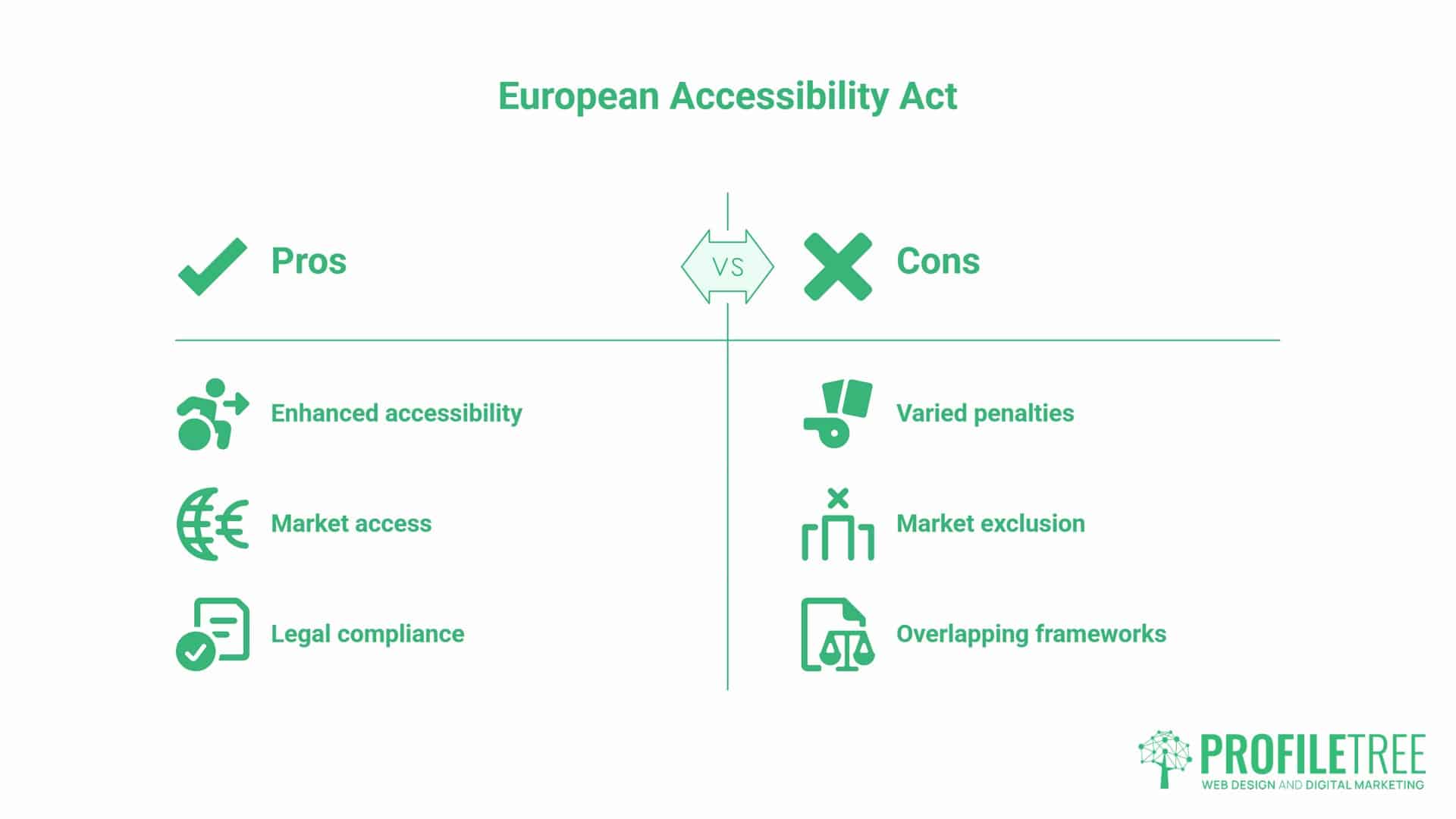
Penalties vary by member state rather than following one EU-wide fine schedule. Ireland’s regulations allow for administrative fines and, in serious or repeated cases, criminal liability. Other countries have gone further: Italy has linked fines to a business’s turnover rather than a fixed cap, and Spain’s ceiling runs into the millions of euros for the most serious breaches. The variation matters if you sell into more than one EU market, since a single non-compliant checkout can expose the same business to different regulators applying different penalty structures simultaneously.
For a UK business, the practical risk isn’t a fine landing on a desk in Belfast. It’s a market surveillance complaint from an EU customer, followed by a formal notice, and eventually the chance of losing the right to sell into that market until the issue is fixed. That’s a slower process than a UK regulator acting directly, but the end point (being shut out of EU sales) can matter more to a growing SME than the fine itself.
It helps to see the three overlapping frameworks side by side, since UK and Irish businesses are often assessed against more than one at once.
| Framework | Applies To | Technical Standard | Enforcement Body |
|---|---|---|---|
| UK Equality Act 2010 | GB and NI businesses under UK law | Reasonable adjustments duty; no fixed technical standard | Equality and Human Rights Commission; the courts |
| European Accessibility Act | Businesses selling in-scope products or services to EU consumers | WCAG 2.1 Level AA via EN 301 549 | National authority per member state, e.g. Ireland’s CCPC |
| Irish Disability Act 2005 | Irish public sector bodies | Sector-specific codes of practice | National Disability Authority |
A Five-Step Compliance Plan
Getting compliant with the European Accessibility Act doesn’t need to be complicated, but skipping steps usually means redoing them later, often at a worse time, like halfway through a market surveillance complaint rather than on your own schedule.
- Audit. Test the site against WCAG 2.1 AA, ideally with both automated tools and a person who actually uses assistive technology.
- Remediate. Fix what the audit finds, prioritising checkout, forms and navigation before anything cosmetic.
- Publish an accessibility statement. State what standard you’re working to, what’s covered, and how someone reports a problem.
- Train the team. Whoever edits the website day-to-day needs to know how to add alt text and structure headings, or the fixes won’t stick.
- Monitor. Accessibility drifts whenever someone adds a new page or product without first checking it. That’s easier to catch with a web design and development partner reviewing new pages before they go live, rather than after a complaint arrives.
Compliance with the European Accessibility Act is the floor, not the finished product. A site that meets WCAG 2.1 AA and nothing more still loses customers if the rest of the experience is confusing or slow. For UK and Irish businesses trading across the border, treating accessibility as ongoing housekeeping rather than a one-off project is what keeps a site both compliant and usable as enforcement grows more active through the rest of 2026 and beyond.
The businesses that come out ahead here aren’t necessarily the ones with the biggest compliance budget. They’re the ones that worked out early, which parts of the European Accessibility Act actually apply to them, fixed the real problems instead of chasing a certificate, and built a process that catches new issues before a customer or a regulator does it for them.
FAQs
Five questions come up more than any others when Irish and UK businesses look at the European Accessibility Act.
Does the European Accessibility Act apply to UK websites with no EU customers?
No. If a business genuinely has no EU consumers, the EAA itself doesn’t apply. It’s worth noting, though, that the UK’s own Equality Act 2010 already creates a separate duty to make reasonable adjustments for disabled customers, so no EU customers doesn’t mean no accessibility obligation at all.
Is Ireland’s version of the law different from the rest of the EU?
Not in substance. Ireland transposed the EAA through S.I. No. 636 of 2023, and the core requirements match the directive. What differs is enforcement: Ireland uses the Competition and Consumer Protection Commission and sector regulators rather than one dedicated accessibility authority.
What counts as a micro-enterprise under the exemption?
Fewer than 10 employees and an annual turnover or balance sheet total under 2 million euro. The exemption applies only to services, not to products placed on the market, and it ceases to apply the moment a business exceeds either threshold.
Does the European Accessibility Act cover mobile apps as well as websites?
Yes. Apps, electronic tickets, ATMs, and self-service kiosks are subject to the same requirements as the website itself. A business that only fixes its site and leaves its app untouched hasn’t finished the job.
What actually happens if a business ignores it?
Enforcement varies by country, but the pattern so far runs from a market surveillance complaint through a formal notice to potential fines or a restriction on selling into that market. Ireland allows for administrative fines and, in serious cases, criminal liability.