
Social Media Strategy for Small Businesses: What Works
Table of Contents
A social media strategy for small businesses should focus on two or three platforms where your audience is most active, set measurable goals tied to business outcomes, and produce content that builds trust rather than chasing follower counts. ProfileTree has helped SMEs across Northern Ireland and Ireland build social strategies that generate real enquiries, not just likes.
Most small businesses approach social media the wrong way. They sign up to every platform, post sporadically, and then wonder why nothing converts. The problem is rarely the effort; it’s the absence of a social media strategy for small businesses.
“Most small businesses don’t need to be on every platform,” says Ciaran Connolly, founder of ProfileTree. “They need to be genuinely useful on one or two, and they need to know why they’re there. That clarity is what turns social media from a time drain into a business tool.”
This guide covers the core components of a working social media strategy: knowing your audience, choosing platforms with purpose, planning content that earns engagement, maintaining a consistent brand voice, and measuring what actually matters.
What a Social Media Strategy Actually Involves
A social media strategy is a working plan that defines your goals, your audience, the platforms you’ll use, the content you’ll create, and how you’ll measure results. It differs from a content calendar, which is an output of the strategy, not the strategy itself.
A good social media strategy for small businesses is specific enough to make daily decisions easier. If someone asks whether your business should be on TikTok, your strategy should provide the answer without requiring a meeting. Without that clarity, every platform decision becomes a debate and every content idea becomes a gamble.
The five components every strategy needs:
- Business goals that social media is expected to support
- A clear audience profile based on who actually buys from you
- A platform selection justified by where your audience spends time
- A content framework that balances informational and commercial posts
- A measurement approach tied to your goals, not vanity metrics
Without all five, you’re guessing. With them, every decision has a reference point.
Setting Goals That Connect to Business Outcomes
“Post more” is not a goal. Neither is “grow our following.” These are activities, not outcomes.
Every goal in your social media strategy for small businesses should connect to something that affects the business. Useful goals include:
- Lead generation: Drive X enquiries per month through social media referral traffic
- Brand awareness: Reach Y new accounts per month in your target geographic area
- Customer retention: Maintain consistent contact with existing customers to support repeat business
- Recruitment or authority: Position key team members as credible voices in your sector
Each goal needs a measurable proxy. Lead generation is tracked through referral traffic and form completions. Brand awareness is tracked through reach and profile visits. Retention can be tracked through engagement from existing customers.
Set one primary goal per platform rather than trying to achieve everything everywhere. A Facebook page aimed at community engagement serves a different purpose to a LinkedIn profile aimed at professional credibility. Mixing goals on a single platform produces mediocre results across the board.
Review your goals quarterly, not annually. Platforms change, audience behaviour shifts, and what worked six months ago may no longer reflect your business priorities. A quarterly check-in takes 30 minutes and keeps your strategy from drifting.
Know Your Target Audience
Before you write a single post, you need to know who you’re writing for. Vague targeting is the biggest waste of time in any social media strategy for small businesses, and the audience profile is the most important document in your strategy because every decision flows from it: platform choice, content format, tone of voice, posting time, and what counts as a result.
Start with your existing customers, not a hypothetical persona. Pull your last 20 enquiries or sales and ask: who are these people, what problem were they trying to solve, and how did they find us?
Key data points to establish:
- Age range and location (affects platform and language choices)
- Role or life stage (business owner, purchasing manager, individual consumer)
- What they searched for before finding you
- What objections did they have before deciding to buy
- Which content formats do they engage with on the platforms you’re considering
For most Northern Ireland and UK-based SMEs serving other businesses, the primary audience is on LinkedIn and uses Google to research before making contact. For SMEs serving consumers, Facebook and Instagram are more relevant, with TikTok increasingly important for under-35s.
A post that reaches 10,000 people outside your target geography has less value than one that reaches 500 people who could realistically become customers. Social platforms optimise for reach; your strategy should optimise for relevance. These are not the same thing.
A broader digital marketing strategy ties your social media audience research back to website traffic, search data, and sales patterns, giving you a much fuller picture of where customers actually come from.
Choose the Right Platforms
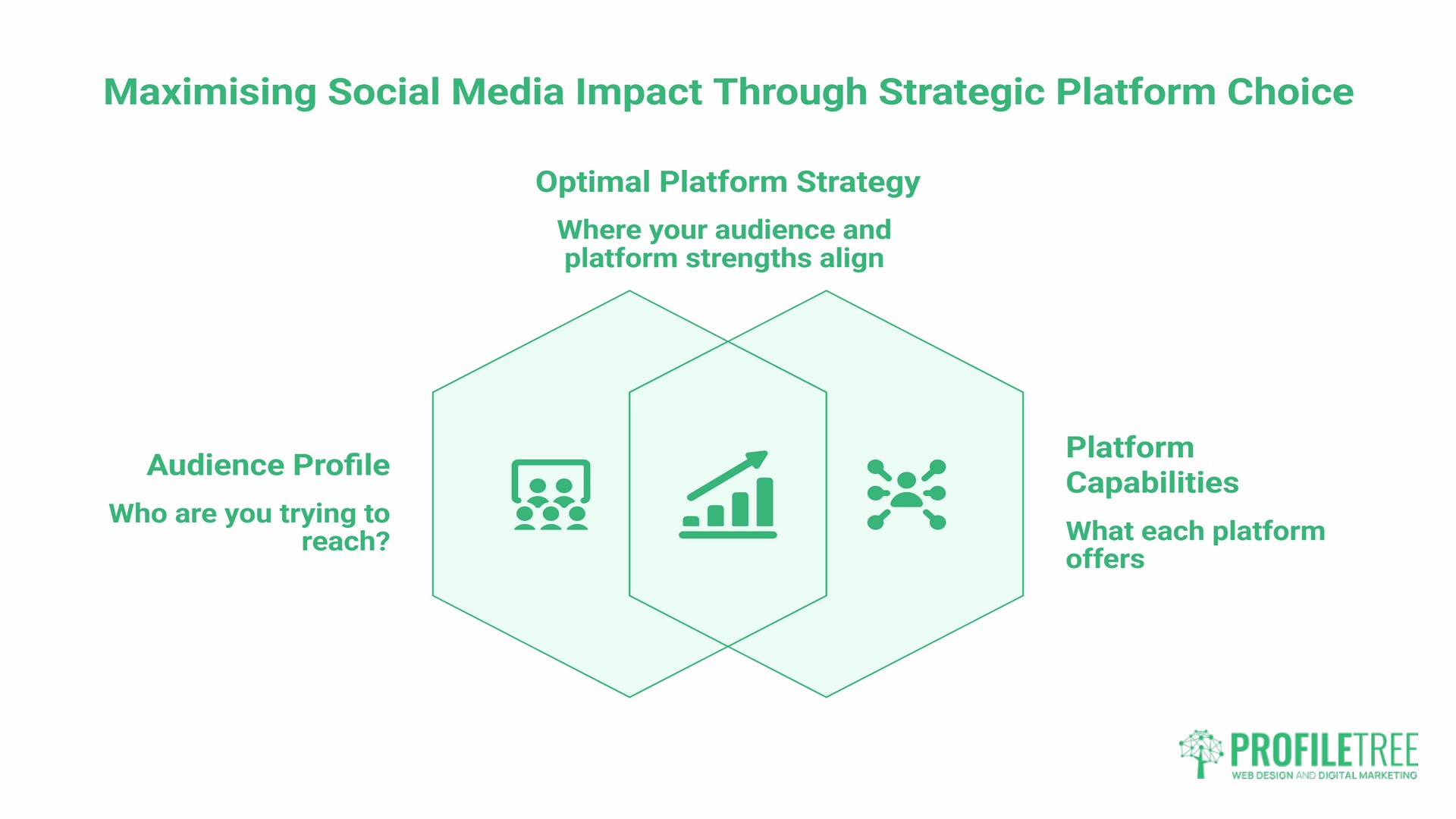
Platform selection is where most small businesses make their first strategic mistake when building a social media strategy for small businesses. They try to be active everywhere and end up producing thin, inconsistent content on six platforms rather than strong content on two.
The right platforms depend entirely on your audience profile.
| Business Type | Primary Platform | Secondary Platform |
|---|---|---|
| Local trades and services | ||
| Professional services (B2B) | Twitter/X | |
| Product-based retail | ||
| Hospitality and food | ||
| Education and training | YouTube |
This isn’t a rigid rule. Your audience research should confirm or challenge these defaults. A trades business with a strong younger customer base might find that Instagram outperforms Facebook. A B2B consultancy might find that LinkedIn generates almost all its leads. Let your data make the final call.
Here is what each major platform actually offers:
- Facebook is still the most widely used platform for local consumer businesses in Northern Ireland and the UK. It supports community groups, local advertising, and direct messaging, and its demographic skews 30 to 65. Useful for service businesses, trades, hospitality, and retail.
- Instagram works for businesses with strong visual output: food, interiors, fashion, fitness, architecture, and creative services. It requires consistent visual quality. Weak imagery damages credibility more than absence does.
- LinkedIn is the correct primary platform for B2B businesses, professional services, and anyone targeting senior decision-makers. It is where business owners and procurement managers spend their time. If you’re selling to other businesses, LinkedIn is not optional.
- TikTok is relevant for consumer businesses targeting under-35s and for businesses with the capacity to produce short, frequent videos. It has a steep learning curve and rewards consistency. Don’t start on TikTok unless you can commit to it for at least six months.
- YouTube has long-term compound value. Videos appear in Google search results and continue to generate views for years. It is high effort but high return for businesses that can invest in video production. ProfileTree’s own channels demonstrate how consistent YouTube publishing builds audiences that convert.
Before choosing new platforms, audit the ones you’re already using. For each one, ask: are you posting consistently, is your audience actually there, and are posts driving any measurable action? If the answer to two of those three is no, consolidate rather than expand.
Plan Content That Earns Engagement
Content planning sits at the heart of a working social media strategy for small businesses. The goal is to create content your target audience finds useful, shares, and acts on, while building credibility for your business over time.
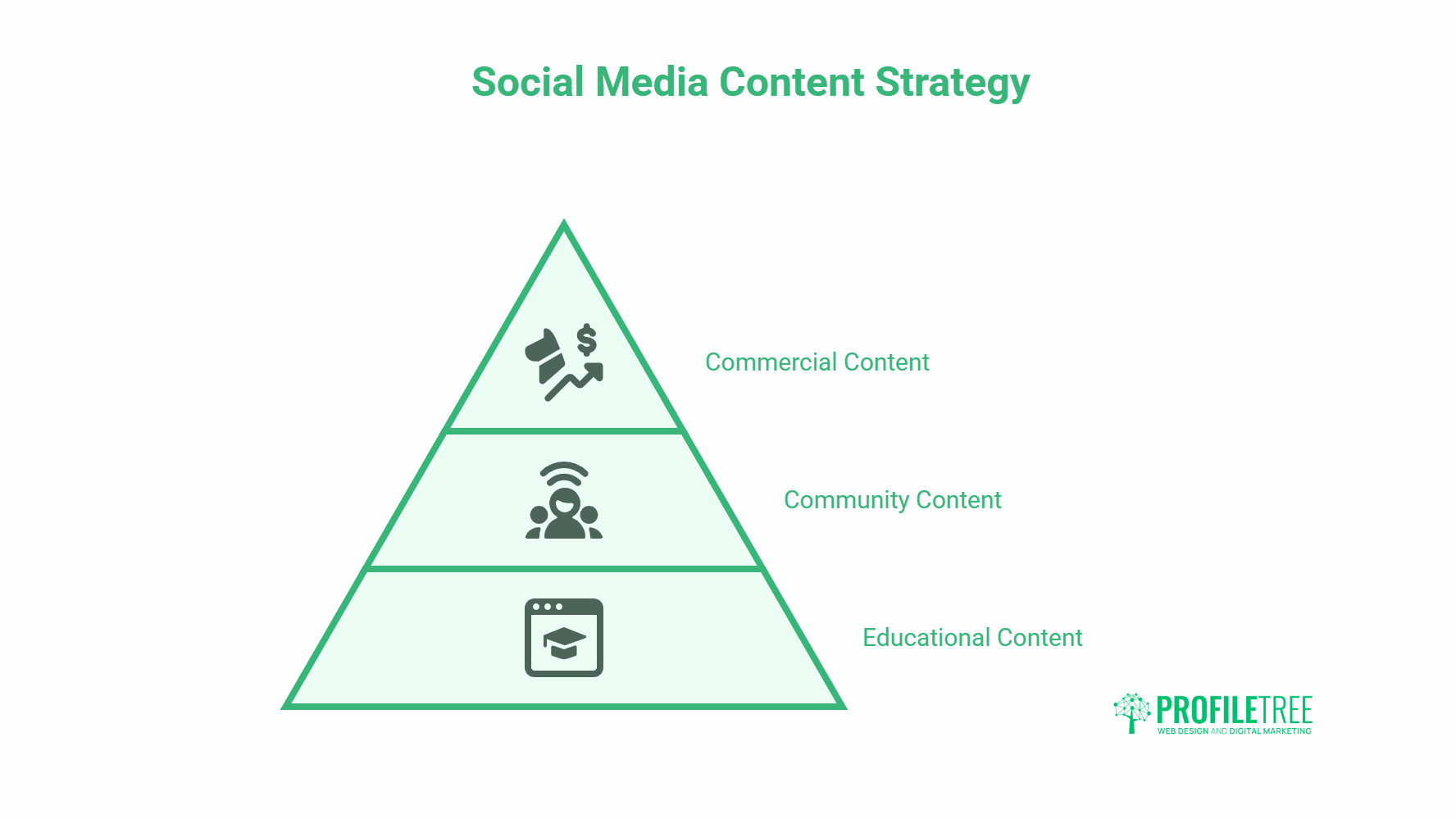
A practical content mix for most small businesses follows a rough 70/20/10 structure:
- 70% educational and informational: Posts that answer questions your customers have, explain how things work, or share useful knowledge. This builds trust and reach.
- 20% community and brand content: Behind-the-scenes posts, team updates, customer stories, and content that humanises the business.
- 10% direct commercial content: Service announcements, offers, case studies, and calls to action.
Most small businesses get this ratio backwards. They post primarily commercial content and wonder why engagement is low. Audiences engage with content that helps them, not content that sells at them.
What Works by Platform
- Facebook: Local proof performs well here. Client results, reviews, before-and-after work, community involvement, and behind-the-scenes content all generate genuine engagement from local audiences. Video outperforms static images in terms of reach.
- Instagram: Visual storytelling. Process content, finished work, team culture, and short-form video through Reels currently get the most organic reach. Product businesses do well here; service businesses need to make abstract services visual.
- LinkedIn: Thought leadership and professional insight. Share what you’ve learned from client work (anonymised where needed), comment on industry trends with a concrete point of view, and post content that helps your target buyers make better decisions. Avoid generic motivational content; it performs poorly with B2B audiences.
- YouTube: Long-form value. How-to content, service explainers, and case study walkthroughs build real authority over time. YouTube content also supports your SEO by increasing dwell time and building topical authority across the subjects your customers search for.
Building a Content Calendar
Consistency matters more than frequency. One well-considered post per week beats five posts of varying quality. A simple content calendar: block out content themes by week, assign post types (educational, proof, promotional, community), and batch-create content in advance.
Buffer, Later, and Hootsuite all handle scheduling well for small teams. The tool matters less than the habit.
Plan one month ahead in outline and two weeks ahead in detail. For each planned post, note the platform, content format (image, video, text, link), topic, goal, and any required assets.
Content Formats That Work
Video consistently generates more reach than static images on most platforms. Short-form video (under 60 seconds) is the dominant format on Instagram Reels, TikTok, and Facebook Reels. Longer explainer videos work well on LinkedIn and YouTube.
Carousels (multi-image posts) perform well on LinkedIn and Instagram for educational content because they encourage swipe-through behaviour. Text-only posts on LinkedIn often outperform image posts for engagement, particularly when they share a strong opinion or tell a specific story.
Use Your Brand Voice Consistently
Brand voice is the consistent personality behind your social media content. It’s not a style guide; it’s how your business sounds when it’s being itself across every post, response, and story.
Define your brand voice in three to five plain-language descriptors. For a local accountancy firm: straightforward, reassuring, precise. For a Belfast café: warm, local, unpretentious. For a B2B software company: direct, knowledgeable, no jargon.
Once you have those descriptors, apply them to every piece of content before publishing. If a post doesn’t sound like your business, rewrite it. Inconsistent voice is one of the most common reasons small business social media feels disjointed, and audiences notice it even when they can’t articulate why.
Brand voice also applies to how you respond to comments, direct messages, and reviews. A business that sounds warm and local in its posts but responds to complaints with corporate boilerplate sends a conflicting signal that erodes the trust built through content.
ProfileTree’s content marketing services help businesses develop a brand voice framework, one of the most underrated elements of any social media strategy for small businesses, and apply it consistently across digital content.
Engage With Your Audience
Posting content is one-half of social media. Responding to it is the other. Small businesses that post consistently but ignore comments, questions, and direct messages undermine the trust they’re building through their content.
Set a response standard: reply to all comments within 24 hours, direct messages within the same working day, and negative feedback within two hours. These reflect what customers consider acceptable and what platforms reward with increased organic reach. On Facebook, your response rate and response time are publicly displayed on your page, and a “Very responsive to messages” badge is a genuine trust signal for local service businesses.
Proactive engagement also matters. Commenting on posts from local businesses, industry accounts, and potential customers builds visibility and goodwill. This is particularly effective on LinkedIn, where thoughtful comments on industry discussions regularly generate profile visits and connection requests.
Customer complaints handled well on social media are visible to everyone who sees them. A measured, solution-focused response to a negative comment demonstrates professionalism more effectively than any promotional post.
Turn Social Media Activity into Enquiries
Social media builds awareness and trust. Converting that into actual business requires a clear path from content to contact.
Every social media profile should include a clear link to a relevant page on your website, not just the homepage. For a web design business, that link goes to the web design services page. For a restaurant, it goes to the reservations or menu page.
Within content, include a contextual call to action in roughly one in five posts. Not a hard sell: “We’ve just helped a Derry-based retailer redesign their website and cut page load time by 60%. If your site is slow or outdated, we’d be happy to take a look.” That’s a contextual call to action attached to a proof point, and it converts far better than a generic “contact us today.”
Link posts that drive website traffic should go to pages designed to convert, not blog posts with no conversion mechanism. The pages that receive social traffic need to be built to turn visitors into enquiries.
For businesses exploring how AI can improve their social media content and scheduling efficiency, ProfileTree’s AI transformation services help SMEs identify where automation adds genuine value without removing the human voice that makes social media work.
Measure What Actually Matters
No social media strategy for small businesses is complete without a clear measurement framework. Platforms surface dozens of metrics, but most of them are noise. The ones that matter connect directly to your business goals.
- For lead generation goals: Track referral traffic from social media in Google Analytics, form completions attributed to social referrals, and direct enquiries that mention social media.
- For brand awareness goals: Track reach (unique accounts reached), profile visits, and follower growth in your target geographic area.
- For engagement goals: Track comments and shares rather than likes. Comments indicate the content provoked a response. Shares extend reach organically.
- For retention goals: Track engagement from existing customers specifically, not aggregate engagement across all followers.
Review your metrics monthly. Look for patterns, not individual post-performance. One high-performing post tells you nothing. A consistent pattern of which content formats and topics generate results tells you where to invest more effort.
When you see that behind-the-scenes video generates three times the reach of product announcements, the correct response is to produce more behind-the-scenes video. Social media data is most useful as a feedback loop, not a report card.
Conduct a Basic Competitor Audit
Understanding what competitors are doing on social media is a useful context. Check their content mix, posting frequency, and engagement levels. More useful than copying them is identifying what they’re not doing. If every competitor in your sector posts only product images, a business that consistently shares useful industry knowledge stands out.
Conduct a basic competitor audit every six months: note their top three platforms, approximate posting frequency, content mix, and engagement levels. Then ask what gap you can credibly fill.
Building a social media strategy for small businesses that converts takes time to get right. If you’d like support developing one tailored to your business, ProfileTree works with SMEs across Northern Ireland and Ireland on social media, content marketing, and broader digital strategy.
Frequently Asked Questions
How much time should a small business spend on social media each week?
A realistic minimum for consistent presence is four to six hours per week, covering content creation, scheduling, and engagement. For most small businesses, this is manageable with a basic scheduling tool and a content plan. Maintaining six platforms with this time budget is not. Two platforms managed well is more effective than six managed poorly.
Do small businesses need to be on every social media platform?
No. You should be present on the platforms where your specific customers spend time. For most B2B businesses in Northern Ireland, LinkedIn is the priority. For most consumer-facing local businesses, Facebook and Instagram cover the majority of the opportunity. Being absent from platforms your customers don’t use has no negative effect.
How long does it take to see results from a social media strategy?
For organic social media, a social media strategy for small businesses typically takes three to six months of consistent activity before meaningful results emerge. Reach and engagement improve faster than lead generation. Paid social advertising produces results faster but requires a budget and ongoing management.
Should small businesses use paid social advertising alongside organic content?
Paid social is worth considering once you have a working organic strategy, because paid amplification of weak content wastes budget. Start with organic, identify which content resonates, then put budget behind your strongest performers. Even small budgets of £5-£10 per boosted post can significantly extend reach once you know what works.
What is the biggest mistake small businesses make on social media?
The most common mistake is inconsistency: posting heavily for a few weeks, going quiet, then posting again. Algorithms favour consistent accounts, and audiences lose confidence in businesses that disappear. A lower posting frequency consistently maintained produces better long-term results than bursts of activity followed by silence.
How do I know if my social media strategy is working?
Compare your results to your stated goals, not to industry benchmarks or competitor follower counts. If your goal is lead generation, the only metric that matters is enquiries attributed to social media. Review monthly, adjust quarterly.
Should I manage social media myself or hire someone?
Many small business owners manage their own social media effectively, particularly in the early stages when authentic, personal content often performs better than polished agency output. As the business grows, the time cost increases. A digital marketing agency can handle strategy, content creation, and paid campaigns while you focus on running the business.