
Email Marketing: A Practical Guide for UK Business Owners
Table of Contents
Email marketing means sending commercial messages to people who have actively agreed to receive them. For UK businesses, the work splits three ways: building your list from customers and enquirers who already know you and never buy one, meeting PECR and UK GDPR consent rules with recorded consent or a valid soft opt-in, and putting your first effort into automated sequences rather than one-off campaigns. Expect to pay around £10 to £15 a month at 500 contacts, rising to £70 to £120 at 10,000. Measure click rate and revenue per send, not open rate, and give the channel six months before judging it.
Email marketing is worth your time if you have repeat customers and something useful to say each month, but it is not worth your time if you want quick wins from a purchased list. The channel pays back through permission, consistency, and automation, in that order.
Most business owners already suspect that email works, but far fewer know what running it actually takes, what it costs, or what the law expects of them. This email marketing guide answers those questions plainly, without the hype that usually surrounds the channel.
What Does Email Marketing Involve Now?
Email marketing is the practice of sending commercial messages to people who actively asked to hear from you. That last part matters more than anything else in this guide. The whole channel rests on permission, so everything worthwhile about it follows from how you collect that permission.
How Has Email Marketing Changed?
The mechanics have shifted quietly over the past few years. Bulk sending to a whole list is now the weakest use of the tool. The money sits in automated sequences triggered by behaviour, such as a welcome series that runs after signup or a follow-up that lands a week after a purchase.
Measurement has changed alongside it. Apple’s Mail Privacy Protection pre-loads tracking pixels and registers an open whether a human read the message or not. Industry analysis suggests this inflates open rates by roughly 15 to 20 percentage points. Click rates and revenue per send now tell you far more than the metric most owners quote.
Does Email Marketing Suit Your Business?
Email marketing works best when you have something worth saying repeatedly and customers who buy more than once. That is why professional services, retailers, hospitality, trades with maintenance cycles, and membership organisations all tend to do well with it.
It works less well if you sell a once-in-a-lifetime purchase to strangers. Even then, a short nurture sequence for enquirers who are not ready to buy often earns its keep. Our team at ProfileTree, a Belfast-based web design and digital marketing agency, sees that pattern repeat across client accounts. If you are weighing the channel against other options, our digital strategy service exists to make exactly that call with you.
How Do You Build an Email Marketing List Without Buying One?
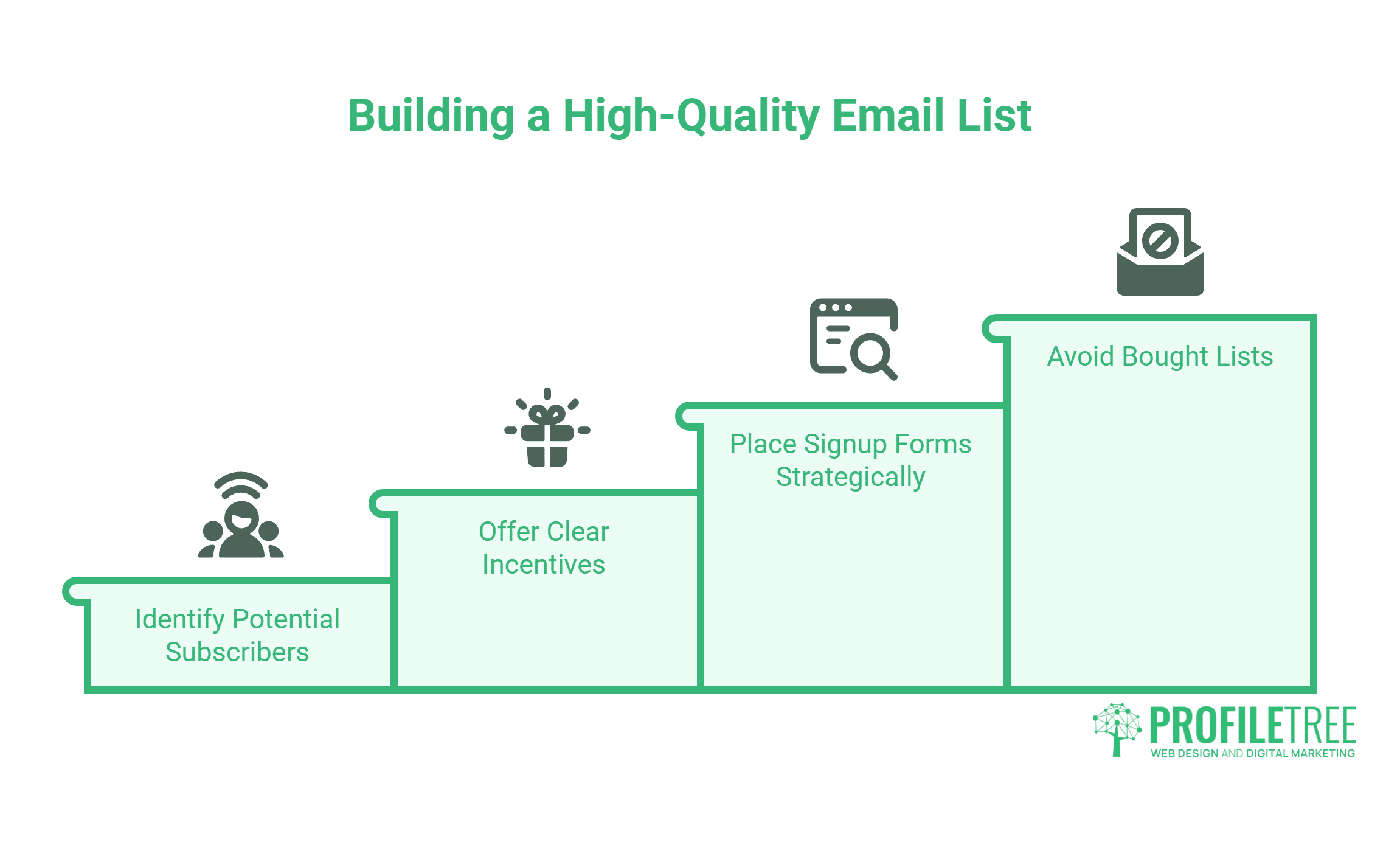
A list is not really a collection of addresses; it’s a group of people who chose to hear from you. That choice is precisely what makes the channel work. Since nobody can buy a choice on someone else’s behalf, bought lists fail before the first send.
Where Do the First Subscribers Come From?
Start with the people already in front of you. Website visitors, existing customers, enquirers who did not convert, event attendees, and social followers are all warmer than any purchased contact.
Each of those groups needs a clear reason to subscribe, so offer a discount for retail, a useful checklist for services, or early access for anything sold in limited stock. Vague promises of a newsletter convert badly because nobody wants more email in the abstract.
Place the signup form where attention already exists, which usually means the end of your popular blog posts, the checkout confirmation page, and the footer of every page. A timed popup helps too, provided you set it late enough that it does not interrupt someone’s first read.
Why are Bought Lists a Dead End?
Three problems should settle the question for any email marketing programme, and the first is legal: addresses obtained from a broker have not consented to hear from you. The second is technical: bought files are riddled with spam traps that will get your sending domain blocked long before your reputation recovers.
The ICO is explicit that no third-party list complies with the soft opt-in exemption. Rented and brokered data always requires genuine consent, and a broker’s assurance does not count on the recipient’s behalf. Scraping addresses from websites carries exactly the same problem in a cheaper wrapper.
The third problem is commercial: people who never asked for your email do not open it. You end up paying every month for contacts who dilute every metric you rely on.
What Should You Send, and How Often?
The question most owners ask is what to write, but the better question is what the reader actually wants to receive. That determines whether anything gets opened at all.
Which Emails Earn Their Place?
Automated sequences do the heavy lifting in email marketing, and the gap is wider than most owners expect. Across more than 180,000 brands studied by Klaviyo, automated flows produced around 41% of email revenue from roughly 5% of sends. Start with welcome sequences, abandoned basket reminders, and post-purchase follow-ups because each one catches a customer who has already shown interest.
Regular campaigns still matter, but every one of them needs a job to do. That might be a genuine offer, useful guidance, a product that solves a known problem, or news that affects the reader. Company announcements that serve only your own ego rarely qualify.
A simple test sorts the two apart. If the message would be welcome arriving from a competitor, it is probably useful. If it would only ever be tolerated, it needs rewriting.
How Often is Too Often?
Email marketing frequency depends on what you sell and how much you genuinely have to say. Most small businesses land somewhere between fortnightly and monthly for campaigns, with automated messages running in the background regardless.
Consistency matters more than volume here because a monthly email that always arrives is worth far more than a weekly one that stops after six weeks. Set your cadence at a level you can sustain during your busiest month, not your quietest.
Rather than guessing, watch your unsubscribes and spam complaints. Treat complaints climbing above roughly 0.1% as the signal to slow down since Gmail and Microsoft both enforce that threshold seriously.
What Do the UK Email Marketing Rules Say in Plain Words?
The rules are narrower than most people fear and stricter than most people follow. Two pieces of law apply to every send you make, and they work together.
What Counts as Consent?
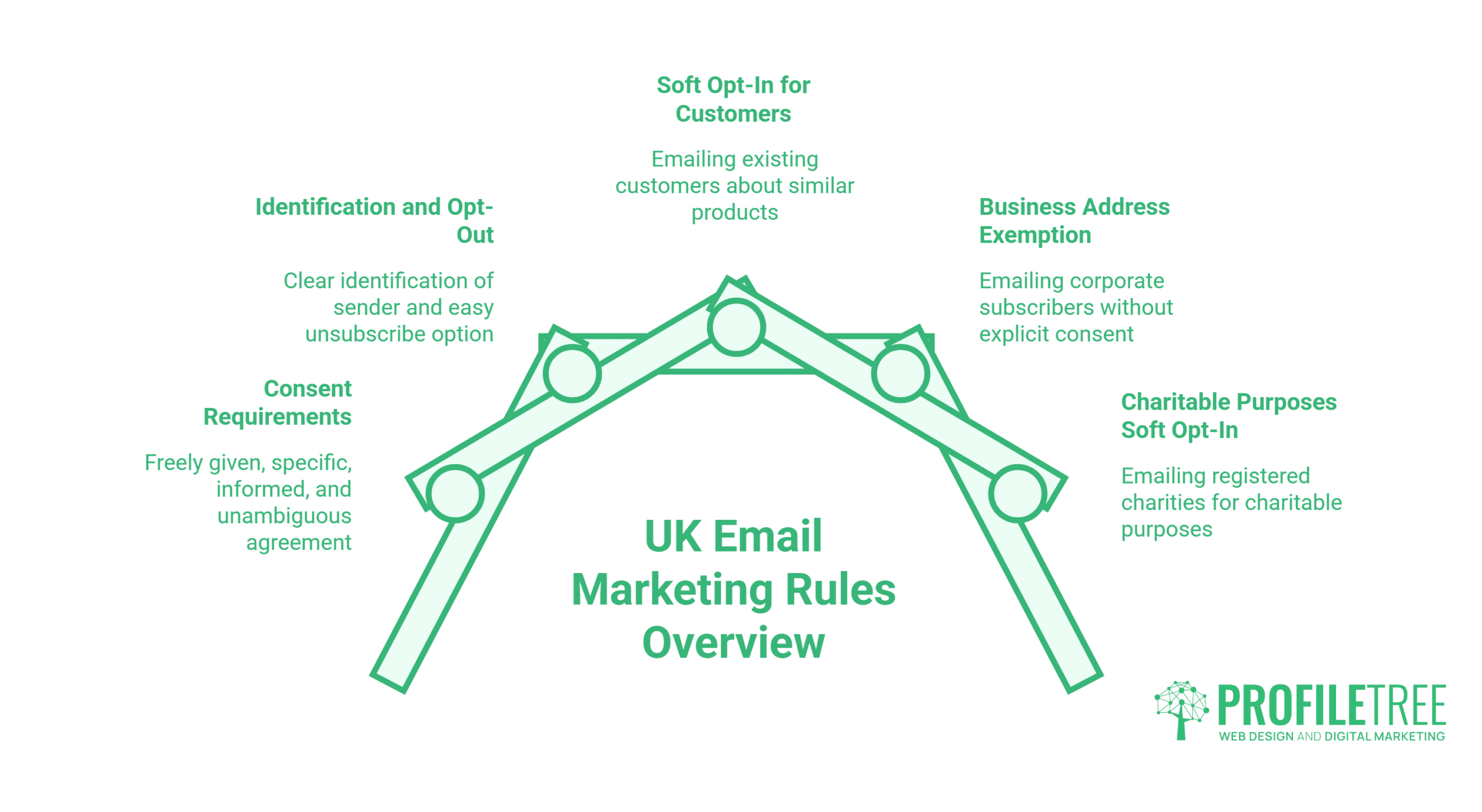
The Privacy and Electronic Communications Regulations, known as PECR, govern email marketing and other electronic mail. UK GDPR supplies the standard of consent, which must be freely given, specific, informed, and unambiguous.
In practice, that means an unticked box that the person actively ticks themselves. It does not mean a pre-ticked box, a buried line in your terms, or consent bundled into a competition entry. You also need to keep records of when and how each person agreed because the burden of proof sits with you.
Every email marketing message must identify you clearly and give a valid contact address. The unsubscribe route must be as easy as the original signup. The ICO’s April 2026 guidance leans hard on both points, so treat them as the minimum, not just good practice.
When Can You Email Without Consent?
Two exemptions exist, and the first is the products and services soft opt-in; it lets you email your own customers about similar products, provided you collected their details during a sale or a sales negotiation. You must also have offered an opt-out at that moment and in every message since.
Business addresses at corporate subscribers sit outside the consent rule altogether, though the identification and opt-out duties still apply. Remember that sole traders and most partnerships count as individuals, not corporate subscribers.
A charitable purposes soft opt-in also arrived in February 2026 for registered charities, covering contact details collected from that date onwards. Read the ICO’s guidance on direct marketing using electronic mail before you rely on any exemption.
What Does Email Marketing Cost to Run?
Platform pricing has moved against small senders over the past two years, so older advice tends to understate this. Free tiers have been cut repeatedly across most of the major providers.
What Do the Platforms Charge?
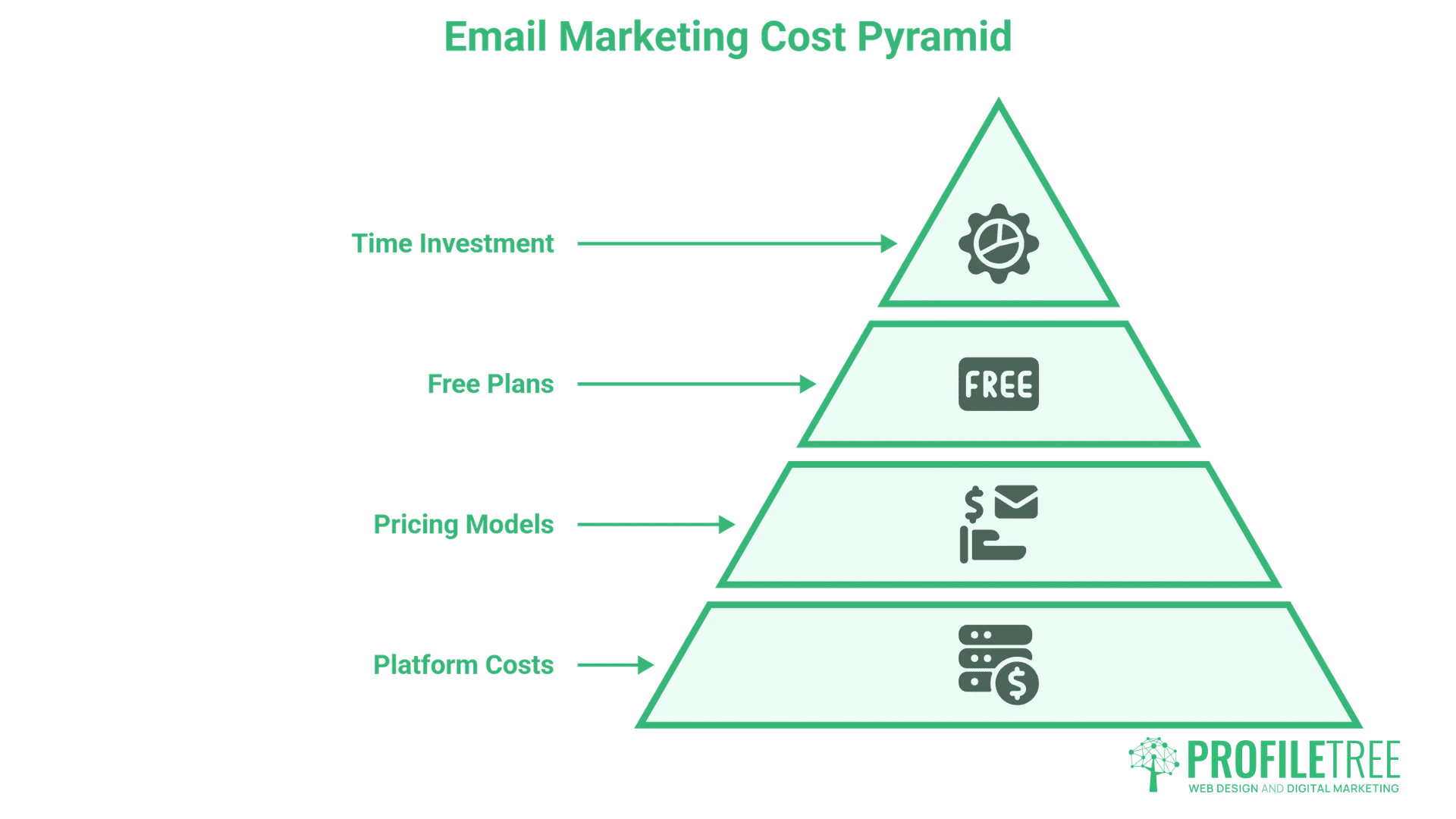
Expect roughly £10 to £15 a month for a list of around 500 contacts on most mainstream platforms. That rises to between £70 and £120 a month at 10,000 contacts, with e-commerce specialists such as Klaviyo at the higher end.
Pricing models differ in ways that matter to the final bill. Some providers charge on contacts stored while others charge on emails sent, and a few count unsubscribed contacts towards your limit until you archive them by hand. Check which model applies before you commit because switching later means migrating your automations too.
Free plans do still exist, but they are tighter than they were. Several now cap you at a few hundred contacts, with daily send limits and provider branding on every message.
What About the Time Cost?
This is the figure most owners underestimate. A single email marketing campaign takes two to four hours once you account for writing, design, testing, and scheduling. A welcome sequence properly takes the better part of a day.
The good news is that automation front-loads the work, so time spent building a sequence keeps paying out for years. That is why the automated layer deserves your first day, not your tenth campaign.
What Results Should You Expect from Email Marketing?
Published email marketing statistics are generous, often quoting £36 or more for every £1 spent. Treat those as a ceiling produced by mature programmes, not a forecast for your first quarter.
Which Numbers are Worth Watching?
Click rate, revenue per send, and list growth are the three worth tracking. Open rate has been an unreliable proxy for human attention ever since privacy tools began inflating it.
Email marketing benchmarks vary by sector. Campaign click rates around 1.5% to 2% are common, whilst automated flows run considerably higher. Your own trend line matters more than any industry average you read.
Track unsubscribes and bounces as health indicators too, since a list decays by roughly a fifth each year through job changes and abandoned addresses. Steady growth amounts to maintenance rather than ambition.
How Long Before it Pays Back?
Give email marketing six months before you judge it. The first two months cover setup and list building, the next two produce early signal, and only then do you have data worth optimising against.
Small lists can still perform well in the meantime. A list of 800 engaged customers regularly outperforms 8,000 indifferent ones and costs far less to maintain.
Ready to Make Email Marketing Work for Your Business?
Most email marketing programmes fail for want of a plan, not a lack of effort, which is where a second opinion pays for itself. ProfileTree builds the strategy, the sequences, and the website infrastructure that make the channel pay for businesses across Northern Ireland, Ireland, and the UK. Talk to our team about where email marketing fits into your wider digital strategy, and we will tell you honestly whether it deserves your budget this year.
FAQs About Email Marketing
These are the questions business owners ask most often before committing to the channel. Each answer assumes a UK sender with a modest list and no dedicated marketing team.
Is email marketing still worth it for a small business?
Yes, for most. It remains one of the few channels you own outright, with no algorithm deciding who sees your message. The caveat is that it rewards consistency above everything else, so it suits owners who can commit to a monthly rhythm, not a one-off push.
How do I start email marketing from nothing?
Pick a platform with a free tier and add a signup form with a specific incentive, then write a three-part welcome sequence before you write a single campaign. Import existing customers only where you can evidence consent or meet the soft opt-in tests. Send your first campaign within a fortnight because a list that never hears from you goes cold quickly.
Can I email people who gave me their business card?
Usually yes, if the card carries a corporate email address and your message relates to their work. You should keep a suppression list of anyone who objects. Personal addresses and sole traders are different because they need either consent or a valid soft opt-in.
Do I need consent for existing customers?
Not necessarily. The products and services soft opt-in covers customers whose details you collected during a sale. It applies as long as you offered an opt-out then and in every message since, and you only market similar products.
What is a good open rate?
Less meaningful than it used to be. Reported averages range widely because privacy tools inflate them. Compare your figure against your own history instead, and prioritise click rate when you need a number that reflects real attention.
How big does my list need to be?
There is no meaningful threshold. A few hundred engaged subscribers can generate real revenue, particularly for higher-value services where a single conversion covers a year of platform fees.
Should I use AI to write my emails?
For drafting and subject line variants, yes, with editing. Readers notice generic writing quickly, and the channel depends on sounding like a person, not a template.
What happens if I get the rules wrong?
The ICO can fine you for email marketing breaches, and complaints from recipients are usually what triggers an investigation in the first place. Most enforcement follows the same pattern: no evidence of consent or an unsubscribe process that quietly did not work.