
Ecommerce SEO Services: Driving Organic Sales for Online Stores
Table of Contents
Ecommerce SEO services focus specifically on improving organic search visibility for online stores, helping retailers attract shoppers actively searching for products they sell. ProfileTree provides ecommerce SEO services from Belfast, helping online retailers across Northern Ireland, Ireland, and the UK generate more organic traffic and sales without relying entirely on paid advertising.
Online retail competition intensifies every year. Paid advertising costs continue rising, squeezing margins for retailers dependent on Google Shopping and social ads. Ecommerce SEO offers an alternative: sustainable organic traffic that doesn’t stop when you stop paying. Ranking on page one for product and category searches puts your store in front of buyers at the exact moment they’re ready to purchase.
Why Ecommerce SEO Differs from Standard SEO
While fundamental SEO principles apply universally, ecommerce sites face unique challenges requiring specialist approaches.
Scale and Complexity
Most business websites have dozens or perhaps hundreds of pages. Ecommerce sites often have thousands or tens of thousands:
| Site Type | Typical Page Count | SEO Complexity |
| Brochure website | 10-50 pages | Low |
| Service business | 50-200 pages | Medium |
| Small ecommerce | 200-2,000 pages | High |
| Medium ecommerce | 2,000-20,000 pages | Very high |
| Large ecommerce | 20,000-500,000+ pages | Extremely high |
This scale creates challenges in:
- Ensuring all pages get crawled and indexed
- Maintaining quality across thousands of product pages
- Managing internal linking at scale
- Preventing duplicate content issues
- Prioritising optimisation efforts
Constantly Changing Inventory
Unlike static service pages, ecommerce sites change constantly:
- New products added regularly
- Old products discontinued
- Seasonal inventory rotations
- Stock levels affecting availability
- Price changes impacting competitiveness
SEO strategies must accommodate this dynamism without creating technical problems.
Commercial Intent Competition
Product searches carry high commercial intent, making them extremely competitive:
- Major retailers invest heavily in SEO
- Marketplaces like Amazon dominate many searches
- Comparison sites compete for informational queries
- Google Shopping results reduce organic real estate
Winning requires sophisticated strategy and sustained effort.
Technical Demands
Ecommerce platforms create technical SEO challenges:
- Faceted navigation generating duplicate URLs
- Session IDs and tracking parameters
- Pagination across category pages
- Product variants creating near-duplicate content
- Site speed with image-heavy pages
- Mobile usability with complex functionality
Core Components of Ecommerce SEO Services
Effective ecommerce SEO addresses multiple interconnected areas.
Technical SEO for Ecommerce
Technical foundations determine whether search engines can effectively crawl, index, and rank your store.
Crawl Budget Optimisation
Search engines allocate limited crawling resources to each site. Ecommerce sites must ensure crawlers spend time on important pages:
- Blocking low-value pages from crawling (filters, sorts, internal search results)
- Using robots.txt strategically
- Implementing pagination correctly
- Managing parameter handling in Search Console
- Creating logical XML sitemaps
Site Architecture
How products are organised affects both users and search engines:
- Logical category hierarchy (no more than 3-4 levels deep)
- Clear URL structure reflecting hierarchy
- Breadcrumb navigation for context
- Internal linking distributing authority
- Flat architecture keeping products accessible
Page Speed Optimisation
Slow sites lose both rankings and conversions:
- Image compression and lazy loading
- Code minification and combining
- Caching implementation
- CDN utilisation
- Core Web Vitals optimisation
Mobile Optimisation
Most ecommerce traffic now comes from mobile devices:
- Responsive design across all templates
- Touch-friendly navigation and buttons
- Mobile page speed priorities
- Checkout process mobile testing
Schema Markup for Products
Structured data enables rich results in search:
Product schema elements:
– Product name and description
– Price and currency
– Availability status
– Review ratings and count
– Brand and SKU
– Images
Rich snippets with prices, ratings, and availability improve click-through rates significantly.
ProfileTree’s website development services include technical SEO optimisation for ecommerce platforms.
Product Page Optimisation
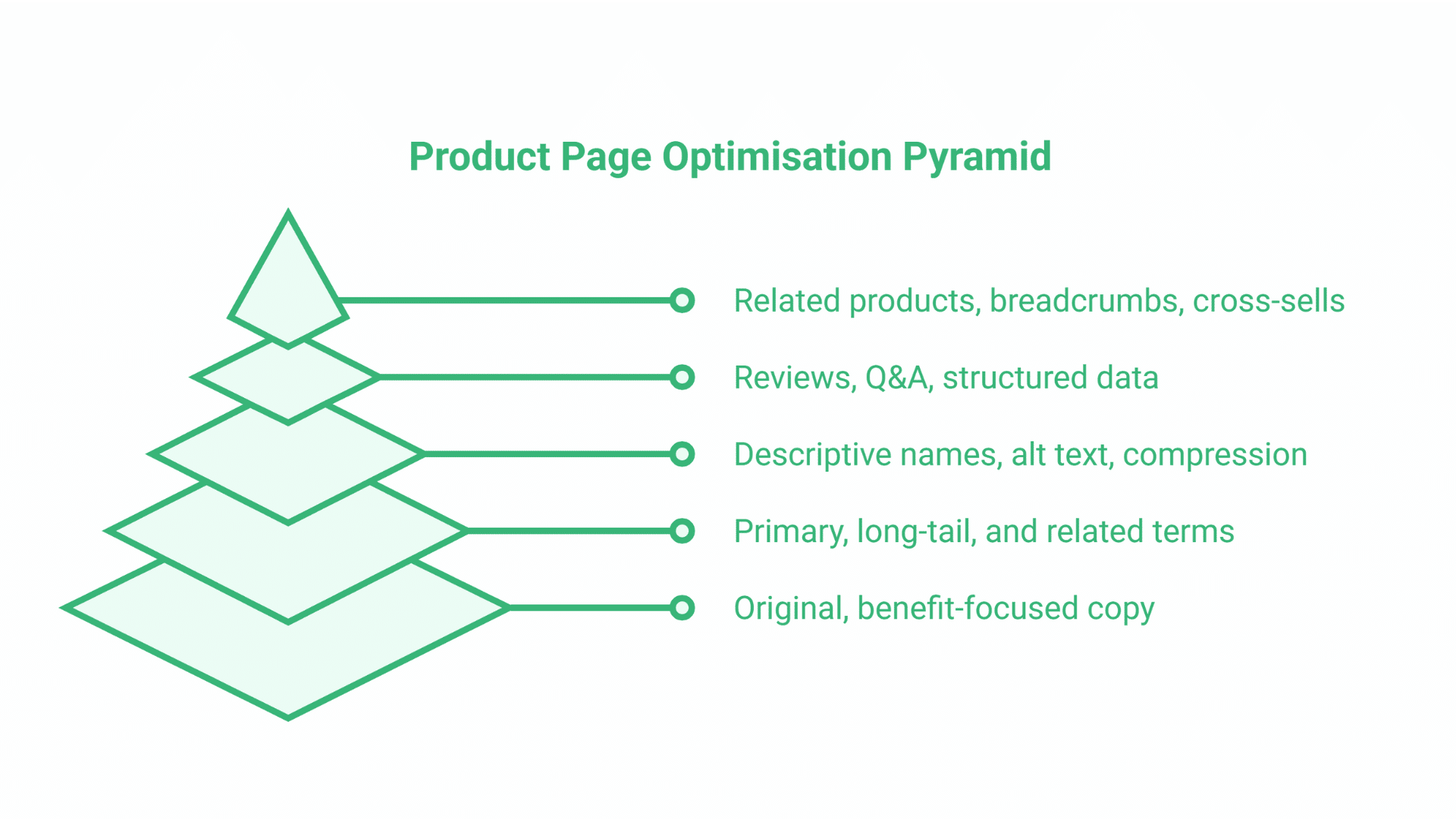
Individual product pages are where purchases happen. Optimisation priorities include:
Unique, Compelling Product Descriptions
Manufacturer descriptions used across multiple retailers create duplicate content. Effective product pages feature:
- Original descriptions written for your audience
- Benefits-focused copy, not just specifications
- Natural keyword integration
- Answers to common customer questions
- Persuasive elements driving purchase
Strategic Keyword Targeting
Each product page should target specific search terms:
- Primary product keyword in title and H1
- Long-tail variations throughout description
- Related terms and synonyms naturally included
- Search intent alignment (transactional focus)
Image Optimisation
Product images significantly impact both rankings and conversions:
- Descriptive file names (blue-running-shoes-nike-air.jpg, not IMG_4532.jpg)
- Alt text describing the product
- Multiple angles and zoom functionality
- Compressed files for fast loading
- WebP format where supported
User-Generated Content
Reviews and Q&A provide unique, keyword-rich content:
- Review functionality encouraging customer feedback
- Q&A sections addressing common queries
- Structured data markup for reviews
- Response management for negative reviews
Internal Linking
Product pages should connect to related content:
- Related products suggestions
- Category breadcrumb links
- Links to buying guides or comparison content
- Cross-sells and upsells
Category Page Optimisation
Category pages often carry more SEO weight than individual products, targeting broader keywords with higher search volumes.
Category Page Content
Many retailers neglect category page content, missing significant opportunity:
- Introductory content explaining the category
- Buying guide elements helping selection
- FAQs addressing common questions
- Internal links to subcategories and key products
Filtering and Faceted Navigation
Faceted navigation allows users to filter by attributes (size, colour, price, brand). Without proper handling, this creates SEO problems:
| Issue | Solution |
| Duplicate content from filter combinations | Canonical tags to main category |
| Crawl budget waste on filter URLs | Robots.txt or noindex for filters |
| Indexable filter pages cannibalising | Strategic index/noindex decisions |
| Useful filter combinations not indexable | Selective indexing for valuable combinations |
Pagination
Categories with many products span multiple pages:
- Proper rel=”next” and rel=”prev” implementation
- Self-referencing canonicals on paginated pages
- “View all” options where practical
- Infinite scroll with crawlable fallback
Content Marketing for Ecommerce
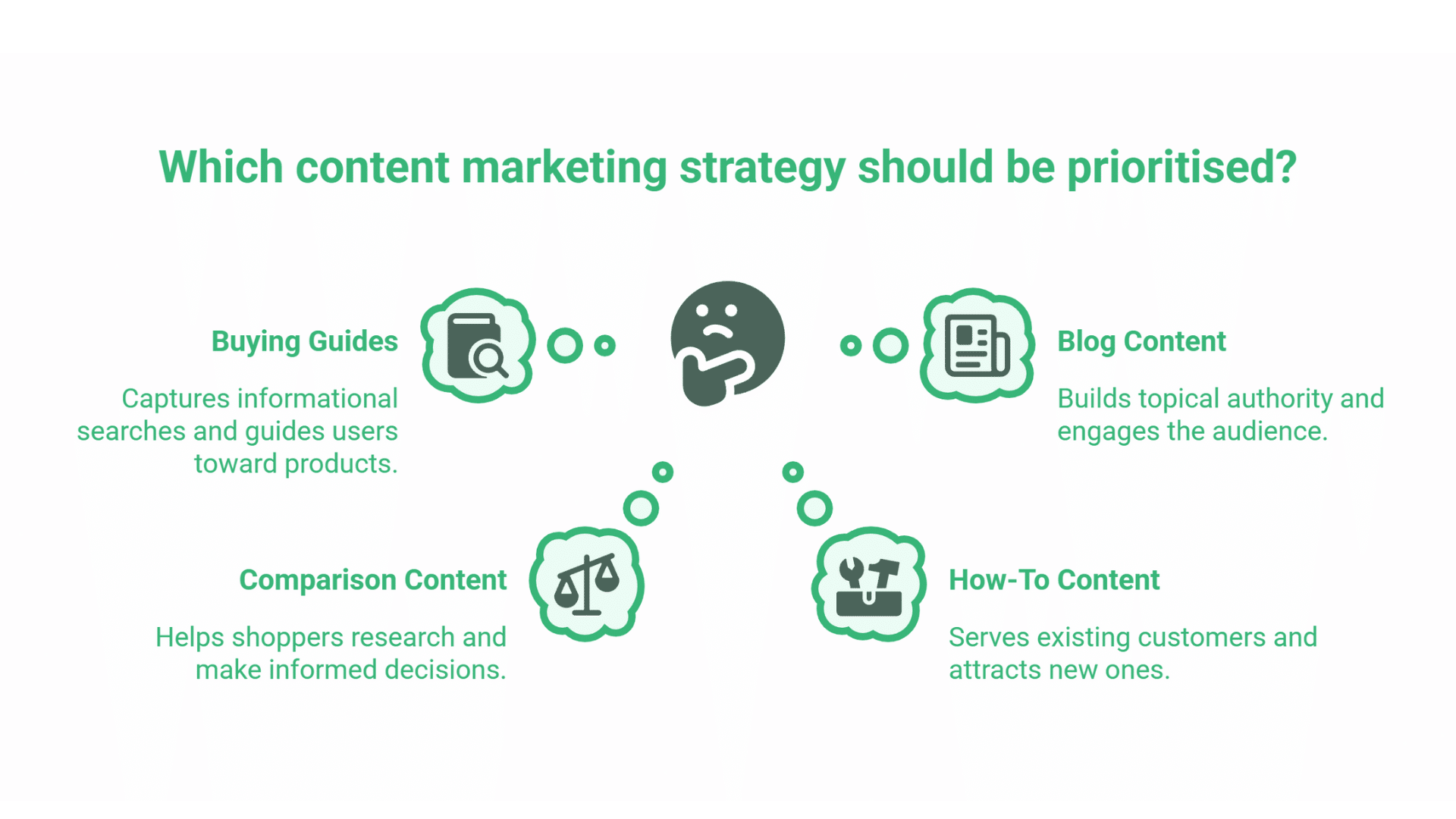
Beyond product and category pages, content marketing builds authority and captures earlier-stage searches.
Buying Guides
Comprehensive guides helping customers choose:
- “How to Choose the Right Running Shoes”
- “Complete Guide to Coffee Machines for Home
- “What Size TV Do I Need? Room Size Calculator”
These capture informational searches and guide users toward products.
Comparison Content
Shoppers research before purchasing:
- Product vs product comparisons
- Brand comparisons within categories
- “Best X for Y” roundups (best laptops for students)
- Feature comparisons across price points
How-To and Tutorial Content
Content serving existing customers also attracts new ones:
- Product usage tutorials
- Care and maintenance guides
- Project ideas using products
- Troubleshooting common issues
Blog and Resource Content
Regular content publishing builds topical authority:
- Industry news and trends
- Seasonal content and gift guides
- Expert interviews and insights
- Behind-the-scenes and brand content
ProfileTree’s content marketing services support ecommerce content strategy and creation.
Link Building for Ecommerce
Authority signals remain crucial for competitive ecommerce rankings.
Product-Based Link Building
Products themselves create link opportunities:
- Product reviews from bloggers and publications
- Gift guide inclusions for seasonal content
- Industry award submissions
- Product photography used by others (with attribution)
Content-Driven Link Building
Valuable content attracts natural links:
- Original research and surveys
- Comprehensive resource guides
- Interactive tools and calculators
- Infographics and visual content
Digital PR for Ecommerce
Media coverage generates authoritative links:
- Product launches and announcements
- Company news and milestones
- Expert commentary on industry trends
- Newsjacking relevant stories
Supplier and Partner Links
Business relationships provide link opportunities:
- Authorised retailer listings on manufacturer sites
- Partner and stockist directories
- Industry association memberships
- Chamber of commerce listings
Ecommerce SEO by Platform
Different platforms present different SEO capabilities and challenges.
Shopify SEO
Shopify powers many small to medium ecommerce sites. SEO considerations include:
Shopify Strengths:
- Clean, mobile-responsive themes
- Built-in SSL certificates
- Automatic sitemap generation
- Reasonable page speed out of the box
Shopify Limitations:
- Limited URL structure flexibility
- Forced /collections/ and /products/ URL prefixes
- Basic robots.txt customisation
- Limited pagination control
Shopify SEO Priorities:
- Theme selection and speed optimisation
- Collection and product page content
- App selection avoiding bloat
- Redirect management for discontinued products
- Structured data implementation
ProfileTree provides Shopify website design with SEO best practices built in.
WooCommerce SEO
WooCommerce runs on WordPress, offering flexibility with complexity:
WooCommerce Strengths:
- Complete URL structure control
- Extensive plugin ecosystem
- Full technical customisation
- WordPress SEO plugin compatibility
WooCommerce Limitations:
- Performance can degrade with scale
- Plugin conflicts create issues
- Requires more technical management
- Security needs ongoing attention
WooCommerce SEO Priorities:
- Hosting and performance optimisation
- Category structure planning
- Plugin selection and configuration
- Image optimisation systems
- Schema markup implementation
Magento SEO
Magento suits larger, more complex ecommerce operations:
Magento Strengths:
- Built for scale and complexity
- Advanced category and attribute handling
- Multi-store capability
- Extensive customisation options
Magento Limitations:
- Resource-intensive hosting requirements
- Steeper learning curve
- Higher development costs
- Complex upgrade paths
Magento SEO Priorities:
- Layered navigation configuration
- Canonical and duplicate content management
- Site speed optimisation
- XML sitemap management
- Structured data implementation
BigCommerce SEO
BigCommerce offers enterprise features in a hosted platform:
BigCommerce Strengths:
- No transaction fees
- Built-in multi-channel selling
- Good SEO features out of box
- Scalable infrastructure
BigCommerce Limitations:
- Template customisation constraints
- Pricing tiers limit features
- Smaller app ecosystem than Shopify
- Less community support
Measuring Ecommerce SEO Success
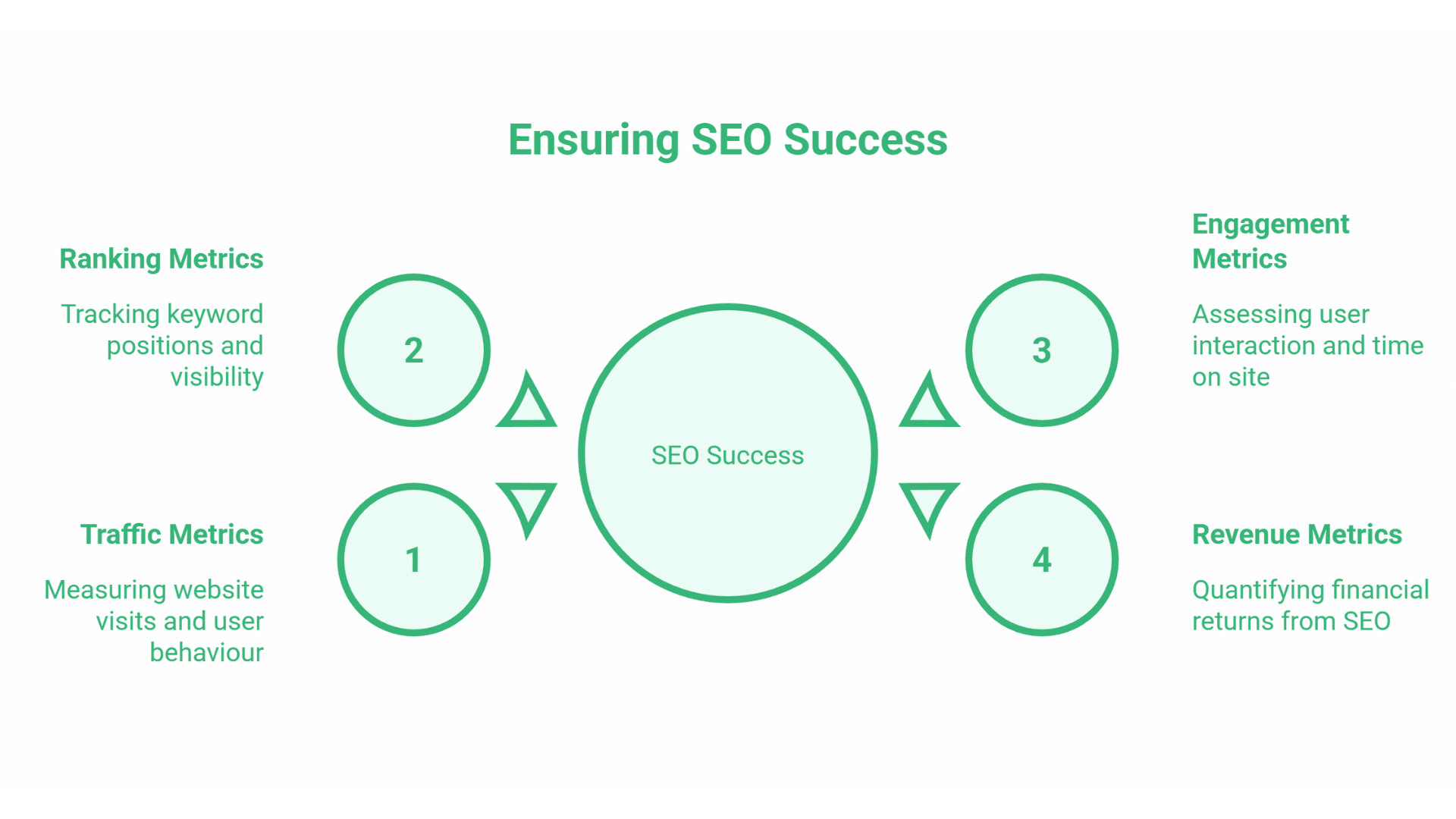
Effective measurement ensures SEO efforts deliver business results.
Key Performance Indicators
Track metrics connecting SEO activity to business outcomes:
Traffic Metrics:
- Organic sessions (total and by page type)
- New vs returning organic visitors
- Organic traffic by device
- Landing page distribution
Ranking Metrics:
- Category keyword positions
- Product keyword positions
- Keywords in top 10/top 3
- Featured snippet captures
- Rich result appearances
Engagement Metrics:
- Bounce rate by page type
- Pages per session from organic
- Time on site from organic
- Product views per session
Revenue Metrics:
- Organic revenue (direct attribution)
- Organic-assisted revenue
- Conversion rate from organic traffic
- Average order value from organic
- Revenue per organic session
Attribution Challenges
Ecommerce attribution is complex:
- Customers often research on one device, purchase on another
- Multiple touchpoints precede purchase
- Organic search may introduce customers who convert via other channels
- Cookie restrictions reduce tracking accuracy
Focus on directional trends rather than precise attribution.
Reporting Frequency
Different metrics warrant different review frequencies:
| Metric Type | Review Frequency |
| Traffic and revenue | Weekly |
| Rankings | Weekly to fortnightly |
| Technical health | Monthly |
| Content performance | Monthly |
| Strategic review | Quarterly |
Common Ecommerce SEO Mistakes
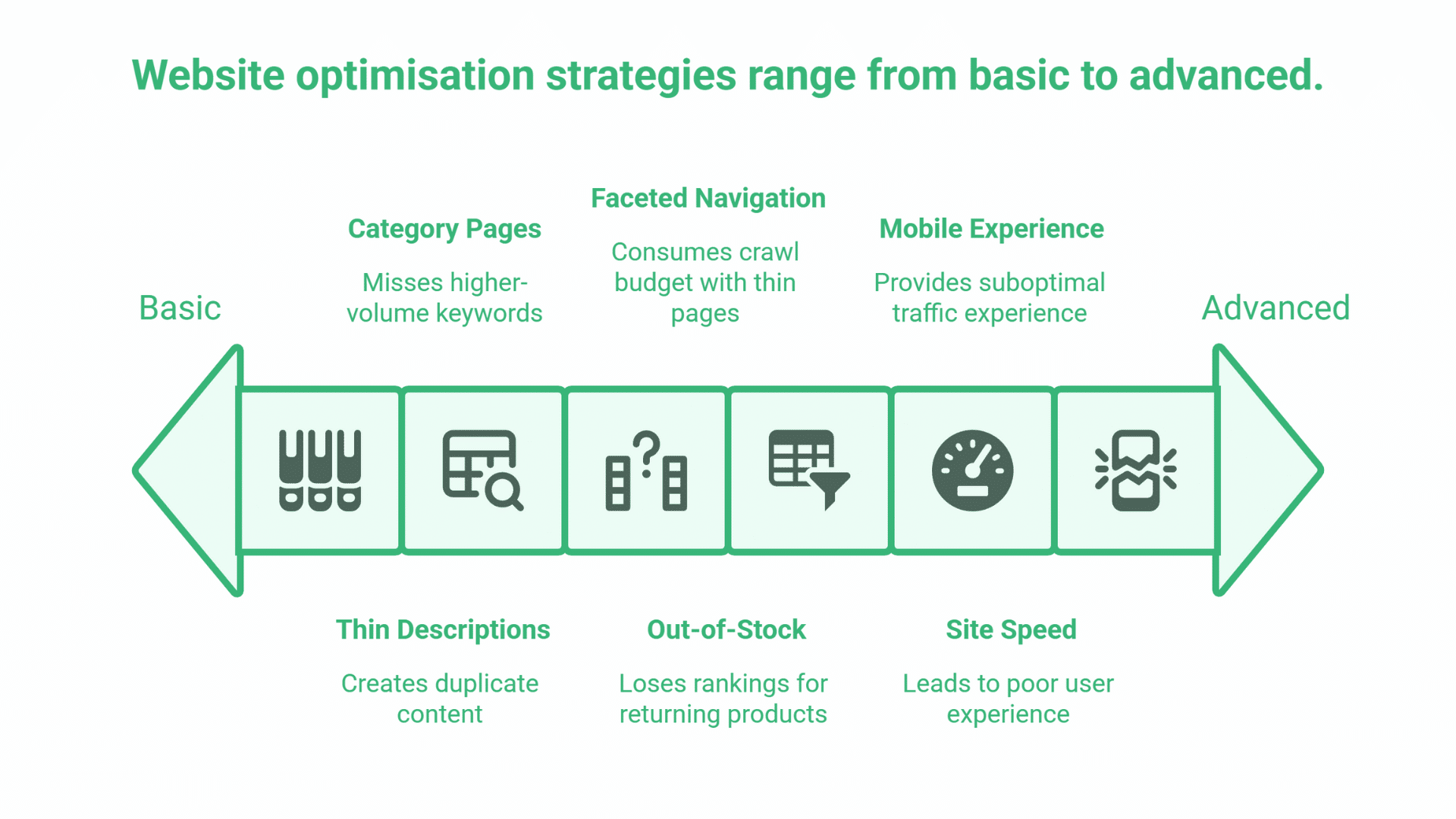
Avoiding common pitfalls accelerates results.
Thin Product Descriptions
Using manufacturer descriptions or minimal content:
Problem: Duplicate content across retailer sites, no differentiation Solution: Unique, comprehensive product descriptions for key products
Ignoring Category Pages
Focusing only on product pages:
Problem: Missing higher-volume category keywords Solution: Category page content strategy with unique, helpful content
Poor Handling of Out-of-Stock Products
Deleting or redirecting out-of-stock pages inappropriately:
Problem: Losing rankings for products that may return Solution: Keep pages live with clear messaging and alternatives
Faceted Navigation Disasters
Allowing all filter combinations to be indexed:
Problem: Thousands of thin, duplicate pages consuming crawl budget Solution: Strategic canonicalisation and crawl management
Neglecting Site Speed
Accepting slow performance:
Problem: Poor user experience and ranking penalties Solution: Ongoing speed optimisation as priority
Ignoring Mobile Experience
Treating mobile as secondary:
Problem: Majority of traffic on suboptimal experience Solution:Mobile-first design and testing
Why Choose ProfileTree for Ecommerce SEO Services?
ProfileTree combines ecommerce expertise with comprehensive digital marketing capability.
Ecommerce Platform Experience
We work across major ecommerce platforms:
- Shopify development and optimisation
- WooCommerce configuration and SEO
- Platform migration with SEO preservation
- Custom ecommerce solutions
Integrated Service Offering
Ecommerce success requires more than SEO alone:
- Website development for performance and UX
- Content marketing driving traffic and authority
- Conversion rate optimisation turning traffic into sales
- Digital strategy aligning channels
UK and Irish Market Understanding
Based in Belfast, ProfileTree understands local ecommerce:
- UK consumer behaviour and expectations
- Irish cross-border considerations
- Regional competition dynamics
- Local payment and delivery preferences
Proven Ecommerce Results
Our 5-star rating from over 450 Google reviews includes numerous ecommerce clients who’ve achieved significant organic revenue growth through our SEO services.
Transparent, Collaborative Approach
We work as partners, not black-box vendors:
- Clear explanations of strategy and tactics
- Regular reporting on meaningful metrics
- Collaborative prioritisation decisions
- Knowledge transfer building your capabilities
FAQs
How long does ecommerce SEO take to show results?
Initial improvements from technical fixes may appear within 1-3 months. Meaningful ranking improvements for competitive category and product terms typically require 6-12 months of sustained effort. Ecommerce SEO compounds over time, with results accelerating as authority builds. Expect to invest at least 6-12 months before judging overall programme effectiveness.
How much do ecommerce SEO services cost?
Ecommerce SEO services typically range from £1,500-£5,000+ monthly for small to medium stores, and £5,000-£15,000+ monthly for larger operations. Costs depend on catalogue size, competition level, current site condition, and scope of services. One-time audits range from £2,000-£10,000 depending on site complexity.
Should I focus on SEO or paid advertising for my online store?
Most successful ecommerce businesses use both channels strategically. Paid advertising delivers immediate traffic and tests product-market fit quickly. SEO builds sustainable traffic that doesn’t depend on ongoing ad spend. Starting with paid while building SEO creates short-term revenue while developing long-term organic assets. The optimal mix depends on your margins, competition, and growth timeline.
Can small online stores compete with Amazon and major retailers?
Yes, but not by targeting the same broad keywords. Small stores compete effectively by focusing on niches, long-tail keywords, superior content, and local markets. A specialist retailer can outrank Amazon for specific product variations, use cases, or buyer needs that large retailers don’t address specifically. The key is finding angles where your expertise and focus create genuine advantages.
How do I handle SEO for products that go out of stock?
Keep product pages live rather than deleting or redirecting, as they retain ranking value. Show clear “out of stock” messaging with expected availability if known. Offer related alternatives and email notification for restocking. If products are permanently discontinued, redirect to the most relevant category or successor product after several months.
Do product reviews really help ecommerce SEO?
Yes, substantially. Reviews provide unique, keyword-rich content that updates regularly. Review schema markup enables star ratings in search results, improving click-through rates. Products with reviews convert better, sending positive engagement signals. Encourage reviews through post-purchase emails and make the review process simple.
What’s more important: optimising products or categories?
Both matter, but category pages often deserve priority for SEO purposes. Categories target higher-volume keywords, rank for broader searches, and distribute authority to products beneath them. Strong category optimisation lifts performance across all products within that category. Once categories are optimised, focus on high-value individual products.
Conclusion
Ecommerce SEO services help online stores build sustainable organic traffic that generates sales without ongoing advertising costs. The technical complexity and competitive intensity of ecommerce search requires specialist expertise that addresses platform-specific challenges, content strategy at scale, and sophisticated technical optimisation.
ProfileTree provides comprehensive ecommerce SEO services for online retailers across Northern Ireland, Ireland, and the UK. Our approach combines technical excellence with strategic content development and authority building, helping stores compete effectively against larger competitors.
Ready to grow your online store through organic search? Contact ProfileTree to discuss how ecommerce SEO services can increase your organic traffic and revenue.