
AI versus Machine Learning: A Guide for SME Decision-Makers
Table of Contents
Artificial intelligence and machine learning appear in almost every conversation about business technology right now. They are used interchangeably in headlines, vendor pitches, and boardroom presentations, but they describe different things, and that distinction matters when you are the person deciding where to invest your budget.
This guide cuts through the terminology to give business owners and marketing managers in the UK and Ireland a clear, practical understanding of artificial intelligence versus machine learning: what each technology actually does, where they overlap, and which one is more likely to solve the specific problems your business faces today.
At a Glance: Artificial Intelligence vs Machine Learning
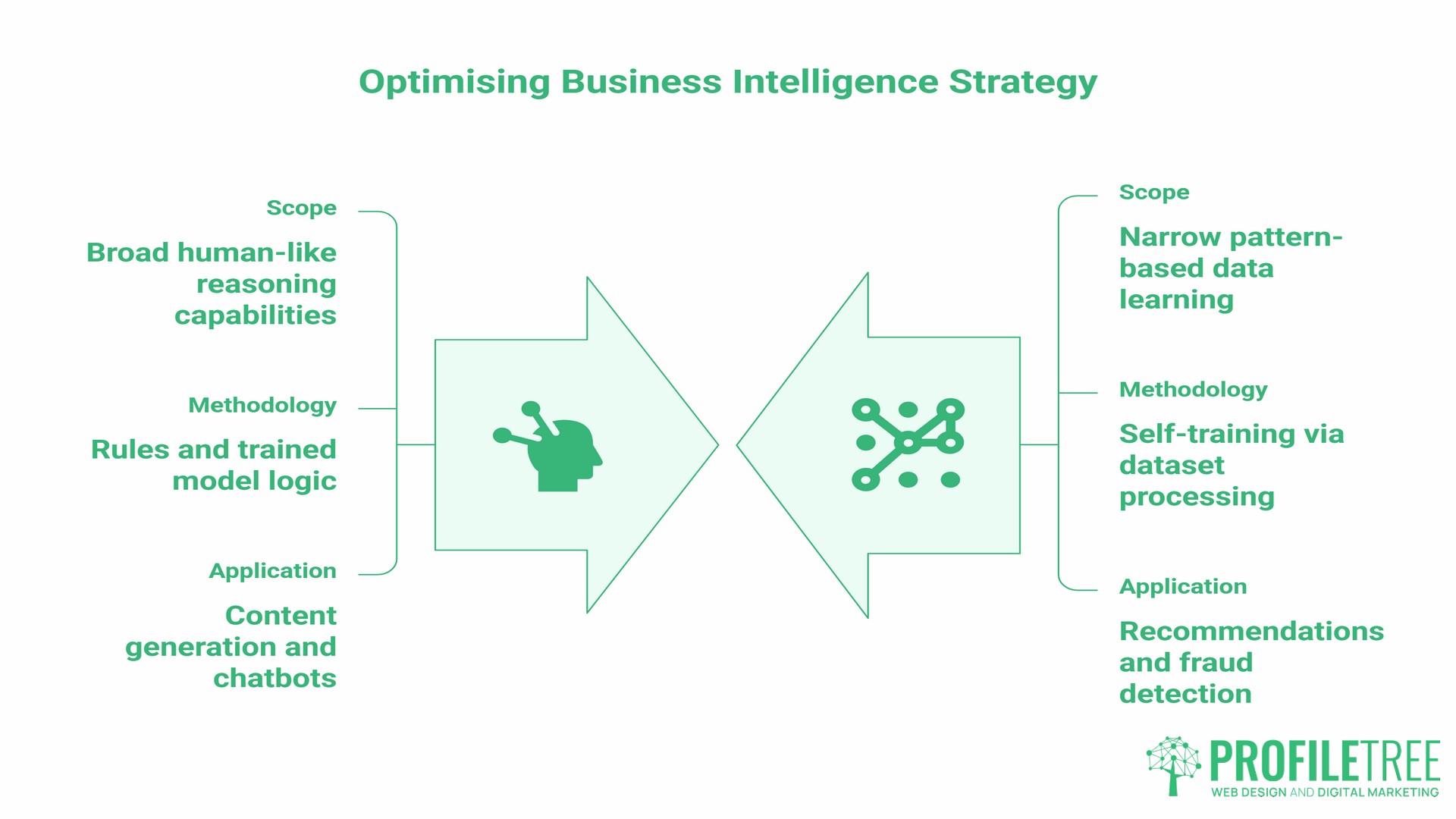
Before going deeper, here is a direct comparison of the two technologies across the dimensions that matter most to business decision-makers.
| Feature | Artificial Intelligence | Machine Learning |
|---|---|---|
| Scope | Broad,mimics human-like reasoning | Narrow, learns patterns from data |
| How it works | Rules, reasoning, and trained models | Trains itself by processing datasets |
| Human intervention | Varies by application | Lower once the model is trained |
| Typical SME use case | Content generation, chatbots, voice assistants | Recommendations, churn prediction, fraud detection |
| Data requirement | Low to high depending on the tool | Low to high, depending on the tool |
| Typical entry point for SMEs | SaaS tools (ChatGPT, Jasper, Canva AI) | Embedded ML in platforms (Shopify, HubSpot, Google Analytics) |
The core relationship to understand is this: machine learning is a subset of artificial intelligence. AI is the broader field; ML is one of the primary methods used to build AI systems. You cannot have machine learning without artificial intelligence as the parent discipline, but AI can exist without machine learning.
When you are weighing up artificial intelligence versus machine learning for your own business, this parent-child relationship is the most important thing to keep in mind. The two are not rivals; they are different levels of the same technology stack.
What is Artificial Intelligence?
Artificial intelligence refers to the ability of computer systems to perform tasks that would normally require human reasoning: understanding language, recognising images, making decisions, and generating responses.
The term covers a wide range of approaches. A rule-based chatbot that follows a decision tree is technically AI. So is a large language model that generates marketing copy from a single sentence of input. The common thread is that the system is designed to replicate some form of intelligent behaviour, rather than simply following a fixed mechanical process.
For most SMEs in the UK and Ireland, practical AI today means one of three things: generative AI tools for content and creative work, AI-powered automation within existing software platforms, or custom AI solutions built by a digital agency or development partner.
Generative AI tools, which produce text, images, video scripts, or code from a prompt, have become the entry point for most small businesses. They are accessible without technical knowledge, available on subscription pricing, and immediately applicable to marketing, customer service, and content production workflows. Understanding where these tools sit in the artificial intelligence versus machine learning debate helps you evaluate them more critically and get more from them.
What AI Can Do for Your Business
The practical applications of AI for UK and Irish SMEs are broad. In marketing, AI tools can generate first drafts, produce social media content at scale, personalise email campaigns, and automate customer-facing chat. In operations, AI can handle document processing, schedule management, and reporting tasks that previously required manual input.
AI is also embedded in the creative tools many businesses already use. Image generation, video editing assistance, and design suggestion tools all draw on AI capabilities. For businesses investing in content marketing, AI tools can meaningfully reduce production time while freeing the team to focus on strategy, quality control, and the editorial judgment that tools cannot replicate.
The important caveat is that AI tools augment human capability; they do not replace the judgment behind a well-executed campaign or a well-designed website. The businesses seeing the strongest results are those treating AI as a capable team member, not as a replacement for the team itself.
What is Machine Learning?
Machine learning is the discipline within AI that enables systems to learn from data without being explicitly programmed for every scenario. Rather than following a fixed set of rules written by a developer, an ML model identifies patterns across large datasets and adjusts its outputs based on what it finds.
There are two primary types of machine learning that matter in a business context.
- Supervised learning trains a model on labelled data, pairs of inputs and known outputs, so that it can predict outcomes for new inputs. Email spam filters, sales forecasting tools, and customer churn prediction models all use supervised learning. The model is trained on historical data and then applies that learning to new cases.
- Unsupervised learning finds structure in unlabelled data, grouping similar items together without being told what to look for. Customer segmentation is the most common business application: an ML model groups your customers by behaviour patterns, spending habits, or engagement levels, even if you never defined those groups yourself.
For SMEs, machine learning is most often encountered not as a standalone technology to build, but as a capability already embedded in the platforms you use. When Shopify predicts which products a returning customer is likely to buy, or when Google Analytics flags unusual traffic behaviour, machine learning is doing the work in the background.
What Machine Learning Can Do for Your Business
The most relevant business applications of machine learning for SMEs fall into a handful of categories.
Prediction is one of the most valuable. ML models can forecast customer churn, identify which leads are most likely to convert, predict inventory requirements based on seasonal patterns, and flag anomalous transactions. These are not theoretical capabilities; they are features built into the CRM and e-commerce platforms many businesses are already paying for.
Personalisation is another. The recommendation engines behind product suggestions on e-commerce platforms, the dynamic content blocks in email marketing tools, and the audience segmentation features in advertising platforms all run on machine learning. The difference between a business that uses these features well and one that uses them poorly is rarely the technology itself; it is whether the underlying data is clean, structured, and sufficient in volume.
Classification and anomaly detection round out the most practical applications. Categorising customer enquiries before they reach your team, flagging suspicious account activity, and automatically tagging content by topic are all ML tasks that, when configured correctly, save significant manual processing time.
Artificial Intelligence versus Machine Learning: The Key Differences
Understanding artificial intelligence versus machine learning comes down to scope and method.
AI is the goal: build a system that can reason, respond, or act in ways that resemble human intelligence. Machine learning is one route to achieving that goal. Not every AI application uses machine learning; some rely on structured rules, decision trees, or symbolic reasoning. But most modern AI systems, particularly the ones SMEs are adopting today, are built on ML foundations.
The practical implication for business owners is this. When a vendor tells you their software uses AI, it is worth asking what kind. A rule-based AI that responds to keywords is fundamentally different from an ML-powered system that adapts based on how your customers actually behave. The second type becomes more accurate over time; the first does not.
A second distinction worth understanding is the difference between narrow AI (systems designed for one specific task, like image recognition or text generation) and the theoretical concept of general AI (a system with broad human-like reasoning across all domains). Every commercial AI tool available today is narrow AI. General AI remains a research concept, not a business-ready technology.
When businesses frame the question as artificial intelligence versus machine learning, they are often really asking: should I use a ready-made AI tool or invest in building a custom ML model? For most SMEs, the honest answer is the former, at least to start. Purpose-built AI applications solve specific problems without requiring data infrastructure, development resources, or ongoing model maintenance.
AI versus ML versus Deep Learning
The artificial intelligence versus machine learning conversation often leads to a third term: deep learning. It is worth a brief explanation to prevent further confusion.
Deep learning is a subset of machine learning that uses multi-layered neural networks to process data. It is the technology behind image recognition at scale, real-time language translation, and the large language models that power tools like ChatGPT.
The nesting works like this. Artificial intelligence is the broadest category. Machine learning sits inside it. Deep learning sits inside machine learning. Generative AI, the category that includes text and image generation tools, is built on deep learning models.
For practical purposes, most SMEs do not need to build or train deep learning models. They interact with the outputs: AI writing tools, image generators, and voice assistants. Understanding where these tools sit in the hierarchy helps clarify what they can and cannot do, and why they sometimes produce confident but inaccurate responses.
AI versus ML in Practice: What This Looks Like for SMEs
The artificial intelligence versus machine learning question becomes most useful when you connect it to real business problems.
- Marketing and content production is where AI tools have had the most immediate impact on SMEs. Businesses across Northern Ireland and the Republic of Ireland are using AI writing assistants to produce first drafts, social media copy, and email sequences faster than traditional copywriting workflows allow. These tools are AI applications, built on ML models trained on large corpora of text, but the end user does not need to understand the underlying model to use them effectively. For businesses building out a digital marketing strategy, AI content tools are now a practical part of the production workflow rather than an experimental addition.
- Customer behaviour analysis is where ML-specific capabilities matter more. If you want to understand which of your customers are at risk of leaving, which products should be cross-sold together, or which audience segments respond to different messages, you are working with a machine learning problem. The platforms that deliver these insights have ML built in. What varies is how well those tools are configured and whether the data feeding them is clean enough to produce reliable outputs.
- Website personalisation sits at the intersection of both. AI determines the rules and logic of a personalised experience; ML refines it based on how visitors actually behave. For businesses investing in web development, this is an increasingly practical consideration: platforms like WordPress, when properly integrated with behavioural data tools, can serve different content to different visitor segments automatically.
- SEO and search visibility is another area where the artificial intelligence versus machine learning distinction has real consequences. Google’s search algorithm has used machine learning to evaluate content quality since the introduction of RankBrain in 2015. The content that performs well now is not keyword-stuffed text; it is content that genuinely answers the questions real users are asking, structured in a way that both humans and AI systems can extract meaning from. Understanding this helps explain why a strong SEO strategy is inseparable from content quality, not a separate technical exercise.
- Automation of internal processes, document handling, customer service triage, scheduling, reporting, typically involves narrow AI rather than bespoke ML. For most SMEs, this means identifying the right tools and configuring them correctly, rather than building anything from scratch.
The UK and Ireland Regulatory Context
For businesses operating in Northern Ireland, the Republic of Ireland, or across both jurisdictions, the regulatory picture for AI and ML is worth understanding before committing to specific tools or vendors.
The EU AI Act, which applies in Ireland and has implications for Northern Ireland businesses trading with the Republic, classifies AI systems by risk level. High-risk applications (such as AI used in hiring decisions or credit scoring) carry compliance obligations. Most of the AI tools that SMEs use daily, such as content generation, analytics, and customer service chatbots, fall into the lower-risk categories. That said, any business using AI to process personal data is still subject to GDPR obligations under both UK and EU frameworks.
The UK’s approach to AI regulation takes a different path. Rather than a single overarching AI law, the UK has opted for a sector-led, principles-based framework, asking existing regulators (the ICO, FCA, and CMA) to apply AI guidance within their own domains. For SMEs, the practical implication is that there is no single compliance checklist to follow; instead, the question is whether your use of AI tools is consistent with the data protection and consumer protection obligations already applying to your sector.
Businesses with operations on both sides of the Irish border should seek advice on which framework governs each activity, particularly if customer data is processed by AI tools hosted outside the UK or EU.
Which Technology Is Right for Your Business?
The artificial intelligence versus machine learning question ultimately resolves to a practical one: what problem are you trying to solve, and what is the most proportionate way to address it?
For most SMEs considering AI adoption for the first time, the starting point is not building anything. It is identifying which AI-powered tools already exist within the platforms you pay for, and whether you are actually using them. Google Analytics 4, most major CRM platforms, and the leading e-commerce tools all include ML capabilities that are enabled by default but rarely configured properly.
The second question is whether you have the data to support more advanced ML applications. Machine learning models need sufficient, clean data to produce reliable outputs. A business with two years of transaction records and a properly tagged CRM is in a reasonable position to explore predictive analytics. A business whose customer data is scattered across spreadsheets and email inboxes is not ready for bespoke ML, but may benefit considerably from AI tools that work with unstructured input.
The third question is team readiness. Deploying AI or ML tools without training the people who will use them produces poor results and often creates resistance. The businesses getting the most value from these technologies are those that invested in building internal understanding before rolling out new platforms. ProfileTree’s digital training programmes are designed specifically for SME teams in the UK and Ireland, covering AI literacy, tool adoption, and the practical skills needed to get measurable value from these technologies without a dedicated data science function.
For businesses ready to move beyond tools and into broader AI transformation, ProfileTree’s AI implementation service covers the full journey: from auditing current workflows and identifying the highest-value opportunities, through to building, integrating, and managing AI-powered solutions that fit the way your business actually operates.
Ciaran Connolly, founder of ProfileTree, puts it plainly: the question SME owners should ask is not whether to choose artificial intelligence versus machine learning in the abstract, but which specific business problem they are trying to solve and whether the technology they are considering actually addresses that problem. Most small businesses need to start with tools that solve one thing well, not platforms that promise to do everything.
Frequently Asked Questions
What is the main difference between artificial intelligence and machine learning in simple terms?
Artificial intelligence is the broad field of building computer systems that can perform tasks requiring human-like reasoning. Machine learning is a specific method within AI that trains systems to learn from data rather than following pre-written rules. All machine learning is AI, but not all AI uses machine learning.
Which is cheaper for a UK small business to adopt?
For most small businesses, AI is cheaper to access in the short term because the primary route is SaaS tools, such as ChatGPT or Canva AI, which require no infrastructure investment. Custom machine learning is more expensive because it requires clean data, development work, and ongoing model maintenance. That said, ML capabilities are embedded in many platforms SMEs already pay for, in which case the cost is already covered.
Do I need a data scientist to use machine learning?
Not for most practical applications. The ML capabilities inside platforms like HubSpot, Shopify, and Google Analytics are accessible without technical expertise. What you need is someone who understands how to interpret the outputs and configure the tools correctly. For bespoke ML development, technical expertise is required, either in-house or through a development partner.
Is ChatGPT artificial intelligence or machine learning?
ChatGPT is a generative AI application built on a large language model, which is itself built on deep learning (a subset of machine learning). It is accurate to describe it as AI, as an ML-powered system, and as a deep learning application. All three are correct; they describe different levels of the same technology stack. In the artificial intelligence versus machine learning framing, ChatGPT is an AI product whose underlying engine is machine learning.
What are the GDPR implications of using ML on customer data in Ireland?
Any use of machine learning that involves processing personal data is subject to GDPR, whether under the EU framework (which applies in Ireland) or the UK GDPR (which applies in Northern Ireland and Great Britain). Key considerations include lawful basis for processing, data minimisation, and transparency: customers should understand if their data is being used to make automated decisions about them. High-risk automated decision-making with legal or similarly significant effects requires a Data Protection Impact Assessment.
What is the difference between AI, ML, and deep learning?
Artificial intelligence is the overarching field. Machine learning is a subset of AI. Deep learning is a subset of machine learning that uses multi-layered neural networks to process complex data. Generative AI tools like image generators and large language models are built on deep learning foundations.