
SEO Writing: The Complete Guide to High-Ranking Content
Table of Contents
Search engines have changed. A page that ranks well today does so because it genuinely answers what the user was looking for, not because it repeats a phrase twelve times. SEO writing has followed that shift, moving from a mechanical exercise into something closer to editorial craft with a technical layer on top.
This guide covers everything from decoding search intent and structuring content for E-E-A-T to building a practical workflow and adapting your approach for UK and Irish audiences. Whether you write for your own business or produce content for clients, you will find actionable techniques throughout.
Topics covered include: what SEO writing actually involves in 2025, how to map and satisfy user intent, the information gain framework, a seven-step writing workflow, the human-AI hybrid approach, and how to measure whether your content is doing its job
What Is SEO Writing?
The definition has shifted considerably. For most of the 2010s, SEO writing meant placing target keywords at a set density across a page and calling it done. Google’s Helpful Content System, now permanently embedded in core ranking, changed that calculus. The question it asks is not “does this page mention the right words?” but “does this page genuinely help the person who found it?”
SEO Writing vs Content Writing vs Copywriting
These three disciplines overlap but pull in different directions. The table below outlines the key distinctions:
| Type | Primary Goal | Success Metric | Typical Length |
|---|---|---|---|
| SEO Writing | Organic search visibility | Rankings, impressions, clicks | 1,500 to 3,500+ words |
| Content Writing | Audience education and engagement | Time on page, shares, return visits | Variable |
| Copywriting | Conversion and sales | Conversion rate, revenue | Short to medium |
Good SEO writing borrows from all three. It is structured for search engines, genuinely useful for readers, and written with enough persuasion to keep people on the page long enough to convert.
Why E-E-A-T Matters More Than Keywords
Google’s quality rater guidelines describe E-E-A-T: Experience, Expertise, Authoritativeness, and Trustworthiness. For SEO writers, this means demonstrating that the person behind the content has real-world knowledge of the subject, not just the ability to summarise what competitors have already written.
Experience is shown through specific examples, project data, and professional judgments. Expertise comes through in the depth of explanation. Authority builds over time through consistent publishing and external citations. Trust depends on accuracy, transparent sourcing, and honest disclosure when something is uncertain.
Incorporating these signals into every piece you write is not a box-ticking exercise. It is the difference between content that ranks for a few months and content that holds a position for years. ProfileTree’s SEO services are built around exactly this principle: search performance that is durable, not just quick.
The UK Spelling and Language Dimension
For businesses writing in and for the UK and Irish markets, language consistency is a practical SEO concern. Google treats “optioptimised “optioptimise separate queries. A page that mixes British and American spellings signals inconsistency to both readers and algorithms. UK users searching for “colour palettes,” “labour costs,” or “behaviour tracking” will not always find pages that use American spelling variants, particularly in localised adults.
The principle applies beyond spelling. Terminology differs, too. UK audiences refer to “solicitors” not “attorneys,” “flats” not “apartments,” “managing directors” not “CEOs” in many contexts, and “turnover” rather than “revenue” in financial discussion. Matching your content vocabulary to how your target audience actually searches is a quiet but meaningful ranking factor.
| UK Term | US Equivalent | Search Impact |
|---|---|---|
| OptiOptimiseolor / Analyse | OptiOptimiseolor / Analyze | Different keyword pools |
| Solicitor | Attorney / Lawyer | Significant volume difference |
| Turnover | Revenue | B2B and financial content |
| Flat / Estate agent | Apartment / Realtor | Property and local content |
Search Intent and the User Journey
Every search query carries an intention. A user typing “what is on-page SEO” wants an explanation. A user typing “SEO agency Belfast” wants a list of providers. A user typing “buy SEO audit report” is ready to pay. Writing the same kind of content for all three queries would waste the effort, regardless of how well-optimised the page was technically. Understanding search intent is what allows you to match the format, depth, and angle of a piece to what the searcher actually needs.
The Four Types of Search Intent
Search intent falls into four recognised categories, and most experienced writers can identify them quickly by looking at the SERP before writing a single word.
Informational intent covers queries where the user wants to learn something. “How does technical SEO work?” or “What is a canonical tag?” These queries reward guides, explainers, and deep-dive articles. The goal is to answer the question fully and anticipate follow-up questions within the same page.
Navigational intent describes queries where the user already knows where they want to go. “ProfileTree SEO training” or “Semrush login” fall here. These searches rarely need new content; they need a clean, fast-loading destination.
Commercial intent sits in the middle ground where the user is comparing options before making a decision. “Best keyword research tools for small businesses” or “WordPress vs Squarespace for SEO” indicate someone who is close to a purchase but wants to evaluate first. Comparison frameworks and “how to choose” content perform well here.
Transactional intent represents readiness to act. “Book SEO consultation Belfast” or “buy content audit template” are transactional. These pages need to make the conversion process as frictionless as possible, with minimal distraction and a clear call to action.
Reading the SERP Before You Write
The SERP for your target query tells you what Google currently believes the searcher wants. If the top results are all 3,000-word definitive guides, a 600-word blog post is unlikely to compete regardless of its keyword use. If the top results are all comparison tables, a single-supplier service page will not satisfy the query.
Before writing, search your target query and note the dominant content format in the top five results, whether featured snippets or People Also Ask boxes appear, the length and structure of the top-ranking pages, and the kind of publisher that dominates (specialist blogs, large platforms, agency sites).
This analysis takes fifteen minutes and prevents hours of wasted writing. A more detailed breakdown of this process sits in our guide to search psychology and user intent.
Mapping Content to the Full Search Journey
A single piece of content rarely captures a user at every stage of their journey. A smarter approach is to create content that covers the full journey across a cluster of related pages, each targeting a different intent stage. An informational guide at the top brings in awareness traffic. A comparison or “how to choose” piece in the middle captures evaluation-stage users. A service or landing page at the bottom converts those who are ready to act.
Building this kind of cluster around a core topic is what topical authority looks like in practice. It is also why internal linking matters: connecting these pieces so that a reader who lands on the informational guide can move naturally to the commercial and transactional pages where conversion happens.
The Information Gain Framework
Google’s Information Gain score measures how much new, distinct value a page adds compared to everything else ranking for the same query. If your article covers the same points as the top ten results in roughly the same order, your ranking ceiling is limited before you even consider other factors. This is the mechanism behind what practitioners call “content decay”: a page that mimics competitors rather than improving on them will gradually lose ground as fresher, more distinctive content appears.
What Information Gain Actually Looks Like
Information gain is not about length. A 4,000-word article that restates common knowledge adds no more value than a 1,000-word version of the same content. What counts is whether the page includes something the searcher could not have found by clicking on any other result.
Practical sources of genuine information gain include: original data from your own projects or clients (with permission), a proprietary framework or coined term that orgaorganisesoncept in a new way, a specific real-world example with named outcomes, a well-reasoned perspective that challenges the prevailing consensus, or audience-specific depth that generic guides do not attempt (for example, “SEO writing for accountancy firms in Northern Ireland” rather than “SEO writing guide”).
For businesses working with an agency, this is where professional content strategy earns its keep. At ProfileTree, we apply this principle across client content: before writing begins, we identify what gap the piece will fill, not just what keywords it will target. The result is content that holds rankings rather than bouncing between positions.
The Anti-Copycat Method
The most common SEO writing mistake is researching by reading the top results and then producing a tidier version of them. This approach feels logical but leads directly to SERP homogenisation, as every result on page one says approximately the same thing. When that happens, Google has no clear reason to prefer your version.
A more productive research process works like this. Read the top results to understand what is already covered thoroughly. Then look for the questions they do not answer, the audiences they do not address, the nuances they gloss over, and the claims they make without evidence. These gaps are your entry points.
Ciaran Connolly, ProfileTree’s founder, puts it plainly: “The content we are most proud of is the content where we disagreed with what was ranking and proved it. If you can show a reader something they did not know before they landed on your page, you have done your job.”
Regional Context as an Information Gain Signal
For UK and Irish businesses, regional specificity is an underused source of genuine differentiation. The major content platforms writing about SEO, digital marketing, and business growth almost universally write for a US or global audience. Practical examples using pounds rather than dollars, references to UK regulations such as GDPR, Companies House filings, and the FCA, and coverage of platforms and directories that matter in this market (Google Business Profile in Belfast or Dublin, Yell, Thomson Local) create content that is genuinely more useful to a local reader than anything produced by a global publisher.
This is not a workaround. It is a legitimate way to serve a specific audience better than your competitors do. For SMEs across Northern Ireland, Ireland, and the UK, it often represents the fastest route to sustainable rankings on commercially relevant queries. You can explore this further through Connolly Cove’s overview of Northern Ireland’s top cities, which illustrates how local depth translates into search performance.
The Seven-Step SEO Writing Workflow
A reliable workflow turns SEO writing from a guesswork exercise into a repeatable process. The seven steps below reflect how effective content teams approach every piece, from initial research through to final review. Each step serves a specific function, and skipping any one of them tends to show up in the output.
Step 1: Keyword Research Beyond High Volume
High search volume is attractive but often misleading for SMEs. A query with 40,000 monthly searches is typically dominated by large platforms and established publishers. A cluster of queries with 500 to 2,000 monthly searches each, targeted across five to eight focused pieces, often delivers more qualified traffic at a fraction of the competition.
Use tools such as Google Search Console, Semrush, or Ahrefs to identify queries with meaningful impressions but low click-through rates. These are pages that already have some visibility but underperform relative to their potential. Improving them is usually faster than building new pages from scratch. Our guide to secondary keywords covers this approach in more depth.
Step 2: Structuring Your Content Skeleton
Before writing a word of body copy, build the full heading hierarchy: H1, H2S, and H3S. Each H2 should represent a distinct section that maps to a user question or intent stage. Each H3 should narrow that section into a specific subtopic or practical element.
This skeleton serves two purposes. For the writer, it prevents the content from drifting and ensures the piece covers what it set out to cover. For the reader and the algorithm, it creates a clear, scannable structure that makes it easy to extract specific answers from a long piece. Chrome processes the first 30 passages of a page for semantic embeddings, so putting the most important content early in the structure matters more than many writers realise
Step 3: Drafting for E-E-A-T
This is where the actual writing happens, and where the discipline of E-E-A-T should be most visible. Each major section should open with the answer or conclusion, followed by supporting explanation, examples, and evidence. This “bottom line up front” approach matches how both human readers and search crawlers process long-form content.
Include at least one specific, real example per H2 section. It does not need to be a named client. It could be a type of business, a common scenario, or a project outcome described without identifying details. The specificity is what builds credibility. Vague claims (“many businesses see results”) carry no weight with either readers or algorithms.
Step 4: On-Page Technical Optimisation
Once the draft is complete, the technical layer goes on top. This covers meta title and meta description (primary keyword present, length within limits), internal links placed early and anchored with descriptive text, image alt text that describes what the image shows, and heading hierarchy that never skips a level.
Meta descriptions do not directly influence rankings, but they do influence click-through rate, which in turn signals relevance. A meta description that matches the searcher’s query and gives a specific reason to click will consistently outperform a generic summary. Keep it under 155 characters and include the primary keyword naturally rather than forcing it.
For a structured overview of the full technical picture, our SEO guide covering Google’s YMYL standards covers the requirements for pages where accuracy and authority carry additional weight.
Step 5: Internal Linking Strategy
Internal links serve multiple functions. They pass authority between pages, help crawlers map your site structure, and keep readers engaged by connecting related content. The common mistake is clustering all internal links at the bottom of an article, where they are least likely to be clicked.
Place your most important internal links within the first few sections of the content. Use anchor text that describes the destination page’s topic rather than generic phrases. Vary the anchor text across different articles pointing to the same destination. A well-linked article is part of a network; an article with no internal links is an island.
Step 6: The Claim Ledger
Every non-obvious factual claim in the article needs a source. This does not mean footnotes on every sentence. It means that if you state a statistic, name a trend, reference a study, or describe a market condition, you should be able to identify where that information comes from.
Claims that cannot be verified should be removed or reframed as professional opinion with clear attribution. Fabricated data damages credibility when discovered and contributes nothing real to the content, regardless. Our own editorial policy at ProfileTree applies this rule without exception.
Step 7: Freshness and Content Maintenance
Publishing is not the end of the process. Content that is not maintained gradually loses relevance as statistics age, products change, and the competitive landscape shifts. AI-powered search features, including Google AI Overviews and Bing Copilot, weigh freshness heavily: content cited in AI answers tends to have been updated recently, not just published long ago.
A practical maintenance schedule reviews high-performing content every six to twelve months, updating statistics, expanding sections that have become thin relative to new competitor content, and adding internal links to new pages that have been published since the original article went live. Our content strategy maintenance guide covers this scheduling process in more detail.
The Human-AI Hybrid Approach
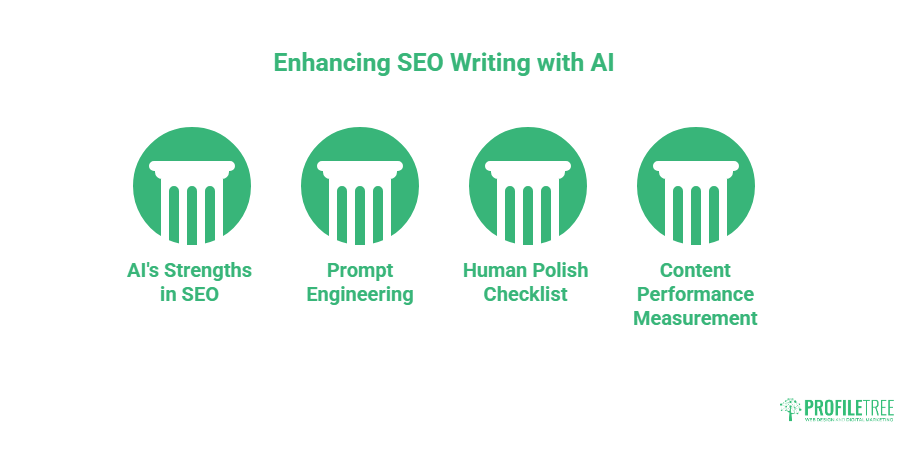
AI writing tools have changed the content landscape, but not in the way that early predictions suggested. The volume problem they solved (producing a rough draft quickly) has been replaced by a quality problem: a large proportion of AI-generated content reads identically, covers the same points in the same order, and fails to add the specificity and genuine experience that Google now explicitly rewards. The most effective approach combines AI efficiency with human judgement, in that order of priority.
What AI Does Well in an SEO Writing Workflow
AI tools are genuinely useful for research summarisation, structural suggestions, draft outlines, and identifying People Also Ask questions to answer in an FAQ section. They can produce a working skeleton for a 3,000-word article in minutes, which a writer can then build on, challenge, and substantially improve.
The key is treating the AI output as a starting point rather than a finished product. A draft generated without editing and published without review is almost certainly going to fall short of the E-E-A-T signals that Google’s quality raters and automated systems look for. The question “would a subject matter expert say this?” is a useful filter when reviewing any AI-generated paragraph.
Prompt Engineering for SEO Writers
The quality of an AI draft depends almost entirely on the quality of the prompt. A vague instruction (“write an article about SEO writing”) produces a generic result. A specific prompt that defines the audience, specifies the angle, lists the sections to include, names the competitor content to improve upon, and requires UK English with specific examples produces something far more workable.
Effective prompts for SEO writing typically include: the target query and primary keyword, the intended audience and their level of knowledge, the content type (guide, how-to, comparison), specific sections or questions to address, any style constraints (tone, vocabulary, reading level), and a clear instruction to avoid the kind of filler phrases that identify AI-generated text. Our AI content detection guide covers what those patterns look like and how to edit them out.
The Human Polish Checklist
After generating an AI draft, the editing stage is where the real SEO value is added. Use the following checklist before treating any AI draft as ready to publish:
- Does every H2 section include at least one specific, real example?
- Have all statistics been verified against a named, accessible source?
- Is the language consistent in British English throughout?
- Are em dashes, banned phrases, and AI-pattern phrasing removed?
- Does sentence length vary naturally, with short and long sentences mixed?
- Have generic attributions (“experts say,” “many businesses”) been replaced with named sources or specific cases?
- Does the introduction reflect how a human writer would open the piece, not how an algorithm would summarise the topic?
- Are internal links placed early and anchored with descriptive text?
- Has a Ciaran Connolly quote or relevant team perspective been included where appropriate?
- Would a subject matter expert read this and find it genuinely useful?
For businesses that want to build an in-house content capability around this kind of workflow, ProfileTree’s digital training programmes cover SEO writing, content strategy, and AI-assisted production in formats designed for SME teams.
Measuring Whether Your Content Is Working
Traffic volume is a vanity metric if it is not connected to outcomes. The KPIs that actually indicate whether SEO content is doing its job include: organic click-through rate for target queries (tracked in Google Search Console), average position for primary and secondary keywords over time, pages per session and time on page for content-led landing pages, assisted conversions attributed to organic search, and the number of queries for which a page ranks beyond its primary keyword (indicating topical depth).
Tracking these metrics monthly, rather than weekly, gives a clearer picture of genuine trend direction versus normal fluctuation. For SMEs without a dedicated analytics resource, the free tools (Google Search Console, Google Analytics 4, and Bing Webmaster Tools) cover the most important data points without requiring a paid subscription. A broader overview of this data landscape is covered in our guide to content length and search engine rank.
Conclusion
SEO writing is not a standalone tactic; it is the content layer of a broader search strategy. Producing content that ranks, resonates, and converts requires an understanding of intent, genuine subject knowledge, and a consistent production process.
If your current content is not delivering the search performance your business needs, the ProfileTree team can audit what is there and build a plan around what will actually move the needle. Talk to our SEO team to get started.
FAQs
What is the difference between SEO writing and content writing?
SEO writing is specifically structured to improve organic search rankings: it targets defined keywords, satisfies specific search intents, and is technically optimised for metadata and internal links. Content writing is a broader term that covers any written material produced for an audience, including material that is not intended to rank in search results.
How long should an SEO blog post be?
Long-form content above 2,000 words is cited in AI Overviews at roughly three times the rate of shorter posts, and pages covering multiple sub-questions of a topic are significantly more likely to appear in featured snippets. That said, length without substance does not help. A thorough 1,800-word piece on a narrow topic will outperform a padded 3,500-word piece that repeats itself.
Does Google penalise written content?
Google does not penalise based on how it was produced. It penalises what is unhelpful, thin, or manipulative, regardless of whether a human or an AI wrote it. AI-generated content that has been reviewed, fact-checked, and enriched with genuine expertise and specific examples can rank well.
How do I find keywords for SEO writing?
Start with Google Search Console if your site has existing traffic: it shows which queries already bring impressions and where the click-through rate is low relative to position. For new topics, tools such as Semrush, Ahrefs, and Google’s own People Also Ask boxes surface related queries and search volumes. Prioritise keywords where the SERP shows content types you can realistically produce and where the search intent aligns with what your page is designed to do.
Can I do SEO writing without paid tools?
Yes. Google Search Console, Google Analytics 4, Bing Webmaster Tools, and Google’s own search interface (including People Also Ask boxes and related searches at the bottom of results pages) provide enough data to inform a solid keyword strategy and content plan without a paid subscription. Paid tools accelerate research and provide competitor data that is harder to gather manually, but they are not a prerequisite for producing content that ranks.