
SEO Competitor Analysis: A Step-by-Step Framework for UK Businesses
Table of Contents
Most SMEs who request an SEO audit from us have already looked at their competitors. They’ve typed their target keywords into Google, noted who appears at the top, and felt the quiet anxiety that comes from not being there. What they rarely have is a structured way to turn that observation into action.
This guide builds that structure. It covers how to identify your true organic competitors (they are often not who you think), how to audit the four areas that determine who wins in UK search, and how to filter the data you collect into a prioritised roadmap rather than a spreadsheet full of tasks you’ll never complete.
The process works whether you’re running the analysis yourself or working with an SEO agency. ProfileTree, a Belfast-based digital agency, uses a version of this framework when onboarding new clients across Northern Ireland, Ireland, and the wider UK.
What SEO Competitor Analysis Actually Means
An SEO competitor analysis is a structured audit of the websites outranking you for the keywords your potential customers are searching. It tells you what they’re doing differently, where they’re stronger, and where they’ve left gaps you can exploit.
It is not simply a list of businesses that sell what you sell. Your business competitors and your search competitors are often different sets of organisations entirely.
Business Competitors vs Search Competitors
A law firm in Belfast might consider two other local practices its main business competitors. In search, though, the pages it’s competing against for “employment law advice Northern Ireland” could include a national legal directory, a government guidance page, and a legal blog from a firm in Leeds. None of those is business competitors. All of them are search competitors.
Before running any tool or pulling any data, search your five most important target keywords manually in Google. Note every URL that appears on page one. That list is your starting point for an SEO competitor analysis, not your list of industry rivals.
Step 1: Identify Your True Organic Competitors
Open a private browsing window and search each of your primary target keywords. Record the top ten results for each. You are looking for patterns: which domains appear repeatedly across multiple searches? Those are your priority competitors.
Once you have a shortlist of four to six competitor domains, you can move into tool-assisted research. Google Search Console will show you which queries your own site is appearing for, which helps you understand the overlap. If you haven’t claimed and verified your Search Console account, do that before anything else. It’s the only source of first-party data you have on your own organic performance.
Free tools, including Google’s own “site:” operator and Bing Webmaster Tools, give you a baseline. Paid platforms such as Semrush and Ahrefs provide more granular data on competitor keyword portfolios and backlink profiles. The data is only as useful as the thinking you apply to it.
A useful prompt for this stage: ask yourself why each competitor ranks where it does. Is it a domain authority built over the years? A single very strong piece of content? A technical advantage? Or simply that nobody else has tried to rank for that term properly? The answer shapes which gap is quickest to close.
Step 2: Run a Keyword Gap Analysis
A keyword gap is any term your competitor ranks for that you do not. It represents a potential customer searching for something you offer and landing on a competitor’s site instead.
Start by exporting the organic keyword rankings for your top two competitors from Semrush or Ahrefs. Filter for UK traffic only; the default view in most tools is global, which inflates volume figures and obscures the local picture. Then cross-reference against your own keyword rankings to identify terms where you have no presence at all.
Prioritising the Gaps
Not all keyword gaps are worth chasing. Prioritise using two filters:
Commercial intent. A term like “SEO agency Northern Ireland” has direct commercial intent. A term like “what does SEO stand for” does not. Close the commercial gaps first.
Difficulty relative to your current authority. If your domain authority is modest, targeting a term where every page-one result is from a national publication or high-authority directory will take years. Find terms where smaller, similar sites are ranking. Those are achievable targets within a realistic timeframe.
Understanding secondary keywords and how they support your primary targets helps here. The goal isn’t just to rank for one competitive term; it’s to build a cluster of related content that reinforces topical authority across the whole subject area.
Step 3: Audit Competitor Content Quality and Velocity
Once you know which keywords your competitors are winning, look at the content they’re using to win them.
What to Assess
Depth and structure. Does the ranking page answer the search query comprehensively, or does it cover the surface and stop? Pages that rank for competitive terms in the UK typically answer multiple sub-questions within a single piece. They include tables, step-by-step sections, and specific examples rather than general statements.
Content length.Content length and search engine rankings have a relationship that varies by query type. For informational queries, longer content often outperforms shorter. For transactional queries, a clear, focused page often beats an exhaustive guide. Check what the top-ranking pages for your target terms look like structurally before deciding how to approach your own.
Publishing frequency. How often does your competitor add new content? A site publishing two well-researched articles per week is building topical authority faster than one publishing two per month. This matters because Google rewards sites that demonstrate ongoing expertise in a subject area, not just one-off pieces.
Content type. Some queries reward how-to guides. Others reward comparison pages or data-led articles. Matching your content format to the format Google is already rewarding for that query is one of the simplest ways to improve your ranking chances without any additional technical work.
The Content Gap Beyond Keywords
There is often a gap that keyword tools don’t show. Read the top-ranking articles for your target terms. Are there angles, questions, or specific scenarios they don’t address? Those are opportunities to write content that isn’t just competing on the same terms but offering something genuinely different.
Step 4: Analyse Competitor Backlink Profiles
Backlinks remain one of the strongest ranking signals in Google’s algorithm, particularly for competitive terms. A competitor with significantly more high-quality backlinks than you will be difficult to outrank for shared keywords, regardless of how good your content is.
What to Look For
Domain authority of linking sites. A link from a well-established regional publication or industry body in the UK carries more weight than dozens of links from low-quality directories. In Ahrefs or Semrush, sort competitor backlinks by domain rating and look at the top 20. That tells you the calibre of sites you’d need to earn links from to compete.
Link types. Editorial links (where a journalist or blogger references your content because it’s useful) are the most valuable. Directory links, forum links, and links clearly bought or exchanged carry little to no value and can actively harm a site’s standing. If a competitor has a backlink profile dominated by low-quality links, that’s a structural weakness. They may be vulnerable to being overtaken by a site with fewer but higher-quality links.
Anchor text patterns. How are linking sites describing your competitor when they link to them? Branded mentions, natural editorial phrases, and topically relevant descriptions are healthy signals. Repetitive exact-match keyword anchor text across multiple links can indicate a manipulative pattern that Google may discount or penalise.
UK-specific sources. For businesses targeting UK customers, links from .co.uk domains and established UK publications carry a geographic relevance signal. If your competitors are earning links from regional chambers of commerce, local news sites, or UK industry associations, those same sources should be on your outreach list.
Understanding meta keywords and on-page signals matters here too, but backlinks remain the off-page factor that’s hardest to replicate quickly, which is why understanding exactly where competitor authority comes from helps you set realistic timescales for catching up.
Step 5: Benchmark Technical SEO Performance
Technical SEO covers the factors that affect whether Google can crawl, index, and render your pages correctly, and whether users have a good enough experience to stay on them. In a competitive analysis, the goal is to identify technical advantages your competitors hold and technical weaknesses they’ve left unaddressed.
Core Web Vitals
Google’s Core Web Vitals measure page loading speed (LCP), visual stability (CLS), and interactivity (INP). You can test any public URL using Google’s PageSpeed Insights. Run your competitors’ key pages alongside your own and note the differences.
A competitor with significantly faster load times on mobile will typically outperform you on mobile search, which now accounts for the majority of UK search traffic. If your site is slow on mobile and your competitor’s isn’t, that is a technical gap with a direct commercial consequence.
Mobile Experience
Related to speed but distinct from it: Does the competitor’s site actually work well on a phone? Text size, button spacing, navigation structure, and form usability on mobile all affect how users behave on the page. Google’s mobile-first indexing means the mobile version of a page is the primary version Google assesses for ranking purposes.
Site Structure and Internal Linking
A well-structured site makes it easier for Google to understand what the site is about and how its pages relate to each other. Look at how a competitor’s top-ranking content links internally. Are there clear topic clusters with a hub page linking to related sub-pages? If yes, that structure is a deliberate SEO decision and one you should replicate in your own architecture.
For SMEs considering a website redesign as part of improving their SEO position, this technical benchmarking stage often reveals that the problem isn’t just content; it’s the underlying site structure that’s holding rankings back. Web design built around SEO requirements from the outset is considerably easier to work with than retrofitting SEO onto a site built without it in mind.
The Regional Dimension: UK, Northern Ireland, and Irish Search
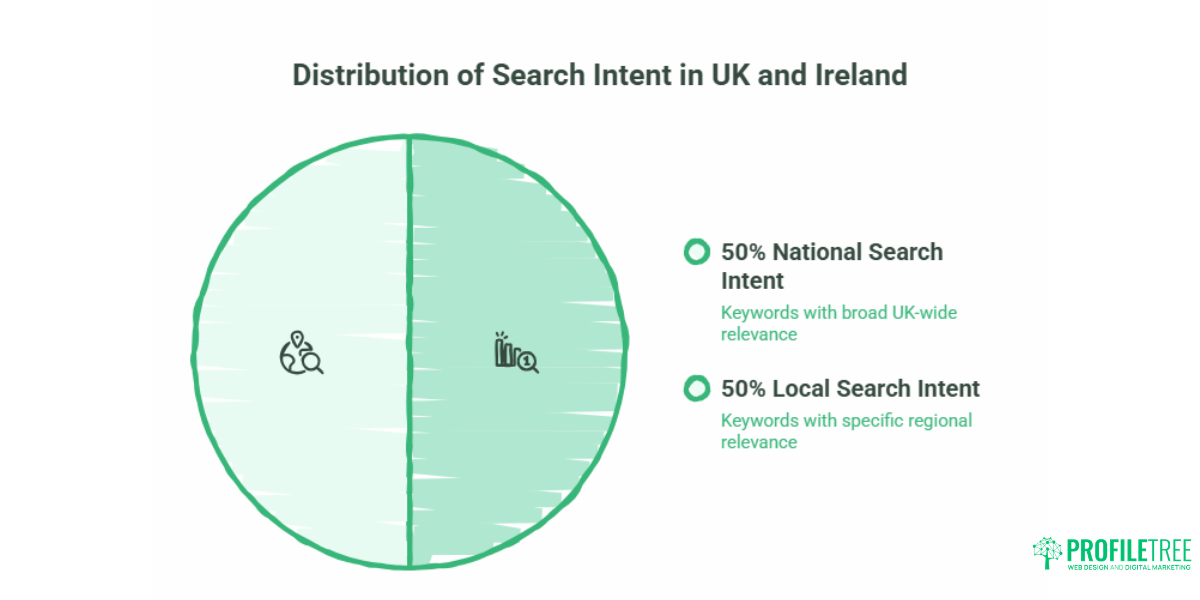
One gap almost no competitor analysis guide addresses is regional SERP variance within the UK and Ireland. The search picture for “accountant Belfast” is fundamentally different from “accountant London.” National brands that dominate broad UK terms often lose to local specialists on location-qualified searches.
For businesses based in Northern Ireland, Ireland, or regional UK cities, this is an advantage worth building on. A solicitor in Derry competing against national directories for “family solicitor Northern Ireland” has a genuine opportunity to outrank those directories for searches that carry clear local intent, because local relevance and proximity signals matter more for those queries than domain authority alone.
When running your competitor analysis, segment your target keywords by geographic intent. Some terms are genuinely national and require a national-level authority to compete for. Others are inherently local, and competing there is a different (and often more achievable) task.
AI-assisted local SEO tools are increasingly useful for tracking how rankings vary by location, letting you monitor not just whether you rank but whether you rank for users in specific areas, which is the metric that actually affects your enquiry volume.
Turning the Analysis Into a Six-Month Roadmap
Data collection is not a strategy. An SEO competitor analysis that ends with a spreadsheet of findings and no prioritised action plan produces very little commercial value.
The Priority Matrix
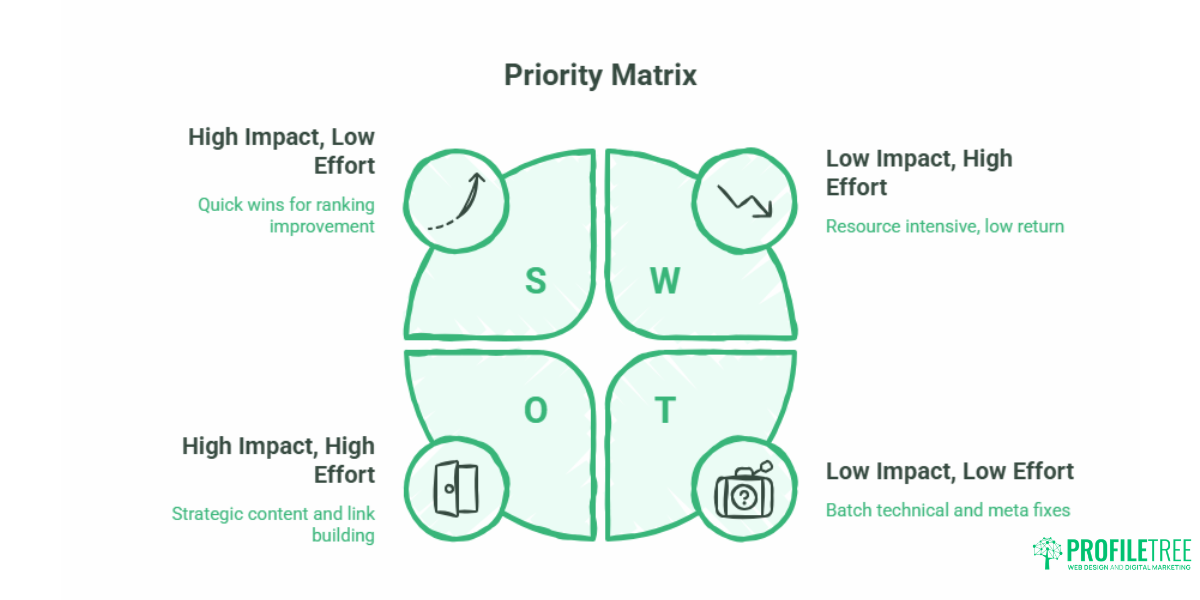
After completing the four-pillar audit above, sort your findings into four categories:
High impact, low effort. These are your first six to eight weeks. Examples: pages where you rank on page two for a term your competitor ranks on page one for, where the gap is thin content rather than a structural authority problem. Adding depth, improving structure, and targeting a featured snippet can move page-two rankings to page one relatively quickly.
High impact, high effort. These go in months two to four. Examples: new pillar content pages targeting keyword gaps with strong commercial intent. These take time to write well, build links to, and gain traction.
Low impact, low effort. Batch these and address them when capacity allows. Examples: technical fixes, meta description improvements, internal linking adjustments.
Low impact, high effort. Deprioritise or remove entirely. The resource cost rarely justifies the outcome.
Review Cadence
A full SEO competitor analysis is worth running every quarter for active campaigns. Between full audits, a monthly pulse-check covering your ranking positions for your top 20 keywords and your competitors’ new content gives you early warning of shifts without requiring the full analytical overhead.
For SMEs without a dedicated in-house SEO resource, this is where maximising ROI from your digital marketing becomes a practical question of prioritisation. The full analysis framework above is achievable, but it takes time to do properly. Many businesses reach a point where the cost of doing it well internally exceeds what an experienced SEO team would charge to do it for them.
Recommended Tool Stack for the UK Market
| Tool | Best For | UK Data Quality | Starting Price |
|---|---|---|---|
| Google Search Console | Your own first-party ranking data | Excellent | Free |
| Google PageSpeed Insights | Technical benchmarking | Excellent | Free |
| Semrush | Keyword gaps, competitor research | Strong UK database | From ~£99/month |
| Ahrefs | Backlink analysis, content research | Strong UK database | From ~£99/month |
| Screaming Frog | Technical site crawl | N/A (crawls your site) | Free up to 500 URLs |
| Bing Webmaster Tools | Secondary search engine data | Good for UK | Free |
For most SMEs, the free tools plus Semrush or Ahrefs at the entry tier are sufficient for regular competitor monitoring. Enterprise-level reporting requires more, but for businesses under roughly £5m turnover, tool spend above £200/month rarely yields proportional returns unless someone with the skills to use the data is in post.
Build or Buy: When to Run It Yourself vs When to Use an Agency
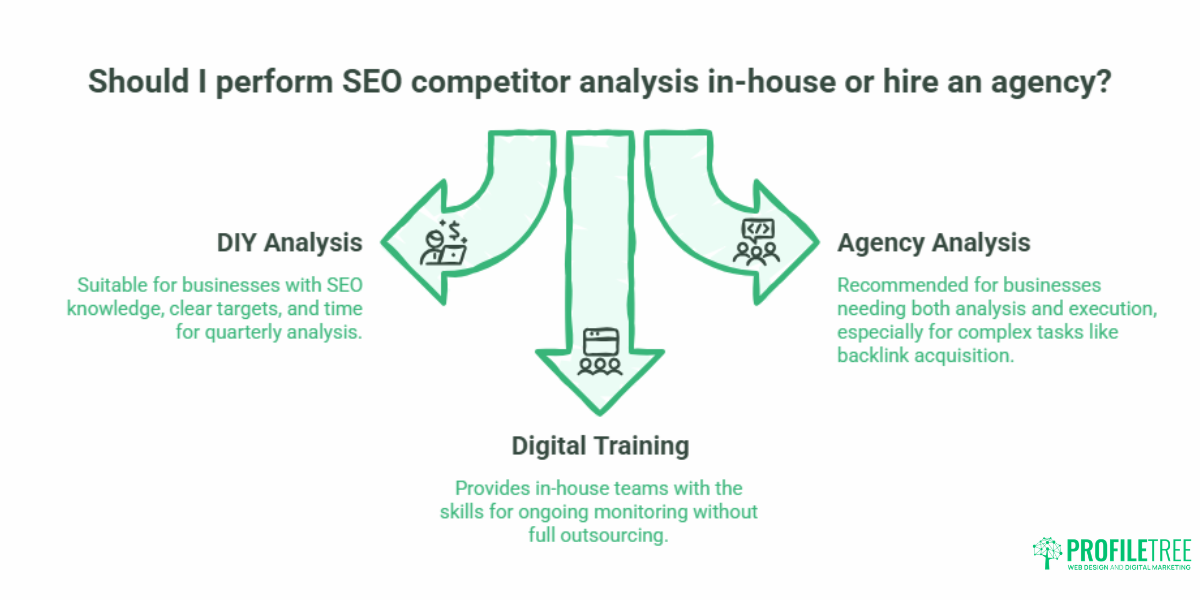
The DIY route works well when you have a marketing manager with some SEO knowledge, a clear keyword target list, and the time to run the analysis properly once per quarter. The framework above is designed to be self-contained for that use case.
It breaks down when the analysis needs to translate directly into content production, technical fixes, and link acquisition, because at that point, you need not just an analyst but an execution team. Knowing that a competitor has 400 backlinks from relevant UK publications tells you what the gap is; closing that gap requires a content and outreach programme that takes months to run.
ProfileTree’s SEO services cover both the analytical layer and the execution. If you’re at the stage of understanding your competitive position but are uncertain how to act on it, digital training programmes are also an option, giving your in-house team the skills to manage ongoing competitor monitoring without outsourcing the function entirely.
As Ciaran Connolly, founder of ProfileTree, puts it: “The businesses that do best with SEO are the ones that treat competitor analysis as a recurring business process, not a one-off project. The picture shifts, competitors invest, and the rankings reflect it. Staying ahead requires the same consistency you’d apply to any other part of the business.”
FAQs
How much does an SEO competitor analysis cost from a UK agency?
Pricing varies considerably by scope. A focused competitor analysis covering keyword gaps, content benchmarking, and backlink profiling typically starts at around £1,500 from a reputable UK agency for a one-off report. More thorough audits that include technical benchmarking, a prioritised roadmap, and a presentation to the client team can run from £3,000 to £5,000 or more. Enterprise-level ongoing competitive monitoring is usually priced as part of a retainer.
What are the three types of SEO competitors?
Direct competitors are organisations targeting the same keywords and the same customers as you are. Indirect competitors rank for related or adjacent terms but serve a slightly different audience or intent. Publisher competitors are media sites, directories, or blogs that rank for your target terms without being businesses in your space at all. Understanding which type of competitor you’re dealing with determines the right counter-strategy for each.
Which tool is best for finding keyword gaps in the UK market?
Semrush and Ahrefs both have strong UK databases and are the standard tools for this task. Semrush’s Keyword Gap tool is slightly more intuitive for direct comparison between domains. Ahrefs’ Content Gap feature is comparable in output. For businesses starting out, Google Search Console’s Performance report, combined with manual SERP analysis, can identify the most obvious gaps at no cost before committing to a paid subscription.
Can I do an SEO competitor analysis for free?
Yes, though with limitations. Google Search Console shows your own keyword data. Manual searching in a private window shows who you’re competing against. Google PageSpeed Insights covers technical performance. Bing Webmaster Tools adds a secondary data layer. The free approach is time-consuming and less granular than paid tools, but it’s a valid starting point for businesses with a limited budget who want to understand their competitive position before investing further.
How often should a UK business run an SEO competitor analysis?
A quarterly deep-dive covering all four pillars outlined above is the standard recommendation for businesses in active growth mode. Between those reviews, a monthly check of your top 20 keyword rankings and any significant new content from your primary competitors keeps you informed without the overhead of a full analysis. For businesses in highly competitive sectors or running active content programmes, a monthly review of keyword movements is worthwhile.
How do I track competitor rankings in specific UK cities or regions?
Geo-targeted rank tracking requires a tool that supports location-specific tracking. Semrush and Ahrefs both offer this. You can set up position tracking for a keyword list and specify a city or region, which shows your rankings as experienced by a user searching from that location. This is particularly relevant for service-area businesses in Northern Ireland, Scotland, or other regions where local intent searches behave differently from national ones.