
Google Analytics Alternatives for Privacy-Conscious SMEs
Table of Contents
If you run a small or medium-sized business and you’re looking for a Google Analytics alternative, you’re not alone. Stricter data protection laws, growing user awareness around privacy, and the ongoing questions around cross-border data transfers have pushed many business owners to question whether Google Analytics is still the right fit for their organisation.
Privacy-first analytics tools give SMEs something straightforward: the ability to measure website performance without compromising on the data rights of visitors. Done well, that approach also builds trust with customers, simplifies GDPR compliance, and reduces legal exposure.
This guide covers the most practical alternatives to Google Analytics, how to evaluate them against your actual business needs, and what to look for before making a switch. ProfileTree’s digital marketing services team regularly advises SMEs across Northern Ireland, Ireland, and the UK on analytics strategy, so the guidance here comes from real implementation experience.
Why SMEs Are Reassessing Google Analytics
The dominant reason businesses seek Google Analytics alternatives is compliance. Under GDPR, personal data processed by tools like Google Analytics can be subject to scrutiny around consent, data transfers to the United States, and the lawful basis for collection.
Several European data protection authorities, including those in Austria, France, Italy, and Denmark, have issued rulings that standard Google Analytics implementations violate GDPR. Those rulings relate specifically to the transfer of personal data to US servers without adequate safeguards. While Google has since introduced the EU-US Data Privacy Framework to address some of these concerns, many privacy-conscious organisations prefer to avoid the issue entirely by choosing a tool that processes data within the EU, or that avoids personal data collection altogether.
There’s also the question of data ownership. With Google Analytics, your data sits inside Google’s infrastructure, subject to its terms of service. Privacy-first alternatives typically give you full ownership of your data, whether that’s via self-hosting or a hosted service with a clear data processing agreement.
The GDPR Compliance Problem in Plain Terms
The core issue is this: Google Analytics sets cookies and collects IP addresses, browser fingerprints, and behavioural data. That constitutes personal data processing under GDPR. For many SMEs, especially those without a dedicated legal or compliance function, the easiest solution is to switch to a tool that collects less data in the first place.
Cookieless analytics tools are one answer. These tools measure traffic and behaviour without storing any personal data, which means you may not need a cookie consent banner at all. That removes friction for visitors and simplifies your compliance obligations significantly.
If you want to understand how your website’s performance connects to your broader digital presence, ProfileTree’s content marketing services team can help you build a measurement framework that respects both your audience and the law.
Key Features to Look For in an Alternative Analytics Tool
Not all privacy-friendly analytics tools are built the same. Before choosing one, define what your business actually needs from an analytics platform.
Real-Time Traffic Data
Real-time reporting lets you see what visitors are doing on your site right now. This is particularly useful for businesses running campaigns, publishing content, or monitoring product launches. Some privacy-first tools limit real-time data to keep infrastructure lightweight; check whether the tool you’re considering meets your operational needs.
User Behaviour and Journey Tracking
Understanding how people move through your website, which pages they land on, where they drop off, and which content leads to enquiries is core to making your site work harder. Look for tools that offer pageview tracking, referral sources, session data, and conversion events without requiring invasive tracking methods.
Conversion and Bounce Rate Metrics
These two metrics tell you whether your content and landing pages are doing their job. Conversion tracking shows how many visitors take a desired action; bounce rate shows how many leave immediately. Privacy-first tools handle these differently, some using session-based modelling rather than individual-level tracking, but the outputs are still actionable.
Heatmaps and Event Tracking
Heatmaps show where visitors click, scroll, and engage on individual pages. Event tracking lets you record specific actions like button clicks, form submissions, or video plays. Not all lightweight analytics platforms include these features; if they matter for your business, check whether your preferred tool supports them natively or via integration.
“Most SMEs don’t need enterprise-level analytics setups. They need clear data on which pages are converting and which are losing people, presented in a way that’s easy to act on. Privacy-friendly tools have matured to the point where that’s genuinely achievable without compromising your legal obligations,” says Ciaran Connolly, founder of ProfileTree.
Privacy-Friendly Analytics Tools Worth Considering
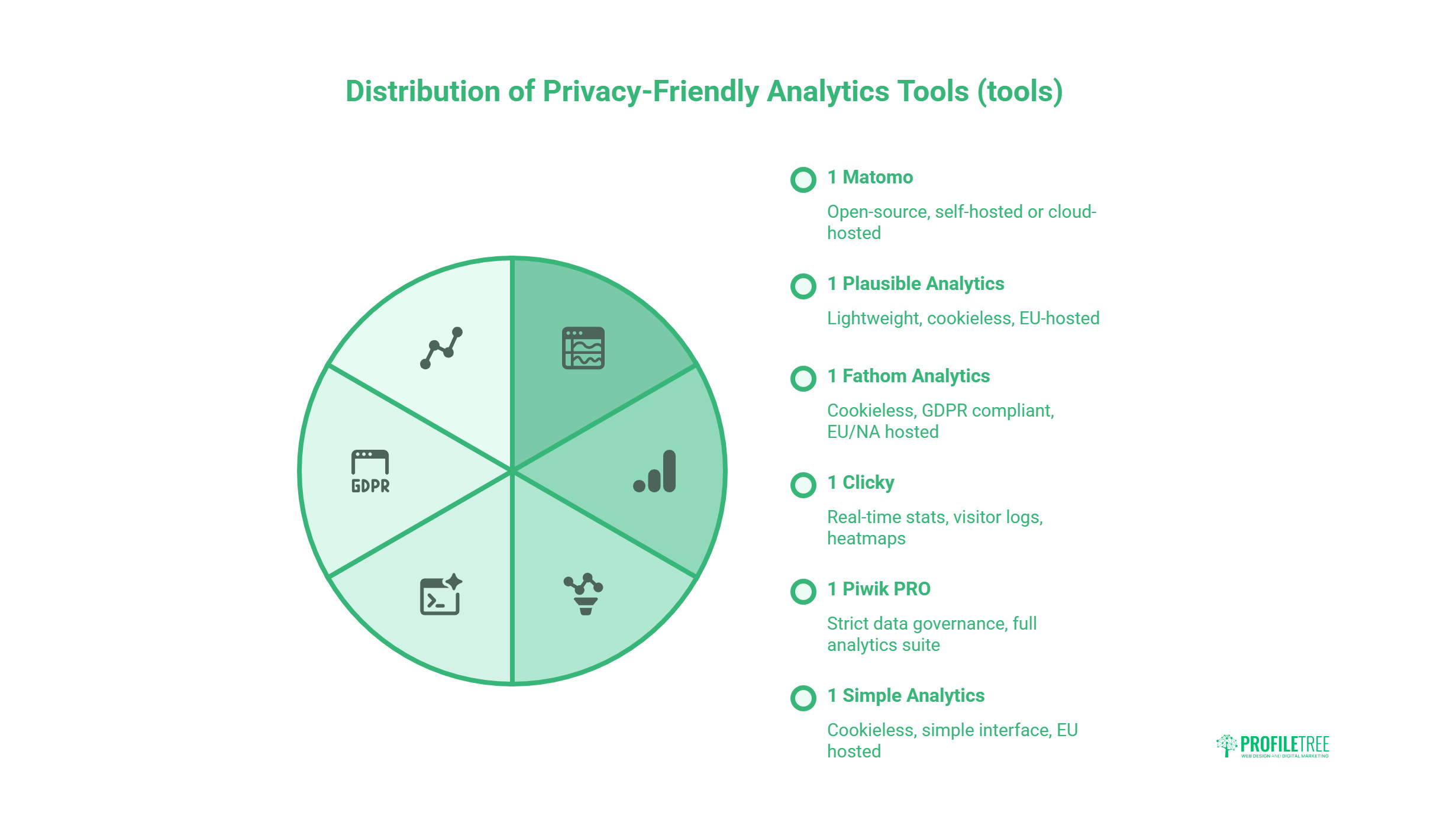
The options below are established tools with genuine privacy credentials. Each takes a different approach, so the right choice depends on your team’s technical comfort, budget, and specific measurement needs.
Matomo
Matomo is an open-source analytics platform that can be self-hosted on your own server or used as a cloud-hosted service. It’s one of the most direct functional replacements for Google Analytics, offering a familiar dashboard with pageviews, sessions, goals, funnels, heatmaps, and event tracking.
The key advantage is data ownership. When self-hosted, all data stays on your infrastructure. Matomo also includes a consent management module, making it easier to handle GDPR requirements within the platform itself. It’s used by over one million websites globally, including a number of government agencies, which speaks to its stability and compliance credentials.
The trade-off is setup complexity. Self-hosting Matomo requires server access and some technical configuration. The cloud-hosted version is simpler to set up but costs more than some lightweight alternatives.
Plausible Analytics
Plausible is a lightweight, open-source tool that collects no personal data and sets no cookies. It measures traffic without tracking individuals, which means it operates outside the scope of GDPR cookie consent requirements for most use cases.
The dashboard is intentionally simple: pageviews, unique visitors, bounce rate, top pages, referral sources, and a few campaign metrics. If you’re coming from a full Google Analytics setup, the reduced feature set will feel like a step down. If you mostly check a handful of core metrics each week, it’s more than sufficient.
Plausible is EU-hosted, with infrastructure in Germany, which addresses the data transfer concerns that have caused problems for other analytics tools under GDPR.
Fathom Analytics
Fathom takes a similar approach to Plausible: cookieless, privacy-first, simple dashboard, and GDPR compliant without requiring a consent banner. It’s a hosted service rather than open-source, which means slightly less control but easier maintenance.
Fathom’s filtering system is particularly well-regarded, letting you exclude specific IP addresses, filter spam traffic, and segment data by URL or referral without complex configuration. It processes data on servers in the EU and North America, with routing designed to keep European visitor data in Europe.
Pricing is based on monthly page views, starting at around $14 per month for smaller sites.
Clicky
Clicky sits in the middle ground between lightweight privacy tools and full-featured analytics platforms. It offers real-time stats, individual visitor logs (with privacy controls), heatmaps, uptime monitoring, and goal tracking. For businesses that need more granular data than Plausible or Fathom provide, Clicky is worth evaluating.
It uses cookies by default but can be configured for cookieless operation. GDPR compliance depends more on your configuration and consent setup than with fully cookieless tools.
Piwik PRO
Piwik PRO is built specifically for organisations with strict data governance requirements, including those in regulated industries. It offers a full analytics suite with tag management, consent management, and a customer data platform, all under a single privacy-focused architecture.
The platform is available with EU-hosted infrastructure and includes detailed data processing agreements designed to satisfy GDPR requirements. It’s more complex and more expensive than lightweight tools, but for larger SMEs or those in sectors like healthcare, finance, or education, the compliance features may justify the additional cost.
Simple Analytics
Simple Analytics collects no personal data and produces no cookies. Its reporting covers the core metrics most SMEs actually use: pages, referrers, time on site, and device types. The interface is clean and fast.
It’s worth noting that Simple Analytics is a hosted service run from the Netherlands, with EU data processing. For businesses that want a verified-simple, GDPR-compliant option without self-hosting overhead, it’s a practical choice.
Comparing Privacy Analytics Tools at a Glance
| Tool | Self-Hosting Option | Cookieless | GDPR-Ready Out of Box | Heatmaps | Approximate Starting Cost |
|---|---|---|---|---|---|
| Matomo | Yes | Optional | Yes | Yes | Free (self-hosted) / ~€19/month |
| Plausible | Yes | Yes | Yes | No | $9/month |
| Fathom | No | Yes | Yes | No | $14/month |
| Clicky | No | Optional | Configurable | Yes | Free (limited) / $9.99/month |
| Piwik PRO | No (enterprise) | Optional | Yes | Yes | Free tier / custom pricing |
| Simple Analytics | No | Yes | Yes | No | $9/month |
Evaluating the Impact on Your Website and User Experience
Switching analytics tools has practical implications beyond data privacy. Two areas that often go unconsidered are page load performance and integration with your existing tools.
Page Load Performance
Google Analytics (especially GA4 with Google Tag Manager) adds JavaScript to every page load. Lightweight tools like Plausible and Fathom use significantly smaller scripts, which can contribute to faster load times. For businesses focused on Core Web Vitals and page experience, this is a genuine benefit.
Matomo’s self-hosted version can be optimised for performance but requires more configuration effort to get there. Clicky and Piwik PRO sit somewhere in between.
Integration with Other Platforms
Most privacy-first tools offer API access for custom integrations, and many integrate with popular CMS platforms including WordPress, Shopify, and others. Before committing to a tool, check whether it connects to the platforms your business already uses, including your email marketing software, CRM, or advertising platforms.
If you’re building or redesigning a website and need help selecting and configuring the right analytics setup from the start, ProfileTree’s web design and development services team handles analytics integration as part of every project.
Migrating from Google Analytics: A Practical Approach
Moving from Google Analytics to an alternative involves three main tasks: exporting historical data, setting up the new tool, and updating your tracking implementation.
Exporting Your Historical Data
Google Analytics allows you to export reports as CSV, PDF, or Google Sheets. Before switching, export the data that matters most to your business: monthly traffic trends, top landing pages, referral sources, and any conversion data you’ll want to reference in future.
Google’s own data export tools are limited; for a more complete export, tools like Google Analytics Data API or third-party export services can help retrieve more granular historical data.
Setting Up the New Tool
Each tool has its own setup process. Self-hosted options like Matomo require server access and database configuration. Hosted tools like Plausible and Fathom involve creating an account, adding a tracking script to your site, and verifying it’s collecting data.
For WordPress sites, most tools offer dedicated plugins that handle the technical installation without code editing. For other platforms, you’ll typically add the tracking script to your site’s header via a tag manager or theme editor.
Updating Your Consent Setup
If you’re switching to a fully cookieless tool, you may be able to simplify or remove your cookie consent banner, depending on your jurisdiction and legal advice. This should be reviewed with your data protection officer or legal adviser before making any changes, as requirements vary.
If your business needs support building a privacy-first digital presence from the ground up, our AI transformation services can help integrate privacy-respecting data tools into a wider strategy for smarter, more ethical use of customer data.
Support, Documentation, and Long-Term Costs
Evaluating Vendor Support
For privacy-first tools, support quality varies significantly. Plausible and Fathom both have active communities and responsive email support, but neither offers phone or live chat. Matomo has a larger ecosystem with professional support contracts available. Piwik PRO provides dedicated support as part of its paid plans.
Before choosing a tool, check the documentation quality: a well-documented platform reduces your dependency on vendor support and makes it easier to onboard new team members.
Total Cost of Ownership
The sticker price of privacy analytics tools is generally lower than enterprise analytics contracts, but total cost includes time for setup, maintenance (particularly for self-hosted options), and training.
For most SMEs, a hosted tool in the £9 to £20 per month range with minimal setup requirements will deliver better value than a self-hosted option that requires ongoing server management.
Frequently Asked Questions
Do I need to show a cookie consent banner if I switch to a cookieless analytics tool?
In most cases, fully cookieless analytics tools that collect no personal data do not trigger GDPR cookie consent requirements. This means you may be able to remove or simplify your consent banner. However, legal requirements vary by country, and you should confirm this with a GDPR-qualified legal adviser before making changes to your consent setup.
Can privacy-first analytics tools still track conversions and goals?
Yes. Tools like Matomo, Clicky, and Piwik PRO offer goal tracking and conversion events comparable to Google Analytics. Lightweight tools like Plausible and Fathom support custom events, which means you can track specific actions like form submissions or button clicks, though the reporting interface is simpler.
How accurate is cookieless tracking compared to cookie-based analytics?
Cookieless tracking is generally less precise at the individual user level, but for aggregate metrics like pageviews, traffic sources, and conversion rates, the data is reliable. Many practitioners argue that cookieless data is actually more representative, because it captures visitors who block cookies or use browsers with default tracking prevention, which cookie-based tools miss entirely.
Is Matomo a direct replacement for Google Analytics?
Matomo is the closest functional replacement available. It mirrors much of GA’s structure, including goals, segments, funnels, and ecommerce tracking, which makes migration easier for teams already familiar with Google Analytics reporting. The main differences are in the setup process and the absence of Google-specific integrations.
What happens to my data if I stop using Google Analytics?
Google Analytics data does not transfer to third-party tools. Once you stop using Google Analytics, historical data in your GA account remains accessible for as long as you retain your account, but it doesn’t import into a new platform. This is why exporting your most important reports before switching is important.
Can I run both Google Analytics and a privacy-first tool at the same time?
Yes. Running both in parallel for a period (typically 30 to 90 days) lets you validate that your new tool is collecting accurate data before you fully switch over. This dual-tracking approach also gives you a comparison point for understanding any differences in reported metrics.
Are there free privacy-friendly analytics tools?
Matomo is free to self-host. Open Web Analytics is another open-source option available at no cost. Most hosted tools offer free tiers with limited page view allowances. For a small business with lower traffic volumes, the free tiers from several providers may be sufficient to start.
Do these tools work with WordPress?
Yes. All the major privacy-first tools, including Matomo, Plausible, Fathom, and Clicky, have WordPress plugins that handle installation without requiring manual code changes. Matomo has an especially well-maintained WordPress plugin with a self-hosted mode that keeps all data within your WordPress hosting environment.
A Practical Summary
Choosing a Google Analytics alternative comes down to three practical questions. How much data do you need? How much technical complexity can your team manage? And what level of GDPR compliance do you require?
For most SMEs, a hosted cookieless tool like Plausible or Fathom provides a straightforward path to privacy compliance with minimal setup and cost. For organisations that need richer behavioural data or operate in regulated industries, Matomo or Piwik PRO are the stronger options.
What all these tools share is a fundamentally different relationship with visitor data: one built on collecting less, owning more, and creating fewer compliance headaches. As data protection enforcement continues to mature across the UK and EU, that approach will only become more valuable.
ProfileTree, a Belfast-based digital marketing and web design agency, works with SMEs across Northern Ireland, Ireland, and the UK to build digital strategies grounded in real performance data and responsible data practices.
For further reading, explore how data-driven content strategy helps SMEs build organic traffic and how AI tools are changing the way small businesses use customer data.