
Beginner’s AI Skills Training: What Business Owners Actually Need to Know
Table of Contents
Artificial intelligence has moved well beyond the technology sector. Business owners across Belfast, Northern Ireland, and the wider UK are now using AI tools to write content, handle customer queries, analyse data, and automate repetitive processes without writing a single line of code.
The barrier to entry is far lower than most people assume. Beginner’s AI skills training is not about learning to build algorithms or studying computer science. It is about understanding what AI tools do, where they fit into your business, and how to use them with enough confidence to get real results.
ProfileTree’s AI transformation services are built around this principle: practical AI adoption for SMEs, not enterprise-level complexity. If you run a small or medium-sized business and want to stay competitive, that is exactly where you need to start.
Why AI Skills Matter More Than AI Hype
There is no shortage of bold claims about what AI will do to business. The more useful question is what AI can do for your business right now, with the time and budget you actually have.
For most SMEs, the immediate opportunities fall into three categories: saving time on content creation, email writing, and customer communications; making better decisions using data that was previously too complex to interpret quickly; and improving customer experience through faster responses and more personalised service.
None of these require a technical background. They require a basic understanding of which tools exist, how to talk to them effectively through prompting, and how to judge whether their output is good enough to use.
The Difference Between AI Literacy and AI Expertise
AI literacy means understanding enough about AI to use it well in your day-to-day work. AI expertise means building or training models from scratch. Business owners need the former, not the latter.
AI literacy covers things like knowing the difference between a large language model and a standard search engine, understanding what a prompt is and how to write a better one, recognising when AI output needs human review, and being aware of the key risks around data privacy and accuracy.
That level of understanding is achievable in a matter of days, not months. It makes a measurable difference to how confidently and effectively you can use tools like ChatGPT, Microsoft Copilot, Google Gemini, or the AI features now built into most marketing platforms.
What Beginner’s AI Skills Training Covers
A structured beginner’s course for business owners typically covers five core areas. You do not need to master all of them before you start using AI tools, but understanding each one helps you get more from the tools you adopt.
How AI Tools Actually Work (Without the Technical Detail)
You do not need to understand neural networks to use AI effectively. What helps is a basic mental model: large language models like ChatGPT are trained on vast amounts of text and learn to predict the most useful response to a given input. They are not databases, and they do not browse the web in real time (unless you give them that capability), and they do not have opinions. They generate text based on patterns in their training data.
Understanding this prevents common mistakes, such as treating AI output as factual without checking it, or expecting consistent results from vague instructions. It also helps you ask better questions and get more usable output from the same tools.
Prompting: The Core Skill for Non-Technical Users
Prompting is the practice of writing clear, specific instructions that get useful output from an AI tool. It is the most important practical skill a business owner can develop, and it requires no technical knowledge whatsoever.
A good prompt typically includes the task you want done, the context the AI needs to do it well, the format you want the output in, and any constraints such as tone, length, and audience. A poorly written prompt produces generic, often unusable output. A well-constructed prompt can produce a first draft, a data analysis summary, or a customer response template in seconds.
Most beginner AI training programmes spend significant time on prompting, and for good reason. It is where most of the practical value sits.
The Main Categories of AI Tools for Business
AI tools for business broadly fall into six categories. Content and copywriting tools include platforms like ChatGPT and Claude. Image and design tools include Adobe Firefly and similar services. Productivity and automation tools include Microsoft Copilot and Zapier’s AI features. Customer service tools cover AI chatbots and live chat assistants. Data and analytics tools include AI-powered reporting in Google Analytics 4 and HubSpot. SEO and marketing tools cover AI-assisted keyword research and ad copy generation.
A beginner’s training programme helps you map these categories to your specific business needs rather than trying to use everything at once.
AI and Data Privacy: What You Need to Know
This is often the area business owners are least confident about, and it is genuinely important. When you input business data, customer details, or sensitive information into an AI tool, you need to understand where that data goes and how it is handled.
Most reputable AI tools have clear data policies. ChatGPT’s enterprise tier allows you to opt out of having your conversations used for model training. Microsoft Copilot is integrated with Microsoft 365’s existing security and compliance framework.
UK and Irish businesses also need to consider GDPR compliance. Inputting personal data about customers into AI tools without understanding the data processing implications creates legal risk. Beginner training that skips this topic is incomplete.
Recognising AI Output That Needs Review
AI tools make mistakes. They generate plausible-sounding but incorrect information, sometimes called hallucinations. They can produce content that is outdated, culturally insensitive, or off-brand. They do not know your business the way you do.
Good AI skills training builds the habit of treating AI output as a starting point, not a finished product. The human review step is not optional. It is where your expertise and judgement add the value that AI cannot replicate.
How Business Owners in Northern Ireland Are Using AI Right Now
Across Belfast and Northern Ireland, SMEs are applying AI in practical ways that directly affect their bottom line. The applications share a common thread: they reduce the time spent on repeatable tasks so that business owners and their teams can focus on higher-value work.
Common examples include retailers using AI to write product descriptions and category page copy at scale, professional services firms using AI to draft client communications and summarise meeting notes, hospitality businesses using AI chatbots to handle booking enquiries outside office hours, and service businesses using AI to create first drafts of proposals, quotes, and follow-up emails.
None of these applications required hiring a data scientist or investing in custom AI development. They used widely available tools combined with the knowledge of how to direct those tools effectively.
ProfileTree’s digital marketing services support businesses in building this kind of AI-assisted marketing approach, integrating tools with existing strategy rather than replacing it.
Building AI Into Your Marketing Without Starting From Scratch
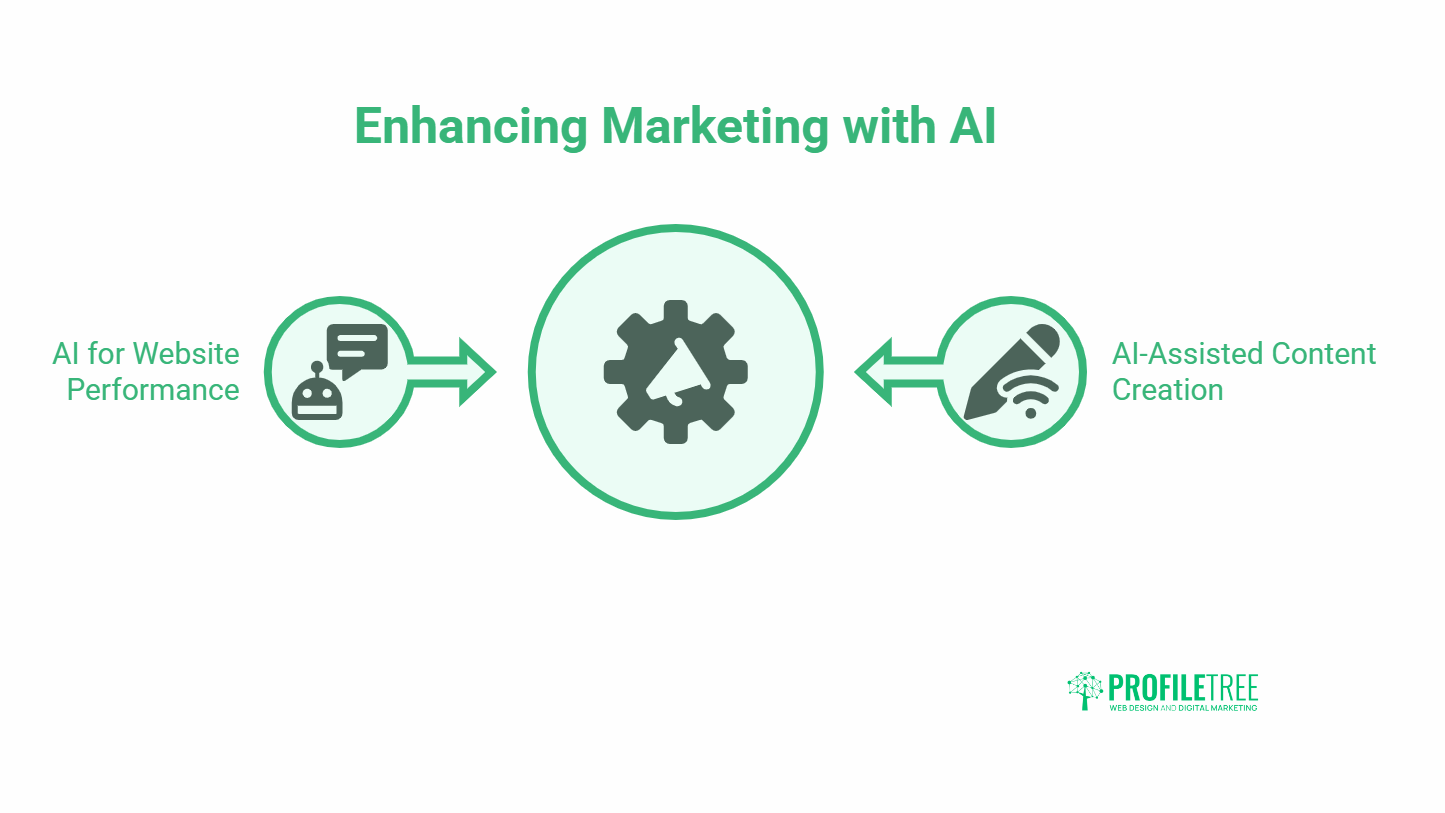
One of the most immediate benefits of AI skills training for business owners is better marketing output, produced faster. Content creation is an area where even basic AI literacy pays off quickly.
AI-Assisted Content Creation
Writing consistent, high-quality content (blog posts, email newsletters, social media updates, website copy) takes significant time. AI tools do not replace the strategic thinking behind good content, but they reduce the time spent on the mechanical parts: drafting, editing, reformatting, and producing variations.
The key is knowing how to direct the output. A business owner who asks an AI tool to “write a blog post about my industry” will get generic content. A business owner who provides context, tone guidelines, specific points to cover, and examples of previous content will get a usable draft that needs light editing rather than a full rewrite.
ProfileTree’s content marketing services include guidance on integrating AI tools into content workflows without losing the quality and authority that drives rankings and reader trust.
AI for Website Performance and Digital Presence
AI tools are also changing what is possible for SME websites. From AI-generated image alt text and metadata suggestions to chatbot integrations that improve conversion rates, the practical applications continue to grow. Businesses that understand these tools can make faster, better-informed decisions about their digital presence.
If you are considering a website built to perform well in search, convert visitors, and support lead generation, understanding how AI fits into that picture is increasingly relevant. ProfileTree’s web design and development services integrate AI-capable features where they genuinely add value for SME clients.
Where to Start With Beginner’s AI Training
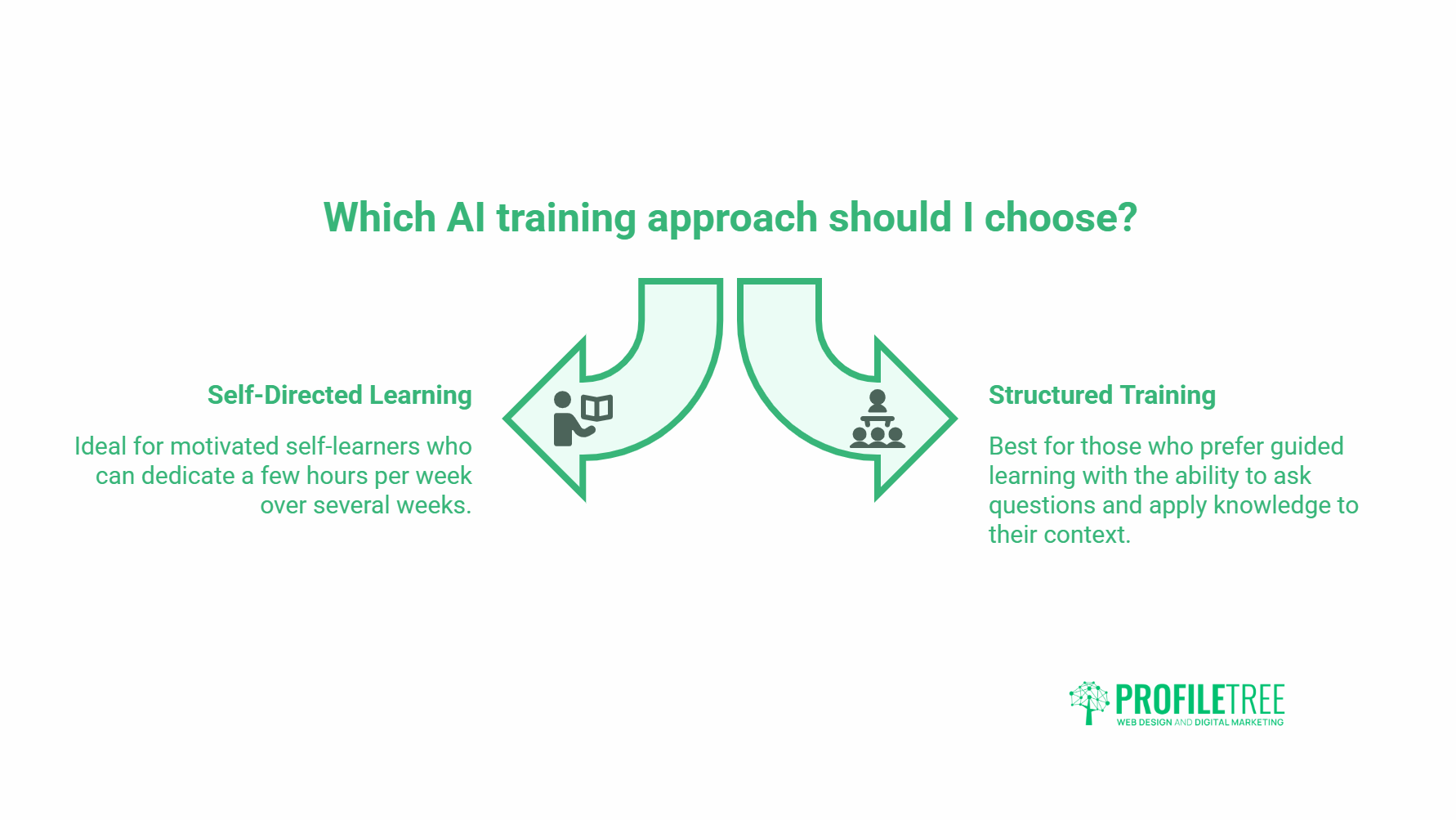
The best starting point depends on how you learn and how much time you have available.
Self-Directed Learning Options
Several high-quality free resources are available for business owners who want to develop AI literacy independently. Google’s AI Essentials course (available at grow.google) provides a structured, practical introduction to AI tools and concepts and is free to complete with a paid certificate option. Elements of AI, developed by the University of Helsinki and Reaktor, covers AI fundamentals without requiring any technical background. Microsoft’s AI Skills Navigator is a free tool that recommends learning paths based on your role and goals.
These resources work well for motivated self-learners who can dedicate a few hours per week over four to six weeks.
Structured Training Programmes
For business owners who want guided learning with the ability to ask questions and apply knowledge to their specific context, a structured training programme delivers faster results. Group workshops, one-to-one coaching, and bespoke in-house training sessions all have their place depending on the size of your team and the depth of knowledge you want to build.
ProfileTree delivers AI training for SMEs across Northern Ireland, Ireland, and the UK. Sessions are practical and focused on tools and applications that are relevant to your type of business. Our AI transformation services cover everything from initial literacy through to integrating AI into marketing and operational workflows.
What Makes AI Training Worth the Investment
“The businesses that will see the most benefit from AI are not necessarily the ones with the biggest budgets. They’re the ones that take the time to understand which tools are relevant to them and learn to use them well,” says Ciaran Connolly, Director of ProfileTree.
The time investment for beginner-level AI training is modest. A business owner who completes a structured programme and practises consistently can expect to save several hours per week on content, communications, and routine tasks within a few months.
The competitive dimension matters as much as the efficiency gains. As AI tools become standard across industries, the gap between businesses that use them effectively and those that do not is widening. Getting ahead of that curve is increasingly a strategic priority, not a nice-to-have.
Frequently Asked Questions
Do I need any technical skills to start AI training as a business owner?
No. Beginner’s AI skills training for business owners does not require any coding knowledge, mathematics background, or technical experience. The focus is on using existing tools effectively, not building new ones.
How long does it take to develop useful AI skills?
Most business owners can develop practical, working AI skills within four to eight weeks of consistent effort, and faster with structured training. The fundamentals of prompting, tool selection, and output review can be covered in a day-long workshop.
Which AI tools should a small business owner learn first?
Start with the tools most relevant to tasks you already do: content creation, productivity, and any AI features already built into platforms you currently use such as Google Analytics 4, HubSpot, or Canva. Depth with a few relevant tools is more valuable than broad familiarity with many.
Is AI training worth it for very small businesses?
Yes, often more so than for larger organisations. Sole traders and micro-businesses benefit disproportionately from time savings because every hour has a high opportunity cost. Learning to use AI for draft writing, customer responses, and routine communications can free up meaningful time each week.
How do I know if an AI course is actually good?
Look for courses that are practical rather than theoretical, cover real business use cases rather than abstract concepts, and include guidance on responsible use and data privacy. Courses from Google, Microsoft, and reputable universities are a reliable starting point.
Can AI replace my marketing team or content writer?
No. AI tools can produce useful drafts and handle repetitive tasks, but they do not replace strategic thinking, brand knowledge, audience understanding, or quality judgement. The most effective approach combines AI efficiency with human expertise.
Conclusion
Beginner’s AI skills training is not a technical course for future developers. It is a practical programme for business owners, marketing managers, and decision-makers who want to use AI tools confidently and get real results from them.
The learning curve is shorter than most people expect. The tools are more accessible than they appear. And the businesses that build this knowledge early are already seeing the benefits in their content output, customer communications, and operational efficiency.
ProfileTree is a Belfast-based digital marketing and AI training agency working with SMEs across Northern Ireland, Ireland, and the UK. If you want to explore how AI training could work for your business, our AI transformation services are a practical starting point.
For further reading, explore how AI is creating new opportunities for SMEs in blockchain and how AI and automation are reshaping marketing technology.