
Business Models for Small Businesses: 12 UK Frameworks
Table of Contents
Most small businesses choose a model by accident rather than by design. They follow what feels familiar, copy what a competitor appears to be doing, or default to hourly billing simply because that is how others in their sector charge. The result is a structure that limits growth before the business has even had a chance to scale.
This guide walks through 12 proven business models suited to UK and Irish entrepreneurs, from subscription retainers to AI-as-a-Service. It covers the critical factors that determine which model fits your stage, your market, and your resources, plus the UK-specific legal and tax context that most guides ignore entirely.
You will also find practical guidance on pivoting an existing model, a comparison matrix to compare options side by side, and a set of FAQs drawn from the questions small business owners ask most often.
What Is a Business Model and Why Does It Matter?
A business model describes how your organisation creates value, delivers it to customers, and captures revenue in return. It is not the same as a business plan. The plan is the structured document that sets out your targets, timelines, and funding requirements. The model is the engine underneath it: the structural logic that determines whether your business can be profitable and scalable at all.
Getting this distinction right matters because many small businesses invest heavily in planning without ever interrogating the underlying model. You can have an excellent marketing plan and a well-staffed team, yet still struggle to grow if your model is fundamentally constrained. A freelance consultant billing by the hour, for instance, hits a natural ceiling the moment their diary is full. The model caps revenue before ambition ever gets a chance to.
Understanding business decision-making through data is one of the most effective ways to evaluate whether your current model is serving you.
The Four Core Components of Any Model
Every business model, regardless of sector or size, rests on four elements. The value proposition defines what problem you solve and for whom. The revenue mechanism describes how money flows in. The cost structure outlines what it takes to deliver the value. And the distribution channel determines how customers find and access what you offer.
When any of these four components is misaligned, the model struggles. A strong value proposition paired with an expensive distribution channel can erase margins before you reach profitability. A low-cost operation with no clear revenue mechanism simply does not sustain itself.
Business Model vs Business Plan: A Direct Comparison
The confusion between these two terms is one of the most common mistakes early-stage entrepreneurs make. Here is how they differ in practice.
| Dimension | Business Model | Business Plan |
|---|---|---|
| Purpose | Defines the structural logic of how value is created and captured | Sets out goals, timelines, and financial projections |
| Time horizon | Long-term; foundational | Short to medium-term; operational |
| Audience | Internal; strategic decision-making | External; investors, lenders, partners |
| Flexibility | Evolves with the market and company stage | Updated periodically or for funding rounds |
Why the Wrong Model Costs More Than You Think
Choosing a model that does not fit your market or capacity does not just slow growth. It creates structural waste: staff time spent on low-margin work, customer acquisition costs that outpace lifetime value, and an inability to reinvest in the business. The earlier a founder identifies a model mismatch, the less expensive it is to correct.
Research into small business failure consistently identifies a poor or misaligned business model as a root cause, sitting alongside cash flow mismanagement and inadequate market research. Fixing the model is often a more productive intervention than doubling down on marketing spend.
5 Critical Factors When Choosing Your Business Model
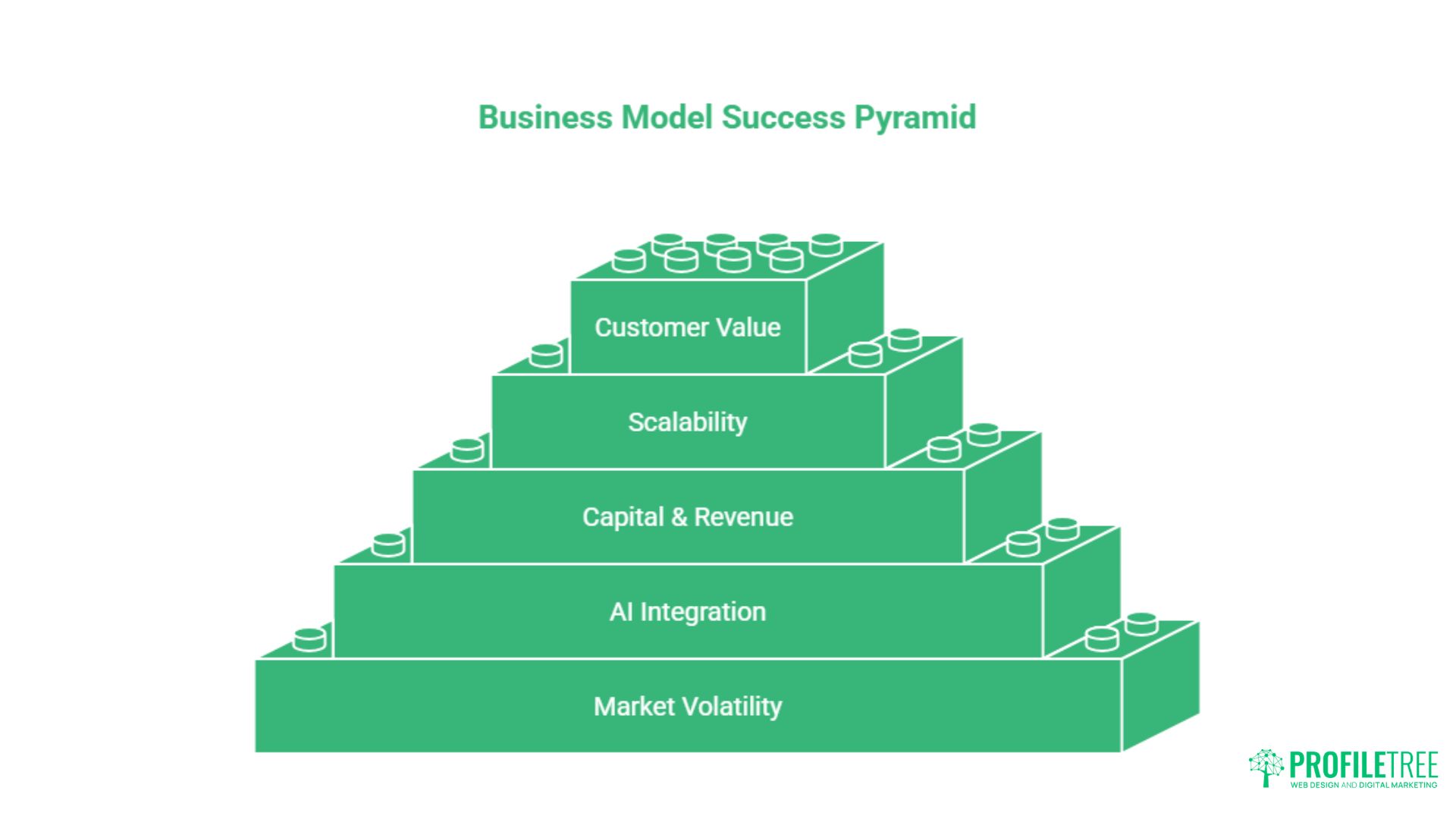
The right model for your business depends on a combination of external conditions and internal realities. The checklist below covers the five factors that matter most for UK and Irish small businesses choosing or reviewing their model right now.
1. Market Volatility and Cost Pressures
UK businesses are operating in an environment shaped by high energy costs, wage inflation, and a consumer base that has become more price-sensitive since 2022. Models that depend on high transaction volumes at thin margins, such as traditional retail, face compounding pressure. Recurring revenue models, by contrast, provide predictability that allows better cost planning.
When evaluating a model under current conditions, the key question is: how many months of forward revenue can you see at any given time? A business with three months of booked recurring income operates from a fundamentally different position than one that restarts from zero each month.
2. AI Integration Capacity
AI tools are now accessible at a price point that makes them viable for businesses with fewer than ten employees. The businesses that integrate AI as an efficiency layer, rather than waiting for it to become standard, gain compounding advantages in speed, cost, and output quality.
The model you choose should have a clear answer to the question: where does AI reduce our costs or increase our output without reducing the quality customers expect? For a consultancy, this might mean AI-assisted research and report generation. For a product business, it might mean automated customer service and demand forecasting.
Exploring how AI supports SME growth gives a practical view of where the efficiency gains are most accessible for smaller organisations.
3. Capital Requirements and Time to First Revenue
Some models require significant upfront capital before generating any return. A franchise model, for instance, typically involves licence fees, fit-out costs, and working capital before a single customer walks through the door. A service-based model can generate revenue within days of launch.
For first-time entrepreneurs or businesses bootstrapping without external funding, the time to first revenue is often the most important variable. Models with shorter payback periods allow founders to learn from real market feedback before committing larger resources.
4. Scalability Without Proportional Cost Growth
Scalability, in practical terms, means the ability to grow revenue without growing costs at the same rate. A productised service, where you package expertise into a fixed-scope deliverable, scales better than open-ended hourly work because delivery becomes more efficient with each iteration.
The question to ask is: if we doubled our revenue next year, would our costs roughly double too? If the answer is yes, the model has a structural scaling problem that no amount of marketing investment will solve.
5. Customer Lifetime Value vs Acquisition Cost
Unit economics are the most reliable indicator of whether a model is working. Customer Lifetime Value (CLV) measures what a customer is worth to your business over the full course of the relationship. Customer Acquisition Cost (CAC) measures what it costs to win each new customer. A healthy model maintains a CLV-to-CAC ratio of at least 3:1.
Models with high acquisition costs, such as those dependent on paid advertising, need either high transaction values or strong repeat purchase behaviour to remain viable. Understanding this ratio before choosing a model prevents the common trap of growing a customer base that costs more to maintain than it generates.
For a deeper look at how data supports these decisions, the ProfileTree guide to structured decision-making covers the frameworks that apply well beyond business model selection.
The 12 Best Business Models for Small Businesses
The comparison table below gives a quick reference for the models covered in this section. Each model is assessed against four practical dimensions to help you narrow your options before reading in detail.
| Model | Startup Cost | Typical Margin | Scalability (1–10) | Time to Revenue |
|---|---|---|---|---|
| Subscription / Retainer | Low | 40–70% | 8 | Days |
| Value-Based Service | Low | 50–80% | 6 | Days–Weeks |
| Direct-to-Consumer (DTC) | Medium | 25–50% | 7 | Weeks |
| Freemium | High | 60–80% (premium tier) | 9 | Months |
| Marketplace | High | 10–30% | 9 | Months |
| Franchise | High | 10–20% | 5 | Months |
| Circular / Sustainable | Medium | 20–45% | 6 | Weeks–Months |
| Aggregator | Medium | 15–35% | 8 | Months |
| Consultancy / Professional Services | Low | 40–65% | 5 | Days |
| Brick-and-Mortar Local | High | 10–30% | 4 | Months |
| White-Label / Dropshipping | Low | 10–30% | 7 | Weeks |
| AI-as-a-Service (AIaaS) | Medium | 50–75% | 9 | Weeks–Months |
All prices and figures in this guide are indicative UK examples and correct at the time of writing; use them as a benchmark rather than fixed quotations.
1. The Subscription / Retainer Model
The subscription model charges customers a recurring fee, typically monthly or annually, in exchange for ongoing access to a product or service. For service businesses, this takes the form of a retainer: a fixed monthly fee for a defined scope of work. The appeal is straightforward. Revenue becomes predictable, cash flow planning becomes simpler, and the cost of serving an existing customer is far lower than acquiring a new one.
For UK businesses, retainer arrangements work particularly well in professional services, digital marketing, accountancy, and IT support, where clients benefit from continuous availability rather than one-off projects. The challenge is defining the scope clearly enough to prevent scope creep from eroding your margin.
2. The Value-Based Service Model
Rather than charging for time, a value-based model charges for the outcome delivered. A consultant who charges £150 per hour is selling time; one who charges £5,000 to redesign a pricing strategy that recovers £40,000 in lost margin is selling value. The fee is anchored to the result, not the hours required.
This model demands a clear understanding of what your work is worth to the client, which requires confidence in your ability to quantify outcomes. It is not appropriate for every service, but for businesses whose work has a measurable financial impact, it typically produces higher revenue per engagement than hourly or day-rate billing. Moving away from hourly billing is one of the most impactful structural decisions a service business can make.
3. The Direct-to-Consumer (DTC) E-commerce Model
DTC removes the retailer or distributor from the chain, allowing a producer or manufacturer to sell directly to the end customer, usually through their own website. The advantages include higher margins, direct access to customer data, and control over the brand experience. The challenge is that the business must fund its own customer acquisition rather than benefiting from the foot traffic of a retail partner.
For UK businesses, the DTC route has become significantly more accessible through platforms that handle payment processing, fulfilment logistics, and inventory management. The remaining investment is primarily in customer acquisition, which makes digital marketing competence a prerequisite for success in this model.
4. The Freemium Model
Freemium offers a core product or service at no cost, then charges for premium features, capacity, or access. The logic is that a large free user base generates word-of-mouth growth and provides a pool of potential paying customers. Spotify and Dropbox are frequently cited examples, though the model applies equally to SaaS tools, online communities, and digital content.
The risk for small businesses is the conversion rate between free and paid tiers. If the free offering is too generous, there is little incentive to upgrade. If it is too limited, users never experience enough value to trust the paid tier. Setting the boundary between free and paid requires careful product thinking and ongoing testing.
5. The Marketplace Model
A marketplace brings buyers and sellers together on a single platform, taking a commission or listing fee on each transaction. The business does not own the inventory or provide the service directly; it earns by facilitating the exchange. Etsy, Airbnb, and Bark are all marketplace businesses operating at different scales.
Building a marketplace from scratch requires solving the classic chicken-and-egg problem: suppliers will not join without buyers, and buyers will not come without suppliers. Most successful marketplace businesses solve this by starting with a narrow, focused niche rather than attempting broad coverage from day one.
6. The Franchise Model
Franchising allows a business to expand by licensing its brand, systems, and operating model to independent operators in exchange for an upfront fee and ongoing royalties. The franchisor receives capital and geographic reach without the operational burden of running every location. The franchisee receives a tested model, brand recognition, and operational support.
UK examples include Costa Coffee, Anytime Fitness, and a range of service franchises in cleaning, recruitment, and financial advice. For a business considering buying a franchise rather than building one, the key due diligence question is whether the royalty structure leaves sufficient margin after operating costs. The British Franchise Association provides guidance on evaluating opportunities within the UK regulatory framework.
7. The Circular / Sustainable Model
Circular models keep products, materials, and components in use for as long as possible, reducing waste and extracting maximum value before disposal. This takes several practical forms: repair and refurbishment services, product leasing rather than sale, rental models, and buy-back schemes. The model is gaining traction partly because of genuine consumer demand for sustainability and partly because UK and Irish green business grants increasingly favour businesses that can demonstrate circular principles.
For SMEs, the circular model often represents a genuine competitive differentiation rather than just a values statement. A furniture business that offers repair and refurbishment alongside new sales, for instance, creates an additional revenue stream while building customer relationships that extend well beyond the initial transaction. Exploring profit alongside purpose gives a useful framework for understanding how sustainability and commercial viability interact.
8. The Aggregator Model
An aggregator collects supply from multiple providers and presents it through a single branded experience, typically handling the customer relationship while subcontracting the underlying delivery. The aggregator does not produce the product or deliver the service; it owns the customer interface and manages quality. Comparethemarket in insurance and Just Eat in food delivery are aggregator businesses.
For smaller businesses, a local or niche aggregator model can work well in sectors where customers struggle to find and compare options: tradespeople, specialist freelancers, and regional service providers. The business value is in the curation and the trusted brand, not in the delivery itself.
9. The Consultancy / Professional Services Model
The professional services model sells expertise directly, typically through a combination of advisory work, project delivery, and training. Law firms, accountancy practices, management consultancies, and marketing agencies all operate within this broad category. The model has low barriers to entry but significant barriers to scale, because growth is constrained by the availability of qualified people rather than by capital or production capacity.
The most common evolution for consultancies that reach a growth ceiling is the productisation of their most repeatable work: packaging a service that was previously delivered as bespoke work into a fixed-scope, fixed-price offering that can be delivered more efficiently and marketed more clearly.
10. The Brick-and-Mortar Local Model
Physical retail and local service businesses remain a significant part of the UK economy despite the sustained growth of e-commerce. The local model draws its strength from geographic proximity, trust built through personal relationships, and the ability to serve needs that require physical presence. Independent retailers, restaurants, personal care businesses, and local tradespeople all operate primarily in this category.
The sustainability of a brick-and-mortar model in the current environment depends heavily on whether the business has developed a digital presence that supports the physical operation. A local restaurant that generates bookings through its own website and social channels is in a meaningfully stronger position than one that relies entirely on passing trade. Cities across Northern Ireland, such as those featured in the ConnollyCove city guide, have a thriving network of independent businesses operating precisely this kind of hybrid local model.
11. The White-Label / Dropshipping Model
White-labelling involves selling a product manufactured by a third party under your own brand. Dropshipping is a related approach where you take orders and pass them directly to a supplier who ships to the customer, with the business never holding inventory. Both models allow a business to offer a product range without manufacturing capability or warehouse space.
The trade-off is margin. Because you are not producing the product, you pay a supplier margin on every sale, which compresses what remains. Both models work best when the business adds genuine value through brand positioning, customer service, or audience ownership rather than simply reselling at a markup that competitors can easily match.
12. The AI-as-a-Service (AIaaS) Model
AIaaS is among the fastest-growing model categories for small businesses with technical capability. The business develops an AI-powered tool, workflow, or service and delivers it to clients either as a subscription product or as a managed service. The value is in the AI capability itself, whether that is automated data processing, content generation, customer service automation, or predictive analytics.
For UK businesses, the opportunity lies in applying AI to sector-specific problems where generic tools fall short. A business that builds an AI-powered quoting tool for a particular trade, or an automated content pipeline for a specific industry, is solving a narrower problem better than broad platforms can. The cost of building such tools has fallen significantly with the availability of AI APIs, making this model accessible to technically capable small businesses without significant capital. Understanding how SMEs adopt AI is a useful starting point for assessing feasibility.
The UK and Ireland Context: Legal Structures and Tax
Most guides on business models are written for a US audience and reference legal structures that simply do not exist in the UK or Ireland. The choice of legal structure is not separate from the business model; it directly affects tax efficiency, liability exposure, and the ability to raise external funding. Getting the structure right at the outset saves significant cost later.
Sole Trader vs Limited Company in the UK
A Sole Trader is the simplest structure: you and the business are legally the same entity. There is no corporation tax; instead, you pay Income Tax and National Insurance on your profits through Self Assessment. The advantages are minimal administration and full control. The disadvantage is unlimited personal liability, meaning personal assets can be pursued if the business incurs debts it cannot pay.
A Limited Company (Ltd) is a separate legal entity from its owner. You pay Corporation Tax on profits (currently 25% for businesses with profits above £250,000, with a lower small profits rate of 19% for those below £50,000). Directors typically draw a combination of salary and dividends to optimise their personal tax position. The administrative overhead is higher, but the liability protection and tax planning flexibility are substantially greater. Most businesses that expect to grow beyond a modest turnover find the Ltd structure more appropriate.
Alongside legal structure, the VAT registration threshold is a practical consideration that interacts directly with your model. Businesses with taxable turnover above £90,000 (the current UK threshold) must register for VAT. For service businesses selling primarily to VAT-registered businesses, this is straightforward. For those selling direct to consumers, the addition of VAT to prices can affect competitiveness.
Irish Business Structures and the Micro-Enterprise Advantage
In Ireland, the equivalent of the Sole Trader structure exists alongside the Designated Activity Company (DAC) and the Private Limited Company (Ltd in Irish law). The Irish government’s Micro-Enterprise grant scheme, administered through Local Enterprise Offices, provides funding of up to €50,000 for eligible businesses at early stages, with a focus on manufacturing, internationally traded services, and innovation. The circular and sustainable models discussed above are frequently eligible under this scheme.
Corporation Tax in Ireland remains at 12.5% for trading income, making the Irish Ltd structure particularly attractive for businesses with high-margin, scalable models such as SaaS or professional services delivered internationally. For businesses operating across both jurisdictions, the correct structure requires advice from a cross-border accountant familiar with both HMRC and Revenue requirements.
Revenue Streams and UK Tax Implications
Different revenue streams carry different tax implications in the UK. Subscription income is treated as regular trading income. Royalty income from licensing has specific rules around withholding tax when received from overseas. Capital gains treatment applies when you sell a business or intellectual property, and Entrepreneurs’ Relief (now Business Asset Disposal Relief) can reduce this to 10% on qualifying gains up to a lifetime limit.
The interaction between model choice and tax is not a detail to address after launch. A business choosing between a franchise model, which generates royalty income, and a direct service model, which generates trading income, is making a decision with material tax consequences. The fundamentals of entrepreneurship cover these structural considerations in a broader context.
How to Pivot: Transitioning Your Existing Business Model
Most businesses do not start with the wrong model and then dramatically abandon it. They start with a model that works at one stage, reach a growth ceiling, and need to evolve. The pivot is usually gradual rather than abrupt, and managing the transition without disrupting existing revenue is the central challenge.
Identifying the Signals That Your Model Needs to Change
Several indicators suggest a model is approaching its limits. Revenue has plateaued despite sustained marketing investment. Customer acquisition costs are rising while customer lifetime value is static or declining. The business is consistently busy but not growing in profitability. The founder is working more hours than the revenue justifies. Each of these signal points to a structural constraint rather than an execution problem.
A business experiencing these patterns needs to ask whether the model itself is the constraint, rather than defaulting to tactics: more advertising, more staff, more product lines. Tactical responses to structural problems typically produce temporary relief followed by a return to the same ceiling.
A Practical Pivot Path for Service Businesses
For service businesses moving from hourly billing to a retainer or value-based model, the transition typically follows a sequence. First, identify the most repeatable work in your current client base: the engagements that follow a similar pattern and produce predictable outcomes. Package this work into a fixed-scope offer with a clear deliverable and a fixed price.
Second, offer the packaged service to two or three existing clients at a price point that is fair to both parties. Use these early engagements to refine the delivery process and gather feedback. Third, move new client acquisition toward the packaged offer rather than bespoke proposals, while continuing to serve existing clients on their current terms until contracts allow renegotiation.
This sequence reduces the risk of the pivot by protecting existing revenue while building the new model in parallel. It also provides real market data on pricing and demand before the business commits fully to the new approach. ProfileTree’s digital marketing strategy resource covers how to position a pivoted offer to new audiences effectively.
How ProfileTree Supports SMEs Through Model Transitions
ProfileTree, the Belfast-based digital agency, works with SMEs across Northern Ireland, Ireland, and the UK who are rethinking how their business is structured and positioned online. When a business pivots its model, the digital infrastructure needs to keep pace: new service pages, revised messaging, updated conversion paths, and the SEO work that makes the new positioning findable.
Ciaran ConnoCiaran Connolly, founder of ProfileTree, notes that the businesses that handle model transitions most successfully are those that update their digital presence in parallel with the operational changes, rather than treating the website as a last step. A business that has pivoted to a retainer model but still has a website built around project-based enquiries is sending conflicting signals to potential clients.
From web design and content marketing to AI implementation and digital training, ProfileTree offers the services that make a model pivot visible and credible to the market. If you are working through a transition and need support with the digital side, speak to the ProfileTree team to explore what that support looks like in practice.
Conclusion
Choosing the right business model is one of the most consequential decisions a small business owner makes, yet it rarely receives the analytical attention it deserves. The 12 frameworks covered here each carry distinct trade-offs in margin, scalability, and capital requirement. Understanding the UK legal and tax context adds another layer of practical specificity that generic guides overlook.
Whether you are starting out, hitting a growth ceiling, or preparing to scale, the model you operate within shapes everything else. Get it right, and every other decision becomes easier.
Ready to strengthen your business model?
ProfileTree works with SMEs across Northern Ireland, Ireland, and the UK to build digital foundations that match and support their commercial model. From strategy and web design to content marketing and AI implementation, the team brings the expertise to make your positioning work online. Talk to our team today.
FAQs
What are the 4 main types of business models?
The four foundational categories are the manufacturer model, which creates products from raw materials; the distributor model, which buys from manufacturers and sells to retailers; the retailer model, which sells directly to end consumers; and the franchise model, which licenses a proven operating system to independent operators.
What is the most profitable business model for a small business?
Profitability depends on the relationship between margins, volume, and acquisition costs rather than on the model type alone. That said, subscription and value-based service models consistently produce the highest margins for small businesses because they carry low variable costs once the delivery process is established.
Is a subscription model better than a one-time purchase?
For most businesses, a subscription structure is preferable from a cash flow and planning perspective. Recurring revenue reduces the cost of customer acquisition over time because you are not constantly replacing churned customers at the same rate you would in a transactional model.
Do I need to change my business model because of AI?
Not necessarily, but you likely need to integrate AI as an efficiency layer within your existing model. For most small businesses, AI is best understood as a tool that reduces the cost or time required to deliver existing services rather than a replacement for the core value you provide.
Which business model is easiest to start with no capital?
Service-based models require the least capital to start because the primary asset is expertise rather than inventory, equipment, or physical premises. A freelance or consultancy model can begin generating revenue within days of launch.