
Advanced Keyword Research: 8 Techniques That Drive Real Traffic
Table of Contents
Most keyword research guides start and end in the same place: find a term with decent search volume, check the difficulty score, and write something. That approach worked five years ago. Today, it produces content that competes in the most crowded part of the SERP and rarely converts.
Advanced keyword research starts from a different question. Not “how many people search for this?” but “which searches lead to the outcome we actually want?” The distinction sounds simple. In practice, it changes almost every decision you make about which content to build, which pages to prioritise, and where your SEO budget is genuinely worth spending.
This guide covers eight advanced keyword research techniques that go beyond basic volume research, including how to apply them in a UK and Irish market context, where the standard advice often leads businesses in the wrong direction.
What Is Advanced Keyword Research?
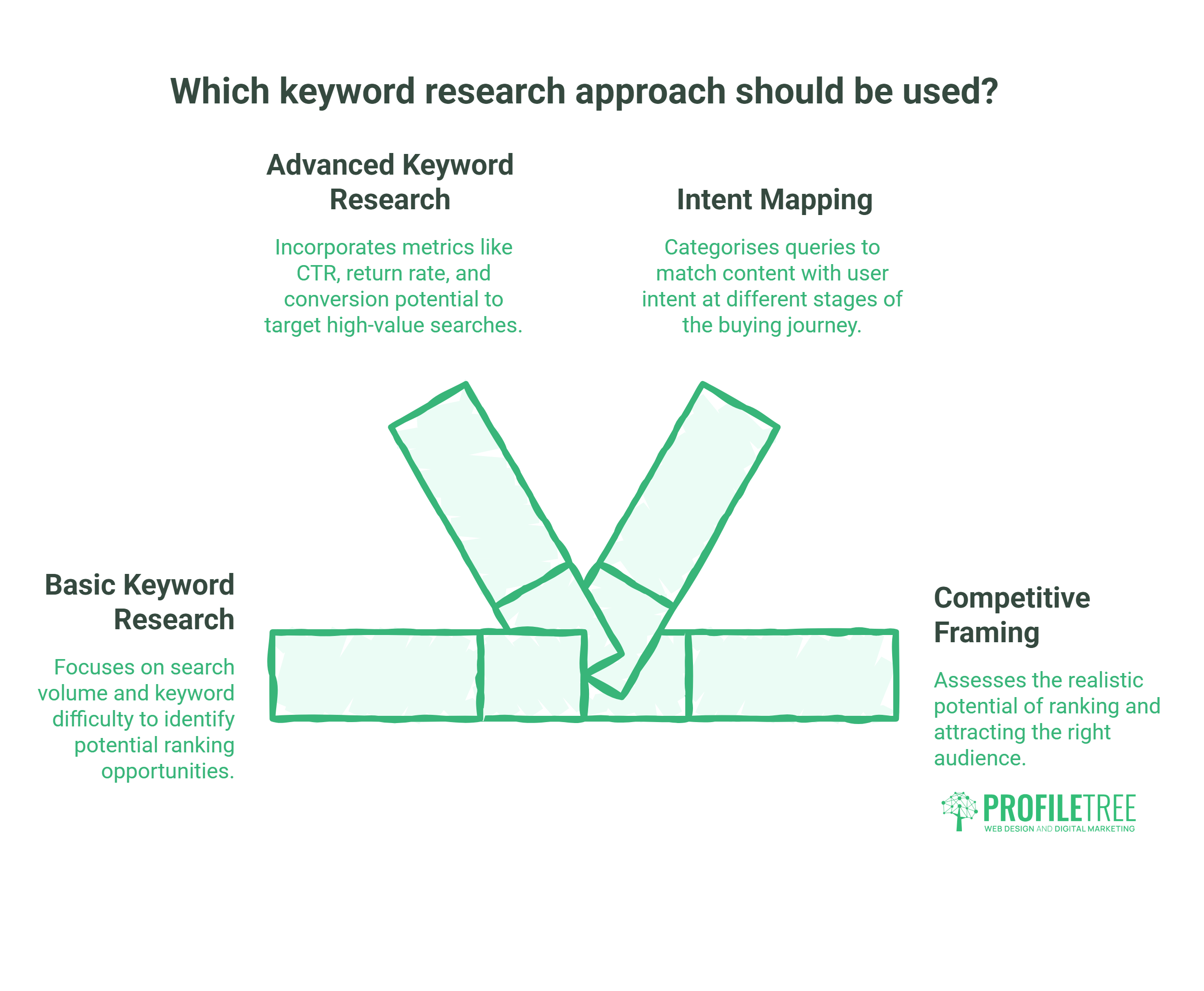
Basic keyword research identifies what people search for. Advanced keyword research identifies which searches are worth targeting, why those searches happen, and what a person needs to find before they convert.
The practical difference shows up in three areas:
- Metrics used: Basic research prioritises search volume and keyword difficulty. Advanced research layers in click-through rates, return rate (how often the same person searches the same term), SERP feature presence, and conversion potential.
- Intent mapping: Basic research treats all queries at face value. Advanced research categorises intent: informational, navigational, commercial investigation, transactional , and builds content that matches the right intent at the right stage of the buying journey.
- Competitive framing: Basic research asks whether you can rank. Advanced research asks whether ranking would actually bring the right audience to your site, and whether the competitive picture makes that goal realistic.
| Factor | Basic Keyword Research | Advanced Keyword Research |
|---|---|---|
| Primary metric | Search volume | Business potential + intent |
| Competitive view | Keyword difficulty score | SERP feature analysis + gap mapping |
| Audience targeting | Broad | Intent-segmented, audience-specific |
| Tools used | Google Keyword Planner | Ahrefs, GSC, GA4, community mining |
| Goal | Traffic | Qualified leads or conversions |
8 Advanced Keyword Research Techniques
Each of the techniques below addresses a specific gap in standard keyword research practice. Some will be immediately applicable to your current content strategy; others will require a shift in how you think about what makes a keyword worth targeting.
Work through them in order the first time. Once they’re familiar, you’ll find yourself applying several simultaneously as a matter of habit.
1. Semantic Topic Clustering and Entity Mapping
Search engines no longer evaluate pages in isolation. They assess whether a site covers a topic with genuine depth across a cluster of related content. Building a semantic topic cluster means identifying one core pillar topic and mapping all the subtopics, questions, and related entities around it before writing a single word.
In Ahrefs, start with Keywords Explorer. Enter your seed keyword and switch to the “Also rank for” tab. This shows you what other terms the pages currently ranking for your seed keyword also appear for. These aren’t random keywords; they reveal the topical territory search engines consider relevant to your primary term.
Group these into clusters by intent. Informational queries (“what is keyword difficulty”) belong in educational content. Commercial investigation queries (“ahrefs vs semrush for small business”) warrant comparison content. Transactional queries (“seo agency belfast”) point to service pages.
For SMEs, this approach is particularly useful because it helps prioritise. You don’t need to cover every branch of a topic immediately; you need to identify which cluster has the clearest commercial connection to your services and build depth there first.
ProfileTree’s SEO services for Northern Ireland businesses use semantic clustering as the foundation of every client content strategy, because topical authority now matters more than individual page optimisation in most competitive markets.
2. Targeting Zero Search Volume Keywords
Ahrefs shows a keyword has zero monthly searches. Most people skip it. That’s often a mistake.
Third-party keyword tools aggregate data from multiple sources and update on a delay, sometimes months behind actual search trends. A keyword with “zero” volume in a tool might have real search activity that hasn’t been captured yet, particularly in B2B, specialist trades, or emerging topics.
The test for a zero-volume keyword isn’t the tool data. It’s whether the term appears in your sales conversations, customer support tickets, community forums, or the language your actual clients use when they describe their problems. If people say it, some of them search it.
Zero-volume keywords also tend to have near-zero competition. A page that genuinely answers a specific question , even a question only 50 people a month search for , can rank in the top three positions within weeks rather than months. For a B2B business where a single conversion is worth thousands of pounds, 50 highly qualified monthly visitors can outperform 5,000 visitors from a broad informational term.
The practical workflow: pull your last three months of sales call notes or customer emails. Identify the exact phrases people use to describe their problems. Run those phrases through Ahrefs Keywords Explorer. The ones showing zero or very low volume with clear commercial intent are your first targets.
3. Localising Search Intent for UK and Ireland Markets
This is the gap that US-produced keyword research guides consistently miss, and it creates a genuine opportunity for businesses operating across the UK, Ireland, and Northern Ireland.
The problem operates at several levels. First, tools like Ahrefs and Semrush show global or US-weighted search volumes by default. A keyword showing 5,000 monthly searches might have only 200 of those in the UK, and 30 in Ireland. Filtering by country is essential, but even then, the data reflects a unified “UK” that doesn’t account for Northern Ireland’s dual-market context (relevant to both UK and Republic of Ireland audiences in many sectors).
Second, terminology differs in ways that matter commercially. Some examples:
| UK/Ireland Term | US Equivalent | Impact |
|---|---|---|
| Solicitor | Attorney / Lawyer | Different intent signals |
| Planning permission | Building permit | Local authority context |
| VAT registration | Sales tax registration | Different regulatory frame |
| Self-assessment | Tax return | HMRC-specific intent |
| Letting agent | Property manager | Different service model |
Targeting the US term instead of the UK one doesn’t just get you the wrong traffic. It gets you traffic that isn’t going to convert, because the regulatory, cultural, and commercial context is different.
In Ahrefs Keywords Explorer, always set the country to the United Kingdom or Ireland before doing any research. Then check whether the highest-volume variant is actually the term your local audience uses, or a US term that happens to have volume.
For businesses in Northern Ireland specifically, it’s worth running research for both the UK and Ireland country settings. Many queries about regulations, funding, and professional services will appear differently depending on which jurisdiction the searcher is in.
4. Competitor Keyword Gap Analysis
Keyword gap analysis identifies terms your competitors rank for that you don’t. Done properly, it’s one of the fastest ways to find content opportunities with proven demand. Someone is already ranking for these terms, which means the search intent is real and the keyword is worth targeting.
In Ahrefs, Site Explorer allows you to run a content gap report by entering your domain alongside two or three competitors. The output shows keywords where your competitors have ranking pages and you don’t.
The most useful part of this exercise isn’t the full list. It’s the filtering. Sort the results by traffic potential rather than search volume. A keyword sending 300 monthly clicks to a competitor’s site is more valuable than one with 2,000 impressions and a 2% CTR dominated by featured snippets.
Also, filter by keyword difficulty below 30 if you’re working with a newer site or a site without significant authority in the topic area. These lower-difficulty gaps are where you can win within a realistic timeframe rather than targeting terms where page-one positions are held by well-established domains with thousands of backlinks.
One further filter: check the SERP for each gap keyword before committing to a content piece. If the top results are all major vendors, aggregators, or Wikipedia, the gap exists because the market is too crowded at the top , not because the topic is neglected.
5. B2B Keyword Research for Long Sales Cycles
B2B keyword research operates by different rules, and applying B2C logic to it produces content that ranks but doesn’t convert.
In B2B, searchers rarely move from awareness to purchase in a single session. A manufacturing company evaluating new ERP software might research the topic over three to six months, across dozens of searches. The keywords at each stage of that journey look completely different.
Early-stage B2B searches are broad and educational: “what is erp software”, “erp implementation challenges”, “how to choose erp for manufacturing”. These terms often have reasonable search volume but low commercial intent. Someone is learning, not buying.
Mid-funnel B2B searches get more specific: “erp software for food manufacturing uk”, “erp implementation timeline”, “erp roi calculation”. Lower volume, but the searcher is now evaluating options. This is where B2B content wins; most competitors only target the broad early-stage terms.
Late-stage B2B searches are often low or zero volume: “erp vendor comparison template”, “erp implementation partner northern ireland”, “erp demo request”. These convert. Build content around them.
When using Ahrefs for B2B keyword research, focus on the “Questions” tab in Keywords Explorer. B2B searchers phrase things as problems to solve, not products to find. “How to reduce stock discrepancies in a warehouse” is a B2B keyword even though it doesn’t contain any product names.
Also check the SERP composition for your target terms. If the top results are all vendor product pages, you’re looking at late-funnel transactional intent. If they’re all blog posts and guides, you’re in the educational phase. Match your content type to what the SERP is already rewarding.
6. Mining Niche Communities for Long-Tail Opportunities
Reddit, Quora, industry forums, and LinkedIn groups are keyword research gold mines that most SEO tools undervalue. The language people use in communities is unfiltered; they say exactly what they’re struggling with, using the exact words they’d type into a search engine.
The process is straightforward. Identify three to five online communities where your target audience is active. Search within those communities for your primary topic. Read threads where your topic comes up, particularly threads where people ask questions rather than share news.
You’re looking for two types of language. First, questions phrased in ways that tools won’t surface, often highly specific, often containing niche terminology, often reflecting problems that exist in the real world but haven’t generated enough search volume for data tools to track yet. Second, the exact vocabulary your audience uses for concepts that might have multiple names, this tells you which variant to target.
Take those phrases into Ahrefs Keywords Explorer. Some will show volume you can work with. Others will be zero-volume but worth targeting anyway for the reasons covered in technique 2.
For UK and Irish businesses, LinkedIn is often underused as a research source. Search for your primary topic in LinkedIn posts and look at the comments. The questions people ask in comment threads are often more revealing than anything you’d find in a forum, because professional audiences in specialist sectors tend to be less active on Reddit but very active on LinkedIn.
7. Using Google Search Console and GA4 to Find Internal Gaps
You already have keyword data from your own site that Ahrefs can’t provide: the actual queries bringing people to your pages, the queries generating impressions without clicks, and (via GA4) the on-site searches people run when they don’t find what they’re looking for.
In Google Search Console, filter the Performance report to show queries with more than 100 impressions and a CTR below 2%. These are pages that are appearing in search results but failing to attract clicks , which usually means the title tag and meta description aren’t matching the search intent well enough, or the page isn’t the best result for that query.
For each high-impression, low-CTR page, check the actual search queries driving those impressions. Often, you’ll find that the majority of impressions come from one or two specific queries you hadn’t explicitly targeted. Updating the page to better serve those queries (and improving the title tag to match) can produce CTR gains within weeks.
GA4’s internal site search report (if you have internal search enabled) shows what people searched for on your own website. These are your most commercial keyword opportunities. Someone is already on your site, looking for something specific, but not finding it. Build that content, add it to the navigation, and link to it from the pages where those searches are most common.
8. Advanced Keyword Research on a Lean Budget
Most keyword research guides assume you have access to a £150/month Ahrefs subscription. Many SMEs don’t. The good news is that most of the advanced techniques above can be approximated using free or low-cost tools.
- Google Search Console (free): Your most accurate source of data for your own site. Use it for internal gap analysis, query harvesting, and CTR optimisation.
- Google Keyword Planner (free with Google Ads account): Shows approximate search volumes in ranges rather than exact figures, but is useful for directional research and validating whether a topic has any search demand.
- Ahrefs Webmaster Tools (free): Limited to your own domain, but gives you accurate backlink data, top-ranking pages, and some keyword data at no cost.
- Google’s “People Also Ask” and autocomplete: Underrated. The PAA boxes show exactly how Google groups related queries, which is a form of semantic clustering data that doesn’t require a paid tool.
- Reddit and LinkedIn (free): As covered in technique 6, community research costs time, not money, and often surfaces opportunities that paid tools miss.
For businesses just starting out with keyword research, the practical recommendation is to use GSC and Ahrefs Webmaster Tools (both free) for the first three months. That gives you enough data to identify your highest-value existing content, your current ranking positions, and your biggest gap opportunities, without spending anything.
Best Tools for Advanced Keyword Analysis
- Ahrefs: The most complete tool for competitive research, backlink analysis, and content gap identification. Keywords Explorer is particularly strong for intent-based filtering and the “Also rank for” data that powers semantic clustering.
- Google Search Console: Free and essential. The most accurate source of data for your own site. No competitive data, but unmatched for internal gap analysis and CTR optimisation.
- GA4: Required for internal site search analysis and understanding how users move through your site after arriving from organic search.
- Semrush: Strong competitor to Ahrefs with slightly different data sets. Some users find its keyword gap analysis more intuitive; others prefer Ahrefs’ backlink data. Worth testing both on a trial basis.
- Screaming Frog (free up to 500 URLs): Useful for auditing how your existing content is internally linked, which affects how keyword authority flows between pages.
For most SMEs, the practical starting point is GSC (free), Ahrefs Webmaster Tools (free), and one paid tool, either Ahrefs or Semrush, used strategically for competitive research rather than run continuously at enterprise scale.
Applying These Techniques Through ProfileTree’s SEO Process
Keyword research doesn’t produce results in isolation. The techniques above need to connect to content creation, internal linking, and ongoing performance monitoring before they translate into rankings and traffic.
At ProfileTree, our content marketing services apply this full process for clients across Northern Ireland, Ireland, and the UK , from the initial keyword gap analysis through to the content briefs, the written articles, and the tracking of whether those pages are actually moving in the SERPs.
For businesses looking to build internal capability, our digital marketing training covers keyword research as part of a practical SEO module , working with real data from your own site rather than hypothetical examples.
As Ciaran Connolly, ProfileTree’s founder, puts it: “The businesses we see getting the best results from SEO aren’t the ones targeting the highest search volumes. They’re the ones who’ve done the work to understand exactly what their ideal customer types into Google at the moment they’re ready to make a decision , and then built genuinely useful content around that.”
Frequently Asked Questions
What are advanced keyword research techniques?
Advanced keyword research techniques go beyond search volume to analyse search intent, semantic relationships between topics, competitive gaps, and conversion potential. Key techniques include semantic topic clustering, zero-volume keyword targeting, competitor gap analysis, community-based research, and internal data mining through Google Search Console and GA4. The goal is to identify which keywords will bring the right audience at the right stage of their buying journey, not simply which terms get the most searches.
How do advanced techniques differ from basic keyword research?
Basic keyword research identifies what people search for and how often. Advanced research asks which searches are worth targeting and why. The practical difference: basic research might identify “web design” as a high-volume term and recommend targeting it. Advanced research would identify that “web design for accountants northern ireland” has lower volume but much higher commercial intent, lower competition, and a far better conversion rate for a specialist agency. Advanced techniques use intent mapping, SERP composition analysis, and business value assessment rather than relying primarily on volume and difficulty scores.
What is semantic SEO and how does it relate to keyword research?
Semantic SEO refers to the practice of building content around topics and entities rather than individual keywords. Search engines now assess whether a site covers a topic comprehensively, not just whether individual pages contain the right words. In keyword research terms, this means identifying the full cluster of related queries around a topic, not just the primary keyword, and building content that addresses the range of intent within that cluster. Pages that cover multiple sub-questions within a topic are significantly more likely to appear in AI Overviews and featured snippets than pages targeting a single keyword.
Why is competitor gap analysis important in advanced keyword research?
Competitor gap analysis identifies where rivals are generating organic traffic that you’re missing. Rather than building content based on assumptions about what might work, gap analysis shows you terms with proven search demand where a competitor has already validated the content opportunity. For SMEs with limited content budgets, this is particularly valuable . It lets you prioritise the gaps most likely to produce results rather than guessing which topics to cover first.
Are zero search volume keywords worth targeting?
Yes, in many cases , particularly for B2B businesses and specialist sectors. Keyword tools aggregate data on a delay and often miss niche terms, emerging queries, and highly specific B2B searches that real buyers use. A keyword showing zero monthly searches in a tool might still generate qualified traffic if it reflects how your actual customers describe their problems. The test is whether the term appears in your sales conversations, customer communications, or community discussions , not whether a tool registers volume. Zero-volume keywords typically have near-zero competition, meaning you can rank quickly if you build genuinely useful content around them.
Can I do advanced keyword research without expensive tools?
Yes. Google Search Console (free) covers internal gap analysis, query harvesting, and CTR optimisation for your own site. Ahrefs Webmaster Tools (free) provides backlink data and ranking information for your domain. Google’s People Also Ask boxes, autocomplete suggestions, and related searches provide semantic clustering data without requiring a paid subscription. Community research on Reddit, LinkedIn, and industry forums surfaces long-tail opportunities that no paid tool captures reliably. For competitive research, a single month of a paid tool like Ahrefs used strategically can provide enough data to inform six months of content planning.