
Developing a Content Strategy for International Markets: A Full Guide
Table of Contents
Expanding into new markets is not simply a matter of translating existing content and pressing publish. The businesses that succeed internationally are those that treat each market as a distinct audience with its own search behaviour, cultural expectations, and buying signals. Getting that distinction right from the start saves significant rework later.
This guide covers the full process: from understanding what separates localisation from translation, to building the technical foundations that support multilingual SEO, to managing content governance when your team spans multiple regions. It is written for marketing managers and business owners in the UK and Ireland who are either preparing for international expansion or trying to improve the performance of existing global content.
You will find a step-by-step framework for creating content for international markets, a practical section on AI-assisted workflows, and specific guidance on the nuances of expanding between the UK, Ireland, and Northern Ireland — a genuinely underserved area in most global content guides.
What Is an International Content Strategy?
An international content strategy is a structured plan for creating, distributing, and managing content across multiple countries or language markets. It goes well beyond swapping out currency symbols or running copy through a translation tool. At its core, it is about understanding how different audiences think, search, and make decisions — and then building content that genuinely serves each of those audiences while maintaining a coherent brand identity.
Before diving into the tactical steps, it helps to understand the three depth levels that define how far your adaptation goes.
Translation, Localisation, and Transcreation Compared
These three terms are often used interchangeably, but they describe very different levels of investment and impact. The table below sets out the key distinctions.
| Approach | What It Involves | Cost | Best For |
|---|---|---|---|
| Translation | Word-for-word conversion between languages | Low | Legal documents, technical specs |
| Localisation | Adapts language, cultural references, formats (date, currency, idiom) | Medium | Blog posts, service pages, email campaigns |
| Transcreation | Reimagines messaging entirely for cultural resonance | High | Advertising copy, brand campaigns, slogans |
For most SMEs, localisation is the right starting point. Full transcreation is worth the investment for high-stakes campaign content, but building your content infrastructure around localised assets first gives you the broadest reach for your budget.
The Four Pillars of a Global Content Framework
Rather than treating international content as a series of one-off translation projects, effective strategies are built on four interconnected pillars. Each pillar addresses a different dimension of the challenge.
Insights covers market research and audience personas — understanding who your readers are in each region, what questions they type into search engines, and what motivates them to convert. Infrastructure refers to the technology stack: your CMS, any translation management system (TMS), and the AI tools you use to accelerate workflows.
Governance is the organisational model — who owns global brand standards, who has authority to adapt content for local markets, and how those two groups collaborate. Performance is the measurement layer: localised KPIs and feedback loops that tell you whether the content is actually working in each market, not just whether it exists.
Ciaran Connolly, founder of ProfileTree, notes: “Most companies invest heavily in the Insights pillar and then underinvest in Governance. The result is brand drift — local teams adapt content in ways that gradually diverge from the core positioning until the brand looks different in every market.”
Choosing Which Markets to Enter First
Not every international opportunity deserves equal investment. A useful prioritisation framework is to score potential markets on three dimensions: search volume for your core services in that language or region, your existing brand recognition there (even minor signals like referral traffic count), and the operational complexity of serving that market.
For UK-based businesses, Ireland is an obvious first expansion because the language overlap reduces localisation costs. But as we will cover later in this guide, same-language markets carry their own distinct risks. For data on how global markets compare in terms of digital maturity and business conditions, these global business statistics provide a useful benchmark before committing to a market-entry plan.
Building the Technical Foundation
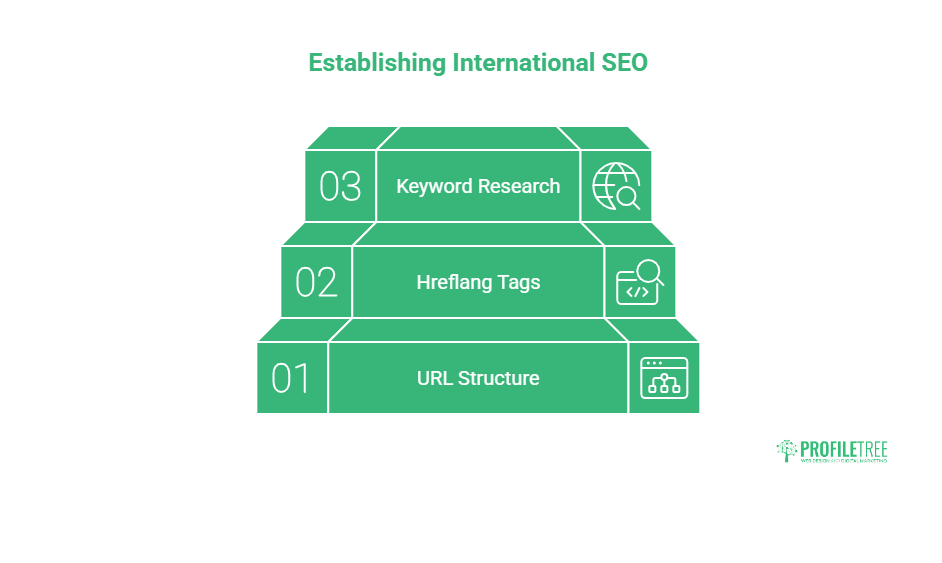
A well-crafted international content strategy will underperform if the technical setup is wrong. Search engines need clear signals about which version of your content is intended for which audience. Without that foundation, you risk content from multiple regions competing against each other in search results — a problem known as cannibalisation.
URL Structure: ccTLDs, Subdomains, and Subfolders
The three main structural options for hosting international content each involve trade-offs. Country-code top-level domains (ccTLDs), such as .ie for Ireland or .de for Germany, send the strongest geographic signal to search engines and users alike. The drawback is that each ccTLD requires its own domain authority to be built from scratch, which is a significant investment for businesses early in their international journey.
Subdomains (for example, ie.yoursite.com) allow you to separate markets clearly while keeping them under one brand. They are easier to manage technically than ccTLDs but do not inherit authority from the root domain as directly as subfolders do. Subfolders (yoursite.com/ie/) are the most common choice for SMEs because they consolidate domain authority and are simpler to maintain. The trade-off is a slightly weaker geographic signal compared to ccTLDs.
For most businesses expanding from the UK into Ireland or Europe, a subfolder structure with proper hreflang implementation is the most practical starting point. You can always migrate to ccTLDs as your international presence matures.
Hreflang Tags: What They Do and How to Get Them Right
Hreflang tags tell search engines which language and regional version of a page to serve to which user. A page targeting Irish readers in English, for example, would carry an hreflang attribute of en-IE, while the same content for UK readers would carry en-GB. Without these tags, Google has to guess which version to surface, and it frequently guesses wrong.
The most common implementation errors are self-referencing failures (each page must reference itself as well as its alternates), missing reciprocal references (if page A references page B, page B must reference page A), and incorrect language or region codes. Checking your implementation with Google Search Console’s International Targeting report after launch is essential. For businesses managing EU localisation strategies, hreflang accuracy becomes particularly critical given the number of language variants involved.
International Keyword Research: Beyond Direct Translation
The same product or service is often searched for using entirely different terminology in different markets, even within the same language. A UK audience might search for “web design agency”; an Irish audience for the same service might use “web design company” or “website designers” at much higher frequency. Simply translating your existing keyword list produces a set of terms that local audiences may rarely use.
Effective international keyword research starts with native-language research in each target market — ideally with input from someone who actually lives and works there. Tools like Google Keyword Planner, Ahrefs, and Semrush all support country-level data.
The most valuable signals, though, come from local search query data gathered after you have some content live in the market. For a deeper look at how search intent varies across regions, the principles in our SEO and YMYL guide apply equally to international contexts, particularly for industries where trust signals matter.
The AI Revolution in International Content
Generative AI has changed the economics of international content production, but it has also introduced new risks that many businesses are not accounting for. The gap between what AI makes possible and what AI does well in a localisation context is significant, and navigating that gap intelligently is now a genuine competitive advantage.
Beyond Machine Translation: AI for Cultural Nuance
Modern large language models perform translation at a quality that would have required an experienced human translator five years ago. For producing a working first draft in a new language, AI is now a reasonable starting point. The problem is at the cultural layer. AI translates meaning accurately far more often than it translates cultural resonance accurately.
A phrase that reads as warmly reassuring in British English can read as patronising in American English, and as oddly formal in Irish English. These are subtle enough differences that an AI system trained on global data will frequently miss them.
The practical solution is an AI-plus-human workflow: use AI to produce the first draft at speed, then route it through a native-speaker reviewer who has been briefed specifically on cultural tone rather than linguistic accuracy. This approach dramatically reduces the time cost of localisation without sacrificing the cultural fit that makes content convert. Staying across how AI tools are evolving is also important; our AI content detection overview covers the signals that search engines and readers use to identify AI-generated copy.
Maintaining Brand Voice Across Multiple Languages
When a brand’s content is being produced in five or more languages simultaneously, voice drift is almost inevitable without a structured system to prevent it. The solution is a brand voice guide that has been deliberately designed for localisation — not just a general tone document written in English and handed to translators.
A localisation-ready voice guide specifies what the brand sounds like in terms of values and intent, not just vocabulary. It explains which aspects of the voice are fixed (the level of formality, the stance on technical jargon, the approach to humour) and which can flex for local audiences (specific idioms, cultural references, examples used).
When every local team works from the same underlying intent, the resulting content can feel genuinely native in each market while remaining recognisably part of the same brand. Brand voice consistency is a challenge even for single-market businesses; the stakes are considerably higher when you are managing multiple language variants.
The Post-Launch Governance Problem
Most international content guides address the production phase in detail and then stop at launch. The harder ongoing problem is content decay: how do you keep five or more language versions of a page updated simultaneously when your source content changes?
The answer requires a governance model with a clear owner. In a centralised model, a global content team owns all updates and cascades changes to local teams for adaptation. In a decentralised model, local teams own their markets with guidance from a global brand function.
Most organisations that manage this well operate on a hybrid model: centralised for brand-critical and technical pages, decentralised for locally generated content like blog posts and social campaigns. The choice should be driven by the volume of content you are managing and the capacity of your local teams, not by a theoretical preference for one model over the other.
Navigating the UK, Ireland, and Northern Ireland Nuances
The conventional wisdom is that expanding from the UK into Ireland is straightforward because the shared language removes the main barrier. In practice, same-language expansion into a close market carries its own specific risks that are easy to underestimate. The differences that matter most are legal, cultural, and commercial — not linguistic.
Currency, Pricing, and Commercial Signals
Ireland uses the euro; the UK uses sterling. This is the most obvious difference, but the implications run deeper than a currency symbol swap. Price points that feel accessible to a UK SME audience can read as expensive or surprisingly cheap to an Irish audience, depending on the exchange rate at the time.
Structural pricing models (monthly vs. annual billing, VAT presentation) also differ in ways that affect conversion. Any pricing-related content needs to be reviewed by someone who understands the commercial norms of the Irish market, not simply converted at the current exchange rate.
Northern Ireland adds a further layer: it uses sterling like the rest of the UK but operates under different commercial and regulatory conditions in certain sectors, particularly following post-Brexit trading arrangements. Content targeting Northern Irish businesses specifically should acknowledge these distinctions rather than treating the region as interchangeable with either Britain or the Republic.
For context on how Brexit has affected digital marketing conditions across the UK, the Brexit digital marketing impact analysis provides relevant background. You can also explore some of what makes Northern Ireland a distinct market by looking at its major cities through a Northern Ireland travel and culture guide — the regional character that shapes tourism also shapes business culture.
Cultural Tone and Editorial Conventions
British and Irish editorial cultures differ in ways that experienced writers notice, even if they find them hard to articulate. Irish content tends to be slightly warmer in register, more comfortable with informality in business contexts, and less inclined toward the understated authority that works well in UK professional writing. Humour lands differently: what reads as dry wit in London can read as blunt in Dublin.
These are not insurmountable differences, but they are real enough to affect how content is received. The practical fix is to have Irish-market content reviewed by someone based in Ireland before publication, with a specific brief to check tone rather than just facts. The same principle applies to Northern Ireland, where the cultural frame sits somewhere between the two and has its own distinct character that neither fully captures.
Search Behaviour and Platform Differences
Keyword data tells a consistent story: Irish search volumes for service-related terms are substantially lower than UK equivalents, but competition levels are also lower, which means ranking difficulty is reduced for well-optimised content. This makes Ireland a relatively accessible first international market for UK-based businesses with established domain authority.
Social media platform preferences also diverge slightly. LinkedIn engagement tends to be proportionally higher among Irish business professionals relative to platform size, while certain UK-centric platforms carry less weight. Any social strategy that runs in parallel with your content needs to account for these differences rather than simply duplicating the UK approach. For a broader look at how social engagement connects to content performance, our analysis of social media and sales growth covers the key mechanisms across markets.
Measuring International Content Performance
Standard web analytics are not set up to surface international content performance without some deliberate configuration. The default view in most tools shows aggregate traffic, which can mask a situation where one market is performing well and another is effectively invisible. Setting up market-specific reporting from the start saves significant diagnostic effort later.
Localised KPIs vs. Global Benchmarks
The same content type can produce very different conversion rates across markets due to differences in audience intent, trust levels, and buying cycles. Using global benchmarks to assess local performance leads to misleading conclusions. A page converting at 1.8% in the Irish market might be significantly outperforming a market-specific baseline, while a 2.5% rate in the UK might be underperforming against what comparable content achieves there.
The solution is to establish market-specific baselines during your first six months of operation in each region, then benchmark against those rather than against global or source-market averages. This applies to engagement metrics as well as conversion: time on page, scroll depth, and return visit rates all vary by market in ways that reflect genuine audience differences rather than content quality issues. Content analysis methods for interpreting these metrics are the same across markets; the context for interpreting the numbers changes.
Tracking International SEO Health
International SEO introduces ranking signals that do not appear in single-market monitoring. Hreflang errors, for example, do not produce obvious symptoms in standard traffic reports — they simply result in the wrong language version being ranked in the wrong market, which shows up as lower-than-expected traffic from that region with no obvious technical explanation.
A useful monitoring setup combines Google Search Console data filtered by country with Bing Webmaster data (which remains more important in some European markets than its UK share would suggest) and periodic crawls to check hreflang implementation integrity. Checking for cannibalisation — where multiple language versions of the same page compete for the same query — is also worth doing quarterly. These technical checks are distinct from content performance monitoring but feed directly into it.
Iterating Based on Market Feedback
The most valuable feedback on international content often comes from sources that are not captured in analytics: sales team conversations, customer service queries in local markets, and direct outreach to contacts in the region. Analytics tells you what is happening; those qualitative signals help explain why.
Building a structured feedback loop between your local market contacts and your content team — even something as simple as a monthly review of the top questions coming from each market’s sales conversations — produces a stream of genuinely useful content ideas that no keyword tool will surface. The digital marketing strategy framework we use with clients incorporates this kind of qualitative signal alongside quantitative data, because the two together produce a more accurate picture of how content is actually performing in each market.
Conclusion
Building a content strategy for international markets is an investment that compounds over time. The businesses that do it well treat localisation as a strategic discipline, not a translation task. They build governance structures before they need them, set up technical foundations properly from the start, and measure performance against market-specific baselines rather than global averages. For UK and Irish SMEs, the opportunity is substantial — particularly in the close markets where a relatively modest localisation effort can produce meaningful results.
Ready to take your content into new markets?
ProfileTree works with SMEs across Northern Ireland, Ireland, and the UK to build content strategies that perform across borders. Get in touch with our team to discuss your international content goals.
FAQs
What is the most common mistake in international content strategy?
Treating localisation as translation. Converting existing content word-for-word into another language preserves the words but loses the cultural context, search intent alignment, and structural adaptation each market needs. Each region requires genuine audience research, not just linguistic conversion.
Should I use a subfolder or a ccTLD for international versions?
For most SMEs, subfolders (yoursite.com/ie/) are the more practical starting point. They consolidate domain authority, are easier to manage, and avoid rebuilding search authority from scratch. ccTLDs (yoursite.ie) send stronger geographic signals but suit businesses already committed to a specific market rather than those still testing it.
What are the four pillars of global content strategy?
Insights (market research and audience understanding), Infrastructure (CMS, translation management systems, AI tools), Governance (who owns global standards vs. local adaptation), and Performance (localised KPIs and feedback loops). Businesses that address all four consistently outperform those that focus on production alone.
How does AI affect international content quality?
AI accelerates first-draft production but frequently misses cultural nuance: tone, idiomatic preference, and local assumptions. The most effective approach is a human-in-the-loop workflow where AI produces the draft and a native-speaker reviewer addresses cultural fit. Unvetted AI translation published without that review is a real risk to international SEO.
What is “glocal” content?
Content that maintains global brand consistency while being meaningfully adapted for local relevance. The fixed elements are values, core positioning, and visual identity. The flexible elements are tone, examples, idioms, and cultural references. The goal is content that feels native to each market rather than imported.