
How to Build a MarTech Stack for Your Business
Table of Contents
A MarTech stack is the set of software tools your business uses to plan, run, and measure marketing activity. For most SMEs, it includes a website CMS, a CRM, an email platform, an analytics tool, and whichever advertising or social channels you use regularly. That is the core. Everything else is a decision you make based on where your marketing gaps actually are.
The challenge is not finding tools. There are thousands of them. The challenge is choosing the ones that genuinely connect, integrating them properly so data flows between them, and making sure your team can actually use them. Get that right, and your MarTech stack becomes the backbone of a measurable marketing operation. Get it wrong, and you end up paying for software that nobody opens.
This guide covers what belongs in a MarTech stack, how to build one aligned with your business goals rather than someone else’s software shortlist, and where the practical pitfalls tend to lie.
What Is a MarTech Stack?
A MarTech (marketing technology) stack is the combination of software platforms your marketing function relies on. The term covers everything from your website CMS and CRM to email automation, paid media dashboards, social scheduling tools, and analytics platforms.
The word “stack” matters. It implies these tools are layered and connected, not operating in isolation. A CMS that never talks to your CRM, or an email platform that cannot pass click data into analytics, is not really a stack. It is a collection of separate subscriptions. The integration layer is where most of the value is, and where most of the problems begin.
For SMEs in Northern Ireland, Ireland, and the wider UK, the practical question is not “which tools are best?” but “which tools will actually work together, within our budget, with the team we have?”
The Core Layers of a MarTech Stack
Most stacks can be mapped across five functional layers. Each one has a distinct job, and the layers need to connect to each other to work properly. The tools you choose within each layer matter less than making sure the layer exists and that data can move between them.
Data and CRM
This is the foundation. Your CRM (Customer Relationship Management) system stores what you know about contacts, leads, and customers: their history, their behaviour, their value over time. Every other tool in your stack should be able to write to it or read from it.
For SMEs, HubSpot’s free tier or Zoho CRM cover most use cases without the overhead of an enterprise platform. The more important question is whether your CRM integrates with your website CMS, because if those two systems cannot share data, you are flying blind on attribution.
Content and CMS
Your CMS is the platform your website runs on. For most SMEs, that is WordPress. The reason WordPress sits comfortably at the centre of a MarTech stack is its integration ecosystem: it connects natively with most CRM platforms, email tools, analytics solutions, and e-commerce layers through well-maintained plugins and REST APIs.
The CMS choice directly affects what your stack can do. A platform that limits API access or charges extra for integrations will cost you more over time than the upfront licensing difference suggests. Web development decisions made at this stage have a long tail.
Analytics and Measurement
You cannot optimise what you cannot measure. Google Analytics 4 is the default starting point and covers most SME needs for web traffic, conversion tracking, and audience segmentation. Its limitations sit in identity resolution and cross-device attribution, which matter more as your marketing spend scales.
For businesses operating under UK GDPR with strong data privacy requirements, Matomo offers an alternative with self-hosted or EU-hosted options that simplify compliance considerably.
A solid grasp of business analytics tools helps you ask the right questions, regardless of the platform you choose. The tool is less important than understanding what you are measuring and why.
Email and Marketing Automation
Email remains one of the highest-return channels in the stack. The automation layer is where it earns its keep: triggering follow-up sequences based on website behaviour, segmenting contacts by their stage in the buying process, and personalising communications without manual effort.
Mailchimp, ActiveCampaign, and Klaviyo cover different parts of the market. The decision comes down to how sophisticated your segmentation needs to be and how closely the tool needs to integrate with your CRM and CMS. If your CRM and email platform cannot sync contact records in both directions, you will spend time on data maintenance that automation was supposed to eliminate.
Advertising and Activation
This layer covers paid media: Google Ads, Meta Ads, LinkedIn Campaign Manager, and any other channels that reach your audience. The key integration requirement is that conversion data flows back into your CRM so you can tie ad spend to actual revenue, not just clicks.
For most SMEs, the risk here is spreading budget across too many channels before any single one has been properly optimised. A focused digital marketing strategy is the prerequisite. The tools are only as useful as the thinking behind them.
How to Build Your MarTech Stack: A Practical Framework
Building a stack well is a five-step process. The steps are sequential for a reason: each one creates the conditions for the next. Skipping ahead to tool selection before the earlier stages are done is the most common reason stacks end up expensive, underused, or both.
Step 1: Start with your business objectives, not a tool shortlist
Before you look at software, write down what your marketing function needs to do in the next 12 months. Generate leads, retain existing customers, improve conversion rates, reduce cost per acquisition: whatever is most pressing. Each objective maps to a tool category. Lead generation points to CRM and email. Conversion rate work points to CMS and analytics. Starting from objectives prevents you from buying tools that solve problems you do not have.
Step 2: Audit what you already have
Most SMEs have more tools than they think, but fewer are integrated than they should be. List every current subscription, what it does, and whether it connects to anything else. This step regularly surfaces “zombie tools” (software still being billed for that nobody actively uses).
A simple audit framework: for each tool, ask whether it generates data you act on, whether another tool in the stack could replace its function, and whether it has been used in the last 90 days by more than one person.
Step 3: Define your integration requirements before buying
Every tool you add to a stack creates a potential integration debt. Before committing to a new platform, determine which existing tools it needs to communicate with, and how that communication will occur. Native integrations (built-in, maintained by the vendor) are more reliable than third-party connectors. Zapier and Make can bridge gaps, but they add complexity and failure points.
The integration question is especially important for the CRM-to-CMS connection. If you are running WordPress and evaluating CRM options, confirm that the integration is documented, actively maintained, and includes bidirectional sync. Digital training for your team on how those integrations work reduces the risk of data gaps that build quietly over months.
Step 4: Build around your team’s capability
A sophisticated tool that nobody uses correctly does less than a simpler tool that the whole team understands. When evaluating platforms, factor in onboarding time, the quality of documentation, and whether the vendor offers adequate support for a business of your size. Enterprise platforms like Salesforce and Marketo are powerful but often require a dedicated marketing operations resource to deliver real value. Most SMEs are better served by platforms designed for their scale.
Step 5: Measure the stack’s performance, not just its tools
Set KPIs for the stack as a system, not just for individual channels. The table below covers the metrics that matter most:
| KPI | What it measures | Why it matters |
|---|---|---|
| Cost per lead | Spend divided by leads generated | Tells you whether your activation layer is working |
| Lead-to-customer rate | Percentage of leads that convert | Reveals CRM and nurture sequence quality |
| Customer acquisition cost | Total marketing spend divided by new customers | The single most important stack efficiency metric |
| Marketing contribution to revenue | Revenue attributable to marketing activity | Connects stack investment to business outcomes |
| Tool adoption rate | Active users versus licensed seats | Flags underutilised subscriptions before renewal |
UK Compliance Considerations
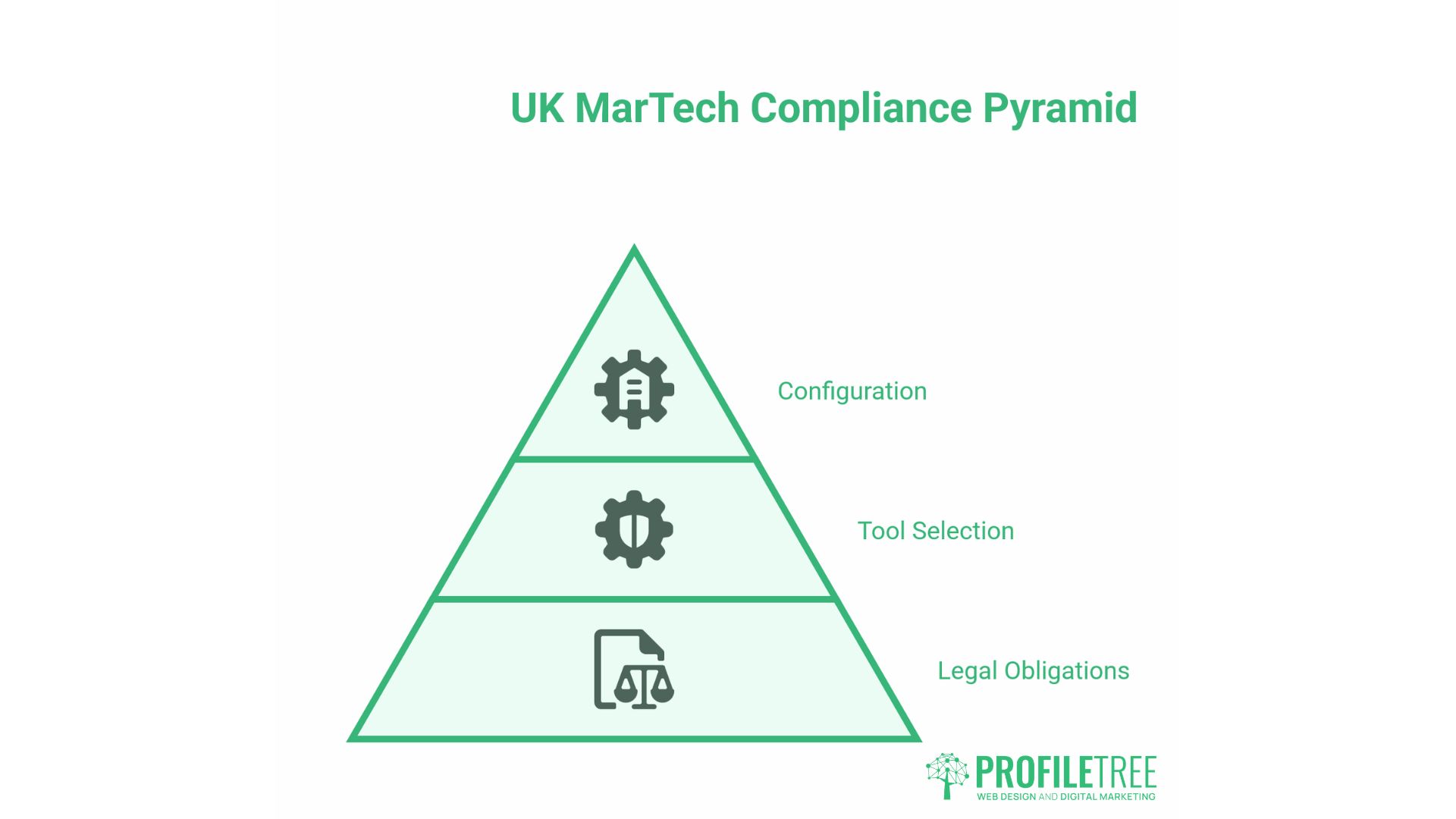
This is an area where most generic MarTech guides offer little of value, because they are written for a US audience. UK businesses face a specific set of obligations that affect which tools you can use and how you configure them.
UK GDPR and data residency. Under UK GDPR, personal data about UK residents must be handled in line with the UK’s data protection framework. When selecting a CRM, analytics, or email platform, check where the vendor stores data and what its standard contractual clauses look like. Tools with UK or EU data centre options (or vendors who have completed the UK IDTA process for international transfers) simplify compliance considerably.
PECR and cookie consent. The Privacy and Electronic Communications Regulations govern the use of cookies and electronic marketing in the UK. Your analytics setup needs a properly implemented consent management platform before any tracking fires. This is a CMS and technical configuration issue as much as a legal one.
Northern Ireland businesses face an additional layer of consideration given cross-border data flows between NI and the Republic of Ireland. EU GDPR applies to personal data about ROI residents processed by NI businesses offering services in the Republic. If your customer base spans both jurisdictions, your data processing agreements and tool selection need to reflect both frameworks.
The practical implication for stack building: compliance is not an afterthought. It affects which analytics platform you choose, how your consent management is configured, and what your CRM data processing agreement says. Build it in from the start rather than retrofitting it later.
Where AI Fits in a Modern Stack
Generative AI and AI-assisted tools are now embedded across most MarTech categories. Understanding where they add genuine value versus where they add noise helps you make better purchasing decisions.
AI in content and CMS. Most CMS platforms now include AI writing assistance, image generation, or automated SEO suggestions. These are useful for speeding up first drafts and surface-level optimisation, but they do not replace editorial judgement. The risk is over-reliance: content produced entirely by AI tooling within a CMS tends to be generic, and Google’s quality evaluation systems are increasingly good at identifying it.
AI in CRM and email. Predictive lead scoring, send-time optimisation, and churn prediction are the most mature AI applications in this layer. These work when the underlying data is clean and plentiful. For many SMEs, the data volume is not yet high enough for predictive models to add meaningful signal over a well-configured manual segmentation.
AI automation and workflow tools. Platforms like Make and Zapier increasingly offer AI-assisted workflow building. The value is in reducing the technical barrier to creating integrations, not in the AI itself. This is a practical efficiency gain for SMEs who lack a dedicated marketing operations resource.
AI implementation as a strategic layer. For businesses evaluating AI more broadly across marketing and operations, overcoming the implementation challenges is as much about organisational readiness as it is about tool selection. The technology is rarely the limiting factor.
Ciaran Connolly quote to be inserted here. Suggested theme: the importance of strategy before technology selection in MarTech, and how SMEs in Northern Ireland often over-invest in tools before they have the underlying data and processes to make use of them.
Common Reasons MarTech Stacks Fail
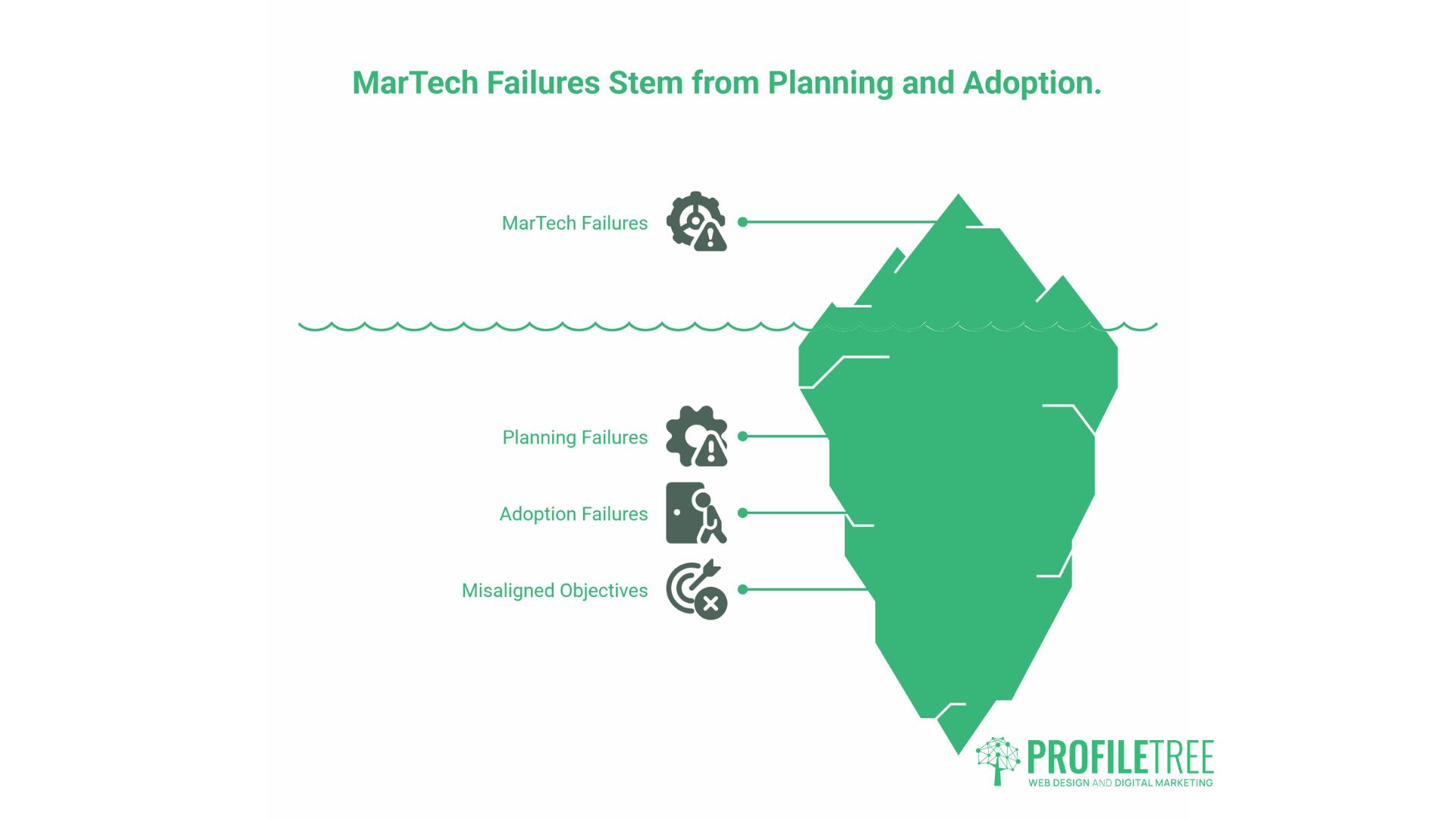
Most MarTech failures are not technology failures. They are planning and adoption failures.
Tool proliferation without integration. Adding platforms without connecting them creates data silos. Your email tool knows who clicked a link. Your CRM does not. Your analytics platform sees conversions but cannot attribute them to the right source. The result is a collection of partial pictures rather than a single view of marketing performance.
Buying a scale you do not have yet. Enterprise platforms make sense at enterprise scale. For an SME with a marketing team of two or three people, paying for Salesforce Marketing Cloud or Adobe Experience Manager before the data, processes, and team capability are in place wastes budget and creates complexity that slows everything down.
Skipping the adoption step. Tools require people to use them correctly. A CRM that sales staff do not log activity in provides no useful data. An analytics platform that nobody checks weekly does not change decisions. Digital training and structured onboarding for new tools are not nice-to-haves; they are the difference between a tool that earns its place and one that gets quietly abandoned at renewal time.
Neglecting data quality. Dirty data compounds over time. Duplicate contacts, inconsistent naming conventions, missing fields, and decayed email addresses make the CRM less useful and the email platform less effective with every passing month. A quarterly data quality review is worth more than most tools you could add to the stack.
Measuring tool activity instead of business outcomes. Tracking open rates, click rates, and session counts is useful for optimisation. It is not the same as measuring whether marketing activity is generating revenue. Connect your stack metrics to actual business outcomes: leads, conversions, revenue, and retention. If you cannot draw a line between a tool’s output and a business result, its place in the stack deserves scrutiny.
Conclusion
A MarTech stack is only as useful as the thinking that precedes it. Define your objectives, audit what you have, prioritise integration over feature count, and build in compliance from the start. For SMEs in Northern Ireland and across the UK, the goal is a lean, connected set of tools that your team actually uses and that gives you a clear read on what your marketing is producing. If you are reviewing your current stack or planning a new one, ProfileTree’s digital marketing strategy services can help you identify the right tools for your specific business goals.
FAQs
What is a MarTech stack?
A MarTech stack is the set of software tools a business uses to plan, run, and measure its marketing activity. It typically includes a CMS, a CRM, an analytics platform, and an email tool. The value comes from how well those tools connect, not how many there are.
How do I build a MarTech stack for a small business?
Start with your marketing objectives, then identify the tool categories that address them. Most small businesses need a CMS, a CRM, an email platform, and an analytics solution. Add complexity only once the core is connected and being used consistently.
What is the difference between a CRM and a CDP?
A CRM stores data about sales interactions and customer history. A Customer Data Platform (CDP) collects real-time behavioural data across multiple touchpoints to build a unified profile for marketing use. Most SMEs need a CRM well before a CDP becomes worthwhile.
How often should I audit my MarTech stack?
A formal audit once a year before renewals is a practical minimum, with a lighter quarterly check on adoption rates and active integrations. Each tool should be assessed on whether it is being used, whether it connects properly to the rest of the stack, and whether its cost is justified.