
Blog Personalisation: Strategy Guide for UK Marketers
Table of Contents
If your blog treats every reader the same, you’re leaving engagement on the table. Someone who found your article through a Google search for ‘content marketing for manufacturers’ has different needs to the subscriber who has read 15 of your posts. Blog personalisation is the practice of tailoring what readers see, based on who they are and how they behave. Done well, it builds loyalty, reduces bounce rates, and makes your content work harder for your business.
This guide covers what blog personalisation actually means in a UK context, how to implement it without breaching UK GDPR, which tools suit different budgets, and how to measure whether it is making a difference.
What is Blog Personalisation in the Privacy-First Era?
Blog personalisation is the process of adapting on-site content, calls to action, and recommended articles to match the preferences, behaviour, or profile of individual readers. What sounds technically complex can start very simply: showing returning visitors a different banner, or recommending articles based on the category a reader has spent most time in.
The shift to a privacy-first web has changed how this works. Third-party cookies, which powered much of the personalisation industry for a decade, are now restricted in most browsers and banned outright under UK GDPR when used without explicit consent. The industry has responded by shifting to first-party data: information you collect directly from your own audience, with their knowledge.
For SMEs and marketing teams across the UK and Ireland, this shift is actually an opportunity. You don’t need a £500-per-month SaaS platform to personalise your blog. What you’ll need is a clear understanding of your audience, a structured approach to collecting first-party data, and the right setup in the tools you likely already use.
| Approach | Complexity | Cost | Best For |
|---|---|---|---|
| Static content | Low | None | New sites or limited resources |
| Manual segmentation (UTM) | Low-Medium | Free | SMBs with basic analytics |
| Dynamic content (rules-based) | Medium | £50–£200/month | Growing teams, lead gen focus |
| AI-driven personalisation | High | £500+/month | Enterprise or high-volume publishers |
Why Personalisation Matters for UK Marketers
Generic content competes on volume. Content personalisation competes on relevance, and for most UK marketing teams working within limited budgets, relevance wins every time.
Content fatigue isn’t a minor inconvenience. Research from multiple studies consistently shows that audiences disengage faster when content doesn’t speak to their specific situation. For B2B audiences in particular, where buyers research extensively before contacting a supplier, the blog that addresses their sector, their stage in the buying process, and their specific question will generate more pipeline than the one that covers the same ground for everyone.
From an SEO standpoint, personalisation indirectly supports rankings. Lower bounce rates, higher time on page, and increased pages per session all send positive engagement signals. Pages covering multiple sub-questions within a topic are considerably more likely to be cited in AI Overviews, according to research published by Ahrefs on AI Overview citation patterns. Personalised content delivery that guides readers to the next relevant article increases those metrics across the board.
For ProfileTree’s clients across Northern Ireland, Ireland, and the UK, this is where content marketing strategy and personalisation converge. Getting the right content to the right reader at the right moment drives commercial outcomes, not just traffic numbers.
The 3 Pillars of Personalised Content
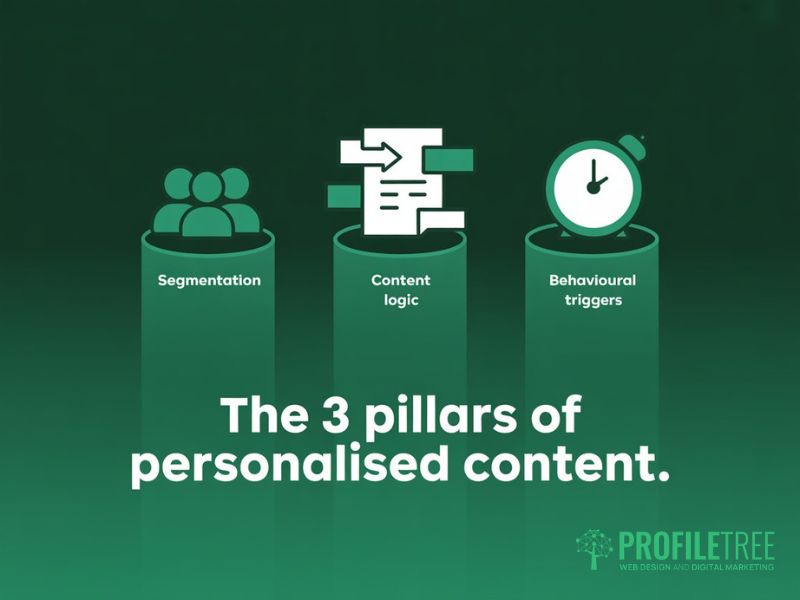
Effective blog personalisation rests on three foundations. Neglect any one of them and the whole approach becomes less effective.
Audience Segmentation: The Who
Segmentation is the practice of grouping your audience into categories that meaningfully predict what content they want. There are two main approaches: role-based segmentation, which groups readers by job function or company type, and interest-based segmentation, which groups them by the topics they engage with.
For most UK SMEs, interest-based segmentation is the more practical starting point. GA4 lets you create audiences based on the pages and categories readers have visited. You can then use those audiences to trigger different content recommendations or CTAs.
| Segment Type | What It Groups | Best Used When |
|---|---|---|
| Role-Based | Job title, industry, company size | You have form data or CRM integration |
| Interest-Based | Topics browsed, categories visited | You are working from analytics only |
| Behavioural | New vs. returning, scroll depth, time on site | You want to differentiate first-time vs. loyal readers |
| Geographic | Country, region, city | You serve multiple distinct markets |
Dynamic Content Logic: The What
Once you know who your reader is, content delivery logic determines what they see. This can be as simple as a conditional block in your CMS that shows one CTA to first-time visitors and a different one to returning readers. It can scale up to a full personalisation engine that swaps article recommendations, hero banners, and lead magnets in real time.
For WordPress sites, plugins like If-So or Elementor’s dynamic content features allow rule-based content swaps without writing custom code. These are reasonable tools for SMEs that want to start personalising without committing to a paid platform.
Behavioural Triggers: The When
Timing is as important as content. A behavioural trigger fires a personalisation event based on something the reader does: reaching a certain scroll depth, spending more than a set number of minutes on a page, visiting a category for the second time, or clicking on a specific type of content.
Exit-intent overlays, scroll-triggered content recommendations, and time-on-page prompts are all examples of trigger-based personalisation. They work because they’re responding to demonstrated interest rather than guessed preference.
7 Practical Personalisation Tactics to Implement Today
These tactics range from genuinely free to mid-tier investment. Each one can be started without an enterprise platform.
1. UTM-Based Content Variations
If you run email campaigns, paid ads, or social promotion, you’re already using UTM parameters to track traffic source. You can use those same parameters to trigger different introductory content or CTAs on your landing pages. A visitor arriving from your ‘manufacturing’ email segment can be shown a manufacturing-specific intro without any additional tool cost.
2. Category-Based Article Recommendations
The simplest form of interest-based personalisation is showing readers more content from the same category they are browsing. Most WordPress themes and plugins support this natively. Check that your related posts logic draws from the same category, not just recency.
3. Returning Visitor Differentiation
First-time visitors need orientation. Returning visitors need depth, and they don’t want to be treated like first-timers. A simple cookie-based check can distinguish between the two and serve different CTAs accordingly. New visitors might see a ‘Start here’ prompt; returning readers might see a guide to your most advanced content.
4. Geography-Based CTA Modifications
If you serve multiple markets, a UK visitor and an Irish visitor may need to be pointed to different contact options, pricing pages, or case studies. Tools like If-So for WordPress allow geographic targeting without additional cost beyond the plugin subscription.
ProfileTree’s web design services in Belfast and wider digital work across Northern Ireland give us direct experience of serving audiences who need region-specific content. The difference between a Belfast business owner and a Dublin one is not just geography; it’s funding bodies, tax regimes, and regulatory context.
5. Scroll-Depth Content Upgrades
Readers who scroll past 75% of an article have demonstrated high interest. Triggering an inline content upgrade, a related guide link, or a contextual CTA at that point converts well precisely because it’s arriving at the moment of peak engagement.
6. Zero-Party Data Polls
Zero-party data is information readers give you voluntarily, such as through a one-question poll. Asking ‘Are you a business owner, marketer, or developer?’ at the start of a guide and then routing readers to a relevant content path is a low-cost, privacy-compliant, and highly effective segmentation method.
7. Smart Internal Linking Based on Reader Stage
Not all internal links carry the same value. A reader who is on their first visit benefits from links to introductory guides. A reader who has visited ten pages is ready for case studies and service pages. Structuring your internal linking to account for the reader stage is a form of personalisation that doesn’t require additional tools, just deliberate architecture.
Our approach to digital marketing strategy for SMEs places internal linking architecture at the centre of content performance. Pages that guide readers through a logical journey outperform pages that simply provide information in isolation.
Navigating UK GDPR and PECR in Blog Tracking

UK GDPR and the Privacy and Electronic Communications Regulations (PECR) govern how you can collect, store, and use data about website visitors. For blog personalisation, the key question is whether you’ll need explicit consent to implement a given tactic.
What Requires Consent
Under PECR, placing non-essential cookies on a device requires prior, freely-given consent. Analytics cookies (including GA4), advertising pixels, and third-party personalisation scripts all fall into this category. You cannot set these cookies until a visitor actively accepts them through a compliant cookie banner.
The Information Commissioner’s Office (ICO) has been clear that pre-ticked boxes, bundled consent, and consent hidden in lengthy terms do not meet the standard. Your consent mechanism must be granular, unambiguous, and withdrawable. The ICO publishes detailed guidance on consent requirements for analytics and tracking at ico.org.uk/pecr-guidance.
What Does Not Require Consent
Server-side analytics, IP-based geographic inference, UTM parameters in URLs, and first-party data you have collected through explicit sign-up processes do not require cookie consent because they do not place cookies on the reader’s device. These are the building blocks of a privacy-first content personalisation approach.
First-Party Data: Your Competitive Advantage
The shift away from third-party cookies benefits publishers who have invested in direct relationships with their audience. An email subscriber list, a CRM with enriched contact data, or even a simple WordPress user base with registered readers gives you personalisation capability that no cookie-dependent competitor can match.
Understanding the compliance environment is a prerequisite for any personalisation programme. ProfileTree’s digital marketing training for business teams covers UK GDPR obligations in the context of content and campaign work, giving your team the confidence to act without legal risk.
The Personalisation Tech Stack: From Free to Enterprise
Budget shouldn’t be a barrier to starting. The following breakdown covers realistic options for UK SMEs through to larger marketing operations.
The Zero-Budget Approach
GA4 audiences let you segment your existing traffic by behaviour, topic interest, and geographic origin without additional spend. Combined with UTM parameters in your campaigns and category-based related posts in WordPress, you’ve got a basic but functional personalisation layer at no extra cost.
Google Looker Studio connects to GA4 and allows you to build dashboards that surface which content topics are performing for which audience segments. This gives you the insight to personalise your editorial calendar, even if you’re not yet personalising individual page experiences.
Mid-Tier Solutions
Tools in the £50 to £200 per month range offer rules-based dynamic content. RightMessage integrates with most CMS platforms and allows content blocks, CTAs, and survey-based segmentation based on declared or inferred audience attributes. OptinMonster offers similar functionality with a stronger focus on conversion-oriented overlays and lead capture.
For most UK SMEs, this tier typically delivers the strongest return on investment. The complexity is manageable, the GDPR footprint is limited if configured correctly, and the impact on lead generation can be measured directly.
| Tool | UK Pricing | Setup Ease | GDPR-Ready | Best For |
|---|---|---|---|---|
| GA4 + Looker Studio | Free | Medium | Yes (with consent mode) | Insight and segmentation planning |
| If-So (WordPress) | From £69/year | Easy | Yes | Geographic and returning visitor targeting |
| RightMessage | From ~£60/month | Medium | Yes | Survey-based segmentation, CTAs |
| OptinMonster | From £14/month | Easy | Partial | Lead capture and content upgrades |
| Enterprise engines (Salesforce, Adobe) | £500+/month | Complex | Configurable | Large-scale, multi-channel publishers |
Enterprise Personalisation Engines
Full-stack enterprise personalisation platforms offer AI-driven content targeting, A/B testing at scale, and deep CRM integration, at a cost and complexity that only large organisations can justify. For most businesses reading this guide, they’re not the right starting point.
The principle worth taking from the enterprise world is the feedback loop: user action drives data capture, data capture drives segment assignment, segment assignment drives content delivery, and delivery performance feeds back into segment refinement. You can approximate this loop with free and mid-tier tools; you don’t need an enterprise licence to think in terms of systems.
Measuring the Success of Your Personalised Blog
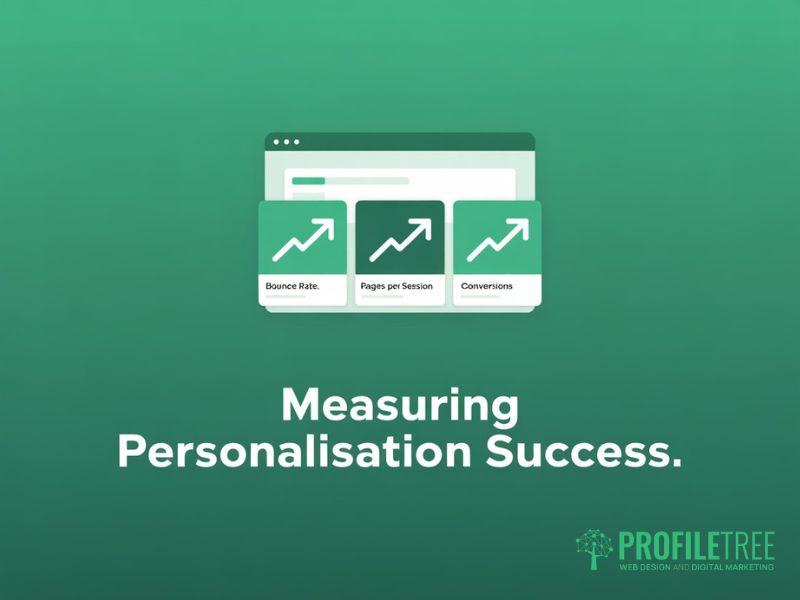
Personalisation’s only as useful as the outcomes you can attribute to it. The following metrics give you a clear picture of whether your efforts are making a measurable difference.
- Bounce rate by segment: Are personalised visitors staying longer than non-personalised visitors?
- Pages per session: Does personalised content recommendation increase the number of articles a reader consumes in one visit?
- Time on page: Do readers who receive personalised recommendations spend more time than those who see generic related posts?
- Conversion rate by segment: Are readers who receive targeted CTAs converting at a higher rate than those who see standard ones?
- Return visit rate: Does personalisation increase the proportion of readers who come back within 30 days?
Set a baseline before you start. Run your first personalisation tactic for a minimum of four weeks before you can draw useful conclusions. Seasonal variation and content publishing patterns both affect these numbers, so you’ll want a consistent period on both sides.
ProfileTree’s SEO services for Northern Ireland businesses incorporate content performance analysis as a standard part of the service. Knowing which content is performing and for whom is the foundation of any decision to personalise further.
FAQs
1. What is the simplest way to start blog personalisation?
Start with UTM-based content or category-based related posts. If you run email campaigns to segmented lists, use UTM parameters to identify which segment has arrived and display a relevant CTA. It requires no additional software beyond your existing CMS and analytics setup.
2. Is blog personalisation legal under UK GDPR?
It depends on the method. Cookie-based personalisation requires explicit, prior consent under PECR. First-party data personalisation (using data from sign-ups or UTM tracking) does not require cookie consent, provided your privacy notice accurately describes how that data is used.
3. How do I personalise my blog for different audiences?
Begin with zero-party data: ask readers directly. A single question at the start of a guide, such as ‘Are you a business owner or a marketer?’, followed by a simple branching content path, is effective and fully privacy-compliant. Once you’ve got enough behavioural data in GA4, build interest-based audiences from category browsing patterns to create segments that improve over time.
4. Does personalisation affect my blog’s SEO?
Not directly, if it’s implemented correctly. Dynamic content delivered via JavaScript is generally treated as safe by Google, which has confirmed it can render it. The risk arises when personalisation serves completely different article text to search engines versus readers, which constitutes cloaking. Keep your core content consistent and only swap secondary elements such as CTAs and recommendations.
5. What is the best free tool for blog personalisation?
Google Looker Studio connected to GA4 is the most capable free option for insight and segmentation planning. For on-page delivery, UTM parameters combined with conditional blocks in your CMS give you basic audience differentiation at zero budget. If your blog runs on WordPress, the free tier of several conditional content plugins gives you returning-visitor detection and basic geographic targeting before you commit to a paid tool.