
Content Repurposing: Get More From Every Piece You Create
Table of Contents
Content repurposing means taking existing material and adapting it into new formats so it reaches audiences who would never have found the original. A webinar becomes a blog series. A blog series becomes a set of social posts. A podcast episode becomes a YouTube Short. The output multiplies; the core thinking only happens once.
For SMEs in Northern Ireland, Ireland, and the UK, this matters in practical terms. Producing content takes time and budget. Getting it in front of the right people across multiple channels, without starting from scratch each time, is one of the more straightforward ways to improve return on that investment.
What this guide covers: how to identify the right content to repurpose, which formats work on which platforms, how to adapt written content and video effectively, and how to measure whether it is working.
What Is Content Repurposing and Why Does It Matter for SMEs?
Content repurposing is the process of reformatting existing material for a different platform, audience, or medium. It is not about copying and pasting the same article everywhere. It is about adapting the substance of what you already know into forms that suit the environment where your audience spends time.
The Difference Between Repurposing and Recycling
Recycling means republishing the same content unchanged. Repurposing means extracting the core idea and rebuilding it to fit a different context. A 2,000-word guide on email marketing does not become a LinkedIn post by cutting it to 200 words. It becomes one by identifying the single most useful insight and building a native post around that, with the guide linked for anyone who wants more depth.
The distinction matters because platforms reward native content. LinkedIn’s algorithm favours posts written for LinkedIn. YouTube favours videos made for YouTube. Dropping a blog post unedited into a social caption is recycling, and it underperforms. Extracting the insight and framing it for the platform is repurposing, and it works.
Why Repurposing Makes Commercial Sense
Businesses that produce a single blog post and leave it there are extracting a fraction of its potential value. The same research, the same perspective, and the same expertise can reach a different audience as a video, a podcast, an email newsletter, or a downloadable checklist, often with minimal additional work.
There is also an SEO angle. Repurposed content creates multiple entry points to your brand. A guide on your website, a YouTube video linked from it, a LinkedIn article referencing both, and an email that drives traffic back to the original page all reinforce the same topical authority across different properties. Google and Bing treat these signals differently, but they accumulate.
For SMEs managing limited content budgets, repurposing is not a shortcut. It is a sensible way to make expertise go further. ProfileTree’s content marketing services are built around this approach: creating assets that work across channels rather than producing more volume for its own sake.
How to Choose What to Repurpose
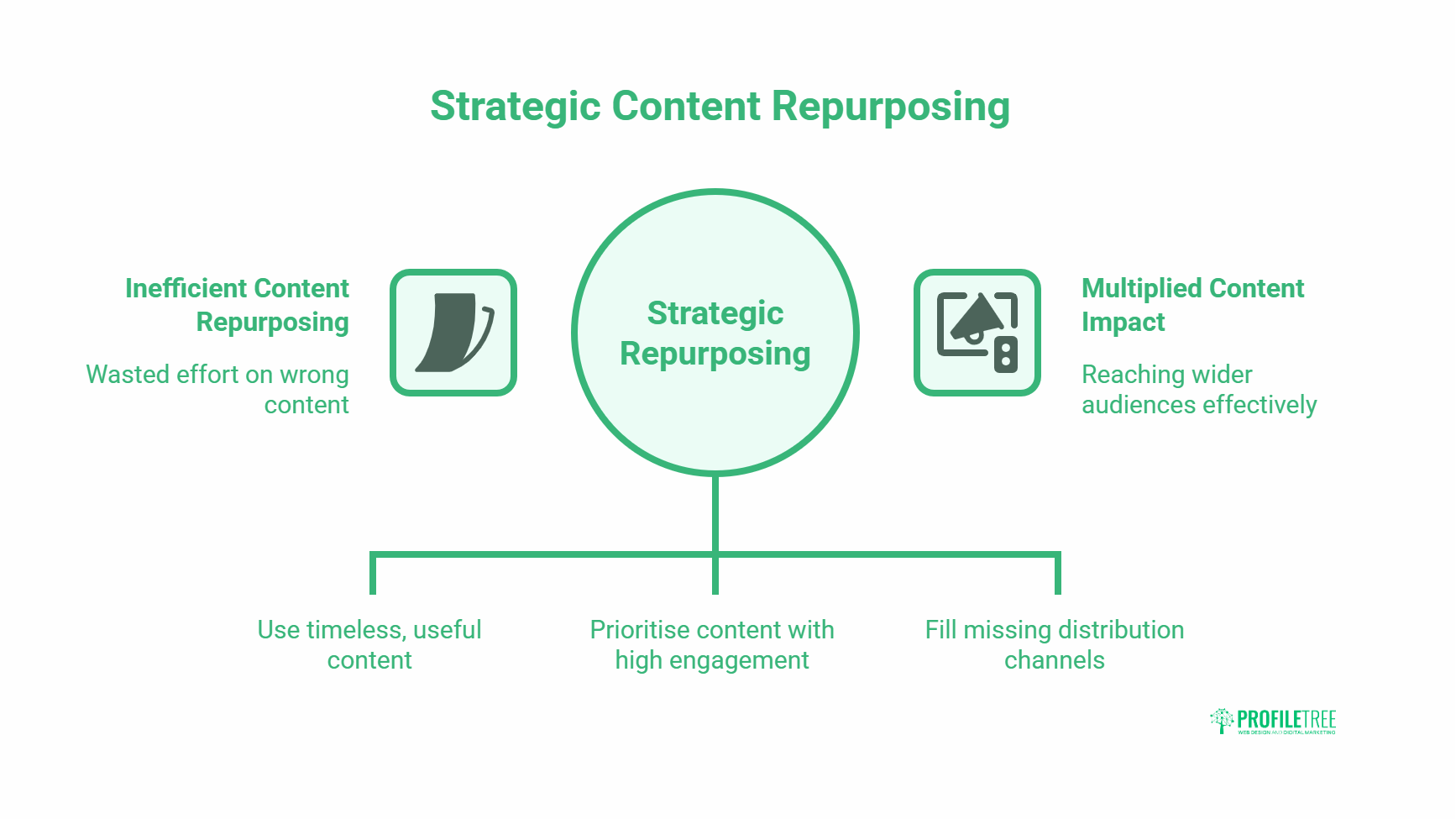
Not all content repurposes well. Choosing the wrong starting point wastes effort; choosing the right one multiplies it.
Start With Evergreen Content
Evergreen content is material that remains accurate and useful regardless of when someone reads it. A guide to writing effective email subject lines is evergreen. A post about a platform feature that changed six months ago is not.
Evergreen content is the best candidate for repurposing because the investment in adapting it pays off over time rather than expiring quickly. Common evergreen formats include how-to guides, explanation pieces, comparison articles, and process walkthroughs, all of which translate well across video, audio, and social formats.
Use Performance Data to Prioritise
Before repurposing anything, check which content has already earned attention. Google Search Console shows which pages draw organic traffic and which queries they appear for. High-impression pages, even those with modest click rates, signal that an audience exists for that topic. These are your strongest candidates.
Equally, look at which pieces generate enquiries or social shares. A blog post that consistently drives contact form submissions clearly resonates with potential buyers. Repurposing that content into a video or email series puts the same message in front of a wider audience.
Consider the Format Gap
Some topics are well covered in written form on your site, but absent from your YouTube channel or LinkedIn profile. That gap is an opportunity. Content repurposing works best when it fills distribution channels that the original format does not reach, rather than duplicating coverage in the same channel.
Content Repurposing Strategies That Work
Turning Blog Posts Into Video Content
A well-structured blog post translates naturally into a video script. The H2 headings become the sections; the opening paragraph becomes the hook; the conclusion becomes the call to action. The result is a video that covers the same ground in a format that suits viewers who prefer watching to reading.
For SMEs, this does not require a production studio. A talking-head video filmed on a decent smartphone, with clear audio and good lighting, performs well on LinkedIn and YouTube for business audiences. The key is to write the video version rather than reading the post aloud. Adapt the language for spoken delivery.
ProfileTree’s video production team regularly works with businesses to turn existing written content into video assets. The starting point is almost always content that the business has already created. Video production and animation services are worth considering once you have identified the content that your audience engages with most.
Expanding Blog Posts Into Lead Magnets
A post that covers a topic thoroughly can often be expanded into a downloadable guide, checklist, or template. The blog post drives organic traffic; the downloadable version captures email addresses. Both serve the same audience at different stages of their research.
The key difference between a post and a guide is depth and practical application. A post explains how something works. A guide gives the reader something to act on: a checklist they can print, a template they can populate, a decision framework they can apply to their own situation.
Breaking Long-Form Content Into Social Posts
A 2,000-word guide contains dozens of standalone observations. Each of those is a potential social post, each framed natively for the platform it appears on.
LinkedIn posts work best when they lead with a specific observation or contrarian point, develop it briefly, and end with a question or clear takeaway. Twitter/X posts work best with a single sharp idea, often leading with a number or a direct statement. Instagram captions can be longer than many assume but need a strong opening line before the “more” cut.
The mistake most businesses make is treating this as volume work, posting frequently without thinking about the native format. One well-constructed LinkedIn post built from a single insight will outperform five posts that are obviously cut from a longer document.
Repurposing Content for Email Marketing
Email is one of the most underused channels for content repurposing. A guide or report that already exists on your website can be broken into a short email series, with each email covering one section and linking back to the full version.
This approach works for two reasons. First, email audiences are often different from blog audiences; subscribers opted in because they want your perspective, not just information on a topic. Second, a series keeps your brand present in their inbox over multiple days rather than a single send.
The structure of a repurposed email series is straightforward: each email opens with a clear statement of what it covers, delivers one or two specific points, and closes with a single action, whether that is reading the next section, downloading a resource, or getting in touch.
Audio and Podcast Repurposing
If your business produces a podcast or has access to recorded conversations, those recordings are a significant content asset. Key sections can be extracted as audiograms for social media. Transcripts can form the basis of blog posts. A Q&A episode on a single topic can become a standalone article.
The reverse also works. Written content can be adapted into podcast scripts for conversational exploration of the same topic, reaching an audience who consumes most content while commuting or exercising rather than reading at a desk.
Platform-Specific Repurposing Guidance
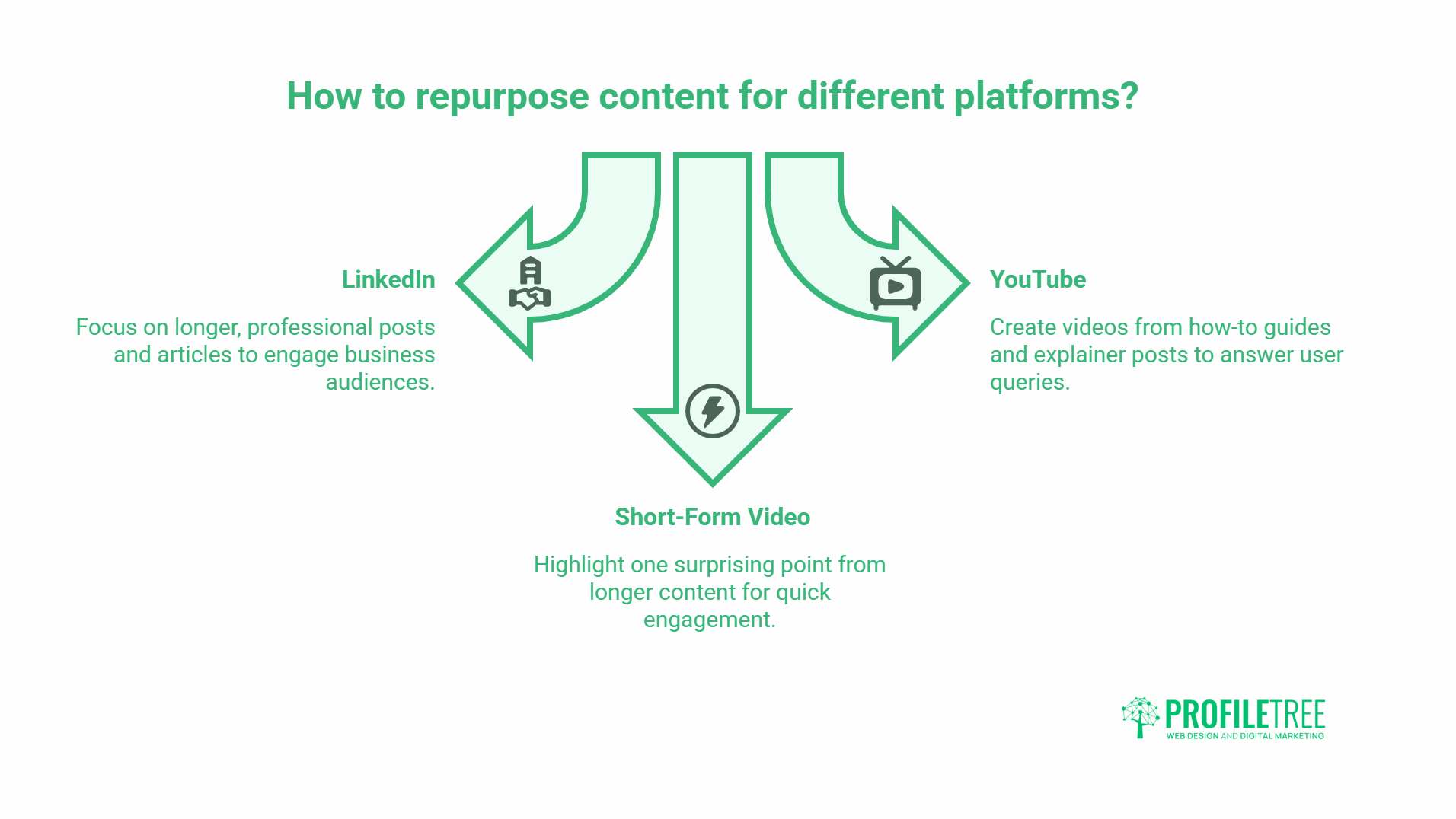
LinkedIn rewards longer, more substantive posts than most social platforms. Business audiences on LinkedIn are actively looking for professional perspectives, which means repurposed content from guides, case studies, and how-to articles performs well when adapted natively.
Posts should be written for the platform, not copied from elsewhere. Lead with a strong first line (LinkedIn truncates posts after two lines before “see more”). Build the argument in short paragraphs. End with either a question that invites comments or a specific takeaway.
Articles work differently from posts on LinkedIn. They are indexed by search engines and suit longer, more detailed content that you want to have a longer shelf life. These are appropriate for repurposing substantial written content.
YouTube
YouTube is a search engine. Users come to it looking for answers, tutorials, and explanations, which makes it well-suited to content that originally appeared as how-to guides and explainer posts on your website.
A YouTube video built from a blog post should not reproduce the post word-for-word. It should address the same question but use demonstration, annotation, and direct camera engagement to do things the written version cannot. Embed the resulting video back into the original blog post. Both properties benefit.
Short-Form Video (Reels, Shorts, TikTok)
Short-form video demands a different approach to longer content. The goal is not to summarise a piece; it is to find one specific, surprising, or counterintuitive point and build thirty to sixty seconds around it.
The most effective short-form repurposing starts by asking: what is the one thing in this content that would make someone stop scrolling? That becomes the video. The rest of the content remains available for those who want to go deeper, linked in the profile or caption.
Measuring Whether Repurposing Is Working
Content repurposing only adds value if it reaches the right audience and contributes to business goals. Tracking this requires looking at different metrics depending on the format.
What to Track
For website content, Google Search Console shows organic impressions, clicks, and position changes over time. A repurposing effort that strengthens topical authority should show gradual improvement in position for the target queries over three to six months. Sudden spikes are less meaningful than sustained improvement.
For social content, reach and engagement rates matter more than follower counts. A LinkedIn post that reaches 2,000 people and generates 40 comments is more valuable than one that reaches 8,000 and generates two. Engagement signals that the content is resonating, not just being served.
For email, open rate and click-through rate are the primary indicators. A repurposed email series that converts subscribers into enquiries is performing well regardless of the open rate benchmarks for your industry.
Feeding Results Back Into the Strategy
Analytics from repurposed content should inform the original content strategy. If a LinkedIn post built from one section of a guide consistently outperforms posts from other sections, that tells you which topic resonates most with that audience. That signal should influence what you write next and what you prioritise for repurposing.
Ciaran Connolly, founder of ProfileTree, puts it this way: “The businesses that get the most from their content treat every piece as a starting point, not a finished product. The insight you’ve built up doesn’t have to live in one format on one page. It can reach people across every channel they use, in the form they prefer.”
Integrating Repurposing Into Your Content Workflow
Content repurposing works best when it is planned from the start rather than treated as an afterthought. The most efficient approach is to produce a core asset, typically a long-form guide or video, with distribution in mind, then adapt it for each channel immediately rather than returning to it weeks later.
A Simple Repurposing Framework
- Step 1. Identify the core asset. This is the piece that contains the most depth and value, usually a long-form guide, a research piece, or a recorded presentation.
- Step 2. List the distribution channels available to your business. Be realistic about which ones your audience actually uses.
- Step 3. For each channel, identify the native format that works best and the single most relevant insight from the core asset that suits that format.
- Step 4. Produce the repurposed versions. Adapt; do not copy.
- Step 5. Link back to the core asset from each repurposed version wherever the platform allows.
- Step 6. Track performance by channel and feed the results into the next content planning cycle.
- ProfileTree’s digital marketing services include content strategy work that incorporates this kind of channel planning from the brief stage. If your business is producing content but not seeing it translate into traffic or enquiries, the issue is often distribution rather than quality.
The Role of SEO in Repurposing
Every repurposing effort on your website should connect to an SEO objective. A new page built from repurposed content should target a specific query. A refreshed article should update both the content and the internal linking structure. A YouTube video should be embedded into the relevant page and be described with the target keyword in its title and description.
Web design and development services play a part here, too. A well-structured website with clear topical architecture makes it easier for repurposed content to earn rankings because Google can understand how each page relates to others in the same cluster.
AI Tools and Content Repurposing
AI tools can assist with content repurposing by drafting social posts from longer articles, generating transcript summaries, or suggesting different angles for the same topic. Used well, they speed up production without replacing the strategic thinking about which content to repurpose, for which audience, and in which format.
The risk is producing volume without purpose. A hundred AI-generated social posts built from a single article will not perform as well as ten posts that have been thought through carefully and adapted for the native format. ProfileTree’s AI transformation services help businesses identify where AI tools add genuine efficiency in their content process and where human judgment still needs to lead.
Frequently Asked Questions
What is content repurposing?
Content repurposing is the process of taking an existing piece of content and adapting it into a different format or for a different platform. A blog post might become a video, a podcast episode, a series of social media posts, or a downloadable guide. The core idea stays the same; the format changes to suit the audience and the channel. The goal is to get more reach and value from content you have already invested time in creating.
How is content repurposing different from content recycling?
Recycling means republishing the same content unchanged across different platforms. Repurposing means actively adapting the content to fit the native format, tone, and expectations of a different channel or audience. A recycled blog post pasted into a LinkedIn caption is obvious and underperforms. A LinkedIn post written from the key insight of that same blog, with language suited to the platform and audience, is repurposing.
Which types of content repurpose most effectively?
Evergreen content repurposes best because it stays relevant over time. How-to guides, explanation pieces, process walkthroughs, and comparison articles are all strong candidates. High-performing content identified through analytics is also worth prioritising: if a blog post already draws traffic or generates enquiries, there is a proven audience for that topic across other formats.
How do I know which platforms to repurpose content for?
Start with the platforms where your target audience is most active, not the ones you personally use most. For most UK and Irish SMEs in B2B markets, LinkedIn and email are the highest-priority channels alongside the website itself. YouTube is worth investing in if the topic suits video explanation. Short-form video on Instagram or TikTok works for consumer-facing businesses and some professional services where a more personal tone is appropriate.
Does repurposing content help SEO?
Yes, but not by duplicating the same content across multiple pages on your website. That creates cannibalisation problems. Repurposing helps SEO by building topical authority across multiple platforms, generating external links from social profiles and third-party sites, and driving traffic back to original content. Embedding a YouTube video into the relevant blog post, for example, increases the time visitors spend on the page, which is a positive engagement signal.
How often should content be repurposed?
There is no fixed frequency. A practical approach is to identify the ten to twenty pieces of content on your website that already attract traffic or that cover your core service areas, then systematically repurpose each one across your active channels over a quarter. After that, build repurposing into the production process for new content from the start so each new piece is planned with distribution in mind.
Content repurposing is not about producing more. It is about making what you already know reach more people. Start with your strongest existing content, identify where your audience spends time, and adapt for each channel rather than copying across them.
If you want to build a content strategy that works across organic search, social, email, and video from the start, get in touch with ProfileTree’s content marketing team.