
Social Media Interactions: A Strategic Guide for UK Businesses
Table of Contents
Social media interactions are the actions people take in response to your content: likes, comments, shares, saves, direct messages, replies, tags and mentions. They are not worth the same amount. A save or a direct message signals commercial intent, while a like tells you someone stopped scrolling for half a second, and most social strategies that produce numbers without producing enquiries are built around the second kind.
That gap has widened over the past year. Ofcom’s Adults’ Media Use and Attitudes research, published in April 2026, found that 49% of adult social media users now actively post, share or comment, down from 61% the year before. Fewer people are interacting at all. Each interaction you do earn therefore carries more weight, which makes ranking them by commercial value worth doing properly.
This guide covers what social media interactions mean for a UK business, how to rank them by what they are actually worth, and how to build a strategy that produces conversations instead of counts. ProfileTree, the Belfast-based digital agency, has worked with businesses across Northern Ireland, Ireland and the UK on that shift. ProfileTree’s social media marketing team sees the same pattern again and again: healthy follower counts, almost no inbound messages. Much of the guidance below is written for owners running an entire social presence alongside a full-time job, so it is built to be practical rather than theoretical.
What Social Media Interactions Really Mean
Social media interactions cover every action a person takes when they encounter your content on a social platform. At the surface level, this includes likes, comments, shares, saves and direct messages. In practice, the term reaches further. Social media interactions also encompass the private conversations sparked by your content, the saves that signal purchase intent and the DMs that begin a sales journey.
Not every social media interaction carries equal weight. A bot-generated comment or a reflexive double-tap tells you very little about your audience. A considered reply, or a direct message asking for a quote, tells you almost everything. Businesses that invest in a structured social media strategy are far better placed to identify which types of interaction actually matter for their commercial goals.
Passive vs Meaningful Social Media Interactions
Platforms like Instagram and LinkedIn now distinguish between passive and meaningful social media interactions internally, even if they do not always surface this distinction to users. Passive interactions require almost no effort: scrolling past a post and accidentally liking it, or tapping a reaction emoji without reading the caption. Meaningful interactions require intent: writing a genuine comment, saving a post to revisit later, sharing content with a private group, or sending a direct message.
For UK businesses, the goal is content that consistently earns the meaningful kind. Ofcom’s 2026 tracker gives a reason to take this seriously: alongside the drop in active posting, 49% of adults now say they worry their posts could cause them problems later, up from 43%, and the qualitative arm of the same study found people moving toward limited-lifespan formats like Instagram Stories over permanent grid posts. A more cautious audience does not respond to a prompt for engagement. It responds to a genuine reason to reply, save or share.
The Role of Dark Social in Modern Social Media Interactions
One of the most overlooked areas of social media interactions is what researchers call dark social: the sharing that happens in private channels such as WhatsApp, Slack, email and iMessage. The scale is easy to underestimate. Ofcom’s Online Nation 2025 report puts WhatsApp in the hands of 90% of UK adults and Facebook and Messenger combined at 93%, which means the private channel is not a niche alongside the public feed; it is where most people spend most of their time. None of that activity appears in standard analytics.
For UK businesses, dark social represents some of the most valuable social media interactions possible. When someone forwards your blog post to a colleague via WhatsApp, or shares your LinkedIn article in a professional Slack channel, they’re making a personal recommendation. Building content specifically designed to be shared privately, such as practical guides, tools and genuinely useful data, is one of the most underused strategies in UK digital marketing. Businesses using WhatsApp Business features to follow up on these private shares often see a faster route from interaction to enquiry than anything happening on the public feed.
The Interaction Pyramid: Ranking Value for ROI
To make better decisions about where to invest your community management time, it helps to rank social media interactions by their actual business value. The Interaction Pyramid below organises the most common interaction types by commercial impact, from lowest to highest.
| Interaction Type | Effort Required | Algorithm Weight | Business Value |
|---|---|---|---|
| Like / Heart | Low | Low | Low (Brand Awareness) |
| Standard Comment | Medium | Medium | Medium (Community) |
| Save | Medium | High | High (Purchase Intent) |
| Public Share | High | High | High (Reach and Virality) |
| Private Share / DM | High | Critical | Highest (Trust and Conversion) |
Tier 1: Advocacy (Shares and Saves)
At the top of the pyramid sit shares and saves. These social media interactions indicate that your content has genuine utility. When someone saves your post, they’re signalling they intend to return to it, which is a leading indicator of purchase intent. The most effective content for generating this tier of social media interactions tends to be practical and specific: a breakdown of Making Tax Digital requirements, a guide to Innovate UK funding or a GDPR compliance checklist. A well-planned content marketing approach makes sure every asset you publish is built around genuine audience utility rather than brand broadcasting.
Tier 2: Conversation (DMs and Long-Form Comments)
Direct messages and substantive comments are where relationships are built. A DM from a potential client asking about your services is one of the most commercially valuable social media interactions you can generate. The shift that matters is treating the inbox as a channel rather than a queue. A support function answers what it is asked. A community-building function asks something back, which is what turns a one-off query into a relationship the business can name six months later. Businesses growing their presence on LinkedIn for business networking tend to see this tier develop first, since professional audiences are more likely to message directly than comment publicly.
Tier 3: Passive Engagement (Likes and Reactions)
Likes and basic reactions are the easiest social media interactions to generate, but the least valuable for your business. They provide a useful pulse check on creative direction, but they should never serve as your primary measure of success. A post that receives 2,000 likes but generates no saves, no shares and no DMs hasn’t moved your business forward. Use them as a signal, not a target.
UK Strategy: Tone, Regulation and Crisis Response
Generic social media advice, most of it written for a US audience, tends to skip two things UK businesses can’t afford to ignore: the tone that actually lands with British and Irish audiences, and the regulatory framework that governs how you’re allowed to ask for interaction in the first place.
The UK Tone: Why Self-Deprecation Outperforms the Hard Sell
British and Irish social audiences respond differently to brand voice than the confident, superlative-heavy tone common in US marketing. A degree of self-deprecating humour, understatement and scepticism toward obvious sales pitches tends to generate stronger social media interactions than polished corporate messaging. This isn’t a licence to be flippant on every post; it’s a reason to write the way your audience actually talks, particularly on Instagram and TikTok, where a stiff corporate voice is one of the fastest ways to suppress interaction. A TikTok content strategy built around this tone tends to earn more comments than one built around polished brand messaging.
ASA Compliance for Competitions and Incentivised Interactions
“Like and share to win” competitions remain among the most common ways UK businesses try to manufacture social media interactions, and they carry real compliance risks. The Advertising Standards Authority expects competition terms to be clear, prize fulfilment to be genuine, and any platform-specific rules (Meta and TikTok both restrict certain types of incentivised sharing in their own terms of service) to be respected alongside general advertising law. Before running any campaign that asks people to like, share or tag a friend in exchange for entry, check the current ASA guidance and the platform’s own promotion rules rather than assuming last year’s approach still applies. Getting this wrong doesn’t just risk a complaint; it can mean disqualifying an entire competition after prizes have already been promised.
Managing Crisis: When Social Media Interactions Turn Negative
A single post, screenshot or viral clip can turn a normally healthy stream of social media interactions into a reputational problem within minutes. The businesses that handle this well tend to have a plan agreed in advance rather than improvising in the moment: who has authority to respond publicly, which comments get a reply versus a private DM, and when a legal or PR adviser needs to be looped in. A clear crisis management framework, reviewed before you need it rather than during an active situation, is one of the most overlooked pieces of a social media strategy. For businesses without an existing plan, building one alongside broader business continuity planning means the social response sits inside a wider framework rather than being handled in isolation.
7 Strategies to Drive High-Intent Social Media Interactions
Building a strategy around high-value social media interactions requires a shift away from broadcasting content and towards designing content that invites a response. The following strategies are grounded in what consistently works for UK businesses across sectors.
1. Design for Reply-First Content
Reply-first content is structured around a question, opinion or scenario that naturally prompts your audience to respond. This might be a LinkedIn post asking your network how they handle a specific challenge, or an Instagram Story poll on a relevant industry topic. Specificity matters: “What do you think about AI?” generates far fewer meaningful social media interactions than “How has AI changed how you brief a design project? Share one example in the comments.”
2. Create Information Utility Content
Checklists, templates, data summaries and step-by-step guides generate saves at a higher rate than any other content type because they have ongoing reference value. Developing this type of content as part of a broader social media strategy makes sure each asset earns its place rather than being produced in isolation. That is the practical test for content marketing built around audience utility: would a reader keep this, or forward it to someone who needs it? When content has utility, it also generates dark social sharing: someone who finds your guide genuinely useful will forward it to a colleague, which is one of the highest-value social media interactions you can earn.
3. Use Video to Drive Real-Time Social Media Interactions
Live video on Instagram, LinkedIn, and YouTube generates some of the most immediate social media interactions. Viewers can ask questions in real time, react with emojis, and share the stream with their networks while the content is still being produced. ProfileTree’s video marketing and video production work is built around creating content that prompts these real-time responses rather than passive viewing.
4. Respond Consistently and Promptly
The quality of your inbound social media interactions is directly influenced by how you respond. Brands that reply to every comment and DM within a reasonable timeframe signal to both their audience and the platform algorithm that the conversation is active. Prompt responses also encourage more social media interactions from the same user in future: when someone comments and receives a genuine, personal reply, they’re far more likely to engage again.
5. Run Targeted Campaigns and Challenges
Campaigns that invite participation generate sustained social media interactions over a defined period. A well-designed hashtag challenge, a user-generated content competition or a collaborative series with complementary brands can drive high volumes of meaningful engagement while expanding your reach. For UK businesses, campaign themes that tap into local context tend to perform most strongly because the audience recognises the reference. The ASA point above still applies here: if entry depends on liking or sharing, check the rules before launch.
6. Collaborate with Relevant Voices
Collaborating with industry experts, sector-specific influencers, and complementary brands considerably amplifies the reach of your social media interactions. In the UK, micro-influencers with smaller but highly engaged audiences in specific niches, such as regional business networks or sector-specific LinkedIn communities, often generate higher-quality engagement than broad-reach collaborations with national figures. The same logic extends past individual creators. Cross-promotion arrangements with complementary brands, where two non-competing businesses serving the same audience introduce each other, tend to produce better-qualified interactions than paid reach because the introduction carries an implied recommendation. The same principle applies on TikTok, where a smaller creator with genuine niche credibility often outperforms a large, generic account.
7. Use Social Listening to Respond at the Right Moment
Social listening tools such as Brandwatch, Mention and the native monitoring features within Hootsuite and Sprout Social allow you to track conversations about your brand, your sector and your competitors in real time. Positioning your brand as an informed voice in a live conversation will consistently generate higher-quality engagement than publishing pre-planned content on the same topic days later.
Human in the Loop: Balancing AI with Authenticity
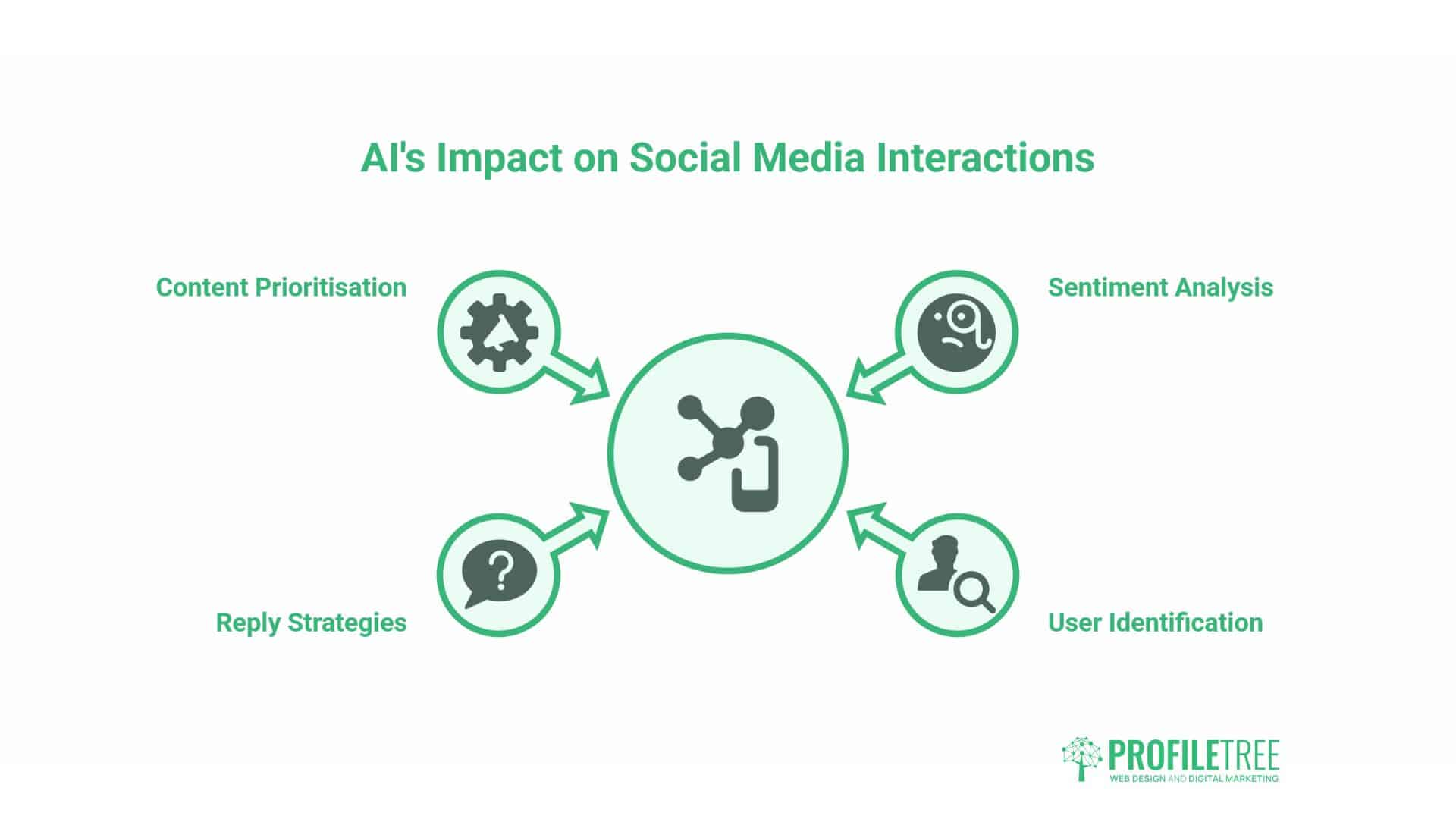
Artificial intelligence is changing both how social media interactions are generated and how they’re managed. AI-powered tools can now analyse sentiment across thousands of comments in seconds, identify users most likely to convert and suggest reply strategies for different interaction types. Platforms themselves use AI to determine which content receives priority distribution based on the quality and depth of the engagement it generates, and recent AI marketing data shows how quickly this shift has moved from experimental to standard practice.
There’s a real limit to how far this should go, though. Audiences are increasingly good at spotting a generic AI-generated reply, and a low-effort automated comment can do more damage to trust than no reply at all. The practical answer for most SMEs isn’t choosing between AI and human community management; it’s using AI for what it does well, sentiment analysis, spotting which comments need urgent attention, drafting a first-pass response and keeping a person responsible for anything that involves a complaint, a sensitive topic or a genuine sales conversation. ProfileTree’s work on overcoming AI implementation challenges covers this balance in more detail for teams deciding where automation genuinely helps.
Measuring the Quality of Your Social Media Interactions
Engagement rate is calculated as total interactions divided by total reach or followers. It’s a useful starting point but a poor endpoint. To understand the true value of your social media interactions, you need a broader measurement framework.
| Metric | What It Measures | Why It Matters |
|---|---|---|
| Save Rate | Saves divided by reach | Indicates content utility and purchase intent |
| Comment Depth | Average words per comment | Distinguishes meaningful from passive responses |
| DM Volume | Direct messages received per post | Reflects audience trust and commercial interest |
| Share-to-Impression Ratio | Shares divided by impressions | Measures virality potential and dark social trigger |
| Response Rate | Replies to your outbound comments | Indicates community health and two-way engagement |
The businesses that generate the strongest commercial returns from social media interactions are those that track what happens after an interaction, not just that one occurred. A DM that leads to a discovery call is worth tracking. A save that precedes a purchase is worth understanding. Building a simple reporting framework that connects this activity to downstream outcomes gives far more actionable data than a monthly engagement rate report.
Ciaran Connolly, founder of ProfileTree, has seen this shift play out consistently across clients: “The businesses that get serious results from social media are not the ones with the highest follower counts or the most likes. They are the ones who treat every DM as a conversation worth having, every comment as a relationship worth building, and every save as a signal worth acting on.”
UK Benchmarks for Social Media Interactions by Sector
Benchmarks vary by platform, sector and audience size, and they move faster than most reporting cycles. Treat the table below as a starting position for UK businesses, not a target to hit.
| Platform | Typical Strong Signal | Primary Interaction Type |
|---|---|---|
| Comments and shares outweigh reactions for B2B reach | Comments, Shares | |
| Ofcom’s 2026 research records a move toward limited-lifespan formats, so Stories interactions increasingly matter alongside grid posts | Saves, Story replies | |
| Reaches 93% of UK adults through Facebook and Messenger combined (Ofcom, 2025); Group discussion still outperforms Page posts for comment volume | Comments in Groups | |
| TikTok | Rewards interactions in the first hour after posting | Comments, Duets |
Recent TikTok statistics for the UK show how quickly this platform’s interaction patterns shift year to year, which is one reason benchmarks need to be revisited regularly rather than treated as fixed targets.
Measuring Success and Building Your Digital Strategy
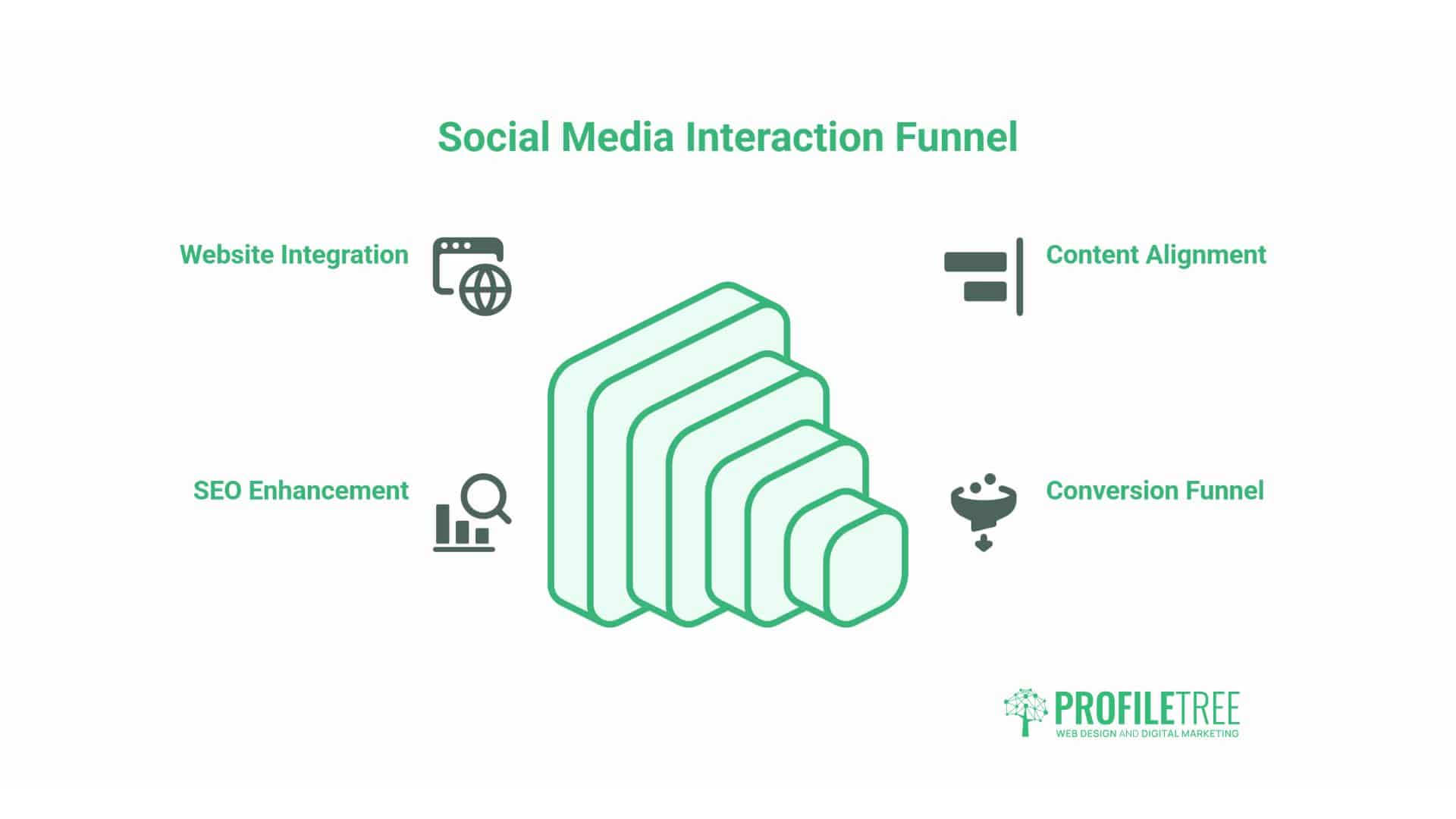
Social media interactions do not exist in isolation. They’re one component of a broader digital strategy that should connect your social presence to your website, content, SEO performance, and conversion funnel. Understanding how social media interactions contribute to this wider picture is what separates a reactive social media presence from a strategic one.
Connecting Social Media Interactions to Your Website
High-value social media interactions should direct traffic to content that converts. This requires that your website content matches the promise made by your social content, that your pages load quickly and that the user journey from social click to enquiry is as simple as possible. A well-structured website design underpins the effectiveness of every social click you earn, and the underlying SEO work on that same site determines whether the traffic a social post sends actually finds a page built to convert it.
UK Compliance and Community Management
UK businesses running online communities sit in a more specific legal position than general advice tends to suggest. The Online Safety Act 2023 places its duties on the provider of a user-to-user service, which for a Facebook page or an Instagram account is the platform, not the business posting on it. The picture changes when a business hosts the space itself. A forum on your own website, a members’ area, or a comment section where users encounter each other’s content can bring the business into scope as a service provider in its own right.
Ofcom estimates that over 100,000 online services fall within the Act, ranging from major platforms to small community forums, and publishes a regulation checker that walks a business through whether its own service qualifies. Running that check once takes very little time. Assuming a brand page creates liability, or assuming a members’ forum does not, are both mistakes worth avoiding, and both sit alongside the ASA rules covered earlier as part of the same compliance picture.
ProfileTree’s digital training programmes include modules on community management, online safety compliance and responsible engagement for UK businesses, and the wider AI training work ProfileTree delivers covers where automated moderation tools fit into that same responsibility.
Tracking online community statistics over time also helps a marketing manager spot when a community is drifting from healthy debate toward a pattern that warrants a moderation policy rather than a one-off response.
The Business Case for Prioritising Quality Social Media Interactions
Social media interactions have always been the currency of the digital community. What has changed is the understanding of which interactions actually hold value: saves, DMs, and private shares consistently outperform volume metrics.
For UK businesses, the practical steps are clear. Map your current social media interactions against the Interaction Pyramid, build a response strategy around the conversations that lead somewhere, and connect that activity to your website, content and sales process. ProfileTree’s digital strategy, content, video, and AI training teams work with businesses across Northern Ireland, Ireland, and the UK to build a connected, measurable system. Businesses ready to move beyond vanity metrics can get in touch with the team.
FAQs
What counts as a social media interaction?
Any action a user takes in response to your content on a social platform: likes, comments, shares, saves, direct messages, replies, tags and mentions. Private sharing via messaging apps also counts as a social media interaction, though it can’t always be tracked directly.
What are the main types of social media interaction?
Broadly, interactions split into passive (likes, reactions), conversational (comments, DMs), and advocacy-based (saves, shares), with private shares through messaging apps and dark social, which sit outside standard analytics but carry some of the highest commercial value.
Which social media interactions are most valuable for businesses?
Direct messages, saves, and private shares carry the highest commercial value because they indicate intent and trust. Public comments and shares are valuable for reach, while likes serve primarily as lightweight signals of content relevance.
Is it against the rules to ask for likes and shares to enter a UK competition?
It isn’t automatically against the rules, but it carries compliance risk. ASA guidance and individual platform terms both place conditions on incentivised sharing, so check current guidance and the specific platform’s promotion policy before launching any “like and share to win” campaign.